

Hollow Fiber Filtration Market by Material (Polymer (PES, PVDF), Ceramic), Technique (Microfiltration, Ultrafiltration), Application (Harvest & Clarification, Concentration, Diafiltration), End Users (Pharma, Biotech, CRO, CMO) - Global Industry Analysis, Share ,Growth ,Regional Outlook And Forecasts, 2026-2035
 Status Published
 Category Healthcare


Content
Hollow Fiber Filtration Market Market Size and Growth 2026 to 2035
The global Hollow Fiber Filtration Market market gathered revenue around USD 893.00 million in 2025 and market is set to grow USD 3,556.53 million by the end of 2035 and is estimated to expand at a modest CAGR of 14.82% during the prediction period 2026 to 2035.
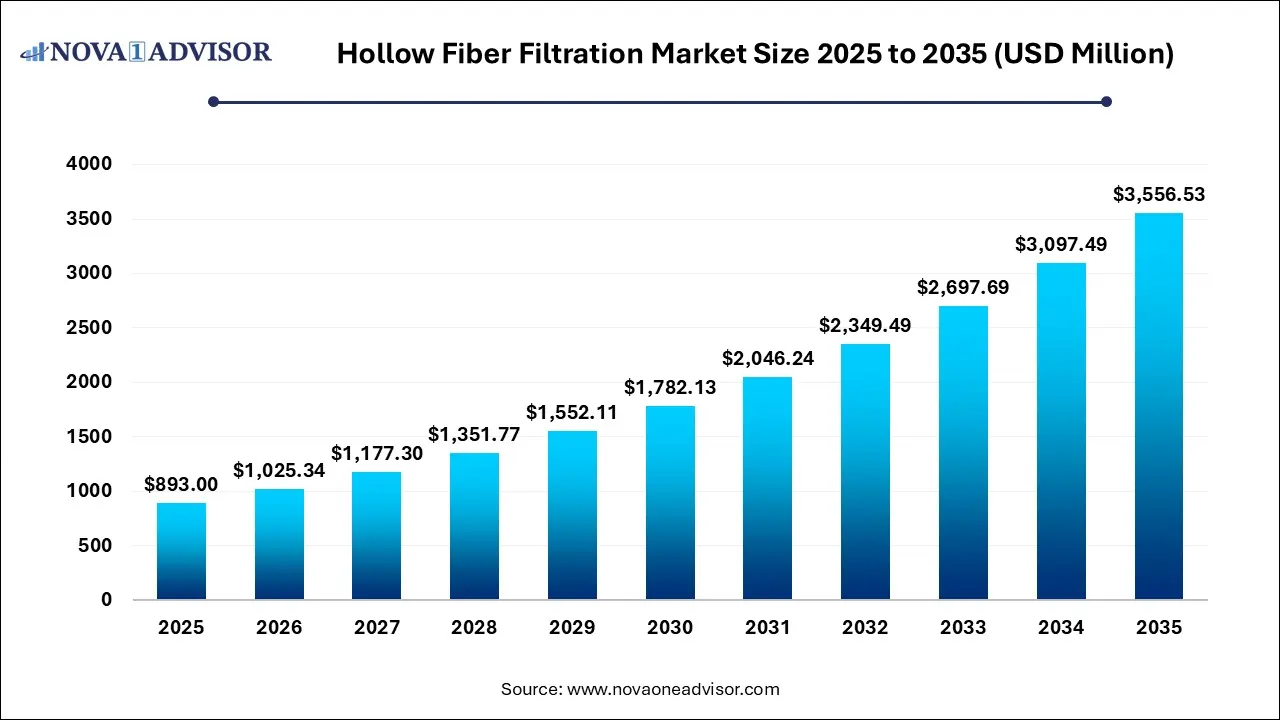
Market Key Takeaways
- The hollow fiber filtration market is witnessing strong growth driven by increasing biopharmaceutical production and demand for high-efficiency filtration systems.
- Polymeric materials dominate the market due to cost-effectiveness and flexibility, while ceramic fibers are gaining traction in niche high-performance applications.
- Continuous cell perfusion is emerging as a critical application area due to its efficiency in biologics manufacturing.
- Ultrafiltration techniques are expanding rapidly with rising use in protein purification and monoclonal antibody production.
- Pharmaceutical and biotechnology manufacturers remain the largest end-user segment, supported by growing biologics pipelines.
- Asia Pacific is the fastest-growing regional market due to expanding pharmaceutical manufacturing infrastructure and investments.
- Integration of AI and automation is improving filtration efficiency, predictive maintenance, and process optimization.
Market Overview
The hollow fiber filtration market plays a critical role in modern separation technologies, particularly in the pharmaceutical, biotechnology, and water treatment industries. Hollow fiber filters consist of semi-permeable membranes arranged in a fiber-like structure, allowing efficient filtration with high surface area-to-volume ratios. These systems are widely used for microfiltration and ultrafiltration processes, enabling the separation of particles, proteins, cells, and other biomolecules.
The growing importance of biologics, including monoclonal antibodies, vaccines, and cell therapies, has significantly increased the demand for advanced filtration technologies. Hollow fiber systems are especially valuable in continuous processing environments, where efficiency, scalability, and sterility are crucial. Their ability to handle high-throughput filtration while maintaining product integrity has positioned them as indispensable tools in bioprocessing.
In addition to healthcare applications, hollow fiber filtration is widely used in water purification, food and beverage processing, and industrial separations. However, the biopharmaceutical sector remains the primary driver of market growth due to increasing R&D investments and the shift toward continuous manufacturing.
Technological advancements such as improved membrane materials, enhanced durability, and integration with automated systems are further propelling market expansion. As regulatory standards become more stringent, the need for reliable and validated filtration systems continues to rise, reinforcing the market’s long-term growth trajectory.
How is AI Transforming the Hollow Fiber Filtration Market?
Artificial Intelligence (AI) is transforming the hollow fiber filtration market by enhancing process efficiency, predictive capabilities, and operational control. In biopharmaceutical manufacturing, AI-driven systems are being integrated into filtration workflows to monitor critical parameters such as pressure, flow rate, membrane fouling, and filtration efficiency in real time.
One of the most impactful applications of AI is predictive maintenance. Traditional filtration systems often suffer from membrane fouling or clogging, which can lead to downtime and product loss. AI algorithms analyze historical and real-time data to predict when membranes need replacement or cleaning, minimizing operational disruptions and improving cost efficiency.
AI is also playing a crucial role in process optimization. For example, in continuous cell perfusion systems, AI models can dynamically adjust flow rates and filtration conditions to maximize yield and maintain cell viability. This is particularly important in biologics production, where even minor variations can impact product quality.
Furthermore, AI-enabled digital twins are being used to simulate filtration processes and optimize system design before actual implementation. This reduces development time and enhances scalability. In large-scale manufacturing facilities, AI integration enables automated decision-making, reducing reliance on manual intervention and improving consistency.
As the industry moves toward smart manufacturing and Industry 4.0, AI-driven hollow fiber filtration systems are expected to become standard, offering enhanced efficiency, reduced costs, and improved product quality.
Major Trends in the Market
- Increasing adoption of continuous bioprocessing technologies
- Rising demand for single-use hollow fiber filtration systems
- Growing use of ultrafiltration in biologics and protein purification
- Expansion of filtration applications in cell and gene therapy
- Development of advanced membrane materials with higher durability
- Integration of automation and AI in filtration systems
- Increasing outsourcing to CROs and CMOs for filtration processes
- Rising demand for high-throughput filtration systems
- Growing focus on sustainability and reusable filtration technologies
- Expansion of pharmaceutical manufacturing in emerging economies
Hollow Fiber Filtration Market Market Report Scope
| Report Coverage | Details |
| Market Size in 2026 | USD 1,025.34 Million |
| Market Size by 2035 | USD 3,556.53 Million |
| Growth Rate From 2026 to 2035 | CAGR of 14.82% |
| Base Year | 2025 |
| Forecast Period | 2026 to 2035 |
| Segments Covered | Material, Application, Technique, End Users, Region |
| Market Analysis (Terms Used) | Value (USD Million/Billion) or (Volume/Units) |
| Regional Scope | North America; Europe; Asia Pacific; Central and South America; the Middle East and Africa |
| Key Companies Profiled | Danaher Corporation, Merck KGaA, Sartorius AG, Thermo Fisher Scientific Inc., Asahi Kasei Corporation, Repligen Corporation, Koch Separation Solutions, 3M Company, GE HealthCare, Parker Hannifin Corporation |
Segmental Insights
By Material
How did the polymeric segment dominate the Hollow Fiber Filtration market?
The polymeric segment is driven by providing cost-effective and high-performance solutions for both large-scale water treatment and precision bioprocessing. Their inherent compatibility with single-use technologies makes them the ideal choice for modern pharmaceutical facilities seeking to eliminate cross-contamination and reduce cleaning validation costs. The superior economic efficiency and versatility of polymers ensure they remain the primary material for the majority of global filtration applications.
How did the ceramic segment expect to hold the fastest-growing Hollow Fiber Filtration market in the coming years?
The ceramic segment is driven by the unmatched resistance in high-pressure, corrosive, and high-temperature environments where polymers fail. While initial capital expenditure is higher, their extended service life and ability to withstand aggressive cleaning cycles offer superior long-term cost efficiency for industrial and pharmaceutical applications.
By Application
How did the concentration and diafiltration segment account for the largest share in the Hollow Fiber Filtration market?
The concentration and diafiltration segment is driven by the technology’s ability to provide gentle, low-shear separation, which is critical for preserving the integrity of delicate biological molecules while ensuring high product recovery. As the global pipeline for biologics and monoclonal antibodies expands, the demand for these scalable and efficient filtration workflows continues to rise. This segment's leadership is secured by its essential role in maintaining the potency and purity required for clinical-grade pharmaceutical products.
How did the continuous cell perfusion segment expect to hold the fastest-growing Hollow Fiber Filtration market in the coming years?
The continuous cell perfusion segment is driven by the biopharmaceutical industry’s rapid transition toward continuous manufacturing to enhance facility throughput. By enabling automated, high-density cell cultivation for several months, these systems allow for process intensification that significantly outpaces traditional batch methods.
By Technique
How did the ultrafiltration segment account for the largest share in the Hollow Fiber Filtration market?
The ultrafiltration segment is driven by prioritizing the high-efficiency, low-shear separation essential for the delicate purification of biologics and vaccines. Its widespread adoption is further bolstered by the global imperative for chemical-free water treatment, where it serves as a critical barrier against bacteria and viruses. The combination of stringent regulatory standards and low operating costs solidifies ultrafiltration as the primary technology for both pharmaceutical processing and large-scale environmental management.
How did the microfiltration segment expect to hold the fastest-growing Hollow Fiber Filtration market in the coming years?
The microfiltration segment is driven by the urgent global need for potable water and high-purity bioprocessing. Its ability to filter particles between 0.1 and 0.7 microns makes it an essential tool for cellular separation and sterile processing, while significantly reducing energy consumption compared to traditional methods. The integration of cross-flow technology to minimize membrane fouling ensures that microfiltration remains a highly reliable and cost-efficient standard for both environmental and pharmaceutical manufacturing.
By End Users
How did the pharmaceutical and biotechnology manufacturers segment account for the largest share in the Hollow Fiber Filtration market?
The pharmaceutical and biotechnology manufacturers segment is driven by the non-negotiable demand for high-purity biologics and vaccines. By integrating single-use technologies and advanced filtration systems, these producers have successfully reduced contamination risks while maintaining the stringent sterility standards required by global regulators. The adoption of continuous manufacturing has further solidified this dominance, providing the scalability and efficiency needed to meet surging therapeutic volumes.
How did the contract research and manufacturing organizations segment expect to hold the fastest-growing Hollow Fiber Filtration market in the coming years?
The contract research and manufacturing organizations segment is driven by the global pipeline for specialized medicine expanding, the strategic reliance on CMO-driven process intensification is solidifying this segment’s role as a primary market catalyst. The inherent scalability of hollow fiber systems allows these organizations to transition seamlessly from clinical trials to commercial production while minimizing capital expenditure and cross-contamination risks.
By Region
North America dominates the regional market due to its well-established pharmaceutical and biotechnology industry. The presence of major market players, advanced healthcare infrastructure, and strong R&D capabilities contribute to the region’s leadership.
Additionally, favorable regulatory frameworks and high adoption of advanced technologies further support market growth in this region.
Asia Pacific is the fastest-growing region due to rapid industrialization, increasing healthcare investments, and expanding pharmaceutical manufacturing capabilities. Countries such as China and India are emerging as key hubs for biopharmaceutical production, driving demand for hollow fiber filtration systems.
List of Top Companies
- Danaher Corporation
- Merck KGaA
- Sartorius AG
- Thermo Fisher Scientific Inc.
- Asahi Kasei Corporation
- Repligen Corporation
- Koch Separation Solutions
- 3M Company
- GE HealthCare
- Parker Hannifin Corporation
Recent Developments
- March 2025: A leading filtration technology company announced the launch of an advanced hollow fiber ultrafiltration system designed for high-throughput biologics production.
- January 2025: A major bioprocessing firm expanded its manufacturing facility in Asia Pacific to increase production capacity for filtration systems.
- November 2024: A global life sciences company introduced a next-generation PVDF hollow fiber membrane with enhanced durability and performance.
- September 2024: A prominent biotechnology company partnered with a filtration solutions provider to develop customized hollow fiber systems for cell therapy applications.
- July 2024: A filtration technology provider acquired a membrane manufacturing company to strengthen its product portfolio and global presence.
Hollow Fiber Filtration Market Segments Covered in the Report
By Material
- Polymeric
- PS/PES
- Polyvinylidene fluoride (PVDF)
- Other polymeric materials
- Ceramic
By Application
- Continuous Cell Perfusion
- Harvest and Clarification
- Concentration and Diafiltration
By Technique
- Microfiltration
-
- <0.2 Micron Meter
- >0.2 Micron Meter and <0.7 Micron Meter
- Ultrafiltration
-
- >50,000 kDa
- >10,000 kDa and <50,000 kDa
- <10,000 kDa
By End Users
- Pharmaceutical and Biotechnology Manufacturers
- Contract Research Organization and Contract Manufacturing Organization (CROs & CMOs)
- Other end users
By Geography
- North America
-
- U.S.
- Canada
- Europe
-
- Germany
- France
- United Kingdom
- Rest of Europe
- Asia Pacific
-
- China
- Japan
- India
- Southeast Asia
- Rest of Asia Pacific
- Latin America
-
- Brazil
- Rest of Latin America
- Middle East & Africa (MEA)
-
- GCC
- North Africa
- South Africa
- Rest of Middle East & Africa

Proceed to Buy
Instant PDF delivery on confirmation

Hollow Fiber Filtration Market Size to Hit USD 3,556.53 Million by 2035
 Request Customization
 Download Sample

Get a Sample of this Report
Hollow Fiber Filtration Market