

Hydroxychloroquine Drugs Market Size, Share, Growth, Report 2026 to 2035
 Status Published
 Category Healthcare


Content
Hydroxychloroquine Drugs Market Size and Growth 2026 to 2035
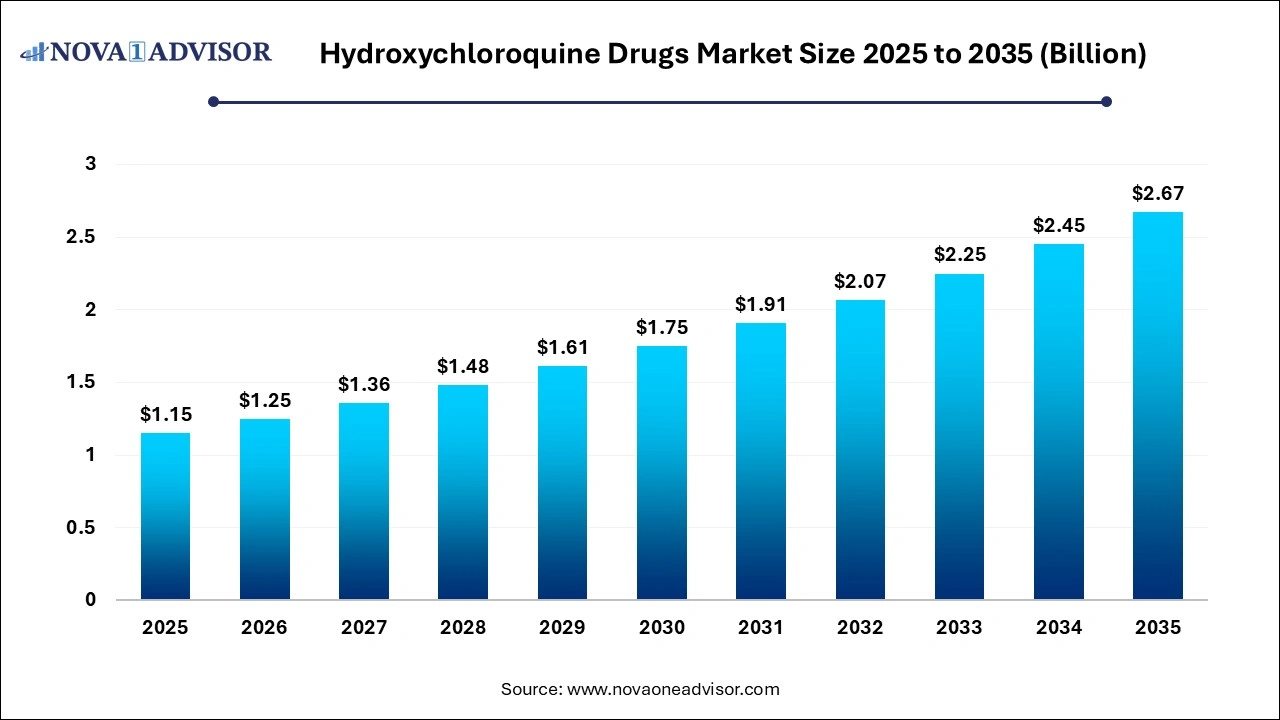
The global hydroxychloroquine drugs market size was valued at USD 1.15 billion in 2025 and is projected to grow from USD 1.25 billion in 2026 to USD 2.67 billion by 2035, at a CAGR of 8.78% from 2026 to 2035.
Key Takeaway
- By application, the malaria segment dominated the market with the largest share in 2025.
- By application, the rheumatoid arthritis segment is expected to grow at the fastest CAGR over the forecast period.
- By distribution channel, the hospital segment dominated the market with the largest share in 2025.
- By form, the tablets segment dominated the market with the largest share in 2025.
- By region, North America dominated the market with the largest share in 2025.
Market Overview
The global Hydroxychloroquine Drugs Market is supported by long-established demand for hydroxychloroquine sulfate, particularly in the treatment of lupus, rheumatoid arthritis, and malaria in areas where susceptible strains remain prevalent. Its mature manufacturing base, generic availability, established clinical use, and relatively low production costs create a market structure centered on consistent pharmaceutical supply rather than newly launched therapies.
Demand is primarily driven by chronic autoimmune treatment, while malaria-related use varies by disease prevalence, resistance patterns, public-health programs, and regional healthcare access. Generic manufacturers with API and formulation capabilities also play an important role in maintaining affordability and supply continuity.
The COVID-19 pandemic temporarily disrupted the market by generating extraordinary demand and clinical interest. However, the subsequent withdrawal of the U.S. FDA’s emergency authorization for COVID-19 use reinforced the distinction between temporary pandemic demand and established therapeutic applications.
Going forward, market growth will depend on autoimmune disease prevalence, access to diagnosis and specialist care, antimalarial requirements, generic pricing, manufacturing efficiency, regulatory compliance, and reliable pharmaceutical supply chains.
Market Outlook
- Market Growth Overview: The global hydroxychloroquine drugs market is expected to grow significantly between 2025 and 2035, driven by the surge in healthcare spending across the globe.
- Sustainability Trends: Sustainability trends involve growing emphasis on green manufacturing and supply chain localization.
- Major Investors: Major investors in the market include Sanofi (the original brand innovator of Plaquenil), Novartis, Zydus Lifesciences, Ipca Laboratories, Teva Pharmaceutical Industries, and Viatris (Mylan).
How is AI Impacting The Global Hydroxychloroquine Drugs Market?
Artificial intelligence (AI) is reshaping the market by facilitating manufacturing quality control, enhancing patient safety monitoring for long-term toxicities, and enhancing target profiling for autoimmune disorders such as lupus. Furthermore, artificial intelligence-driven platforms optimize the high-volume manufacturing of standard pharmaceutical formulations, reducing operational expenditures by maintaining uniform quality standards across baseline medication portfolios.
Major Trends in the Hydroxychloroquine Drugs Market
- Growing emphasis on autoimmune-disease management: Chronic conditions such as lupus and rheumatoid arthritis continue to provide a more predictable demand base than episodic infectious-disease applications.
- Expansion of generic competition: Multiple manufacturers and suppliers compete on price, manufacturing scale, regulatory compliance, geographic reach, and supply reliability.
- Increasing importance of medication safety monitoring: Long-term hydroxychloroquine treatment is driving greater attention toward ophthalmic monitoring, dose optimization, interaction management, and patient follow-up.
- Shift toward supply-chain resilience: Pharmaceutical manufacturers are investing in backward integration, diversified sourcing, digital manufacturing, and inventory visibility.
- Digitalization of pharmaceutical distribution: E-prescriptions, online pharmacies, digital patient services, and automated fulfillment are gradually changing how chronic medicines reach patients.
Hydroxychloroquine Drugs Market Report Scope
| Report Coverage | Details |
| Market Size in 2026 | USD 1.25 Billion |
| Market Size by 2035 | USD 2.67 Billion |
| Growth Rate From 2026 to 2035 | CAGR of 8.78% |
| Base Year | 2025 |
| Forecast Period | 2026 to 2035 |
| Segments Covered | By Application, By Distribution Channel, By Form, By Region |
| Market Analysis (Terms Used) | Value (USD Million/Billion) or (Volume/Units) |
| Regional Scope | North America; Europe; Asia Pacific; Central and South America; the Middle East and Africa |
| Key Companies Profiled | Sanofi, Amneal Pharmaceuticals, Inc., Mylan N.V., Teva Pharmaceutical Industries Ltd., Novartis AG, Zydus Cadila, Dr. Reddy’s Laboratories Ltd., Sun Pharmaceutical Industries Ltd., Lupin Limited, and Prasco Laboratories |
Market Driver – Rising Burden of Autoimmune Diseases:
The growing prevalence and diagnosis of autoimmune diseases such as lupus and rheumatoid arthritis is supporting recurring demand for hydroxychloroquine. Its established clinical role, generic availability, affordability, and suitability for long-term treatment make it an important option in chronic disease management. Expanding healthcare access and specialist care in emerging markets further support market demand.
Market Restraint – Safety Monitoring and Regulatory Constraints:
Safety considerations associated with long-term hydroxychloroquine use, including retinal toxicity and potential cardiac risks, can increase monitoring requirements and treatment complexity. Regulatory scrutiny and pharmacovigilance obligations also limit unsupported off-label use, requiring manufacturers and healthcare providers to maintain strong quality, labeling, and compliance practices.
Market Opportunity – Digitalized Chronic Care and Emerging-Market Access:
Digital healthcare tools such as telemedicine, electronic prescriptions, refill reminders, and remote monitoring can improve continuity of hydroxychloroquine therapy for chronic autoimmune patients. At the same time, expanding pharmaceutical manufacturing and healthcare access across Asia-Pacific, Latin America, Africa, and the Middle East create opportunities for manufacturers offering affordable, reliably supplied products.
Segmental Insights
By Application
Why did the malaria segment dominate the global hydroxychloroquine drugs market?
The malaria segment dominated the market with the largest share in 2025. The dominance of the segment can be attributed to the growing incidence of malaria in developing regions and its cost-effectiveness. In addition, large-scale public health programs, international health organizations, and national strategic reserves routinely engage in the bulk procurement and stockpiling of this medication to ensure preparedness for potential outbreaks.
How did the rheumatoid arthritis segment expected to hold the significantly growing global hydroxychloroquine drugs market in the coming years?
The rheumatoid arthritis segment is expected to grow at the fastest CAGR over the forecast period. The growth of the segment can be credited to the growing incidence of autoimmune disorders and growing chronic disease management in geriatric populations. Also, enhanced recognition and timely clinical identification of rheumatic conditions in emerging healthcare sectors drive higher overall use of pharmaceutical treatments.
By Distribution Channel
Why did the hospital segment dominate the global hydroxychloroquine drugs market?
The hospital segment dominated the market with the largest share in 2025. The dominance of the segment can be attributed to the growing autoimmune disease admissions and surge in volume of inpatient care needing supervised administration of anti-rheumatic therapies. The global expansion of specialized rheumatology and immunology divisions in premier medical institutions drives a corresponding rise in prescription volume.
How did the online pharmacies segment expected to hold the significantly growing global hydroxychloroquine drugs market in the coming years?
The online pharmacies segment is expected to grow at the fastest CAGR over the forecast period. The growth of the segment can be driven by growing patient preference for telehealth consultations and home delivery along with extensive e-commerce growth in healthcare. Digital pharmaceutical platforms facilitate cost-effective patient acquisition by providing streamlined price evaluation mechanisms, promotional incentives, and accessible generic alternatives.
- In July 2025, Novartis announced the receipt of Swiss regulatory approval for Coartem Baby, designating it as the inaugural pharmacological treatment for malaria in neonates and infants. Eight partner nations in Africa that participated in the clinical evaluation are anticipated to grant authorization for the medication, marketed alternatively as Riamet Baby.
By Form
Why did the tablets segment dominate the global hydroxychloroquine drugs market?
The tablets segment dominated the market with the largest share in 2025. The dominance of the segment is owing to its cost-effectiveness, high patient compliance, and standard clinical protocols. Furthermore, oral tablets provide enhanced convenience in administration and storage relative to injectable formulations, which makes them the preferred modality for outpatient and home-based therapeutic regimens.
How did the oral suspension segment expected to hold the significantly growing global hydroxychloroquine drugs market in the coming years?
The oral suspension segment is expected to grow at the fastest CAGR over the study period. The growth of the segment is due to the growing need for flexible pediatric dosing and customized compounding solutions for targeted antimalarial treatments. Moreover, investments are primarily directed toward masking the bitter taste of active ingredients and stabilizing the shelf life of liquid formulations to enhance overall patient compliance.
By Region
Why did the North American region account for the largest share of the global hydroxychloroquine drugs market?
North America dominated the market with the largest share in 2025. The dominance of the region can be attributed to the growing incidence of chronic autoimmune conditions such as rheumatoid arthritis and strong clinical guideline support. In addition, the proliferation of digital prescribing architectures, specialized telehealth modalities, and automated stock surveillance systems significantly enhances therapeutic compliance and refill forecasting precision.
U.S. Global Hydroxychloroquine Drugs Market Trends
The growth of the market in the country can be driven by the extensive generic drug availability and strong insurance coverage. Also, established rheumatology frameworks, standardized diagnostic protocols, and systematic patient surveillance systems jointly facilitate optimal rates of sustained therapeutic compliance.
Why did the Asia-Pacific region become the fastest-growing global hydroxychloroquine drugs market during the forecast period?
Asia Pacific is expected to grow at the fastest CAGR over the forecast period. The growth of the region can be credited to the growing incidence of malaria and expanding manufacturing capabilities for active pharmaceutical ingredients (APIs). Furthermore, the smooth expansion of retail hospital pharmacies and emerging digital platforms significantly enhances medication accessibility and patient convenience.
China Global Hydroxychloroquine Drugs Market Trends
The market in the country is growing due to the growing healthcare access across regional hospital networks and growing local diagnosis of autoimmune diseases. Moreover, China remains a key global provider of active pharmaceutical ingredients, supporting reliable production capacity and enterprise scaling.
Key Players in the Global Hydroxychloroquine Drugs Market
- Sanofi: It is a pioneer and major global brand manufacturer, historically known for producing the reference brand-name version (Plaquenil) of hydroxychloroquine.
- Teva Pharmaceutical Industries: It provides widespread global generic distribution of hydroxychloroquine tablets across North America and Europe.
- Viatris (Mylan): It manufactures and distributes broad-scale generic anti-malarial and anti-rheumatic medications globally.
Recent Developments
- In April 2026, Zydus Lifesciences has obtained regulatory clearance from the Drugs Controller General of India (DCGI) to conduct two Phase III clinical trials for Zintrodiazine, a novel anti-malarial agent targeting drug-resistant strains of Plasmodium falciparum and Plasmodium vivax.
Segments Covered in the Report
This report forecasts revenue growth at country levels and provides an analysis of the latest industry trends in each of the sub-segments from 2021 to 2035. For this study, Nova one advisor, Inc. has hydroxychloroquine drugs market.
By Application
- Coronavirus Disease (COVID-19)
- Malaria
- Lupus Erythematosus
- Rheumatoid Arthritis
- Polycystic Ovary Syndrome
- Others
By Distribution Channel
- Hospital Pharmacy
- Retail Pharmacy
- Online Pharmacy
By Form
- Tablet
- Capsules
- Oral Suspension
By Region
- North America
- Europe
- Asia-Pacific
- Latin America
- Middle East & Africa (MEA)

Proceed to Buy
Instant PDF delivery on confirmation

Hydroxychloroquine Drugs Market Size to Exceed USD 2.67 Billion by 2035
 Request Customization
 Download Sample
Warning: Trying to access array offset on value of type null in /home/multiwpmr/public_html/report-details.php on line 1145

Get a Sample of this Report
Hydroxychloroquine Drugs Market