

Indoor Farming Technology Market Size, Share, Growth, Regional Outlook And Forecasts, 2026-2035
 Status Published
 Category Agriculture


Content
Indoor Farming Technology Market Size, Growth and Trends 2026 to 2035
The global indoor farming technology market size was evaluated at USD 24.52 billion in 2025 and is expected to be worth around USD 63.02 billion by 2035 with a CAGR of 9.9%
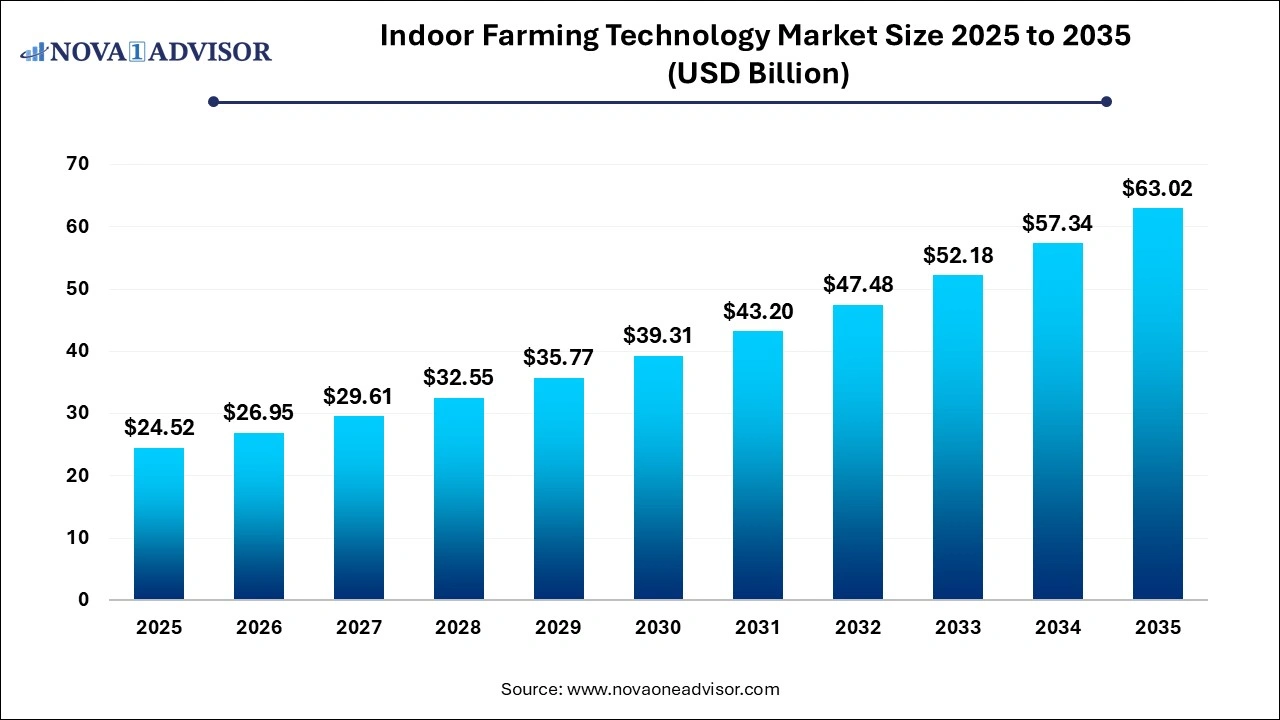
Indoor Farming Technology Market Outlook
- Market Growth Overview: The indoor farming technology market is expected to grow significantly between 2026 and 2035, driven by the growing urbanization and space scarcity, high efficiency in technological advancement, and high demand for organic food.
- Sustainability Trends: Sustainability trends involve energy efficiency and renewables, water conservation, localization, and urban farming.
- Major Investors: Major investors in the market include Ares Management, BMO Capital Markets, JS Capital Management, One Madison Group, and CDPQ.
Indoor Farming Technology Market Report Scope
| Report Attribute | Details |
| Market Size Value in 2026 | USD 26.95 Billion |
| Revenue Forecast in 2035 | USD 63.02 Billion |
| Growth Rate | CAGR of 9.9% |
| Base Year for Estimation | 2025 |
| Forecast Period | 2026 - 2035 |
| Quantitative Units | Revenue in USD Million/Billion, and CAGR from 2026 to 2035 |
| Segments Covered | By Growing System, By Facility Type, By Component, By Crop Type |
| Regional Scope | North America; Europe; Asia Pacific; Latin America; MEA |
| Key Companies Profiled | Signify Holding, Everlight Electronics, Argus Control Systems, LumiGrow |
Indoor Farming Technology Market Segmental Insights
By Growing System Insights
How did the hydroponics segment dominate the Indoor Farming Technology market?
The hydroponics segment is driven by providing superior resource efficiency and high-quality yields through direct nutrient delivery. Its compatibility with vertical stacking makes it the primary choice for space-constrained urban environments, where integration with IoT sensors and automated irrigation optimizes production. The surging consumer demand for pesticide-free local produce, supported by global government sustainability incentives, has solidified its position as the industry’s most adopted growing system.
How did the aeroponics segment expect to hold the fastest-growing Indoor Farming Technology market in the coming years?
The aeroponics segment is driven by the integration of AI-driven growth analytics and ultrasonic foggers, which have transitioned the technology from niche experiments to large-scale, high-productivity commercial applications. The rising demand for pesticide-free microgreens and leafy greens is driving massive government and private investment, particularly across North America and the Asia-Pacific.
By Facility Type Insights
How did the glass or poly greenhouses segment account for the largest share in the Indoor Farming Technology market?
The glass of poly greenhouses segment is driven by offering a cost-effective and durable structural advantage with lower capital expenditure per square foot than vertical farms. Their ability to leverage advanced automation for large-scale production of high-demand crops like tomatoes and cucumbers ensures maximum yields across diverse climates. As a mature and established technology, they maintain the highest market penetration, providing a scalable solution for commercial producers aiming to deliver fresh, locally grown produce.
How did the indoor vertical farms segment expect to hold the fastest-growing Indoor Farming Technology market in the coming years?
The indoor vertical farms segment is driven by leveraging AI-integrated IoT sensors and advanced LED technology to achieve significantly higher yields than conventional agriculture. Its ability to use water and minimal land directly addresses global resource scarcity, making it the premier solution for sustainable, high-density food production in expanding cities. The massive investments across Europe and Asia are accelerating the shift toward these building-based systems to secure local food supplies and reduce transportation costs.
By Component Insights
How did the hardware segment account for the notable share in the Indoor Farming Technology market?
The hardware segment is driven by the foundational requirement for establishing controlled-environment agriculture (CEA), often accounting for initial capital costs. The segment is anchored by LED lighting systems, which are critical for photosynthesis, and climate control systems, which are currently the fastest-growing sub-component. As the industry matures from pilot projects to large-scale commercial operations, the demand for specialized sensors, automated irrigation, and structural hardware continues to surge.
How did the software and services segment expect to hold the fastest-growing Indoor Farming Technology market in the coming years?
The software and services segment is driven by the essential need for AI and automation to manage complex climate and nutrient systems. As vertical farming scales, these data-driven platforms optimize real-time production efficiency and yield forecasting while significantly reducing labor and energy costs. The software has become the indispensable brain of modern large-scale facilities, ensuring the long-term economic sustainability of high-tech food production.
By Crop Type Insights
How did the fruits & vegetables segment account for the notable share in the Indoor Farming Technology market?
The fruits & vegetables segment is driven by its high profitability and constant consumer demand for fresh, pesticide-free staples like leafy greens and tomatoes. Their rapid growth cycles allow for multiple annual harvests, significantly boosting economic returns when compared to traditional, seasonal agriculture. These crops are highly optimized for hydroponic and LED systems, ensuring superior quality control and food safety for expanding urban populations.
How did the herbs and microgreens segment expect to hold the fastest-growing Indoor Farming Technology market in the coming years?
The herbs and microgreens segment is driven by its short growth cycles, which allow for high-frequency harvesting and rapid capital turnover. These high-value crops command premium pricing from gourmet chefs and health-conscious consumers due to their concentrated nutritional profiles and intense flavors. By utilizing IoT-enhanced vertical farming, growers can produce year-round, pesticide-free yields in compact urban spaces, directly addressing the demand for local and sustainable food.
Indoor Farming Technology Market Regional Insights
The research report includes a detailed study of regions of North America, Europe, Asia Pacific, Latin America, and Middle East and Africa. The report has been curated after observing and studying various factors that determine regional growth such as economic, environmental, social, technological, and political status of the particular region. Analysts have studied the data of revenue, sales, and manufacturers of each region. This section analyses region-wise revenue and volume for the forecast period of 2016 to 2027. These analyses will help the reader to understand the potential worth of investment in a particular region.
The major regions covered in the report are North America, Europe, Asia-Pacific, South America, Middle East & Africa, etc. The report has specifically covered major countries including U.S., Canada, Germany, France, U.K., Italy, Russia, China, Japan, South Korea, India, Australia, Taiwan, Indonesia, Thailand, Malaysia, Philippines, Vietnam, Mexico, Brazil, Turkey, Saudi Arabia, UAE, etc. It includes revenue and volume analysis of each region and their respective countries for the forecast years. It also contains country-wise volume and revenue from the year 2016 to 2021. Additionally, it provides the reader with accurate data on volume sales according to the consumption for the same years.
Key Players in the Indoor Farming Technology Market
- Signify Holding: As a leader in horticultural LED lighting, Signify develops advanced Philips GreenPower LED systems and "light recipes" that optimize photosynthesis and energy efficiency for commercial greenhouses and vertical farms.
- Everlight Electronics: Everlight offers high-performance LED grow lights and components designed to support various indoor farming applications, focusing on energy efficiency and longevity.
- Argus Control Systems: Argus specializes in advanced environmental control systems that enable growers to manage climate, fertigation, and lighting for commercial greenhouses and vertical farming. They provide customized, automated software solutions that increase yield and energy efficiency for producers.
- LumiGrow: LumiGrow specializes in smart horticultural lighting, offering adjustable LED spectra that allow farmers to precisely tailor light output to specific crop needs.

Proceed to Buy
Instant PDF delivery on confirmation

 Request Customization
 Download Sample

Get a Sample of this Report
Indoor Farming Technology Market