

Infertility Treatment Market Size, Share, Growth, Report 2026 to 2035
 Status Published
 Category Healthcare


Content
Infertility Treatment Market Size and Growth 2026 to 2035
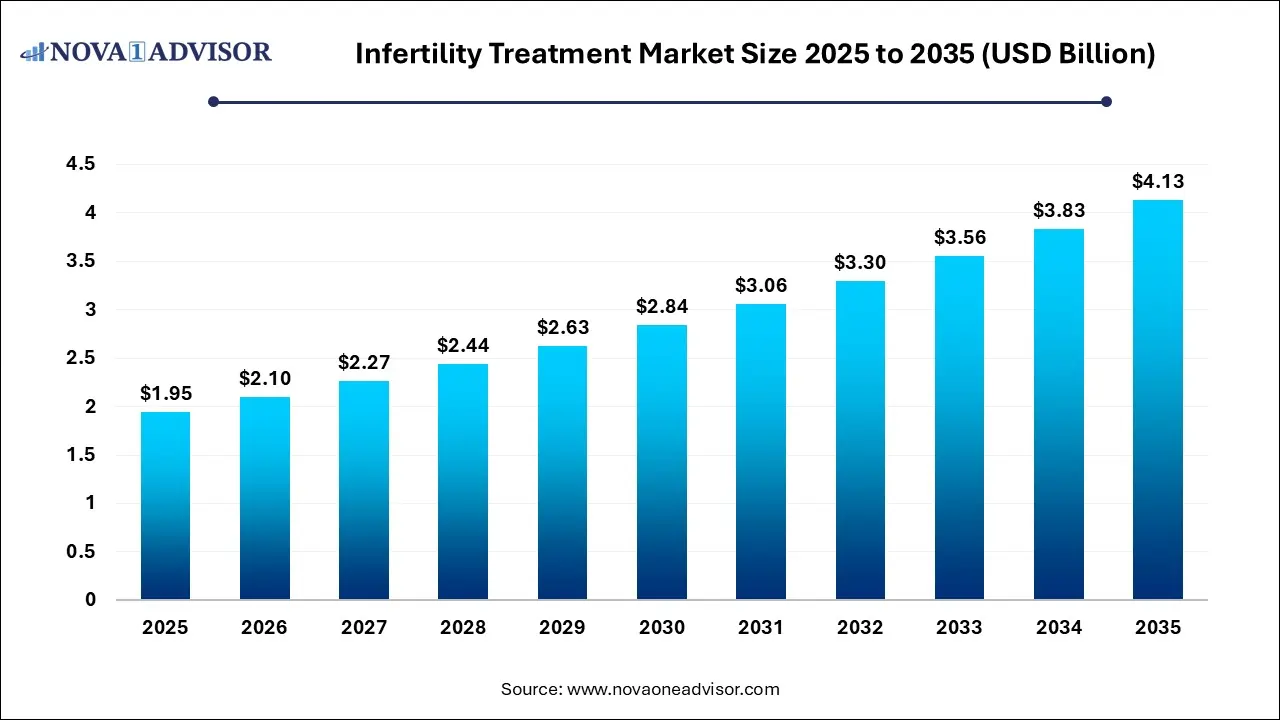
The global Infertility Treatment market size was estimated at USD 1.95 billion in 2025 and is projected to hit around USD 4.13 billion by 2035, growing at a CAGR of 7.8% during the forecast period from 2026 to 2035.
Market Key Takeaways
- The infertility treatment market is witnessing steady expansion driven by rising infertility prevalence, delayed parenthood, and lifestyle-related disorders.
- Assisted reproductive technologies (ART), particularly IVF and ICSI, dominate the procedural landscape due to higher success rates.
- Media & consumables represent a recurring revenue stream and are among the fastest-growing product segments.
- Asia Pacific is emerging as a high-growth region owing to increasing awareness, affordability, and medical tourism.
- Technological advancements such as AI-based embryo selection and time-lapse imaging are transforming treatment outcomes.
- Male infertility diagnosis and treatment are gaining traction, reducing the traditional gender imbalance in treatment focus.
Market Overview
The global infertility treatment market encompasses a broad spectrum of medical technologies, pharmaceuticals, and procedures aimed at assisting individuals and couples in achieving pregnancy. Infertility, defined as the inability to conceive after 12 months of unprotected intercourse, has become a growing public health concern worldwide. Increasing stress levels, hormonal imbalances, environmental pollutants, obesity, and delayed childbearing are major contributors to rising infertility rates.
The market includes products such as advanced laboratory equipment, consumables, and accessories, along with procedures like assisted reproductive technologies (ART), artificial insemination, and fertility surgeries. ART procedures such as in vitro fertilization (IVF) and intracytoplasmic sperm injection (ICSI) have gained widespread adoption due to improved success rates and technological advancements.
Globally, the demand for infertility treatments is influenced by socio-economic changes, including increasing awareness, growing acceptance of fertility treatments, and supportive government initiatives in certain regions. Developed markets such as North America and Europe continue to lead in terms of adoption and innovation, while emerging economies in Asia Pacific are witnessing rapid growth due to improving healthcare infrastructure and affordability.
Market Outlook
- Market Growth Overview: The infertility treatment market is expected to grow significantly between 2025 and 2035, driven by the rising infertility prevalence, increased awareness and acceptance, and rising female infertility treatment demand.
- Sustainability Trends: Sustainability trends involve green IVF lab initiatives, sustainable cryostorage management, and lifestyle and chemical awareness.
- Major Investors: Major investors in the market include KKR, BPEA EQT, Nordic Capital, CVC Capital Partners & Hartenberg Holding, and Webster Equity Partners.
Major Trends in the Market
- Increasing adoption of AI and machine learning in embryo selection and fertility diagnostics
- Rising popularity of fertility preservation techniques such as egg and sperm freezing
- Growth of fertility tourism, particularly in Asia Pacific and Eastern Europe
- Expansion of specialized fertility clinics and chains
- Increasing awareness and acceptance of male infertility treatments
- Advancements in minimally invasive fertility surgeries
- Integration of digital health platforms for fertility tracking and monitoring
- Rising use of donor gametes and surrogacy arrangements
- Development of time-lapse imaging systems for embryo monitoring
- Increasing investments and partnerships among fertility service providers
Infertility Treatment Market Report Scope
| Report Coverage | Details |
| Market Size in 2026 | USD 2.10 Billion |
| Market Size by 2035 | USD 4.13 Billion |
| Growth Rate From 2026 to 2035 | CAGR of 7.8% |
| Base Year | 2025 |
| Forecast Period | 2026 to 2035 |
| Segments Covered | By Product, By Procedure, By Patient type, By End User, By Geography |
| Market Analysis (Terms Used) | Value (USD Million/Billion) or (Volume/Units) |
| Regional Scope | North America; Europe; Asia Pacific; Central and South America; the Middle East and Africa |
| Key Companies Profiled | The Cooper Companies Inc., Cook Group, Vitrolife, Thermo Fisher Scientific, Inc., Esco Micro Pte. Ltd., Genea Biomedx, IVFtech ApS, FUJIFILM Irvine Scientific, The Baker Company, Inc., Kitazato Corporation, Rocket Medical plc, IHMedical A/S, Hamilton Thorne Ltd., ZEISS Group, MedGyn Products, Inc. |
Market Driver
Rising Prevalence of Infertility Due to Lifestyle and Demographic Changes
One of the most significant drivers of the infertility treatment market is the increasing prevalence of infertility caused by lifestyle changes and shifting demographic patterns. Modern lifestyles characterized by high stress, sedentary habits, poor diet, and exposure to environmental toxins have significantly impacted reproductive health. Additionally, rising rates of obesity, smoking, and alcohol consumption have further contributed to infertility in both men and women.
Another critical factor is delayed parenthood. With more individuals prioritizing education and career advancement, the average age of first-time parents has increased substantially. Female fertility declines with age, particularly after 35, leading to higher demand for assisted reproductive technologies. Similarly, male fertility is also affected by age-related factors and declining sperm quality.
Urbanization and increased awareness about reproductive health have also led to higher diagnosis rates, further boosting demand for infertility treatments. For example, in countries like India and China, growing awareness campaigns and improved diagnostic infrastructure have led to a surge in patients seeking treatment. This combination of biological, social, and environmental factors continues to drive sustained growth in the infertility treatment market.
Market Restraint
High Cost of Treatment and Limited Insurance Coverage
Despite significant advancements in infertility treatments, the high cost associated with these procedures remains a major restraint. Treatments such as IVF and ICSI involve multiple stages, including hormonal stimulation, egg retrieval, fertilization, and embryo transfer, all of which require specialized equipment and skilled professionals. This results in high treatment costs, often making them inaccessible to a large portion of the population.
In many countries, infertility treatments are not fully covered by insurance policies, placing a substantial financial burden on patients. Even in developed regions, reimbursement policies vary widely, limiting affordability. For instance, a single IVF cycle can cost thousands of dollars, and multiple cycles are often required for successful pregnancy outcomes.
Additionally, the cost of advanced technologies such as genetic screening and time-lapse imaging further increases the overall treatment expense. In developing countries, although costs may be relatively lower, affordability remains a concern for middle- and low-income populations. This financial barrier restricts market penetration and limits access to advanced infertility treatments, thereby restraining overall market growth.
Market Opportunity
Expansion of Fertility Services in Emerging Markets
Emerging markets present a significant opportunity for the infertility treatment industry due to improving healthcare infrastructure, increasing disposable income, and growing awareness. Countries in Asia Pacific, Latin America, and the Middle East are witnessing rapid urbanization and a shift toward modern lifestyles, which has led to increased infertility rates.
Governments and private players are investing heavily in healthcare infrastructure, including the establishment of fertility clinics and specialized centers. Additionally, the lower cost of treatment in these regions compared to developed markets has led to the rise of fertility tourism. Patients from countries with high treatment costs often travel to destinations such as India, Thailand, and Malaysia for affordable yet high-quality treatments.
Moreover, increasing awareness campaigns and educational initiatives are encouraging more individuals to seek medical help for infertility. The adoption of advanced technologies in these regions further enhances treatment success rates. This combination of affordability, accessibility, and technological advancement makes emerging markets a lucrative growth opportunity for industry players.
Segmental Insights
By Product
How did the media & consumables segment dominate the Infertility Treatment market?
The media & consumables segment is driven by essential products, including culture media and catheters, which are high-volume necessities required for every single patient cycle. Continuous advancements in verification and embryo culture formulations have significantly boosted clinical success rates, making high-end consumables indispensable for modern clinics. Its role in optimizing embryo survivability and ensuring safe transfers solidifies them as the primary financial engine of the infertility treatment market.
How did the equipment segment expect to hold the fastest-growing Infertility Treatment market in the coming years?
The equipment segment is driven by the high-precision tools, such as microfluidic sperm-sorting chips and automated cryosystems, which are becoming essential for modernizing fertility labs to meet the needs of a rising global patient base. The strategic partnership and workflow automation are making high-tech infertility treatments more accessible and scalable, driving a double-digit growth trajectory.
By Procedure
How did the assisted reproductive technology segment account for the largest share in the Infertility Treatment market?
The assisted reproductive technology segment is driven by its high clinical success rates in treating complex conditions, such as blocked fallopian tubes and advanced maternal age. The integration of preimplantation genetic testing and a strategic shift toward frozen embryo cycles have significantly enhanced safety and patient trust. Rising global infertility rates, coupled with an expansion of specialized clinics, have made these comprehensive solutions more accessible of specialized clinics, have made these comprehensive solutions more accessible than ever before.
How did the intracytoplasmic sperm injection segment expect to hold the fastest-growing Infertility Treatment market in the coming years?
The intracytoplasmic sperm injection segment is driven by the integration of AI-driven sperm selection and automated micromanipulation, which has significantly enhanced precision, making it a more predictable and attractive option than traditional IVF. Its frequent combination with preimplantation genetic testing (PGT) ensures the selection of healthy embryos, further driving adoption in advanced clinical settings. It provides a definitive solution for male-factor infertility, achieving successful fertilisation even in cases of critically low sperm count or motility.
By Patient Type
How did the female infertility treatment segment account for the largest share in the Infertility Treatment market?
The female infertility treatment segment is driven by the high clinical prevalence of conditions, such as PCOS and endometriosis, which necessitate advanced medical interventions. The widespread adoption of IVF and egg freezing has significantly expanded the revenue base, as women increasingly seek both immediate treatment and long-term fertility preservation. The high biological complexity and broad range of therapeutic options, from hormonal therapy to surgical procedures, solidify this segment as the primary driver of the global infertility market.
How did the male infertility treatment segment expect to hold the fastest-growing Infertility Treatment market in the coming years?
The male infertility treatment segment is driven by advanced techniques like ICSI and DNA fragmentation analysis, which provide definitive solutions for severe reproductive challenges. The integration of AI-driven sperm selection and automated analysis (CASA) has significantly improved treatment precision and success rates, encouraging more men to seek clinical help. The rise of app-linked home testing kits is breaking down traditional barriers by offering a private, comfortable diagnostic experience that addresses common patient discomfort.
By End User
How did the fertility centers segment account for the largest share in the Infertility Treatment market?
The fertility centers segment is driven by providing a comprehensive, one-stop shop for advanced procedures like IVF, PGT, and cryopreservation within a single specialized environment. Their investment in cutting-edge laboratory technology and AI-driven monitoring allows them to achieve superior pregnancy success rates compared to general hospitals. The rapid expansion of private equity-backed clinic chains has further improved operational efficiency and accessibility, making them the primary destination for patients seeking specialized care.
How did the cryobanks segment expect to hold the fastest-growing Infertility Treatment market in the coming years?
The cryobanks segment is driven by the shift toward delayed parenthood and a surge in demand for social egg freezing and donor programs. The transition to vitrification technology has drastically improved sample viability, instilling greater patient confidence in long-term storage solutions for both elective and medical fertility preservation. The integration of advanced genetic screening ensures the health of stored embryos, adding significant value and security to these specialized services.
By Region
North America dominates the infertility treatment market due to advanced healthcare infrastructure, high adoption of ART procedures, and strong presence of key market players. The region also benefits from high awareness levels and technological innovation. Favorable reimbursement policies in certain areas further support market growth.
Asia Pacific is the fastest-growing region, driven by increasing infertility rates, improving healthcare facilities, and rising medical tourism. Countries such as India, China, and Japan are witnessing rapid expansion of fertility clinics and adoption of advanced technologies. Lower treatment costs compared to Western countries make the region an attractive destination for international patients.
Key Players in the Infertility Treatment Market
- The Cooper Companies Inc.
CooperSurgical, a division of The Cooper Companies, is a market leader providing a comprehensive portfolio of IVF products, including media, genetic testing solutions, and advanced lab equipment like workstations and incubators.
- Cook Group
Cook Medical, part of the Cook Group, specializes in developing minimally invasive medical devices and tools for reproductive health, such as oocyte retrieval kits and embryo transfer catheters.
- Vitrolife
Vitrolife provides a comprehensive range of IVF products and services, specializing in cultivation media for embryo development, time-lapse embryo monitoring systems (EmbryoScope), and advanced genetic testing.
- Thermo Fisher Scientific, Inc.
Thermo Fisher Scientific supports the IVF segment by providing essential laboratory consumables, such as Nunc™ IVF dishes, along with advanced instrumentation like CO2 incubators and centrifugation equipment. Additionally, they contribute to the infertility treatment market by offering next-generation sequencing (NGS) platforms for Preimplantation Genetic Testing (PGT-A) to analyze embryo health.
Segments Covered in the Report
This research report offers market revenue, sales volume, production assessment and prognoses by classifying it on the basis of various aspects. Further, this research study investigates market size, production, consumption and its development trends at global, regional, and country level for the period of 2021 to 2035 and covers subsequent region in its scope:
By Product
- Equipment
- Microscopes
- Imaging Systems
- Sperm Analyzer Systems
- Ovum Aspiration Pumps
- Micromanipulator Systems
- Incubators
- Gas Analyzers
- Laser Systems
- Cryosystems
- Sperm Separation Devices
- Media & Consumables
- Accessories
By Procedure
- Assisted Reproductive Technology
- Intracytoplasmic Morphologically Selected Sperm Injection
- Gamete Donation
- In Vitro Fertilization
- Intracytoplasmic Sperm Injection
- Surrogacy
- Artificial Insemination
- Intrauterine Insemination
- Intracervical Insemination
- Intratubal Insemination
- Fertility Surgeries
- Vasovasostomy
- Vasoepididymostomy
- Laparoscopy
- Hysteroscopy
- Myomectomy
- Laparotomy
- Tubal Ligation Reversal
- Varicocelectomy
- Microsurgical Reconstruction
- Other Infertility Treatment Procedures
By Patient type
- Female Infertility Treatment
- Male Infertility Treatment
By End User
- Fertility Centers
- Hospitals & Surgical Clinics
- Cryobanks
- Research Institutes
By Geography
North America
- U.S.
- Canada
Europe
- Germany
- France
- United Kingdom
- Rest of Europe
Asia Pacific
- China
- Japan
- India
- Southeast Asia
- Rest of Asia Pacific
Latin America
- Brazil
- Rest of Latin America
Middle East & Africa (MEA)
- GCC
- North Africa
- South Africa
- Rest of Middle East & Africa
FAQ's

Proceed to Buy
Instant PDF delivery on confirmation

Infertility Treatment Market Size to Hit USD 4.13 Billion by 2035
 Request Customization
 Download Sample

Get a Sample of this Report
Infertility Treatment Market