

Infrared Spectroscopy Devices Market Size, Share, and Trends 2026 to 2035
 Status Published
 Category Healthcare


Content
Infrared Spectroscopy Devices Market Size and Growth 2026 to 2035
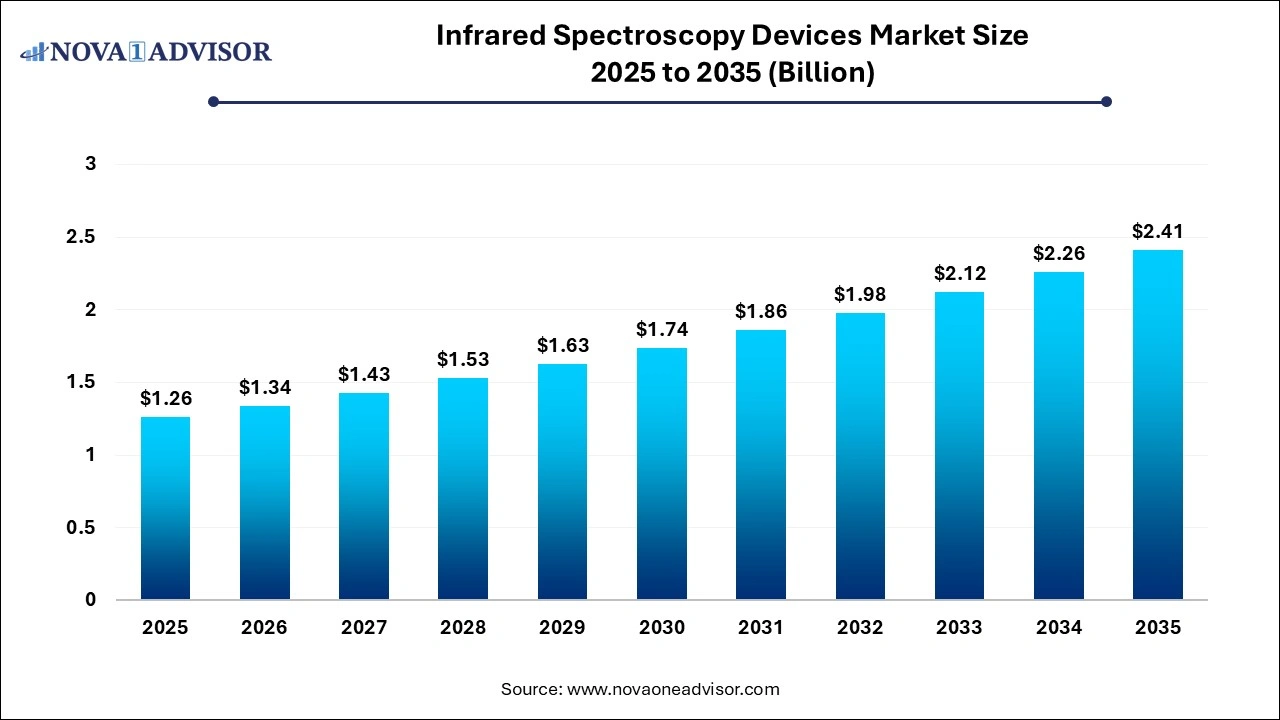
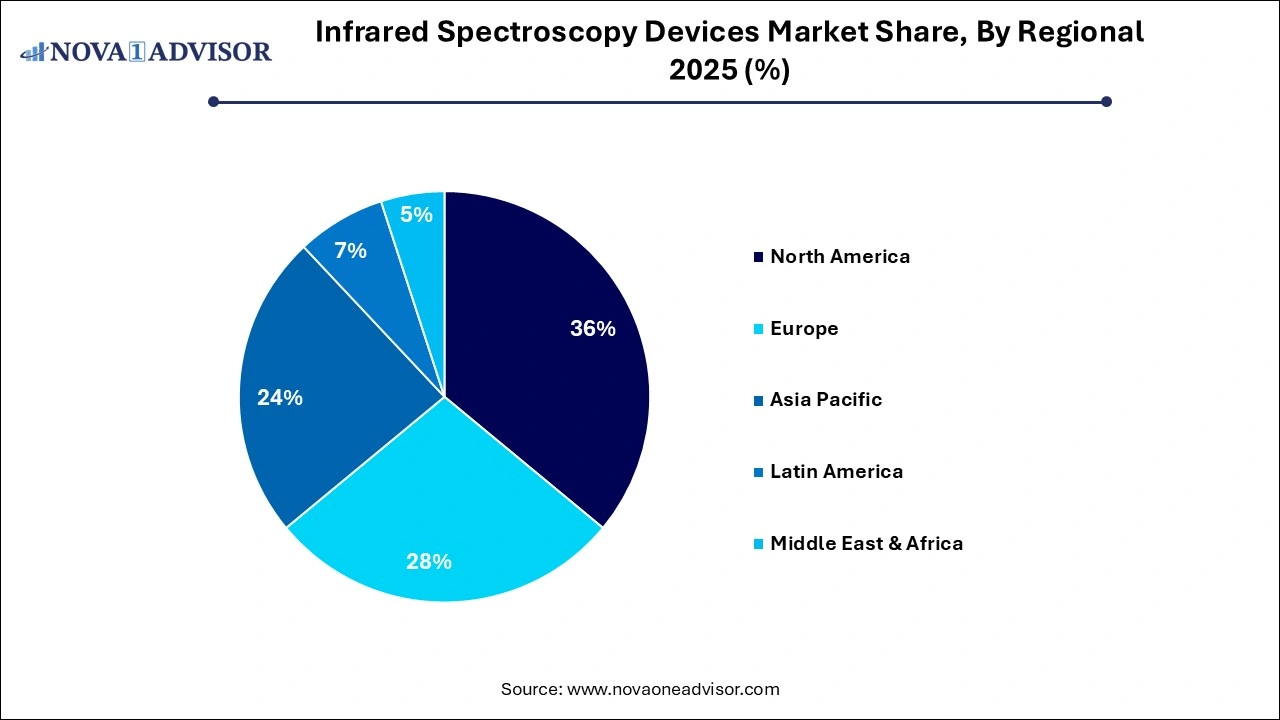
The global infrared spectroscopy devices market size was valued at USD 1.26 billion in 2025 and is projected to grow from USD 1.34 billion in 2026 to USD 2.41 billion by 2035, at a CAGR of 6.7% from 2026 to 2035. North America dominated the market, accounting for a revenue share of 36.0% in 2025.
Key Takeaway
- By spectrum sensitivity, the near-infrared (NIR) segment dominated the market with the largest share in 2025.
- By spectrum sensitivity, the mid-infrared (mid-IR) segment is expected to grow at the fastest CAGR over the forecast period.
- By technology, the Fourier transform infrared spectroscopy segment dominated the market with the largest share in 2025.
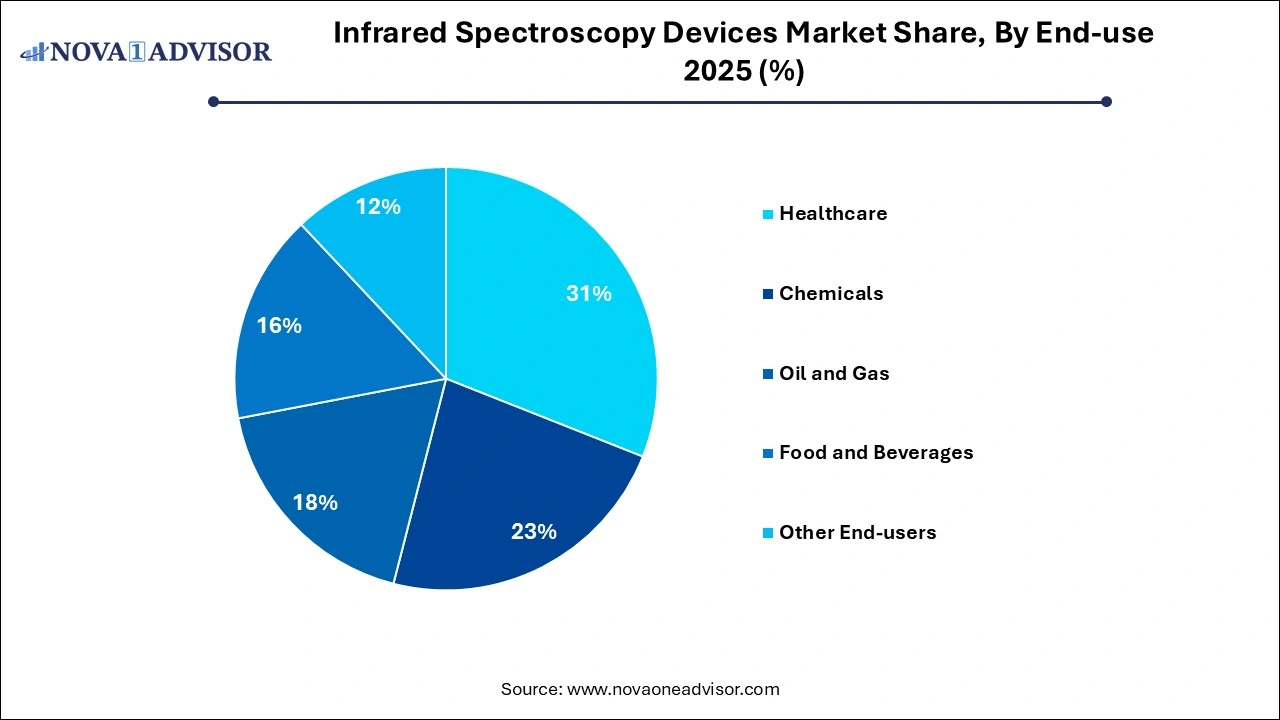
- By end user, the healthcare segment dominated the market with the largest share of 31.0% in 2025.
- By region, North America dominated the market with the largest share of 36.0% in 2025.
Market Overview
The global infrared spectroscopy devices market is experiencing steady growth due to increasing demand for accurate molecular analysis, material characterization, and quality control across industries. Infrared spectroscopy enables rapid identification of chemical compositions and material properties, making it an essential analytical tool in pharmaceuticals, healthcare, chemicals, food & beverages, environmental testing, and industrial manufacturing. Advancements in detector technology, portable instruments, digital data processing, and software analytics have expanded its applications beyond traditional laboratories into on-site and real-time testing.
The pharmaceutical and healthcare sectors remain the largest end-users, utilizing FTIR and NIR technologies for drug development, raw material verification, process monitoring, and regulatory compliance. Rising adoption of Process Analytical Technology (PAT) and continuous manufacturing is further strengthening market demand. At the same time, industries such as food safety, petrochemicals, advanced materials, semiconductors, and environmental monitoring are increasingly deploying infrared spectroscopy devices for fast, non-destructive, and reliable quality assessment. Looking ahead, innovations in laboratory automation, AI-powered analytics, cloud connectivity, and instrument miniaturization are expected to enhance operational efficiency and support continued market expansion.
Market Outlook
- Market Growth Overview: The global infrared spectroscopy devices market is expected to grow significantly between 2025 and 2035, driven by its increasing demand in the healthcare sector.
- Sustainability Trends: Sustainability trends involve a growing transition towards non-destructive testing and use of energy-efficient green manufacturing practices.
- Major Investors: Major investors in the market include Thermo Fisher Scientific, Agilent Technologies, Bruker Corporation, PerkinElmer, and Shimadzu Corporation.
How is AI Impacting The Global Infrared Spectroscopy Devices Market?
Artificial intelligence (AI) is revolutionizing the market by transitioning systems from expert-oriented laboratory tools into real-time and autonomous decision-support networks. Furthermore, Convolutional Neural Networks (CNNs) and deep learning frameworks autonomously reduce noise, correct scattering, and extract salient patterns from intricate data matrices.
In the pharmaceutical industry, AI-integrated infrared spectroscopy accelerates drug development, raw material verification, counterfeit drug detection, and quality control by rapidly correlating spectral signatures with extensive reference databases. In manufacturing, AI combined with inline infrared sensors enables real-time process monitoring, helping optimize production, reduce material waste, and maintain consistent product quality. Food manufacturers also leverage AI-enabled near-infrared (NIR) systems to continuously monitor moisture, protein, fat, and sugar content during processing.
Additionally, AI supports predictive maintenance by monitoring instrument performance and identifying potential equipment issues before failures occur, minimizing downtime and maintenance costs. With the growing adoption of cloud-based platforms and digital laboratories, AI is also facilitating centralized data sharing, standardized workflows, and continuous improvement of analytical models, making infrared spectroscopy systems smarter, more reliable, and increasingly valuable across industries.
Infrared Spectroscopy Devices Market Report Scope
| Report Coverage | Details |
| Market Size in 2026 | USD 2.05 Billion |
| Market Size by 2035 | USD 3.23 Billion |
| Growth Rate From 2026 to 2035 | CAGR of 5.16% |
| Base Year | 2025 |
| Forecast Period | 2026 to 2035 |
| Segments Covered | By End-user, By Technology, By Spectrum Sensitivity, By Region |
| Market Analysis (Terms Used) | Value (USD Million/Billion) or (Volume/Units) |
| Regional Scope | North America; Europe; Asia Pacific; Central and South America; the Middle East and Africa |
| Key Companies Profiled | PerkinElmer, Jasco, Shimadzu, Bruker Corp., Agilent Technologies, Thermo Fisher Scientific Inc., Princeton Instruments, Sartorius AG and others |
Market Driver
Increasing Demand for Quality Assurance Across Regulated Industries
The growing emphasis on quality assurance and regulatory compliance is a key driver of the global infrared spectroscopy devices market. Industries such as pharmaceuticals, biotechnology, food & beverages, chemicals, and petrochemicals rely on infrared spectroscopy for rapid, non-destructive analysis to ensure product quality and consistency. FTIR and NIR technologies are widely used for raw material verification, process monitoring, contamination detection, and final product testing. As regulatory standards continue to tighten, organizations are increasingly investing in advanced spectroscopy systems to improve analytical accuracy, reduce testing time, and maintain compliance.
Market Restraint
High Equipment Costs and Need for Skilled Professionals
The high initial cost of advanced infrared spectroscopy systems remains a major challenge for market growth. Premium FTIR instruments with sophisticated detectors, automation features, and specialized software require substantial capital investment, making them less accessible for small laboratories and emerging-market organizations. In addition, effective operation, calibration, and data interpretation require skilled professionals, while ongoing expenses related to maintenance, software upgrades, and regulatory validation further increase the total cost of ownership.
Market Opportunity
Growing Demand for Portable and Real-Time Spectroscopy Solutions
Rising demand for portable and real-time analytical technologies presents a significant opportunity for the infrared spectroscopy devices market. Compact FTIR and NIR instruments enable rapid, on-site testing across industries such as pharmaceuticals, food safety, environmental monitoring, agriculture, mining, and industrial manufacturing. Advances in miniaturization, wireless connectivity, cloud computing, and AI-powered analytics are enhancing the performance and usability of portable spectroscopy devices. These innovations are expanding field-based applications and supporting faster decision-making, creating new growth opportunities for manufacturers worldwide.
Segmental Insights
By Spectrum Sensitivity
Why did the near-infrared (NIR) segment dominate the global infrared spectroscopy devices market?
The near-infrared (NIR) segment dominated the market with the largest share in 2025. The dominance of the segment can be attributed to the growing need for non-destructive testing and stringent food and pharma regulations. In addition, the integration of machine learning algorithms has significantly increased the versatility and precision of near-infrared spectroscopy (NIRS) for the analysis of complex mixtures.
How did the mid-infrared (mid-IR) segment expected to hold the significantly growing global infrared spectroscopy devices market in the coming years?
The mid-infrared (mid-IR) segment is expected to grow at the fastest CAGR over the forecast period. The growth of the segment can be credited to the technological innovations in infrared (FTIR) systems and stringent industrial quality control. It also demonstrates extensive use across raw material identification, in-process drug monitoring, and biomedical research applications.
By Technology
Why did the fourier transform infrared spectroscopy segment dominate the global infrared spectroscopy devices market?
The fourier transform infrared spectroscopy segment dominated the market with the largest share in 2025. The dominance of the segment can be linked to the surge in pharmaceutical R&D and growing need for ongoing production along with AI-driven data automation. Fourier-transform infrared (FTIR) spectroscopy is increasingly integrated into continuous online monitoring systems to facilitate real-time chemical tracking.
How did the dispersive infrared spectroscopy segment expected to hold the significantly growing global infrared spectroscopy devices market in the coming years?
The dispersive infrared spectroscopy segment is expected to grow at the fastest CAGR over the forecast period. The growth of the segment can be driven by its cost-effectiveness setup for basic educational and chemical labs along with growing use in industrial quality control. It acts as a standard instrumental baseline in academic teaching laboratories owing to its conventional optical architecture and automated operational mechanics.
By End-User
Why did the healthcare segment dominate the global infrared spectroscopy devices market?
The healthcare segment dominated the market with the largest share in 2025. The dominance of the segment is owing to the increasing investments in drug discovery and rapid technological automation across the sector. Furthermore, smaller device sizes enable smooth integration into space-constrained clinical and laboratory workstations.
How did the chemicals segment expected to hold the significantly growing global infrared spectroscopy devices market in the coming years?
The chemicals segment is expected to grow at the fastest CAGR over the forecast period. The growth of the segment is due to stringent regulatory compliance and growing artificial intelligence-assisted spectral analysis. Chemical manufacturers are increasingly adopting inline and online infrared (IR) spectroscopy to facilitate real-time reaction monitoring, driving market growth further.
By Regional
Why did the North American region account for the largest share in the global infrared spectroscopy devices market?
North America dominated the market with the largest share in 2025. The dominance of the region can be attributed to the increasing demand for portable field-testing devices and the robust presence of high-tech healthcare infrastructure in major cities. In addition, as the demand for decentralized and real-time analytics increases, the commercial market in the region is rapidly transitioning toward portable and handheld diagnostic systems.
U.S. Global Infrared Spectroscopy Devices Market Trends
The growth of the market in the country can be driven by the growing R&D in pharmaceuticals and increasing adoption of portable lab technology. Also, stringent oversight by regulatory bodies, such as the Food and Drug Administration (FDA) and the Environmental Protection Agency (EPA), mandates that laboratories implement robust material characterization techniques.
Why did the Asia-Pacific region become the fastest-growing global infrared spectroscopy devices market during the forecast period?
Asia Pacific is expected to grow at the fastest CAGR over the forecast period. The growth of the region can be credited to the increase in pharmaceutical manufacturing and heavy industrial automation across emerging nations such as China, India, and Japan. Furthermore, the surge in global population, along with heightened concerns regarding food safety, has raised the demand for routine authenticity and contamination testing using advanced near-infrared technology.
China Global Infrared Spectroscopy Devices Market Trends
The market in the country is growing due to increasing food safety testing and its extensive adoption in chemical and semiconductor quality control. Moreover, national programs support domestic scientific inquiry, advanced technological fabrication, and the modernization of premier research facilities.
Key Players in the Global Infrared Spectroscopy Devices Market
- Thermo Fisher Scientific: Provides high-end benchtop and portable FTIR systems widely used for material science, life sciences, and regulatory quality control.
- PerkinElmer Inc.: It supplies an extensive range of infrared detection and analytical instruments tailored for environmental, food safety, and clinical screening.
- Shimadzu Corporation: It delivers versatile analytical instruments, driving significant adoption across Asia-Pacific manufacturing and pharmaceutical sectors.
Recent Developments
- In June 2026, the EU-funded MIMIR Project has commenced a 36-month initiative to advance field-deployable analytical chemistry by adapting laboratory-grade spectroscopy for operational field use. Coordinated by CyRIC Cyprus Research and Innovation Center Ltd. the program builds directly upon foundational findings from the antecedent BROMEDIR initiative.
Segments Covered in the Report
This report forecasts revenue growth at country levels and provides an analysis of the latest industry trends in each of the sub-segments from 2021 to 2035. For this study, Nova one advisor, Inc. has infrared spectroscopy devices market.
By End-user
- Healthcare
- Chemicals
- Oil and Gas
- Food and Beverages
- Other End-users
By Technology
- Fourier Transform Infrared Spectroscopy
- Dispersive Infrared Spectroscopy
By Spectrum Sensitivity
- Near-Infrared (NIR)
- Mid-Infrared (Mid IR)
- Far-Infrared (Far IR)
By Region
- North America
- Europe
- Asia Pacific
- Latin America
- Middle East & Africa
FAQ's

Proceed to Buy
Instant PDF delivery on confirmation

Infrared Spectroscopy Devices Market Size to Hit USD 2.41 Billion by 2035
 Request Customization
 Download Sample

Get a Sample of this Report
Infrared Spectroscopy Devices Market