

Intra-cranial Pressure (ICP) Monitor Market Size, Share, Forecast Report, 2026 - 2035
 Status Published
 Category Healthcare


Content
Intra-Cranial Pressure (ICP) Monitor Market Size and Growth 2026 to 2035
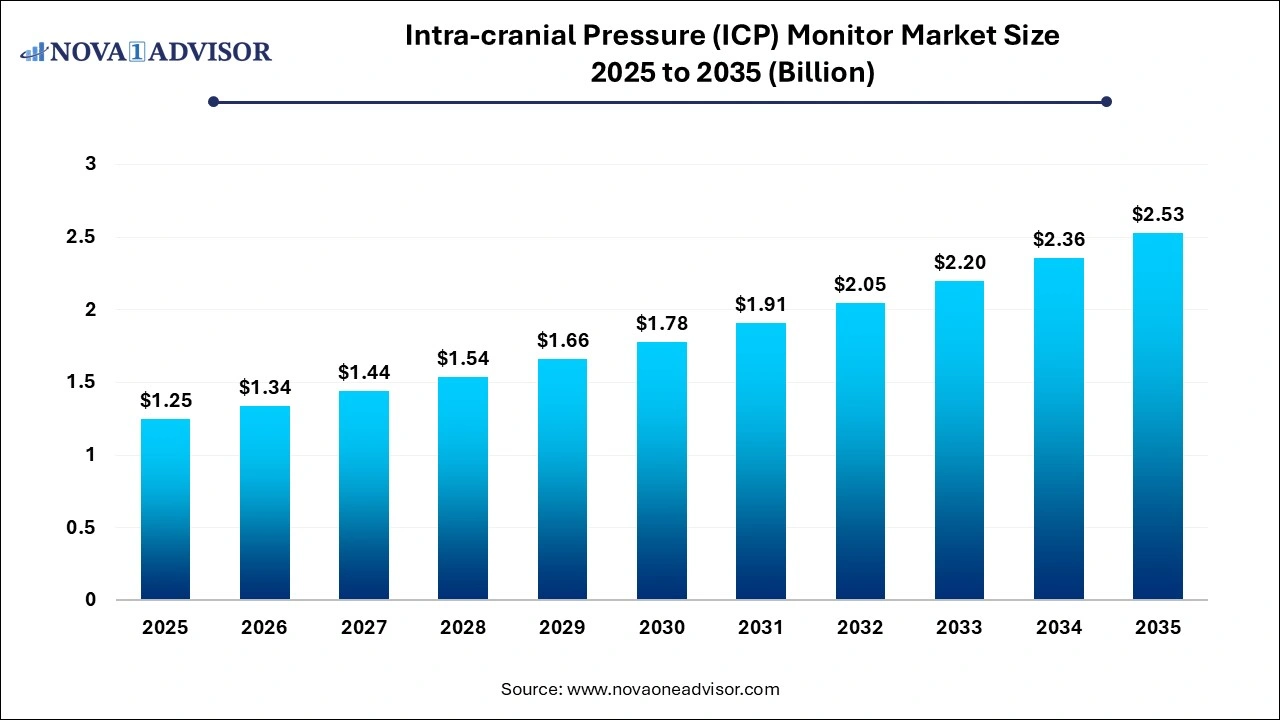
The global intra-cranial pressure (ICP) monitor market size was valued at USD 1.25 billion in 2025 and is projected to grow from USD 1.34 billion in 2026 to USD 2.53 billion by 2035, at a CAGR of 7.3% from 2026 to 2035. North America dominated the market, accounting for a revenue share of 38.0% in 2025.
Key Takeaway
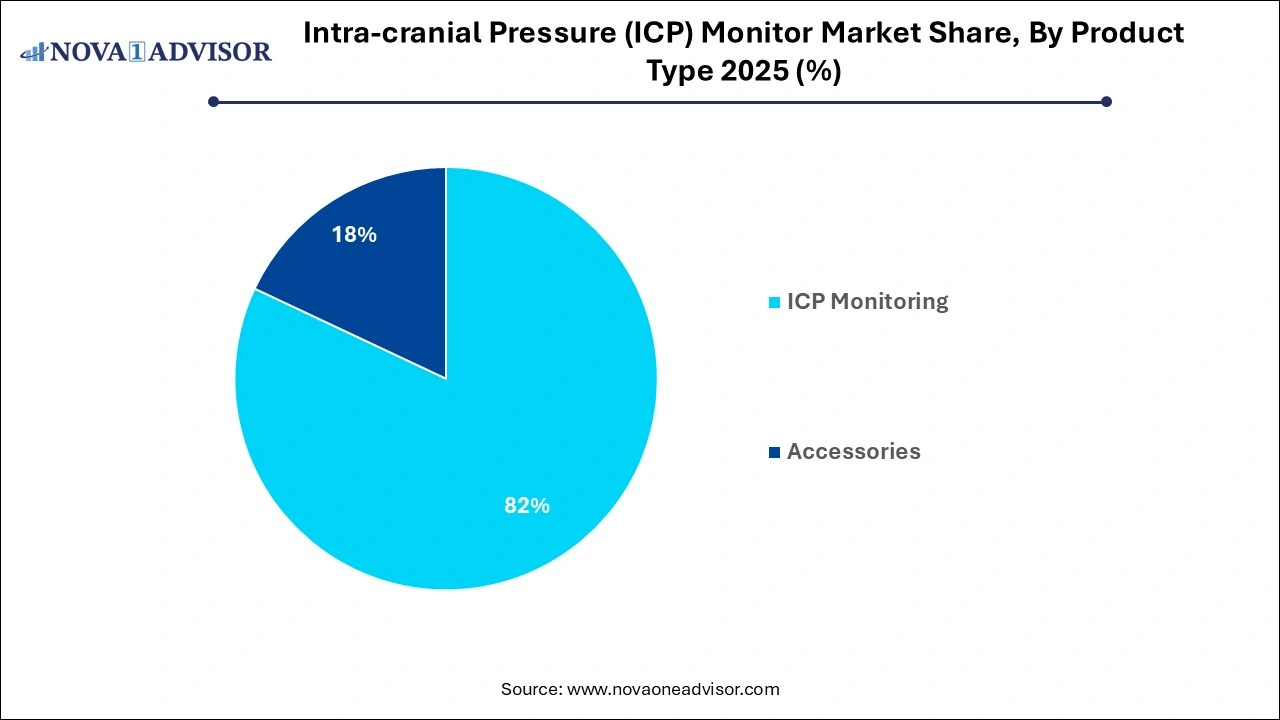
- By product type, the ICP monitoring devices segment dominated the market with the largest share of 82.0% in 2025.
- By product type, the accessories segment is expected to grow at the fastest CAGR over the forecast period.
- By application, the traumatic brain injury (TBI) segment dominated the market with the largest share in 2025.
- By end user, the hospital segment dominated the market with the largest share in 2025.
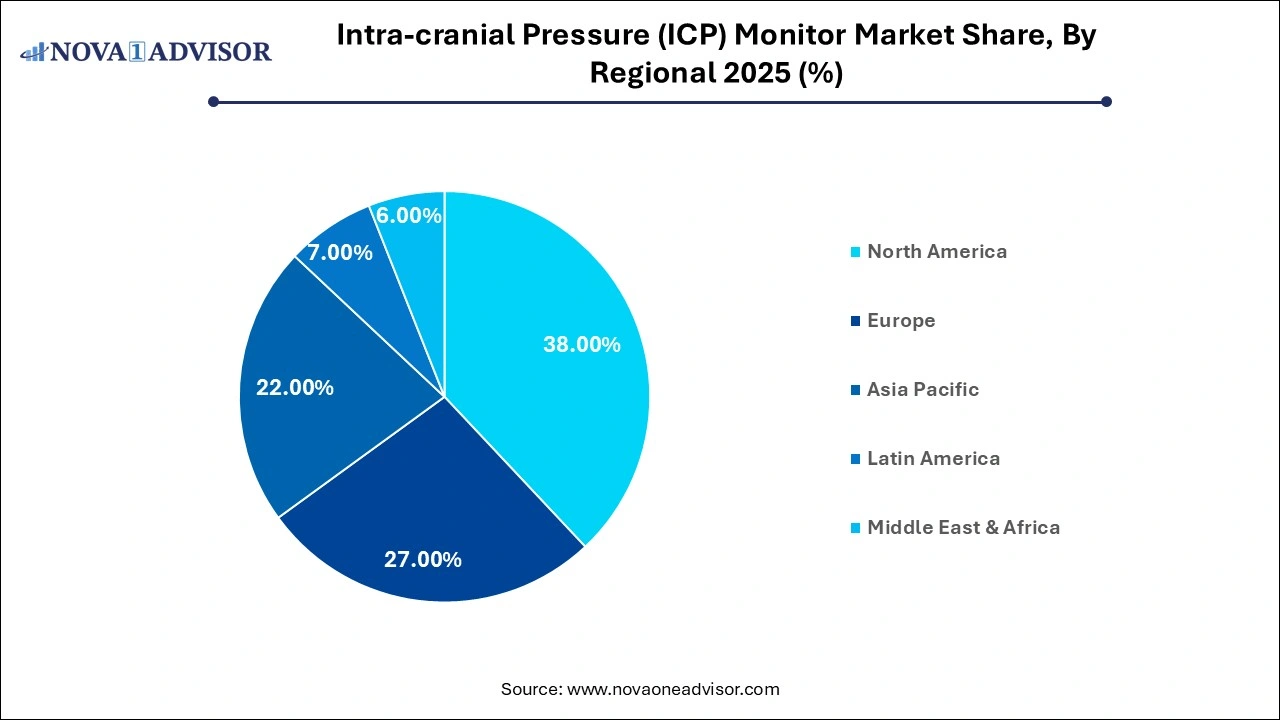
- By region, North America dominated the market with the largest share of 38.0% in 2025.
Market Overview
The global Intra-Cranial Pressure (ICP) Monitor Market focuses on technologies used to measure and monitor pressure inside the skull, particularly in severe traumatic brain injury, brain swelling, intracranial bleeding, and other neurological conditions. The market includes invasive and emerging non-invasive monitoring systems, along with catheters, sensors, probes, ventricular drainage components, and accessories.
Invasive ICP monitors remain widely used in neurocritical care because they provide direct and continuous pressure measurements. However, growing interest in safer and less invasive approaches is driving innovation in optical, Doppler, tympanic, imaging, and other monitoring technologies.
Market growth is supported by the increasing need for advanced neurocritical-care services, rising neurological injuries, hospital infrastructure development, replacement of older monitoring equipment, and technological advancements. The market is also moving toward integrated platforms that combine ICP readings with blood pressure, cerebral perfusion pressure, oxygenation, and other physiological data to improve clinical decision-making.
Market Outlook
- Market Growth Overview: The intracranial pressure monitoring market is expected to grow significantly between 2025 and 2035, driven by the rising incidence of neurological disorders, traumatic brain injuries, and strokes, along with advances in minimally invasive and non-invasive neuromonitoring technologies.
- Sustainability Trends: Sustainability trends involve minimizing medical waste and transitioning towards reusable hybrid components.
- Major Investors: Major investors in the market include Medtronic, Integra LifeSciences, Natus Medical, Raumedic, Codman Neuro (Johnson & Johnson), and Spiegelberg.
How is AI Impacting The Global Intra-Cranial Pressure (ICP) Monitor Market?
Artificial intelligence (AI) is reshaping the market by supporting non-invasive pressure estimation, predictive analytics, automated waveform interpretation, and optimized real-time alerts in intensive care units. Furthermore, AI-enabled platforms can integrate continuous monitoring data with hospital electronic health record systems, helping clinicians identify patterns associated with intracranial hypertension and intervene earlier.
AI is also supporting the development of non-invasive ICP estimation, which could expand monitoring beyond specialized neuro-ICUs to emergency departments, ambulances, and smaller hospitals. Predictive analytics may further help clinicians anticipate pressure changes and support faster intervention.
The growing integration of AI is encouraging manufacturers to develop connected monitoring platforms that integrate with ICU dashboards and electronic health records. However, clinical validation, regulatory approval, cybersecurity, interoperability, and false-alert management remain important challenges.
Intra-Cranial Pressure (ICP) Monitor Market Report Scope
| Report Coverage | Details |
| Market Size in 2026 | USD 1.34 Billion |
| Market Size by 2035 | USD 2.53 Billion |
| Growth Rate From 2026 to 2035 | CAGR of 7.3% |
| Base Year | 2025 |
| Forecast Period | 2026 to 2035 |
| Segments Covered | By Product Type, By Technique, By Application, By End-User, By Region |
| Market Analysis (Terms Used) | Value (USD Million/Billion) or (Volume/Units) |
| Regional Scope | North America; Europe; Asia Pacific; Central and South America; the Middle East and Africa |
| Key Companies Profiled | Covidien plc (Ireland), Compumedics Limited (Australia), Natus Medical Incorporated (US), Integra LifeSciences Corporation (US), Codman & Shurtleff, Inc. (US), Raumedic (USA) and Vittamed |
Market Driver: Rising Need for Continuous Monitoring in Severe Brain Injury
The growing need for continuous monitoring in severe brain injury is a major driver of the ICP monitor market. Conditions such as traumatic brain injury, brain swelling, hematomas, and impaired cerebrospinal-fluid circulation can change rapidly, making continuous physiological monitoring valuable alongside imaging. Increasing investment in neurocritical-care facilities and specialized intensive-care services is further supporting demand.
Market Restraint: Invasive Procedures and Clinical Complexity
The invasive nature of many established ICP monitoring technologies remains a key market restraint. Catheter and sensor placement can involve infection, bleeding, calibration, and positioning considerations and requires trained clinical personnel. Additional costs for disposable components, sterile kits, transducers, and monitoring equipment can also limit adoption, particularly in smaller hospitals and resource-constrained healthcare systems. Product recalls and component-quality concerns can further influence purchasing decisions.
Market Opportunity: Reliable Non-Invasive ICP Monitoring
The development of accurate non-invasive ICP monitoring represents a major long-term opportunity. Technologies that estimate ICP without intracranial sensor placement could reduce procedural risks and potentially expand monitoring into emergency departments, ambulances, smaller hospitals, and other care settings. Companies developing optical and other non-invasive approaches are attracting investment, highlighting strong commercial interest in next-generation brain-monitoring technologies. Successful clinical validation, regulatory approval, and demonstrated accuracy could significantly broaden the addressable market.
Segmental Insights
By Product Type
Why did the ICP monitoring devices segment dominate the global intra-cranial pressure (ICP) monitor market?
The ICP monitoring devices segment dominated the market with the largest share in 2025. The dominance of the segment can be attributed to the increasing incidence of traumatic brain injuries and ongoing innovations in neurocritical care technology. In addition, the integration of high-reliability fiber-optic and micro transducer systems significantly enhances measurement precision during critical neurosurgical procedures.
How did the accessories segment expected to hold the significantly growing global intra-cranial pressure (ICP) monitor market in the coming years?
The accessories segment is expected to grow at the fastest CAGR over the forecast period. The growth of the segment can be credited to the increasing neurocritical care admissions and rise in demand for single-use consumables. Also, upgrades to digital bedside monitors drive an increased demand for specialized adapter cables, proprietary sensor tips, and calibration kits, leading to segment growth soon.
By Application
Why did the traumatic brain injury segment dominate the global intra-cranial pressure (ICP) monitor market?
The traumatic brain injury (TBI) segment dominated the market with the largest share in 2025. The dominance of the segment can be linked to the increasing rates of road accidents and the robust presence of cutting-edge neurocritical care. Protocols in emergency departments and intensive care units strictly require continuous intracranial pressure monitoring for patients with severe traumatic brain injury to effectively manage intracranial hypertension.
How did the intracerebral hemorrhage segment expected to hold the significantly growing global intra-cranial pressure (ICP) monitor market in the coming years?
The intracerebral hemorrhage (ICH) segment is expected to grow at the fastest CAGR over the forecast period. The growth of the segment can be driven by a surge in the elderly population, growing stroke rates, and adoption of innovative neurocritical care management. Real-time intracranial pressure (ICP) monitoring identifies early mechanical mass effects and cerebral edema, allowing neurointensivists to administer timely osmotic therapy and prevent irreversible brain herniation.
By End User
Why did the hospital segment dominate the global intra-cranial pressure (ICP) monitor market?
The hospital segment dominated the market with the largest share in 2025. The dominance of the segment is owing to the growing volume of traumatic brain injuries (TBIs) and increasing neurocritical admissions rates. Furthermore, hospitals routinely upgrade to advanced fiber-optic, AI-enabled, and digital monitoring systems that integrate smoothly with central hospital IT platforms, impacting positive segment growth soon.
How did the ambulatory surgical centers segment expected to hold the significantly growing global intra-cranial pressure (ICP) monitor market in the coming years?
The ambulatory surgical centers (ASCs) segment is expected to grow at the fastest CAGR over the forecast period. The growth of the segment is due to an ongoing transition towards outpatient neuro-procedures and increasing demand for cost-effective care along with the rise of portable monitoring technologies. Moreover, conducting minor diagnostic or follow-up procedures within ambulatory surgery centers substantially reduces the risk of nosocomial infections, enhancing patient satisfaction and preference.
By Region
Why did the North American region account for the largest share in the global intra-cranial pressure (ICP) monitor market?
North America dominated the market with the largest share in 2025. The dominance of the region can be attributed to the increasing prevalence of TBI and stroke and the presence of well-established neurocritical care infrastructure in major countries. In addition, robust reimbursement frameworks from both public and private payers minimized capital barriers for healthcare institutions adopting advanced, high-cost monitoring technologies.
U.S. Intra-cranial Pressure (ICP) Monitor Market Trends
The growth of the market in the country can be driven by the increasing rate of traumatic brain injuries and strokes and the surge in volume of neurocritical care admissions in major cities. Also, the extensive presence of specialized neurosurgical centers, premier healthcare institutions, and corporate headquarters of leading medical device manufacturers directly facilitates ongoing clinical research and development.
Why did the Asia-Pacific region become the fastest-growing global intra-cranial pressure (ICP) monitor market during the forecast period?
Asia Pacific is expected to grow at the fastest CAGR over the forecast period. The growth of the region can be credited to the increasing traffic incidents and ongoing urbanization in emerging economies such as China and India. Furthermore, its regional adoption is expanding as healthcare institutions integrate established invasive protocols along with the emerging non-invasive monitoring technologies and artificial intelligence-driven analytics.
China Intra-cranial Pressure (ICP) Monitor Market Trends
The market in the country is growing due to an increasing incidence of traumatic brain injuries and strokes coupled with the growing investments in hospital and healthcare infrastructure. Moreover, supportive governmental policies and robust state sponsorship for regional medical technology innovation facilitate the growth of the domestic commercial landscape.
Key Players in the Intra-cranial Pressure (ICP) Monitor Market
- Integra LifeSciences: It provides the Codman CereLink ICP monitor and market-leading neurosurgery solutions for traumatic brain injury and hydrocephalus management.
- Medtronic: It offers advanced monitoring devices such as the NEUROVENT-PTO ICP catheter line for real-time parenchymal pressure tracking.
- RAUMEDIC AG: It focuses on high-fidelity pressure measurement systems and specialized neuro-monitoring items, including portable and home-use concepts.
Recent Developments
- In October 2025, London-based neurological health technology company CoMind raised €51 million in a funding round led by Plural, bringing its total funding to €85 million. The company is developing CoMind One, a non-invasive neuromonitoring system designed to measure cerebral perfusion, cerebral autoregulation, and intracranial pressure using infrared light technology.
Segments Covered in the Report
This report forecasts revenue growth at country levels and provides an analysis of the latest industry trends in each of the sub-segments from 2021 to 2035. For this study, Nova one advisor, Inc. has intra-cranial pressure (ICP) monitor market.
By Product Type
- ICP Monitoring
- External Ventricular Drainage (EVD) Systems
- Microtransducers
- Accessories
- Catheters
- Probes
- Sensors
- Fixation Devices
- Others
By Technique
- Invasive Monitoring
- Ventriculostomy
- Subarachnoid Screw
- Others
- Non-invasive Monitoring
- Transcranial Doppler
- Tympanic Membrane Displacement
- MRI/CT Imaging
- Others
By Application
- Traumatic Brain Injury (TBI)
- Subarachnoid Hemorrhage (SAH)
- Intracerebral Hemorrhage (ICH)
- Meningitis
- Cerebral Edema
- Hydrocephalus
- Others
By End-user
- Hospitals
- Trauma Centers
- Ambulatory Surgical Centers (ASCs)
- Specialty Clinics
By Region
- North America
- Europe
- Asia-Pacific
- Latin America
- Middle East & Africa (MEA)
FAQ's

Proceed to Buy
Instant PDF delivery on confirmation

Intra-cranial Pressure (ICP) Monitor Market Size to Hit USD 2.53 Billion by 2035
 Request Customization
 Download Sample

Get a Sample of this Report
Intra-cranial Pressure (ICP) Monitor Market