

IV Poles Market Size, Share, Forecast Report, 2026 - 2035
 Status Published
 Category Healthcare


Content
IV Poles Market Size and Growth 2026 to 2035
The global IV poles market size was valued at USD 1.95 billion in 2025 and is projected to grow from USD 2.07 billion in 2026 to USD 3.59 billion by 2035, at a CAGR of 6.3% from 2026 to 2035.
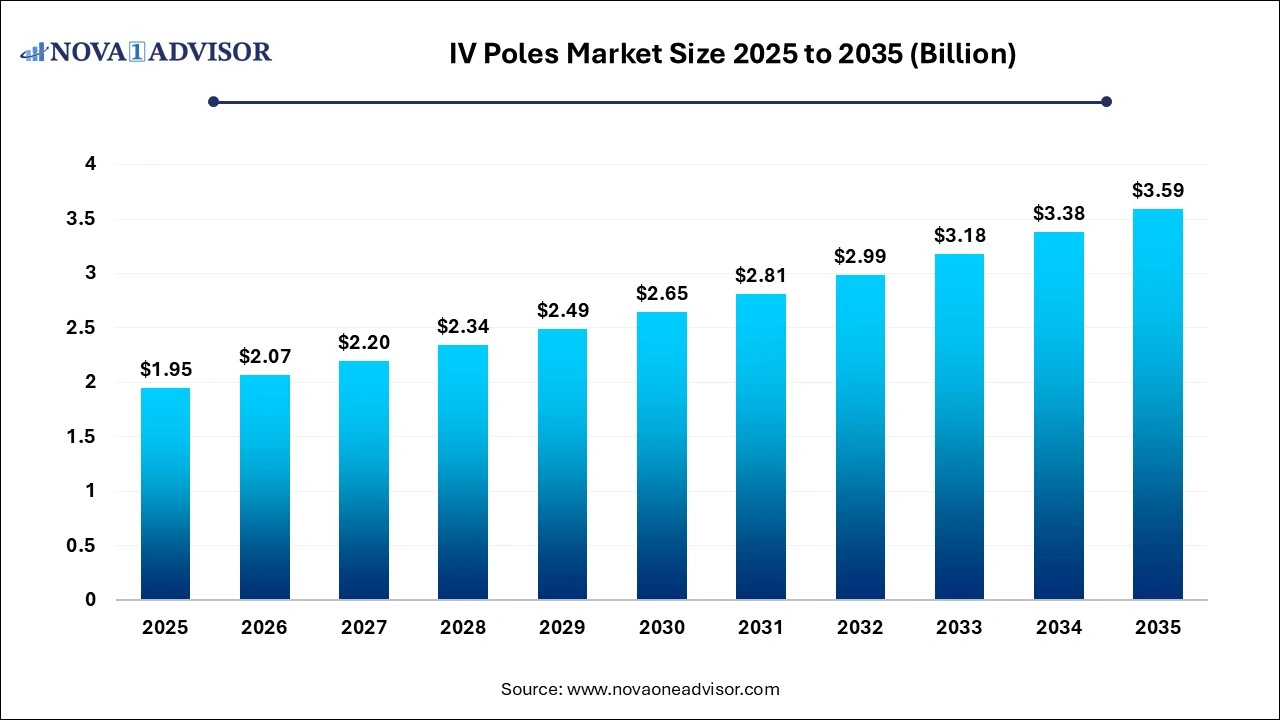
Key Takeaway:
- By product type, the mobile IV poles segment dominated the market with the largest share in 2025.
- By product type, the stationary IV poles segment is expected to grow at the fastest CAGR over the forecast period.
- By material, the stainless steel IV pole segment dominated the market with the largest share in 2025.
- By adjustment mechanism, the manual height adjustment IV poles segment dominated the market with the largest share in 2025.
- By region, North America dominated the market with the largest share in 2025.
Market Overview
The global IV Poles Market includes mobile, stationary, and ceiling-mounted support systems used to hold IV solution containers, infusion pumps, syringe pumps, and related equipment. These devices are essential across hospitals and treatment settings where patients require intravenous fluids, medications, nutrition, or other therapies while remaining mobile.
Market development is increasingly influenced by the growing complexity of infusion therapy. Patients in intensive care, oncology, surgery, critical care, and complex inpatient settings may require multiple pumps and fluid containers simultaneously, creating demand for poles with higher load capacity, stability, maneuverability, and ergonomic designs.
Manufacturers are also integrating IV poles with hospital beds, stretchers, and transport systems to support safer patient mobility and reduce floor congestion. Competition is therefore shifting beyond basic structural support toward stability, caster performance, equipment capacity, cleaning durability, ergonomics, and compatibility with hospital workflows.
Future opportunities are emerging around smart and connected IV poles, including load-cell monitoring, fluid-volume tracking, wireless charging, concealed tubing, and IoT connectivity. These developments could transform conventional IV stands into integrated platforms supporting both infusion management and patient mobility.
Market Outlook
- Market Growth Overview: The global IV poles market is expected to grow significantly between 2025 and 2035, driven by the growing global surgical infrastructure.
- Sustainability Trends: Sustainability trends involve growing emphasis on adopting sustainable raw materials and minimizing manufacturing carbon footprints.
- Major Investors: Major investors in the market include 3M, Cardinal Health, Medline Industries, B. Braun Melsungen AG, Fresenius Kabi, Promotal SAS, ALVO Medical, medifa-hesse, AliMed, and GF Health Products.
How is AI Impacting The Global IV Poles Market?
Artificial intelligence (AI) is reshaping the market by transitioning conventional hardware toward smart and connected ecosystems by optimizing asset tracking. In addition, artificial intelligence algorithms process data streams from interconnected intravenous infusion poles throughout a medical facility to monitor inventory utilization. This capability enables healthcare institutions to strategically allocate devices to areas of highest demand.
Major Trends in the IV Poles Market
- Increasing demand for mobile infusion support: Hospitals are emphasizing patient mobility, creating demand for stable and maneuverable wheeled IV poles.
- Multi-device IV poles: Poles are increasingly designed to support multiple infusion pumps, syringe pumps, fluid bags, and accessories.
- Improved caster technology: Manufacturers are focusing on smoother movement, braking performance, directional control, and stability.
- Ergonomic designs: Height adjustment, patient hand grips, accessory positioning, and improved handles are becoming important product differentiators.
- Integration with hospital beds: IV poles can increasingly attach directly to beds and transport systems to simplify patient movement.
IV Poles Market Report Scope
| Report Coverage | Details |
| Market Size in 2026 | USD 2.07 Billion |
| Market Size by 2035 | USD 3.59 Billion |
| Growth Rate From 2026 to 2035 | CAGR of 6.3% |
| Base Year | 2025 |
| Forecast Period | 2026 to 2035 |
| Segments Covered | By Product Type, By Material, By Adjustment Mechanism, By Region |
| Market Analysis (Terms Used) | Value (USD Million/Billion) or (Volume/Units) |
| Regional Scope | North America; Europe; Asia Pacific; Central and South America; the Middle East and Africa |
| Key Companies Profiled | Baxter International Inc., Stryker Corporation, Medline Industries LP, Cardinal Health Inc., B. Braun Melsungen AG, Fresenius Medical Care AG & Co. KGaA, Invacare Corporation, Drive DeVilbliss Healthcare (Drive Medical), Shandong Weigao Group Medical Polymer Company Ltd., Pryor Products, Pedigo Products Inc., Clinton Industries Inc., Blickman Inc., Villard Medical |
Market Driver – Increasing Volume of Intravenous Therapies:
The expanding use of intravenous fluids, medications, nutrition, blood products, and complex infusion therapies is driving demand for IV poles across hospitals and outpatient settings. Increasing numbers of infusion pumps, particularly in intensive care, oncology, surgery, and critical care, require stable and mobile support systems. Growing emphasis on patient mobility further strengthens demand for maneuverable IV poles.
Market Restraint – Product Commoditization and Long Replacement Cycles:
Basic IV poles have relatively simple mechanical designs, limiting differentiation and creating significant price competition. Durable poles can remain in service for many years, reducing replacement frequency. While smart features can create differentiation, sensors, connectivity, displays, and software increase product costs and require healthcare providers to identify clear operational or safety benefits.
Market Opportunity – Smart and Multi-Functional IV Poles:
Next-generation IV poles can evolve into integrated patient-mobility and infusion-support platforms capable of carrying pumps, monitoring devices, oxygen equipment, and other accessories. Embedded sensors could monitor load, estimate fluid volume, detect movement, and transmit data to hospital systems. Growth in intensive care, high-dependency treatment, outpatient infusion, and home-based therapies creates opportunities for manufacturers offering connected, compact, and multifunctional solutions.
Segmental Insights
By Product Type
Why did the mobile IV poles segment dominate the global IV poles market?
The mobile IV poles segment dominated the market with the largest share in 2025. The dominance of the segment can be attributed to the growing patient mobility demands during ongoing infusions and growing numbers of hospital admissions. In addition, there is a rising requirement for intuitive, portable medical devices that enable patient self-management beyond conventional clinical facilities, leading to segment growth soon.
How did the stationary IV poles segment expected to hold the significantly growing global IV poles market in the coming years?
The stationary IV poles segment is expected to grow at the fastest CAGR over the forecast period. The growth of the segment can be credited to the growing demand in intensive care units (ICUs) and fixed-bed hospital units. Also, high and sustained occupancy levels across general inpatient wards, operating theaters, and intensive care units require the deployment of dependable, fixed bedside infusion configurations.
By Material
Why did the stainless steel IV pole segment dominate the global IV poles market?
The stainless steel IV pole segment dominated the market with the largest share in 2025. The dominance of the segment can be linked to its better structural durability, high corrosion resistance, and stringent hospital infection control protocols. To comply with rigorous patient-safety mandates; health authorities mandate the utilization of clinical furnishings characterized by safe, non-porous surfaces.
How did the aluminum IV poles segment expected to hold the significantly growing global IV poles market in the coming years?
The aluminum IV poles segment is expected to grow at the fastest CAGR over the forecast period. The growth of the segment can be driven by growing surgical volumes and the growing home healthcare sector needing lightweight and portable patient mobility. Smooth, non-porous surfaces inhibit bacterial proliferation, fulfilling stringent clinical infection control mandates.
By Adjustment Mechanism
Why did the manual height adjustment IV poles pole segment dominate the global IV poles market?
The manual height adjustment IV poles segment dominated the market with the largest share in 2025. The dominance of the segment is owing to its cost-effectivity, reliability, and lack of reliance on external power sources. Furthermore, independent operation empowers staff to make instantaneous height adjustments during transit or in locations lacking accessible electrical outlets.
How did the motorized height adjustment segment expected to hold the significantly growing global IV poles market in the coming years?
The motorized height adjustment segment is expected to grow at the fastest CAGR over the forecast period. The growth of the segment is due to the growing need for innovative critical care automation and stringent hospital safety protocols preventing manual lifting injuries. Moreover, hospitals increasingly favor smart medical infrastructure equipped with unified power distribution, resilient battery backups, and digital sensor networks.
By Region
Why did the North American region account for the largest share of the global IV poles market?
North America dominated the market with the largest share in 2025. The dominance of the region can be attributed to the surge in healthcare spending, growing elderly population, and increasing chronic illnesses such as cancer. Furthermore, robust public and private medical funding throughout the United States and Canada enables clinics and hospitals to consistently procure advanced equipment.
U.S. Global IV Poles Market Trends
The growth of the market in the country can be driven by the growing demand in acute care, home healthcare settings, and ambulatory surgical centers. Moreover, substantial national healthcare expenditures allow medical facilities to systematically modernize patient-room infrastructure and bedside amenities.
Why did the Asia-Pacific region become the fastest-growing global IV poles market during the forecast period?
Asia Pacific is expected to grow at the fastest CAGR over the forecast period. The growth of the region can be credited to the growing investments in healthcare infrastructure and increasing inpatient volumes in emerging economies such as China and India. In addition, the rising patient preference for home-based care and remote treatment alternatives has led to an increased demand and substantial sales growth for portable, lightweight mobile poles.
China Global IV Poles Market Trends
The market in the country is growing due to the growing domestic manufacturing capabilities and ongoing healthcare infrastructure modernization programs. Moreover, China's robust domestic manufacturing ecosystem facilitates the cost-effective mass production of medical hardware. This strength significantly diminishes dependence on expensive foreign imports and accelerates the efficiency of domestic supply chains.
Key Players in the Global IV Poles Market
- 3M: Provides diverse healthcare equipment and supplies, incorporating reliable patient-care infrastructure accessories like standard infusion stands.
- Medline Industries: Supplies comprehensive medical and surgical solutions, featuring extensive mobile caster IV pole lineups for clinics and acute care.
- Cardinal Health: A massive global distributor and manufacturer of medical products, offering a broad range of hospital room essentials, including heavy-duty IV poles.
Recent Developments
- In July 2025, Medline Industries, LP, introduced the ComfortTemp Patient Warming System, which incorporates specialized disposable garments and thermal blankets. This FDA 510(k)-cleared Class II medical device optimizes thermal regulation via a proprietary locking hose interface and a rotating elbow configuration.
Segments Covered in the Report
This report forecasts revenue growth at country levels and provides an analysis of the latest industry trends in each of the sub-segments from 2021 to 2035. For this study, Nova one advisor, Inc. has IV poles market.
By Product Type
- Mobile IV Poles
- Stationary IV Poles
- Ceiling-Mounted IV Poles
By Material
- Stainless Steel
- Aluminum
- Plastic-Coated Steel
- Composite Materials
By Adjustment Mechanism
- Manual Height Adjustment
- Locking Clamp Adjustment
- Motorized Height Adjustment
By Region
- North America
- Europe
- Asia-Pacific
- Latin America
- Middle East & Africa (MEA)

Proceed to Buy
Instant PDF delivery on confirmation

 Request Customization
 Download Sample

Get a Sample of this Report
IV Poles Market