

LASIK Eye Surgery Market Size, Share, Forecast Report, 2026 - 2035
 Status Published
 Category Healthcare


Content
LASIK Eye Surgery Market Size and Growth 2026 to 2035
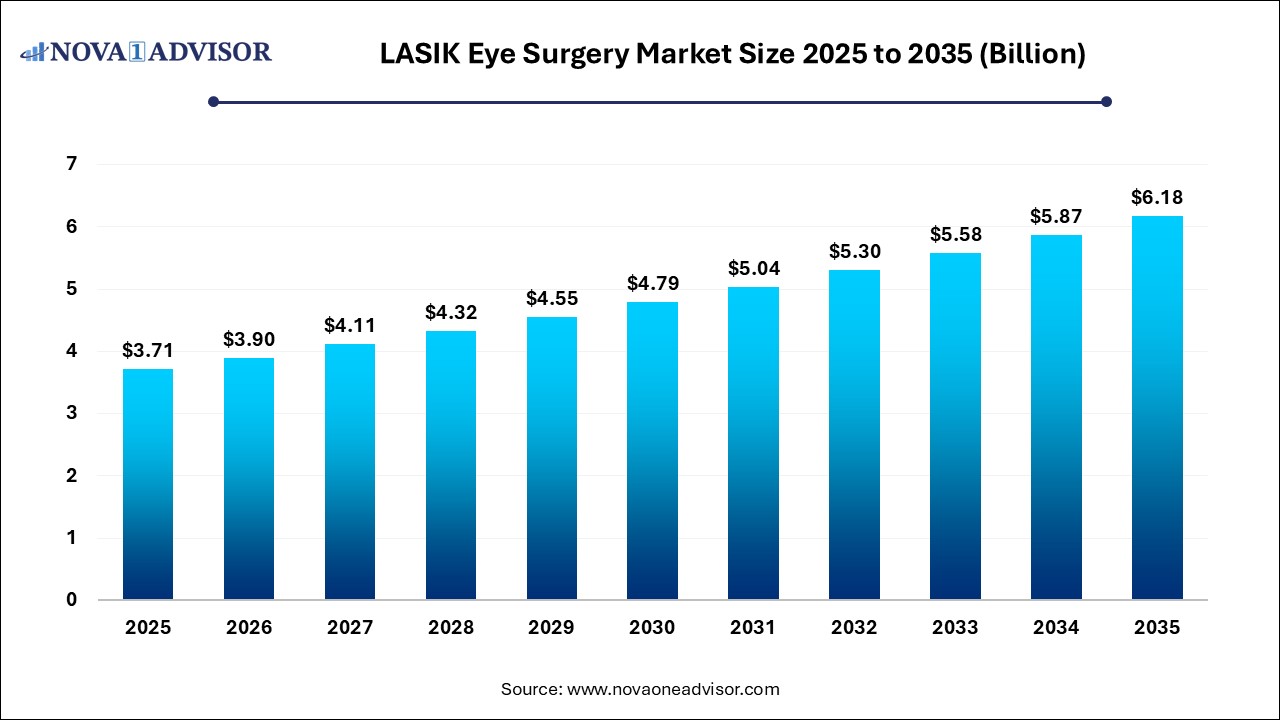
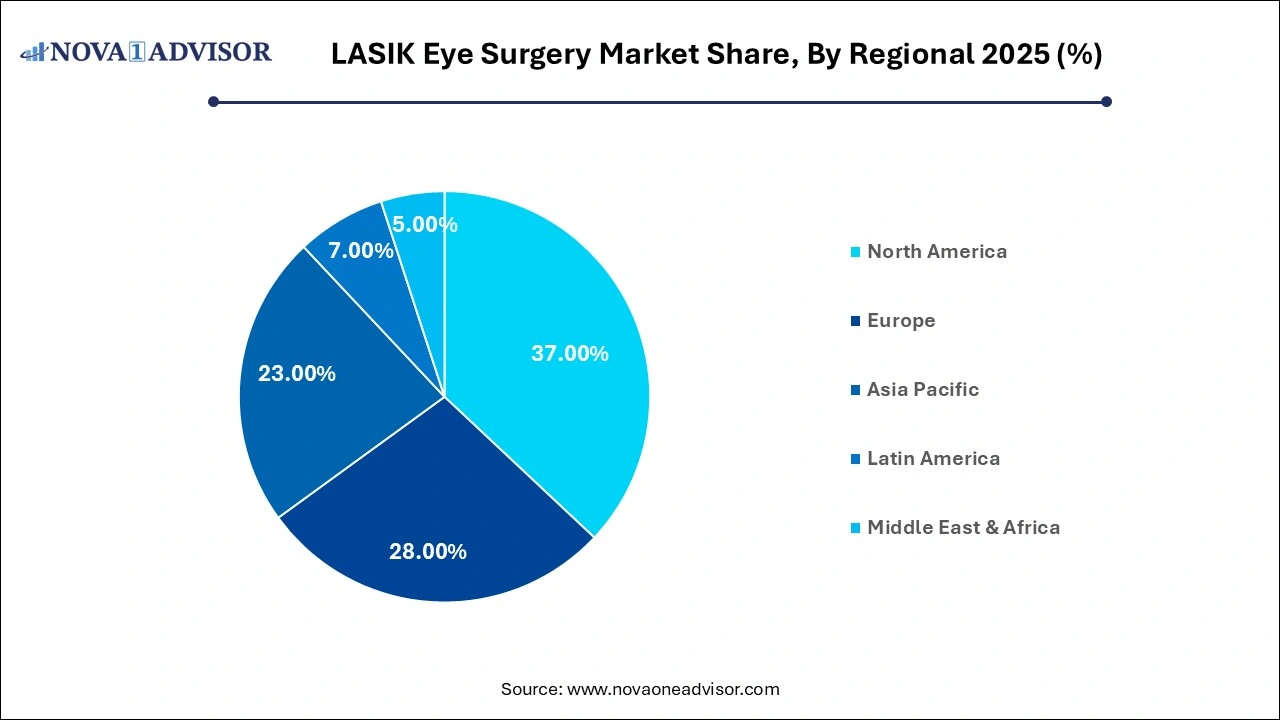
The global LASIK eye surgery market size was valued at USD 3.71 billion in 2025 and is projected to grow from USD 3.90 billion in 2026 to USD 6.18 billion by 2035, at a CAGR of 5.23% from 2026 to 2035. North America dominated the market, accounting for a revenue share of 37.0% in 2025.
Key Takeaway
- By type, the wavefront-guided segment dominated the market with the largest share in 2025.
- By type, the topography-guided segment is expected to grow at the fastest CAGR over the forecast period.
- By end user, the LASIK centers segment dominated the market with the largest share in 2025.
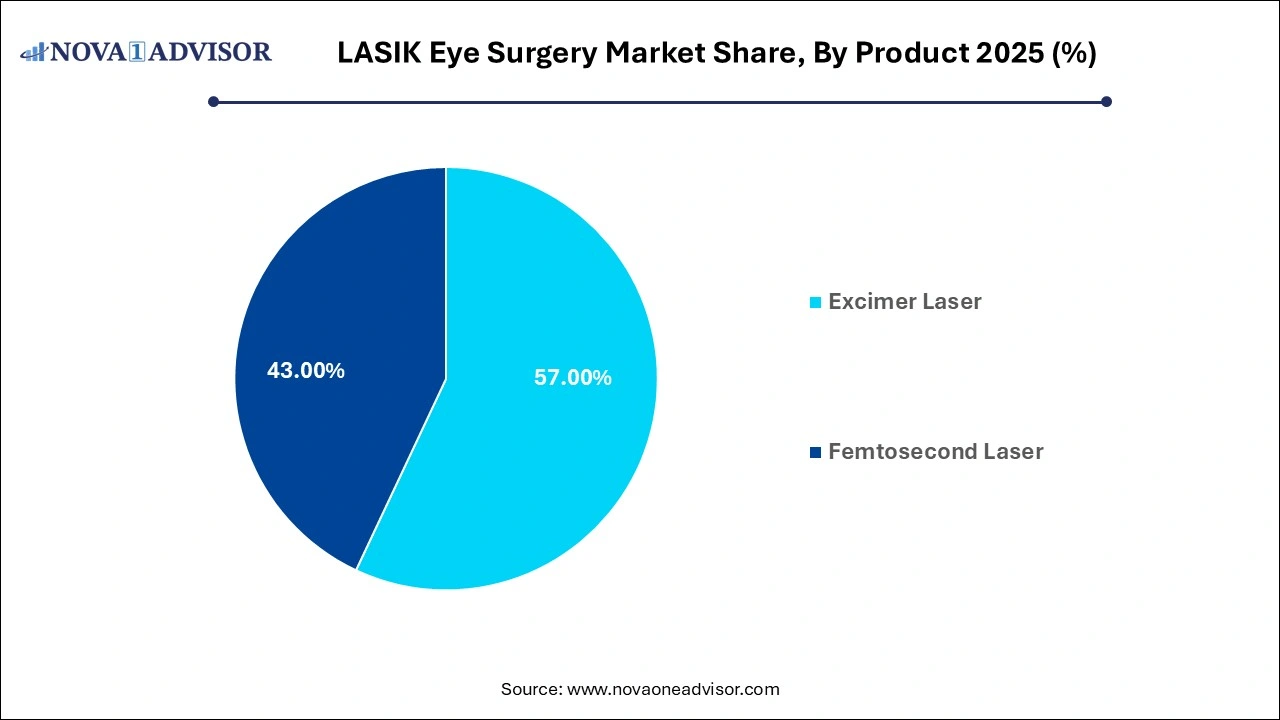
- By product, the excimer laser segment dominated the market with the largest share of 57.0% in 2025.
- By region, North America dominated the market with the largest share of 37.0% in 2025.
Market Overview
The global LASIK eye surgery market includes laser systems, diagnostic technologies, treatment-planning software, surgical consumables, procedures, and related services used to correct refractive errors. Rising myopia, astigmatism, and hyperopia are expanding the potential patient base.
Modern LASIK platforms integrate excimer and femtosecond lasers with eye tracking, corneal topography, wavefront analysis, tomography, and personalized treatment planning. Advances in diagnostics are improving patient selection, surgical precision, and treatment customization.
The market is increasingly moving toward personalized LASIK, with technologies such as ray tracing and digital eye modeling supporting patient-specific procedures. Faster lasers, improved tracking, automated centration, and femtosecond technology are also enhancing surgical efficiency and patient experience.
Competition from SMILE, PRK, phakic intraocular lenses, and advanced contact lenses remains significant. However, LASIK continues to benefit from its established clinical history, broad correction capabilities, rapid visual recovery for many eligible patients, and strong surgeon familiarity. Demand is also influenced by consumer awareness, disposable income, financing availability, and lifestyle preferences.
Market Outlook
- Market Growth Overview: The global LASIK eye surgery market is expected to grow significantly between 2025 and 2035, driven by the increasing prevalence of refractive errors across the globe.
- Sustainability Trends: Sustainability trends involve increasing emphasis on minimizing medical waste and reducing energy use in laser systems.
- Major Investors: Major investors in the market include Alcon, Johnson & Johnson Vision Care, Carl Zeiss Meditec, Bausch + Lomb, Ziemer Ophthalmic Systems, and NIDEK CO., LTD.
How is AI Impacting The Global LASIK Eye Surgery Market?
Artificial intelligence (AI) is reshaping the market by enhancing safety, reducing procedure times down to seconds, and designing 3D digital "clones" of eyes to forecast outcomes with high precision. Furthermore, high-speed machine learning algorithms monitor microscopic ocular saccades, optimizing instantaneous laser modulation or suspension after detection of ocular displacement.
AI-powered diagnostic analysis can identify unusual corneal patterns and support early detection of patients requiring additional evaluation. Machine-learning models can also analyze historical surgical outcomes to improve treatment planning and refine refractive correction strategies.
Personalized digital eye models represent another major development. Alcon's wavelight plus uses ray tracing to model an individual's optical system and support customized LASIK treatment, demonstrating the growing role of computational modeling and digital representations in refractive surgery.
AI can further enhance eye tracking, intraoperative monitoring, and postoperative follow-up by analyzing eye movements, corneal changes, residual refractive errors, and visual outcomes. However, adoption depends on clinical validation, diverse training data, regulatory approval, and consistent performance across patient populations.
As AI becomes integrated into diagnostic and laser platforms, competition is increasingly shifting beyond hardware toward intelligent software, personalized treatment planning, connected data ecosystems, and integrated diagnostic-to-treatment workflows.
LASIK Eye Surgery Market Report Scope
| Report Coverage | Details |
| Market Size in 2026 | USD 3.90 Billion |
| Market Size by 2035 | USD 6.18 Billion |
| Growth Rate From 2026 to 2035 | CAGR of 5.23% |
| Base Year | 2025 |
| Forecast Period | 2026 to 2035 |
| Segments Covered | By Type, By End Use, By Product, By Region |
| Market Analysis (Terms Used) | Value (USD Million/Billion) or (Volume/Units) |
| Regional Scope | North America; Europe; Asia Pacific; Central and South America; the Middle East and Africa |
| Key Companies Profiled | Abbott Inc. (U.S.), Alcon Laboratories Inc. (U.S.), AMO Manufacturing USA, LLC (U.S.), Bausch & Lomb Incorporated (U.S.), Carl Zeiss, Inc. (Germany), LaserSight Technologies, Inc (U.S.), Nidek Inc. (Japan) |
Market Driver: Rising Burden of Myopia and Refractive Errors
The growing prevalence of myopia, astigmatism, and hyperopia is expanding the potential patient pool for LASIK. Adults seeking reduced dependence on glasses or contact lenses, including athletes, professionals, travelers, and military personnel, are supporting demand. Advances in faster, more precise, and personalized laser systems are further improving patient interest and treatment options.
Market Restraint: Elective Costs and Clinical Eligibility
LASIK is largely elective and often requires out-of-pocket payment, limiting adoption among price-sensitive patients. Strict clinical screening also excludes individuals with unsuitable corneal conditions, unstable prescriptions, or other ocular risks. Concerns about dry eye, glare, halos, night-vision issues, and residual refractive errors, along with competition from SMILE, PRK, and phakic IOLs, can further influence treatment decisions.
Market Opportunity: Personalized and AI-Assisted Refractive Surgery
Personalized treatment planning, AI-assisted diagnostics, ray tracing, and digital eye models are creating significant growth opportunities. Technologies such as Alcon's wavelight plus aim to tailor LASIK to individual optical characteristics. Future platforms could integrate tomography, wavefront analysis, pupil measurements, treatment planning, and postoperative monitoring into unified digital workflows. Asia-Pacific also offers strong potential due to its large patient population, rising incomes, expanding ophthalmology networks, and medical tourism.
Segmental Insights
By Type
Why did the wavefront-guided segment dominate the global LASIK eye surgery market?
The wavefront-guided segment dominated the market with the largest share in 2025. The dominance of the segment can be attributed to its accuracy in correcting higher-order aberrations by offering better visual outcomes specific to individual eye anatomy. In addition, there is a growing consumer willingness to invest in premium, highly customized refractive treatments specific to unique ocular profiles.
How did the topography-guided segment expected to hold the significantly growing global LASIK eye surgery market in the coming years?
The topography-guided segment is expected to grow at the fastest CAGR over the forecast period. The growth of the segment can be credited to its growing applications in treating complex refractive conditions and irregular corneas. Also, advanced diagnostic instruments map thousands of distinct corneal elevation points, enabling highly tailored surgical ablation procedures, leading to segment growth further.
By End User
Why did the LASIK centers segment dominate the global LASIK eye surgery market?
The LASIK centers segment dominated the market with the largest share in 2025. The dominance of the segment can be linked to the presence of highly trained surgeons and more competitive pricing models that appeal to an extensive range of patients. LASIK centers provide an integrated, comprehensive workflow that covers patient screening, diagnostic data collection, the surgical procedure, and immediate postoperative care within a single facility.
How did the eye care clinics segment expected to hold the significantly growing global LASIK eye surgery market in the coming years?
The eye care clinics segment is expected to grow at the fastest CAGR over the forecast period. The growth of the segment can be driven by increasing accessibility in semi-urban and urban areas coupled with their collaboration with ophthalmic device manufacturers. The surge in digital screen time and device dependency has expanded the population of young patients seeking permanent vision correction procedures.
- In September 2025, Thumbay University Hospital, a premier academic healthcare institution in the region, has announced the official inauguration of the Thumbay Institute of LASIK & Eye Surgery at Thumbay Medicity, Ajman. The opening ceremony was attended by chief guest Dr. Mohamed Hesham, medical director & consultant ophthalmologist at Magrabi Health Eye Hospital, Dubai.
By Product
Why did the excimer laser segment dominate the global LASIK eye surgery market?
The excimer laser segment dominated the market with the largest share in 2025. The dominance of the segment is owing to the increasing rates of myopia and strong industry product portfolios. Furthermore, patients increasingly opt for specialized eye care centers and localized clinics due to the advantages of rapid procedural durations and reduced overall patient discomfort.
How did the femtosecond laser segment expected to hold the significantly growing global LASIK eye surgery market in the coming years?
The femtosecond laser segment is expected to grow at the fastest CAGR over the study period. The growth of the segment is due to the growing need for completely bladeless procedures and better corneal flap precision to lower complication rates. Moreover, these versatile systems are suitable for both refractive LASIK and advanced femtosecond laser-assisted cataract surgery.
By Region
Why did the North American region account for the largest share of the global LASIK eye surgery market?
North America dominated the market with the largest share in 2025. The dominance of the region can be attributed to the increasing awareness among patients and the presence of cutting-edge healthcare infrastructure in major countries. In addition, the region is characterized by a sophisticated ophthalmic ecosystem consisting of specialized corporate LASIK providers, premier private practices, and expanding Ambulatory Surgical Centers (ASCs).
U.S. Global LASIK Eye Surgery Market Trends
The growth of the market in the country can be driven by the increasing disposable incomes and extensive acceptance of selective vision correction. Also, consumers increasingly choose LASIK eye surgery because it offers daily convenience, a rapid recovery period, and substantial long-term financial savings relative to traditional corrective eyewear.
Why did the Asia-Pacific region become the fastest-growing global LASIK eye surgery market during the forecast period?
Asia Pacific is expected to grow at the fastest CAGR over the forecast period. The growth of the region can be credited to the increase in myopia rates due to a surge in screen time along with the increasing middle-class disposable incomes in emerging economies such as China and India. Furthermore, patients increasingly choose to undergo LASIK surgery to permanently eliminate the daily inconvenience and cumulative financial expenditures associated with corrective eyewear.
China Global LASIK Eye Surgery Market Trends
The market in the country is growing due to an increase in the prevalence of near-sightedness, ongoing growth of private eye hospital chains, and a surge in disposable incomes. Moreover, leading private ophthalmology hospital groups have significantly expanded their operational footprint across various urban tiers, hence enhancing overall patient accessibility.
Key Players in the Global LASIK Eye Surgery Market
- Alcon Inc. (Alcon): A global leader based in Switzerland, famous for its WaveLight refractive laser suites and diagnostic systems.
- Carl Zeiss AG (Carl Zeiss Meditec): A German technology leader known for precision optics, femtosecond lasers, and SMILE/LASIK platforms.
- NIDEK CO., LTD. (NIDEK): A Japanese manufacturer providing specialized ophthalmic surgical equipment and diagnostic devices.
Recent Developments
- In September 2025, Alcon has announced the introduction of its latest advancement in refractive vision correction: Wavelight Plus, the market's first fully personalized laser-assisted in situ keratomileusis (LASIK) treatment. This innovative, precision-driven technology is now expanding into the North American commercial market.
Segments Covered in the Report
This report forecasts revenue growth at country levels and provides an analysis of the latest industry trends in each of the sub-segments from 2021 to 2035. For this study, Nova one advisor, Inc. has LASIK eye surgery market.
By Type
- Wavefront Optimized
- Wavefront-Guided
- Topography Guided
- All Laser
By End-User
- Hospitals
- Eye Care Clinic
- LASIK Centres
- Others
By Product
- Excimer Laser
- Femtosecond Laser
By Region
- North America
- Europe
- Asia-Pacific
- Latin America
- Middle East & Africa (MEA)
FAQ's

Proceed to Buy
Instant PDF delivery on confirmation

 Request Customization
 Download Sample

Get a Sample of this Report
LASIK Eye Surgery Market