

LDL Test Market Size, Share, and Trends 2026 to 2035
 Status Published
 Category Healthcare


Content
LDL Test Market Summary
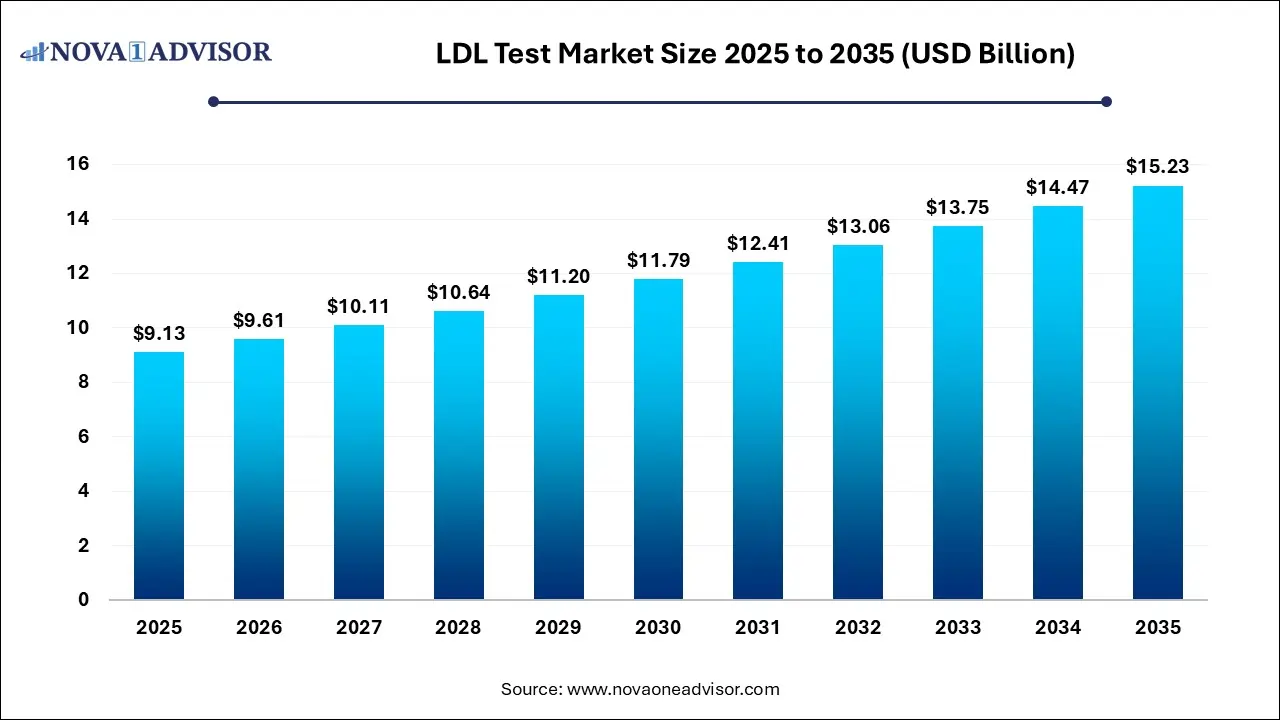
The global LDL Test Market size was estimated at USD 9.13 billion in 2025 and is projected to hit around USD 15.23 billion by 2035, growing at a CAGR of 5.25% during the forecast period from 2026 to 2035.
Market Key Takeaways
- The LDL Test Market is expanding steadily due to the increasing global burden of cardiovascular diseases (CVDs).
- Rising awareness regarding preventive healthcare and routine lipid screening is driving demand.
- Diagnostic laboratories dominate the end-use segment due to high testing volumes and advanced infrastructure.
- Lipid panel tests remain the most widely used test type owing to their comprehensive diagnostic capability.
- Enzymatic assays lead the technology segment due to their cost efficiency and scalability.
- North America holds the largest market share, supported by established healthcare systems and screening programs.
- Home-based testing is emerging rapidly, driven by digital health adoption and consumer awareness.
Market Overview
The LDL Test Market plays a critical role in modern healthcare diagnostics, focusing on the measurement of low-density lipoprotein (LDL) cholesterol, often referred to as “bad cholesterol.” Elevated LDL levels are strongly associated with an increased risk of cardiovascular diseases, including coronary artery disease, stroke, and atherosclerosis. As cardiovascular diseases remain one of the leading causes of mortality globally, LDL testing has become a cornerstone of preventive and diagnostic healthcare.
LDL testing is typically conducted as part of a lipid profile or lipid panel, which includes measurements of total cholesterol, high-density lipoprotein (HDL), triglycerides, and LDL cholesterol. These tests are widely used in routine health check-ups, clinical diagnostics, and research settings. The increasing prevalence of lifestyle-related risk factors such as obesity, sedentary behavior, and unhealthy diets has significantly contributed to the rising demand for LDL testing.
Healthcare systems across the globe are shifting toward preventive care models, emphasizing early detection and management of chronic diseases. LDL testing is a key component of these strategies, enabling healthcare providers to identify high-risk individuals and implement timely interventions. For instance, regular lipid screening is recommended for adults over the age of 40 in many countries, contributing to consistent demand for LDL tests.
Technological advancements have further enhanced the accuracy and efficiency of LDL testing. Automated analyzers, high-throughput platforms, and advanced assay techniques have improved test reliability and reduced turnaround times. Additionally, the integration of digital health systems and electronic medical records has streamlined data management and improved clinical decision-making.
The market is also witnessing the emergence of home-based testing solutions, allowing individuals to monitor their cholesterol levels conveniently. These innovations are particularly relevant in the context of increasing health consciousness and the growing adoption of telemedicine.
Market Outlook
- Market Growth Overview: The global LDL test market is expected to grow significantly between 2025 and 2035, driven by the rising prevalence of chronic disease, growing focus on preventative healthcare awareness, and the rise of point-of-care and at-home testing kits.
- Sustainability Trends: Sustainability trends involve eco-friendly and non-enzymatic sensors, decentralized testing and reduced travel, and paper-based analytical devices.
- Major Investors: Major investors in the market include Abbott Laboratories, F. Hoffmann-La Roche Ltd., Siemens Healthineers AG, and Thermo Fisher Scientific Inc.
How is AI Transforming the LDL Test Market?
Artificial Intelligence (AI) is significantly transforming the LDL Test Market by enhancing diagnostic accuracy, improving workflow efficiency, and enabling predictive healthcare. AI technologies are being integrated into laboratory systems, clinical decision support tools, and digital health platforms to optimize LDL testing and interpretation.
One of the primary applications of AI is in data analysis and risk prediction. Machine learning algorithms can analyze large datasets, including patient history, genetic information, and lifestyle factors, to predict the risk of cardiovascular diseases. This enables healthcare providers to identify high-risk individuals and recommend appropriate interventions, such as lifestyle modifications or medication.
AI is also improving the accuracy of LDL measurements by optimizing assay calibration and quality control processes. Automated systems equipped with AI can detect anomalies in test results, ensuring consistency and reliability. This is particularly important in high-volume diagnostic laboratories, where even minor errors can have significant implications.
In addition, AI-powered clinical decision support systems (CDSS) are assisting physicians in interpreting lipid profiles and making treatment decisions. For example, AI tools can recommend personalized treatment plans based on LDL levels, patient history, and risk factors. This enhances the effectiveness of treatment and improves patient outcomes.
AI is also driving innovation in home-based testing. Smart devices equipped with AI algorithms can analyze test results and provide real-time feedback to users. These devices can be integrated with mobile applications, enabling continuous monitoring and remote consultation with healthcare providers.
Furthermore, pharmaceutical companies are leveraging AI to develop new therapies targeting cholesterol management. By analyzing clinical trial data and patient responses, AI can accelerate drug development and improve treatment efficacy.
LDL Test Market Report Scope
| Report Coverage | Details |
| Market Size in 2026 | USD 9.61 Billion |
| Market Size by 2035 | USD 15.23 Billion |
| Growth Rate From 2026 to 2035 | CAGR of 5.25% |
| Base Year | 2025 |
| Forecast Period | 2026 to 2035 |
| Segments Covered | Application, End Use, Test Type, Technology, By Region |
| Market Analysis (Terms Used) | Value (USD Million/Billion) or (Volume/Units) |
| Regional Scope | North America; Europe; Asia Pacific; Central and South America; the Middle East and Africa |
| Key Companies Profiled | Abbott Laboratories (US), Roche Diagnostics (CH), Siemens Healthineers (DE), Thermo Fisher Scientific (US), Danaher Corporation (US), Bayer AG (DE), PerkinElmer, Inc. (US), Quest Diagnostics (US), LabCorp (US) |
Segmental Analysis
By End Use
Diagnostic laboratories dominated the end-use segment due to high testing volumes and advanced infrastructure. Diagnostic laboratories are equipped with sophisticated equipment and automated systems, enabling them to process large numbers of tests efficiently. These facilities are often the primary choice for LDL testing, particularly for routine health check-ups and clinical diagnostics. The availability of skilled professionals and standardized procedures further enhances the reliability of test results.
Additionally, diagnostic laboratories often collaborate with hospitals and clinics, creating a strong referral network. This contributes to a steady flow of patients and consistent demand for LDL testing services. The adoption of advanced technologies and integration with digital health systems further strengthens their position in the market.
Home care settings are expected to be the fastest-growing segment due to increasing consumer awareness and convenience. The rise of home-based testing solutions has empowered individuals to monitor their health independently. These settings offer convenience, cost savings, and accessibility, making them particularly attractive for patients with chronic conditions.
By Test Type
Lipid panel tests dominated the test type segment due to their comprehensive diagnostic capability. Lipid panels provide a complete overview of cholesterol levels, including LDL, HDL, total cholesterol, and triglycerides. This makes them a preferred choice for healthcare providers, as they offer a holistic assessment of cardiovascular risk.
These tests are widely used in routine health screenings and clinical diagnostics, contributing to their dominance. The ability to detect multiple parameters in a single test enhances efficiency and reduces costs.
Apolipoprotein B tests are expected to be the fastest-growing segment due to their superior predictive value. ApoB testing provides a more accurate assessment of cardiovascular risk by measuring the number of atherogenic particles. As awareness of advanced biomarkers increases, the demand for ApoB testing is expected to rise.
By Technology
Enzymatic assays dominated the technology segment due to their cost-effectiveness and scalability. These assays are widely used in diagnostic laboratories due to their simplicity, reliability, and compatibility with automated systems. They enable high-throughput testing, making them suitable for large-scale screening programs.
Enzymatic assays are also relatively affordable, making them accessible to a wide range of healthcare facilities. Their established presence in the market further contributes to their dominance.
Mass spectrometry is expected to be the fastest-growing segment due to its high accuracy and precision. This technology offers superior analytical capabilities, enabling detailed analysis of lipid profiles. Although currently limited by high costs, advancements in technology are expected to make mass spectrometry more accessible in the future.
By Application
Clinical testing dominated the application segment due to its critical role in disease diagnosis and management. LDL testing is a standard component of clinical diagnostics, particularly for patients with cardiovascular conditions. Healthcare providers rely on these tests to monitor cholesterol levels and assess treatment efficacy.
The increasing prevalence of chronic diseases and the emphasis on preventive care are driving demand in this segment. Clinical testing remains the backbone of the LDL Test Market.
Home testing is expected to be the fastest-growing segment due to technological advancements and consumer demand. The availability of portable devices and digital health platforms has made home testing more accessible and reliable. This segment is expected to grow rapidly as consumers seek convenient healthcare solutions.
By Region
North America dominated the regional segment due to advanced healthcare infrastructure and high awareness levels. The region has a well-established healthcare system, strong reimbursement policies, and widespread adoption of advanced diagnostic technologies. Regular screening programs and high healthcare expenditure further support market growth.
Additionally, the presence of leading market players and ongoing research activities contribute to the region’s dominance.
Asia Pacific is expected to be the fastest-growing region due to increasing healthcare investments and rising awareness. Rapid urbanization, changing lifestyles, and growing healthcare infrastructure are driving demand for LDL testing in this region. Countries such as India and China are witnessing significant growth in diagnostic services.
Recent Developments
- March 2024: Abbott Laboratories introduced advanced lipid testing solutions for improved cardiovascular diagnostics.
- January 2024: Roche Diagnostics enhanced its lipid testing portfolio with new assay technologies.
- November 2023: Siemens Healthineers launched upgraded laboratory systems for high-throughput cholesterol testing.
- August 2023: Thermo Fisher Scientific expanded its research tools for lipid analysis.
Key Players in the Global LDL Test Market
- Thermo Fisher Scientific Inc.
Thermo Fisher contributes to the LDL test market by offering a comprehensive range of diagnostic reagents, specialized assay kits, and automated clinical chemistry analyzers, such as the Amplex Red Cholesterol Assay Kit, used for high-precision laboratory measurements of low-density lipoprotein.
- BD (Becton Dickinson)
BD contributes to the LDL test market by developing advanced pre-analytical sample preparation and automated flow cytometry systems that improve the accuracy and speed of lipid testing processes.
- Abbott Laboratories
Abbott contributes to the global LDL test market through its innovative, rapid point-of-care testing technologies like the Afinion system and molecular diagnostics such as Alinity m, which allow for quick and precise cholesterol monitoring.
Segments Covered in the Report
This report forecasts revenue growth at country levels and provides an analysis of the latest industry trends in each of the sub-segments from 2021 to 2035. For this study, Nova one advisor, Inc. has segmented the LDL Test Market.
By End Use
- Hospitals
- Diagnostic Laboratories
- Home Care Settings
- Pharmaceutical Companies
By Test Type
- Direct LDL Test
- Calculated LDL Test
- Apolipoprotein B Test
- Lipid Panel Test
By Technology
- Enzymatic Assays
- Immunoassays
- Chromatography
- Mass Spectrometry
By Application
- Clinical Testing
- Home Testing
- Research Laboratories
- Health Screening
By Region
- North America
- Europe
- Asia Pacific
- Latin America
- Middle East and Africa (MEA)
FAQ's

Proceed to Buy
Instant PDF delivery on confirmation

 Request Customization
 Download Sample

Get a Sample of this Report
LDL Test Market