

Magnetic Resonance Imaging (MRI) Systems Market Size, Share, and Trends 2026 to 2035
 Status Published
 Category Healthcare


Content
Magnetic Resonance Imaging (MRI) Systems Market Size and Growth 2026 to 2035
The global magnetic resonance imaging (MRI) systems market size was valued at USD 6.85 billion in 2025 and is projected to grow from USD 7.34 billion in 2026 to USD 13.73 billion by 2035, at a CAGR of 7.2% from 2026 to 2035.
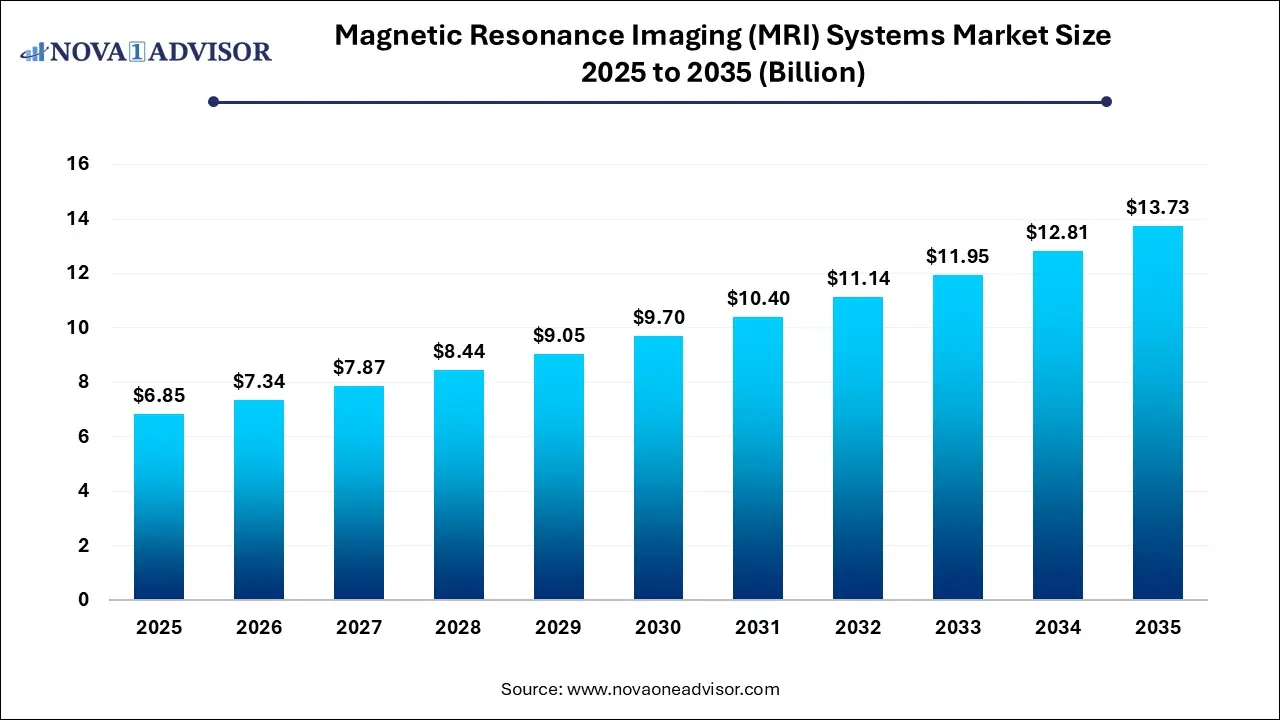
Key Takeaway:
- By type, the closed MRI systems segment dominated the market and accounted for the largest revenue share in 2025.
- By type, the wide-bore MRI systems segment fastest growing in the market in 2025.
- By field strength, the high-field MRI systems segment dominated the market and accounted for the largest revenue share in 2025.
- By disease application, the brain and neurological MRI segment dominated the market and accounted for the largest revenue share in 2025.
- By end user, the hospitals & clinics segment dominated the market and accounted for the largest revenue share in 2025.
- By region, North America accounted for the largest revenue share in 2025.
Market Overview
The Magnetic Resonance Imaging (MRI) Systems Market is experiencing steady growth due to the rising demand for accurate, non-invasive diagnostic imaging and the increasing prevalence of chronic diseases worldwide. MRI systems have become essential in diagnosing neurological, musculoskeletal, cardiovascular, and oncological conditions by providing high-resolution images of soft tissues without using ionizing radiation. Growing emphasis on early disease detection, coupled with expanding healthcare infrastructure and increased investments in advanced imaging technologies, continues to drive market expansion.
Technological advancements such as artificial intelligence-enabled image reconstruction, faster scanning protocols, wide-bore and patient-friendly systems, and automated workflow solutions are significantly improving diagnostic efficiency and patient experience. Additionally, increasing adoption of MRI in precision medicine, clinical research, and specialized imaging applications is creating new growth opportunities. As healthcare providers continue to prioritize accurate diagnosis, operational efficiency, and personalized treatment planning, the MRI systems market is expected to witness sustained growth across both developed and emerging healthcare markets.
Market Outlook
- Market Growth Overview: The global magnetic resonance imaging (MRI) systems market is expected to grow significantly between 2025 and 2035, driven by the growing geriatric population, expanded healthcare access, and integration of artificial intelligence.
- Sustainability Trends: Sustainability trends involve helium reduction and independence, energy-efficient power modes, and lighter magnets and circular economies.
- Major Investors: Major investors in the market include Siemens Healthineers, GE HealthCare, Koninklijke Philips N.V., Canon Medical Systems, and Fujifilm.
How AI is Impacting the Global Magnetic Resonance Imaging (MRI) Systems Market?
AI and ML are transforming the global magnetic resonance imaging (MRI) systems industry by drastically accelerating scan times and enhancing image quality. Deep learning algorithms can now reconstruct high-resolution images from significantly undersampled data, minimizing motion artifacts and greatly improving patient comfort. Furthermore, AI tools automate the segmentation and quantification of anatomical structures, enabling radiologists to detect conditions like brain lesions and tumors with much higher precision.
Magnetic Resonance Imaging (MRI) Systems Market Report Scope
| Report Coverage | Details |
| Market Size in 2026 | USD 7.34 Billion |
| Market Size by 2035 | USD 13.73 Billion |
| Growth Rate From 2026 to 2035 | CAGR of 7.2% |
| Base Year | 2025 |
| Forecast Period | 2026 to 2035 |
| Segments Covered | By Type, By Field Strength, By Disease application, By End-User, By Region |
| Market Analysis (Terms Used) | Value (USD Million/Billion) or (Volume/Units) |
| Regional Scope | North America; Europe; Asia Pacific; Central and South America; the Middle East and Africa |
| Key Companies Profiled | Hitachi, Siemens AG, Canon Medical Systems, GE Healthcare, Philips, Toshiba Corporation, Toshiba Corporation, Xingaoyi, Aurora Imaging Technologies, Inc. |
Market Driver
Rising Global Burden of Chronic and Neurological Diseases Driving MRI Demand
The increasing prevalence of chronic diseases, including neurological disorders, cardiovascular conditions, cancer, and musculoskeletal diseases, is a major driver of the Magnetic Resonance Imaging (MRI) Systems Market. MRI has become an essential diagnostic tool due to its ability to provide detailed soft tissue imaging without radiation exposure. Growing emphasis on early diagnosis, preventive healthcare, and accurate treatment planning is further increasing the adoption of advanced MRI systems across hospitals and diagnostic centers.
Market Restraint
High Capital Investment and Operational Costs Limit Market Expansion
The high cost of purchasing, installing, and maintaining MRI systems remains a significant challenge for market growth. Advanced MRI scanners require specialized infrastructure, skilled professionals, regular maintenance, and substantial operational expenses, making them difficult to afford for smaller healthcare facilities. Limited healthcare budgets and reimbursement constraints in developing regions further restrict widespread adoption.
Market Opportunity
Expansion of AI-Enabled MRI Solutions and Emerging Healthcare Infrastructure Creates New Growth Opportunities
The integration of artificial intelligence with MRI technology, along with expanding healthcare infrastructure in emerging economies, presents significant growth opportunities for the market. AI-powered imaging solutions improve workflow efficiency, reduce scan times, and enhance diagnostic accuracy, while increasing investments in hospitals and diagnostic centers create demand for advanced, cost-effective MRI systems. The growing focus on precision medicine and digital healthcare is expected to further accelerate market expansion.
Segmental Insights
By Type
How did the closed MRI systems segment dominate the Global Magnetic Resonance Imaging (MRI) Systems market?
The closed MRI systems segment is driven by the higher magnetic field strengths that generate superior signal-to-noise ratios, producing the highly detailed images necessary for complex diagnostics in neurology and oncology. This elevated magnetic performance enables shorter scan times and advanced imaging sequences, minimizing motion artifacts to dramatically increase patient throughput.
How did the wide-bore MRI systems segment expect to hold the fastest-growing Global Magnetic Resonance Imaging (MRI) Systems market in the coming years?
The wide-bore MRI systems segment is driven by the integration of deep learning reconstruction software, which accelerates scan acquisition times by up to two-thirds while simultaneously boosting structural image clarity. The inclusion of powerful gradient coils and advanced radiofrequency pulse sequences allows these scanners to achieve higher resolution without compromising clinical workflow efficiency.
By Field Strength
How did the high-field MRI systems segment dominate the Global Magnetic Resonance Imaging (MRI) Systems market?
The high-field MRI systems segment is driven by the widespread institutional adoption across large hospitals and diagnostic imaging centers equipped to support premium healthcare infrastructure. The favourable insurance reimbursement frameworks in major markets, such as North America, highly subsidize high-performance imaging, promoting the continuous installation of these systems
How did the very-high-field MRI systems segment expect to hold the fastest-growing Global Magnetic Resonance Imaging (MRI) Systems market in the coming years?
The very-high-field MRI systems segment is driven by the embedded artificial intelligence accelerate data processing, enhances diagnostic precision, and effectively compensates for inherent diagnostic precision, and effectively compensates for inherent ultra-high-field limitations. The medical imaging vendors are shifting their commercial models away from basic hardware sales toward long-term digital diagnostic partnerships.
By Disease Application
How did the brain and neurological MRI segment dominate the Global Magnetic Resonance Imaging (MRI) Systems market?
The brain and neurological MRI segment is driven by the intersecting diagnostic and technical strengths of secure neurology as the largest and most foundational disease application segment in the global imaging landscape. The heavy investments in global neuroscience research, coupled with the seamless integration of artificial intelligence into functional brain mapping, have rapidly expanded the use of MRI into psychiatric evaluations and pre-surgical planning for epilepsy and intracranial tumors.
How did the cardiovascular MRI segment expect to hold the fastest-growing Global Magnetic Resonance Imaging (MRI) Systems market in the coming years?
The cardiovascular MRI segment is driven by the advanced imaging techniques, such as echo-planar imaging and breath-hold-free scans, that drastically reduce scan duration to optimize patient throughput. The industry-wide shift toward high-field 1.5 Tesla and 33.0 Tesla scanners ensures superior soft-tissue contrast and exceptional spatial resolution for tracking intricate blood vessels.
By End-User
How did the hospitals & clinics segment dominate the Global Magnetic Resonance Imaging (MRI) Systems market?
The hospitals & clinics segment is driven by the implementation of next-generation high-field systems and AI-integrated software; hospitals successfully maximize diagnostic accuracy and secure their dominant end-user market position. The technical edge, hospitals frequently participate in clinical research and academic collaborations that require advanced, multi-parametric imaging capabilities.
How did the diagnostic centers segment expect to hold the fastest-growing Global Magnetic Resonance Imaging (MRI) Systems market in the coming years?
The diagnostic centers segment is driven by the transition to cryogen-free, helium-lean magnet designs that drastically lower long-term cooling costs while removing the need for heavy, expensive quench-pipe ventilation systems. These lightweight, compact systems take up significantly less space, permitting diagnostic networks to easily install advanced 1.5T or 3T systems within smaller urban clinics.
By Regional
How did the North America region account for the largest share in the Global Magnetic Resonance Imaging (MRI) Systems market?
North America is driven by the favourable regulations and high capital availability that enable the early adoption of advanced imaging technologies, such as high-field 1.5T and 3T systems and AI-integrated reconstruction platforms. The growing demographic of aging individuals and high rates of cardiovascular diseases and neurological disorders generate continuous clinical demand for non-invasive diagnostic imaging.
U.S. Global Magnetic Resonance Imaging (MRI) Systems Market Trends
The U.S. is experiencing a powerful sustainability shift as hospitals and clinics prioritize helium-free MRI systems, which lower lifetime maintenance costs and eliminate reliance on scarce liquid helium. The industry is navigating a bifurcated hardware trend, deploying ultra-high-field 7T systems for advanced research on one end, while expanding wide-bore and open architectures to maximize patient comfort.
How did the Asia-Pacific region become the fastest-growing Global Magnetic Resonance Imaging (MRI) Systems Market during the forecast period?
Asia Pacific is driven by the development of affordable, lower-tesla systems and helium-free configurations that vastly reduce installation and operational costs, making premium radiological tools accessible to resource-constrained hospitals across the region. The quickly adopting AI-enabled workflows and advanced high-field systems that maximize scanning speed and diagnostic accuracy.
China Global Magnetic Resonance Imaging (MRI) Systems Market Trends
China’s government-led volume-based procurement rounds that compress hardware prices, rapidly expanding the installed base across previously underserved county-level hospitals. To handle this expanding footprint, widespread AI diagnostic aids in tertiary centers reduce radiologist reading times to process larger daily scan volumes and justify the hardware investments.
How Did Europe Hold A Notable Share in the Global Magnetic Resonance Imaging (MRI) Systems Market?
Europe’s regional innovation initiatives drive rapid advancements in scanner speeds and radio frequency technologies, placing European institutions at the forefront of ultra-high-field research using pioneering 7T and 11.7T systems.
Germany Global Magnetic Resonance Imaging (MRI) Systems Market Trends
Germany’s specialized cardiovascular imaging applications are expanding at the fastest compound annual growth rate to secure Germany's position at the forefront of advanced European radiology. Ongoing remains the primary diagnostic for overall MRI usage across the country.
Key Players in the Global Magnetic Resonance Imaging (MRI) Systems Market
- Hitachi: Hitachi contributes to the global MRI market primarily by pioneering open architecture and permanent magnet systems designed to reduce patient claustrophobia and lower total installation costs. Their ECHELON Smart Plus systems utilize advanced AI-assisted motion correction and noise reduction to deliver high-quality images in community hospital settings.
- Siemens AG: Siemens AG is a global market leader that continually drives industry innovation with high-field strengths and deep-learning software solutions like Deep Resolve that accelerate image reconstruction. Their platforms, such as the MAGNETOM series, are highly utilized for precision neuroimaging and functional brain mapping across clinics and research centers.
- Canon Medical Systems : Canon Medical Systems impacts the global MRI market by integrating its deep-learning reconstruction engine, AiCE, to produce sharp, diagnostic-quality images with reduced scan times.
Segments Covered in the Report
This report forecasts revenue growth at country levels and provides an analysis of the latest industry trends in each of the sub-segments from 2021 to 2035. For this study, Nova one advisor, Inc. has magnetic resonance imaging (MRI) systems market.
By Type
- Open MRI
- Closed MRI
- Standard Bore MR
- Wide-Bore MRI
By Field Strength
- High-Field MRI Systems
- 5t MRI Systems
- 3t MRI Systems
- Low-To-Mid-Field MRI Systems
- Very-High-Field MRI Systems
- Others
By Disease application
- Spine and musculoskeletal MRI
- Brain and neurological MRI
- Pelvic and Abdominal MRI
- Breast MRI
- Cardiovascular MRI
- Others
By End-User
- Hospital & Clinics
- Diagnostic Centers
- Others
By Region
- North America
- Europe
- Asia-Pacific
- Latin America
- Middle East & Africa (MEA)
FAQ's

Proceed to Buy
Instant PDF delivery on confirmation

Magnetic Resonance Imaging (MRI) Systems Market Size to Hit USD 13.73 Billion ...
 Request Customization
 Download Sample

Get a Sample of this Report
Magnetic Resonance Imaging (MRI) Systems Market