

Medical Radiation Shielding Market Size, Share, Forecast Report, 2026 - 2035
 Status Published
 Category Healthcare


Content
Medical Radiation Shielding Market Size and Growth 2026 to 2035
The global medical radiation shielding market size was valued at USD 1.32 billion in 2025 and is projected to grow from USD 1.41 billion in 2026 to USD 2.57 billion by 2035, at a CAGR of 6.9% from 2026 to 2035.
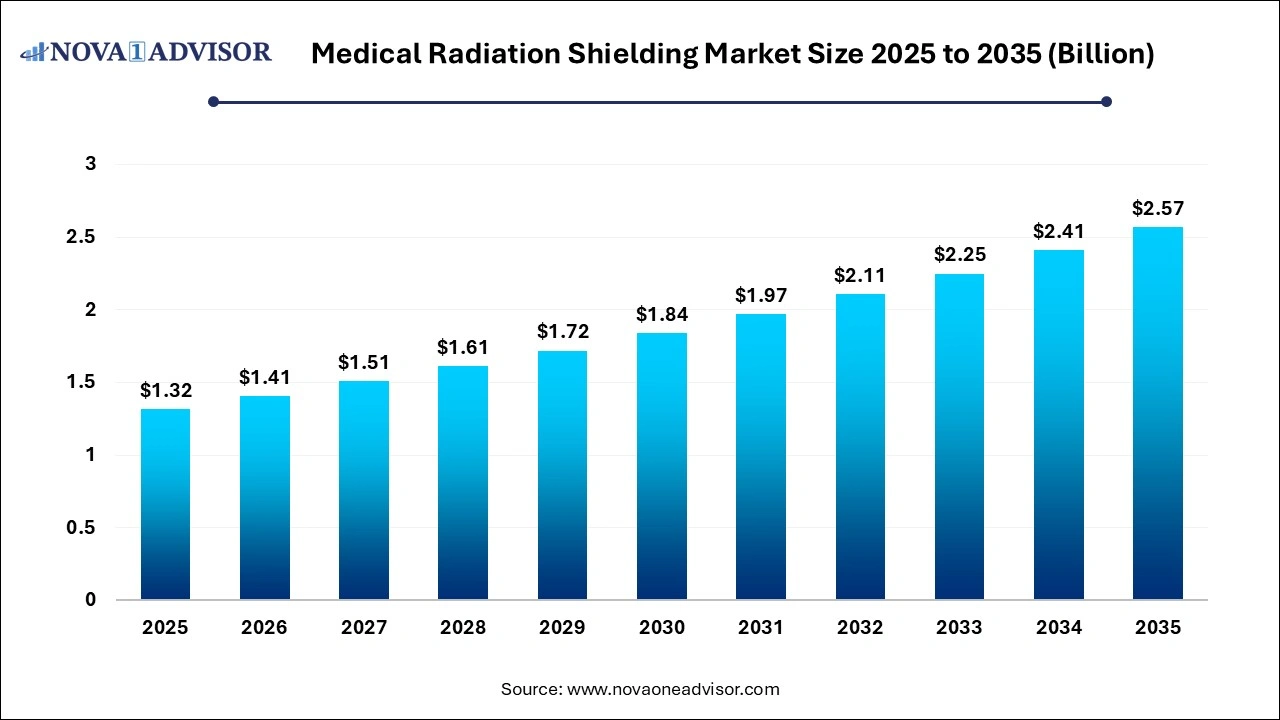
Key Takeaway
- By product type, the X-ray shields segment dominated the market with the largest share in 2025.
- By product type, the MRI shields segment is expected to grow at the fastest CAGR over the forecast period.
- By material, the lead-based shielding segment dominated the market with the largest share in 2025.
- By application, the diagnostics segment dominated the market with the largest share in 2025.
- By region, North America dominated the market with the largest share in 2025
Market Overview
The medical radiation shielding market includes materials, protective equipment, structural barriers, and specialized room solutions designed to control radiation exposure across diagnostic imaging, radiation therapy, nuclear medicine, and interventional procedures. Applications include X-ray, CT, fluoroscopy, mammography, dental imaging, radiotherapy, PET, and SPECT, while MRI shielding primarily addresses radiofrequency interference and magnetic-field control.
Lead remains widely used for X-ray shielding because of its strong attenuation properties, while lead-free and composite materials are gaining attention due to weight, handling, and occupational comfort considerations. Radiation therapy and nuclear medicine require more specialized solutions, including structural barriers, shielding doors, labyrinths, hot-room protection, radioactive-material storage, and customized facility designs.
Market demand is driven by healthcare infrastructure expansion, new imaging and radiotherapy installations, cancer-center development, nuclear medicine growth, equipment replacement, and evolving radiation-safety requirements. Increasingly, suppliers are differentiating through advanced materials, radiation engineering, customized designs, installation expertise, and regulatory support.
Market Outlook
- Market Growth Overview: The global medical radiation shielding market is expected to grow significantly between 2025 and 2035, driven by the growing prevalence of chronic diseases across the globe.
- Sustainability Trends: Sustainability trends involve replacing toxic heavy metals with lead-free solutions such as polymer composites and bismuth.
- Major Investors: Major investors in the market include Nelco, Mirion Technologies, ETS-Lindgren, MarShield, Gaven Industries, Radiation Protection Products, AmRay Group, and Veritas Medical Solutions.
How is AI Impacting The Global Medical Radiation Shielding Market?
Artificial intelligence (AI) is reshaping the market by allowing smart and real-time dose tracking, along with facilitating material designs through predictive modelling. Furthermore, machine learning models propel the evaluation of composite shielding efficacy by replacing conventional, time-intensive physical experimentation with high-throughput virtual screening methodologies.
Major Trends in the Market
- Shift toward lead-free and lightweight shielding: Healthcare providers are increasingly interested in materials that reduce the physical burden of protective apparel without compromising attenuation performance.
- Growth of hybrid shielding materials: Manufacturers are combining different high-density and polymeric materials to balance radiation attenuation, flexibility, weight, and durability.
- Expansion of CT and advanced imaging: Increasing CT utilization creates continued demand for structural and patient-protection solutions.
- Growth of interventional radiology: Fluoroscopy-intensive procedures are increasing attention toward occupational protection, ceiling-suspended barriers, table-side shielding, and wearable alternatives.
- Increasing radiation therapy infrastructure: Cancer-treatment capacity expansion supports demand for structural shielding and specialized treatment-room systems.
Medical Radiation Shielding Market Report Scope
| Report Coverage | Details |
| Market Size in 2026 | USD 1.41 Billion |
| Market Size by 2035 | USD 2.57 Billion |
| Growth Rate From 2026 to 2035 | CAGR of 6.9% |
| Base Year | 2025 |
| Forecast Period | 2026 to 2035 |
| Segments Covered | Product type, Material, Application, Region |
| Market Analysis (Terms Used) | Value (USD Million/Billion) or (Volume/Units) |
| Regional Scope | North America; Europe; Asia Pacific; Central and South America; the Middle East and Africa |
| Key Companies Profiled | Amray Group; ETS-Lindgren; Gaven Industries; MarShield; MAVIG GmbH; NELCO; Nuclear Shields B.V.; Radiation Protection Products, Inc.; VacuTec Meßtechnik GmbH; Veritas Medical Solutions |
Major Driver: Expansion of Diagnostic Imaging and Radiation-Based Healthcare
The growing use of X-ray, CT, fluoroscopy, mammography, radiotherapy, PET, and SPECT is increasing demand for radiation-shielding solutions across hospitals and diagnostic centers. Rising cancer treatment volumes, interventional procedures, nuclear medicine applications, and occupational radiation-safety requirements are further supporting demand. Healthcare facilities increasingly require structural barriers, protective equipment, shielding curtains, suspended systems, and specialized room designs to manage exposure effectively.
Major Restraint: High Installation Costs and Material-Performance Trade-offs
Radiation shielding can involve significant engineering and installation costs because requirements vary according to radiation energy, equipment workload, room configuration, construction, and adjacent occupancy. Radiotherapy and nuclear-medicine facilities can require particularly complex structural shielding. Lead offers excellent attenuation but adds considerable weight, while lightweight and lead-free alternatives may involve greater thickness, higher material costs, or manufacturing complexity. These trade-offs can influence adoption, particularly in cost-sensitive healthcare systems.
Major Opportunity: Lightweight, Lead-Free, and Application-Specific Shielding
The development of lightweight and lead-free shielding materials is creating opportunities to improve occupational protection while reducing ergonomic challenges. Composites incorporating materials such as tungsten, bismuth, barium, antimony, and borated polymers can be engineered for specific radiation environments. AI-assisted materials research is also emerging as a tool for optimizing shielding performance. Higher-value opportunities are increasingly centered on customized solutions designed around radiation type, clinical workflow, room geometry, ergonomics, and regulatory requirements.
Segmental Insights
By Product Type
Why did the X-ray shields segment dominate the global medical radiation shielding market?
The X-ray shields segment dominated the market with the largest share in 2025. The dominance of the segment can be attributed to the growing adoption of diagnostic imaging procedures in healthcare settings and innovations in material science. In addition, hospitals must pass stringent safety regulations before operating diagnostic X-ray rooms, which requires certified shielding installations.
How did the MRI shields segment expected to hold the significantly growing global medical radiation shielding market in the coming years?
The MRI shields segment is expected to grow at the fastest CAGR over the forecast period. The growth of the segment can be credited to the growing need for innovative MRI technologies in healthcare facilities across the globe and the latest innovations in MRI shielding. The proliferation of standalone diagnostic centers has significantly propelled the demand for scalable, modular MRI room retrofits within the decentralized healthcare market.
By Material
Why did the lead-based shielding segment dominate the global medical radiation shielding market?
The lead-based shielding segment dominated the market with the largest share in 2025. The dominance of the segment can be linked to its high density and extensive use of X-rays and CT scanners in the healthcare sector. Increasing medical spending and hospital builds across developing economies scale up basic radiology room construction.
How did the non-lead shielding segment expected to hold the significantly growing global medical radiation shielding market in the coming years?
The non-lead shielding segment is expected to grow at the fastest CAGR over the forecast period. The growth of the segment can be driven by growing concerns about the potential toxicity and impact of conventional lead-based shielding materials. Healthcare facilities heavily focus on green procurement and eco-friendly hospital architecture by phasing out harmful materials such as lead.
By Application
Why did the diagnostics segment dominate the global medical radiation shielding market?
The diagnostics segment dominated the market with the largest share in 2025. The dominance of the segment is owing to the growing incidence of chronic diseases like cancer and a surge in the elderly population across the globe. Furthermore, the advancement of modular, lightweight, and lead-free composite shielding materials facilitates a more efficient and economically viable approach to retrofitting legacy medical facilities.
How did the therapeutics segment expected to hold the significantly growing global medical radiation shielding market in the coming years?
The therapeutics segment is expected to grow at the fastest CAGR during the study period. The growth of the segment is due to growing adoption of cutting-edge radiation therapy techniques and enhanced patient treatment outcomes. Moreover, strict regulatory standards from health authorities require facilities to upgrade or install effective radiation barriers to ensure operator and patient safety.
By Region
Why did the North American region account for the largest share of the global medical radiation shielding market?
North America dominated the market with the largest share in 2025. The dominance of the region can be attributed to the increasing burden of chronic diseases and a surge in the number of nuclear medicine surgeries. Furthermore, significant capital expenditures by hospital networks in the United States and Canada facilitate ongoing facility enhancements and the integration of advanced, modular shielding systems.
- In July 2026, Minneapolis-based Egg Medical announced the official release of the EggNest Complete 2.0 enhanced radiation protection device (ERPD) system, engineered to reduce scatter radiation within interventional suites. This next-generation platform integrates robust shielding with a refined, lightweight architecture and modernized components.
U.S. Global Medical Radiation Shielding Market Trends
The growth of the market in the country can be driven by the surge in R&D activities in medical devices and increasing spending on hospital setups. Also, strong clinical focus on reducing cumulative radiation exposure for physicians and technicians' fuels recurrent investments in high-performance personal protective equipment (PPE).
Why did the Asia-Pacific region become the fastest-growing global medical radiation shielding market during the forecast period?
Asia Pacific is expected to grow at the fastest CAGR over the forecast period. The growth of the region can be credited to the growing incidence of cancer and extensive investments in hospital infrastructure, along with the surge in the number of nuclear medicine installations. Furthermore, increased regional awareness of radiation exposure hazards has prompted hospitals to implement rigorous safety protocols and compliant protective equipment.
China Global Medical Radiation Shielding Market Trends
The market in the country is growing due to the surge in government healthcare spending and extensive growth in patient populations across the major cities. Moreover, government-led structural reforms facilitate comprehensive capital investments aimed at modernizing regional and metropolitan healthcare infrastructure through advanced hospital upgrades and strategic clinic development.
Key Players in the Global Medical Radiation Shielding Market
- NELCO Worldwide (USA): A dominant player in structural radiation shielding. NELCO specializes in complex medical shielding projects, notably launching modular, prefabricated LINAC vault systems that slash construction timelines by up to 40%.
- Ray-Bar Engineering Corp. (USA): A major manufacturer of structural radiation defense components, including lead-lined drywall, plywood, and specialized doors. Ray-Bar is a chief innovator in heavy impact-resistant ultra-clear lead glass panels used in interventional radiology suites.
- MarShield (Canada): A specialized vendor of custom radiation shielding, heavily driving the market shift toward sustainability by manufacturing high-demand lead-free composite barriers, doors, and curtains.
Recent Development
- In August 2026, OncoSil Medical (ASX: OSL) has secured Humanitarian Device Exemption (HDE) approval from the U.S. Food and Drug Administration (FDA) for the OncoSil device, designated for the management of distal cholangiocarcinoma (dCCA), a rare malignancy of the bile duct.
Segments Covered in the Report
This report forecasts revenue growth at country levels and provides an analysis of the latest industry trends in each of the sub-segments from 2021 to 2035. For this study, Nova one advisor, Inc. has medical radiation shielding market.
By Product Type
- X-ray Shields
- Lead Sheets and Plates
- Lead Bricks
- Lead Curtains
- Lead Glass
- Lead Aprons
- MRI Shields
- RF Shielding Systems
- Magnetic Shielding Systems
- Gamma Shields
- Gamma Camera Shields
- Positron Emission Tomography (PET) Shields
- Neutron Shields
- Neutron Absorbers
- Neutron Reflectors
By Material
- Lead-based Shielding
- Non-lead Shielding
- Hybrid Shielding
By Application
- Diagnostics
- Radiography (X-ray)
- Computed Tomography (CT)
- Fluoroscopy
- Mammography
- Dental Imaging
- Therapeutics
- Radiotherapy
- Brachytherapy
- Proton Therapy
- Nuclear Medicine
- SPECT (Single Photon Emission Computed Tomography)
- Positron Emission Tomography (PET)
By Region
- North America
- Europe
- Asia-Pacific
- Latin America
- Middle East & Africa (MEA)
FAQ's

Proceed to Buy
Instant PDF delivery on confirmation

Medical Radiation Shielding Market Size to Exceed USD 2.57 Billion by 2035
 Request Customization
 Download Sample

Get a Sample of this Report
Medical Radiation Shielding Market