

Medical Tubing Market Size, Share, and Trends 2026 to 2035
 Status Published
 Category Healthcare


Content
Medical Tubing Market Size and Growth 2026 to 2035
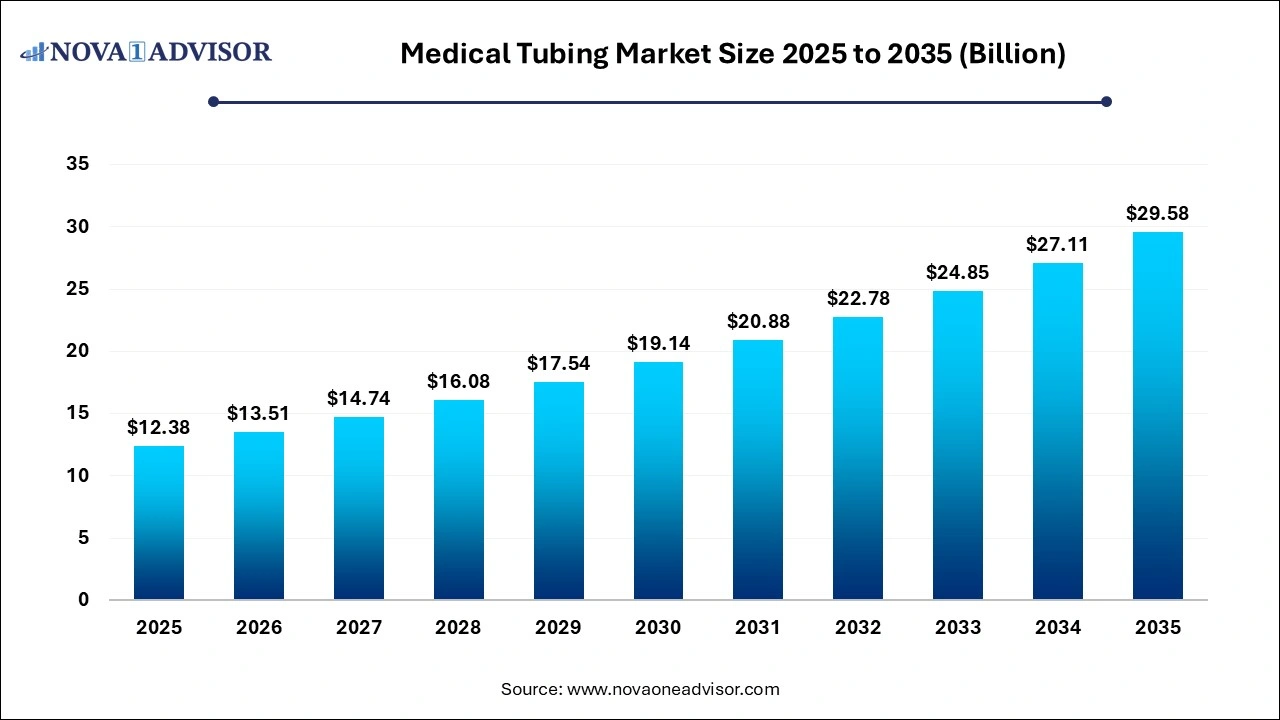
The global medical tubing market size was valued at USD 12.38 billion in 2025 and is projected to grow from USD 13.51 billion in 2026 to USD 29.58 billion by 2035, at a CAGR of 9.1% from 2026 to 2035.
Key Takeaway
- By product, the polyvinyl chloride (PVC) segment dominated the market with the largest share in 2025.
- By product, the fluoropolymers segment is expected to grow at the fastest CAGR over the forecast period.
- By application, the bulk disposable tubing segment dominated the market with the largest share in 2025.
- By region, North America dominated the market with the largest share in 2025.
Market Overview
Medical tubing is a critical component in medical devices, drug-delivery systems, diagnostic equipment, and biopharmaceutical processing, enabling the controlled movement of fluids, gases, and biological materials. The market spans materials such as silicone, PVC, polyolefins, polyimide, PTFE, FEP, and other advanced polymers, each selected according to requirements for flexibility, biocompatibility, chemical resistance, sterilization, pressure tolerance, and dimensional precision.
Demand is closely connected to the expansion of minimally invasive procedures, infusion and dialysis systems, catheter-based interventions, and single-use biopharmaceutical manufacturing. At the same time, manufacturers are increasingly adopting cleanroom extrusion, multilayer and co-extruded structures, micro-tubing, reinforced designs, specialized coatings, and customized geometries to meet application-specific performance requirements.
Competition includes diversified medical-technology companies and specialized extrusion manufacturers, with differentiation increasingly centered on material expertise, precision manufacturing, regulatory compliance, customization, and long-term OEM partnerships. As medical devices become smaller, more complex, and increasingly integrated, demand is shifting from standardized tubing toward high-performance and application-specific solutions, creating opportunities for suppliers with advanced extrusion, assembly, and materials capabilities.
Market Outlook
- Market Growth Overview: The global medical tubing market is expected to grow significantly between 2025 and 2035, driven by the growing need for minimally invasive procedures across the globe.
- Sustainability Trends: Sustainability trends involve growing adoption of bio-based and bioresorbable polymers.
- Major Investors: Major investors in the market include W. L. Gore & Associates, The Lubrizol Corporation, Nordson Corporation, TE Connectivity, Zeus Industrial Products, Teleflex, Raumedic, and Tekni-Plex.
How is AI Impacting The Global Medical Tubing Market?
Artificial intelligence (AI) is reshaping the market by predicting supply chain demands, automating quality checks, and customizing catheter or IV designs. Furthermore, machine learning algorithms analyze real-time video feeds during the extrusion process to immediately detect micro-cracks, variations in wall thickness, and bubble anomalies.
Major Trends in the Market
- Expansion of minimally invasive procedures: Smaller and more navigable medical devices are increasing demand for micro-tubing, multilumen structures, reinforced tubing, and advanced catheter shafts.
- Shift toward customized tubing: OEMs increasingly require application-specific dimensions, durometers, radiopacity, surface treatments, reinforcement, and multilayer structures.
- Growth of single-use biopharmaceutical processing: Pharmaceutical and cell-therapy manufacturing is increasing demand for validated, sterile and application-specific tubing systems.
- Advanced polymer adoption: Fluoropolymers, polyimide, specialty polyolefins, thermoplastic elastomers, and medical-grade polyurethane are gaining relevance in high-performance applications.
- Cleanroom and regional manufacturing expansion: Medical-device manufacturers are seeking suppliers with validated manufacturing environments closer to major OEM clusters.
Medical Tubing Market Report Scope
| Report Coverage | Details |
| Market Size in 2026 | USD 13.51 Billion |
| Market Size by 2035 | USD 29.58 Billion |
| Growth Rate From 2026 to 2035 | CAGR of 9.1% |
| Base Year | 2025 |
| Forecast Period | 2026 to 2035 |
| Segments Covered | By Product ,By Application, By Region |
| Market Analysis (Terms Used) | Value (USD Million/Billion) or (Volume/Units) |
| Regional Scope | North America; Europe; Asia Pacific; Central and South America; the Middle East and Africa |
| Key Companies Profiled | Asahi Tec Corp.; MDC Industries; Nordson Corp.; ZARYS International Group; Hitachi Cable America, Inc.; NewAge Industries, Inc.; TE Connectivity; Freudenberg & Co. KG; Spectrum Plastics Group; ATAG SpA |
Major Driver: Growth of Minimally Invasive Procedures
The rising adoption of minimally invasive procedures is driving demand for advanced medical tubing used in catheters, delivery systems, inflation channels, and fluid pathways. Cardiovascular, neurovascular, electrophysiology, endoscopy, and urology procedures increasingly require tubing with smaller diameters, thinner walls, precise dimensions, flexibility, kink resistance, lubricity, and multilumen designs. This is increasing demand for precision extrusion and specialized polymer-processing capabilities.
Major Restraint: Stringent Quality and Regulatory Requirements
Medical tubing must meet demanding requirements for biocompatibility, cleanliness, dimensional accuracy, sterilization compatibility, traceability, and quality control. Material or process changes may require extensive validation before adoption by medical-device manufacturers. These requirements increase qualification costs, development timelines, testing needs, and barriers to entry, although they are essential for maintaining patient safety and product reliability.
Major Opportunity: Regionalized Precision Manufacturing
The expansion of medical-device manufacturing in Asia-Pacific is creating opportunities for localized medical tubing production. Manufacturers are investing in regional extrusion, cleanroom, engineering, and validation capabilities to support faster delivery and closer collaboration with OEMs. India is an emerging example, with Lubrizol and Polyhose expanding medical tubing manufacturing capacity in Chennai, supporting the development of customized tubing for cardiovascular and neurovascular applications.
Segmental Insights
By Product
Why did the polyvinyl chloride (PVC) segment dominate the global medical tubing market?
The polyvinyl chloride (PVC) segment dominated the market with the largest share in 2025. The dominance of the segment can be attributed to its flexibility, cost-effectiveness, and exceptional compatibility with sterilization methods. In addition, polyvinyl chloride (PVC) maintains its mechanical integrity when exposed to standard medical sterilization methods, including gamma irradiation and ethylene oxide.
How did the fluoropolymers segment expected to hold the significantly growing global medical tubing market in the coming years?
The fluoropolymers segment is expected to grow at the fastest CAGR over the forecast period. The growth of the segment can be credited to its excellent chemical resistance and low friction properties, which make them crucial for innovative medical applications. These materials are well-suited for advanced drug delivery systems due to their increased melting points and robust resistance to aggressive bodily fluids and pharmaceutical solvents.
By Application
Why did the bulk disposable tubing segment dominate the global medical tubing market?
The bulk disposable tubing segment dominated the market with the largest share in 2025. The dominance of the segment can be linked to the increasing emphasis on infection control and hospital hygiene, with a surge in adoption of disposable tubing. The rising prevalence of chronic conditions, such as renal failure and cardiovascular diseases, increasingly needs ongoing dialysis and specialized infusion therapies.
How did the drug delivery systems segment expected to hold the significantly growing global medical tubing market in the coming years?
The drug delivery systems segment is expected to grow at the fastest CAGR during the study period. The growth of the segment can be driven by growing adoption of cutting-edge infusion systems and targeted drug delivery devices. Furthermore, the steady expansion in the adoption of ambulatory infusion pumps used for home-based chemotherapy, pain management, and clinical nutrition sustains a high-volume demand for the consistent manufacture of reliable fluid transfer lines.
By Region
Why did the North American region account for the largest share of the global medical tubing market?
North America dominated the market with the largest share in 2025. The dominance of the region can be attributed to the strong presence of well-established healthcare infrastructure and growing adoption of cutting-edge medical technologies across major countries. In addition, ongoing development of innovative co-extruded and multi-layer tubing offers enhanced flexibility, chemical resistance, and mechanical strength.
U.S. Global Medical Tubing Market Trends
The growth of the market in the country can be driven by the robust presence of major market players and well-established healthcare systems in major cities. Also, FDA regulations require medical device manufacturers to use high-grade, biocompatible materials including silicone, fluoropolymers, and advanced polyvinyl chloride (PVC) that offer superior chemical resistance and preserve the integrity of sterile fluid pathways.
Why did the Asia-Pacific region become the fastest-growing global medical tubing market during the forecast period?
Asia Pacific is expected to grow at the fastest CAGR over the forecast period. The growth of the region can be credited to ongoing growth of healthcare infrastructure and a surge in medical device production in emerging economies such as China and India. Furthermore, low production expenses, cost-effective labour availability, and favourable governmental policies collectively serve as key catalysts, impelling major domestic and international original equipment manufacturers (OEMs) to establish localized manufacturing hubs.
- In February 2026, Q-Sera Pty Ltd, an Australian venture-backed enterprise, has announced the inaugural commercial deployment of its patented evacuated blood collection system. This milestone is marked by Terumo Corporation's official introduction of the VenoJect II RAPClot™ blood collection tubes to the Japanese medical market.
China Global Medical Tubing Market
The market in the country is growing due to the surge in geriatric population and extensive healthcare infrastructure investments in major regions. Moreover, the extensive shift towards minimally invasive surgeries and other treatment options increases the demand for precision-extruded and advanced options, driving market growth soon.
Key Players in the Global Medical Tubing Market
- Saint-Gobain (France): Saint-Gobain is a massive global manufacturer offering specialized polymer and silicone fluid-transfer solutions. Their performance plastics division delivers high-purity, biocompatible tubing extensively utilized across biopharmaceutical processing.
- W. L. Gore & Associates, Inc. (US): W. L. Gore & Associates is globally recognized for its advanced fluoropolymer technologies, notably expanded polytetrafluoroethylene (ePTFE). In the medical tubing space, Gore provides high-performance vascular grafts and specialized catheter components.
- Nordson Corporation (US): Nordson Corporation leverages its medical division (Nordson MEDICAL) to supply precision fluid management components, including specialized micro-tubing, engineered extrusions, and innovative biopharmaceutical connectivity retainers.
Recent Developments
- In June 2026, Lubrizol, a global leader in specialty chemicals, in partnership with fluid conveyance systems manufacturer Polyhose, has officially inaugurated a new medical manufacturing facility in Chennai, India. This joint venture represents a substantial strategic investment in the nation's rapidly expanding medical technology sector.
Segments Covered in the Report
This report forecasts revenue growth at country levels and provides an analysis of the latest industry trends in each of the sub-segments from 2021 to 2035. For this study, Nova one advisor, Inc. has medical tubing market.
By Product
- Silicone
- Polyolefins
- Polyimide
- Polyvinyl Chloride
- Polycarbonates
- Fluoropolymers
- Polytetrafluoroethylene (PTFE)
- Fluorinated ethylene propylene (FEP)
- Others
By Application
- Bulk disposable tubing
- Silicone
- Polyolefins
- Polyimide
- Polyvinyl Chloride
- Polycarbonates
- Fluoropolymers
- Polytetrafluoroethylene (PTFE)
- Fluorinated ethylene propylene (FEP)
- Others
- Drug delivery systems
- Silicone
- Polyolefins
- Polyimide
- Polyvinyl Chloride
- Polycarbonates
- Fluoropolymers
- Polytetrafluoroethylene (PTFE)
- Fluorinated ethylene propylene (FEP)
- Others
- Catheters
- Silicone
- Polyolefins
- Polyimide
- Polyvinyl Chloride
- Polycarbonates
- Fluoropolymers
- Polytetrafluoroethylene (PTFE)
- Fluorinated ethylene propylene (FEP)
- Others
- Biopharmaceutical laboratory equipment
- Silicone
- Polyolefins
- Polyimide
- Polyvinyl Chloride
- Polycarbonates
- Fluoropolymers
- Polytetrafluoroethylene (PTFE)
- Fluorinated ethylene propylene (FEP)
- Others
- Others
- Silicone
- Polyolefins
- Polyimide
- Polyvinyl Chloride
- Polycarbonates
- Fluoropolymers
- Polytetrafluoroethylene (PTFE)
- Fluorinated ethylene propylene (FEP)
- Others
By Region
- North America
- Europe
- Asia-Pacific
- Latin America
- Middle East & Africa (MEA)
FAQ's

Proceed to Buy
Instant PDF delivery on confirmation

 Request Customization
 Download Sample

Get a Sample of this Report
Medical Tubing Market