

Medication Dispenser Market Size, Share, Forecast Report, 2026 - 2035
 Status Published
 Category Healthcare


Content
Medication Dispenser Market Size and Growth 2026 to 2035
The global medication dispenser market size was valued at USD 2.35 billion in 2025 and is projected to grow from USD 2.52 billion in 2026 to USD 4.71 billion by 2035, at a CAGR of 7.2% from 2026 to 2035.
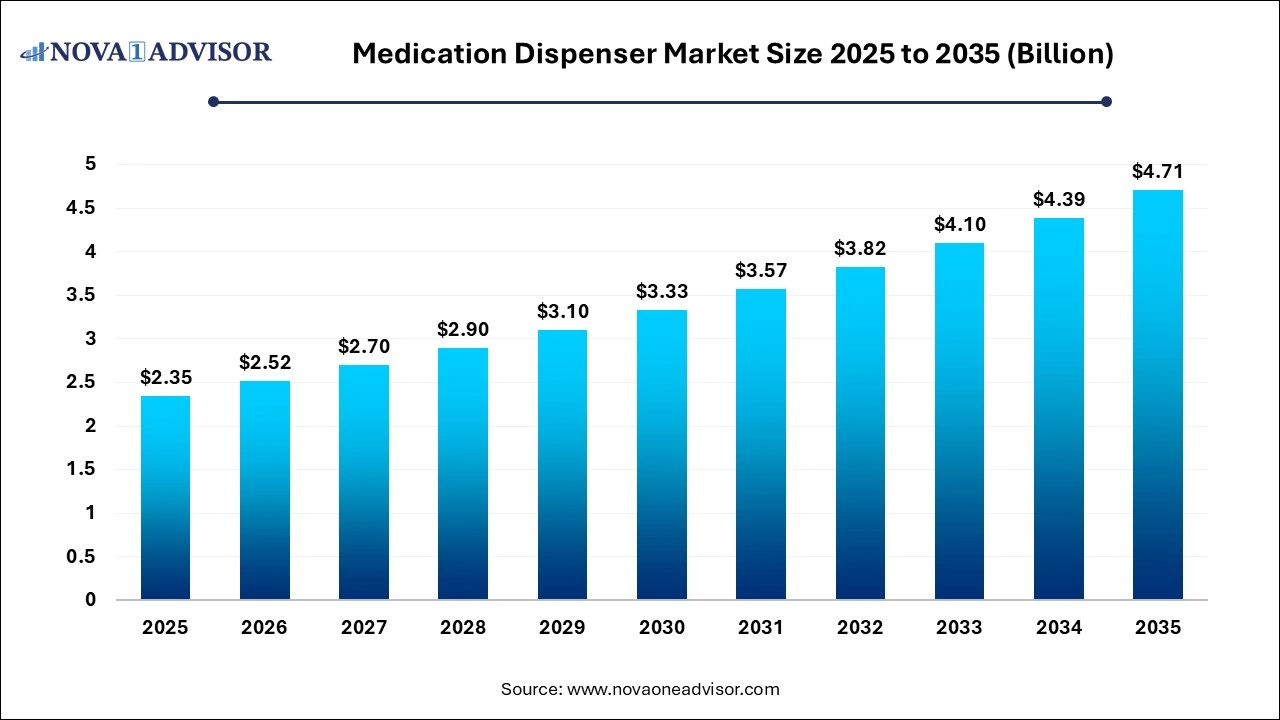
Key Takeaway
- By product type, the pharmacy-based (ADS) segment dominated the market with the largest share in 2025.
- By product type, the ward-based ADS segment is expected to grow at the fastest CAGR over the forecast period.
- By end user, the hospital pharmacies segment dominated the market with the largest share in 2025.
- By region, North America dominated the market with the largest share in 2025.
Market Overview
The global Medication Dispenser Market is expanding as healthcare providers adopt automated technologies to improve medication safety, inventory control, workflow efficiency, and traceability. Modern dispensing systems are evolving from standalone automated cabinets into connected medication-management platforms integrated with pharmacy systems, EHRs, eMARs, barcode technologies, RFID, and analytics. These solutions support hospitals, pharmacies, nursing facilities, ambulatory surgical centers, and other institutional care settings, particularly where complex medication workflows require secure access, real-time inventory visibility, and accurate dispensing.
Market Outlook
- Market Growth Overview: The global medication dispenser market is expected to grow significantly between 2025 and 2035, driven by the increasing concern regarding medication non-compliance.
- Sustainability Trends: Sustainability trends involve increasing emphasis on minizing ecological footprints through sustianble materials.
- Major Investors: Major investors in the market include Becton, Dickinson and Company (BD), Omnicell, Inc., Capsa Healthcare, ScriptPro LLC, McKesson Corporation, Baxter International, and Swisslog Holding AG.
How is AI Impacting The Global Medication Dispenser Market?
Artificial intelligence (AI) is reshaping the market by the ongoing shift from passive pill storage into data-driven and proactive systems. AI integration enhances patient adherence tracking and minimizes dispensing errors in hospitals. Furthermore, advanced dispensing cabinets use artificial intelligence and barcode verification protocols to reduce retrieval durations, eradicate manual entry discrepancies, and monitor controlled substances.
Major Trends in the Market
- AI-powered medication analytics: Dispensing platforms are increasingly incorporating AI to identify inventory patterns, improve visibility, and support operational decision-making.
- Connected dispensing ecosystems: Standalone cabinets are being integrated with EHRs, pharmacy information systems, inventory platforms, and medication administration workflows.
- Growth of autonomous pharmacy concepts: Providers and technology companies are moving toward end-to-end automation covering medication storage, preparation, dispensing, transport, and replenishment.
- Real-time inventory visibility: Hospitals increasingly want immediate visibility into medication availability across central pharmacies, wards, and individual dispensing devices.
- Greater controlled-substance security: Biometric identification, RFID, access permissions, transaction histories, and audit trails are becoming important differentiators.
Medication Dispenser Market Report Scope
| Report Coverage | Details |
| Market Size in 2026 | USD 2.52 Billion |
| Market Size by 2035 | USD 4.71 Billion |
| Growth Rate From 2026 to 2035 | CAGR of 7.2% |
| Base Year | 2025 |
| Forecast Period | 2026 to 2035 |
| Segments Covered | By Product Type, By End-User, By Region |
| Market Analysis (Terms Used) | Value (USD Million/Billion) or (Volume/Units) |
| Regional Scope | North America; Europe; Asia Pacific; Central and South America; the Middle East and Africa |
| Key Companies Profiled | BD, Omnicell, Swisslog Healthcare, ARxIUM, ScriptPro, Capsa Healthcare, Baxter, Yuyama, TouchPoint Medical, Pearson Medical Technologies |
Market Driver – Increasing Need for Medication Safety and Workflow Efficiency
The growing focus on medication safety, workforce productivity, and efficient healthcare operations is a key driver of the Medication Dispenser Market. Automated dispensing systems reduce manual steps involved in medication storage, retrieval, access control, documentation, replenishment, and reconciliation. By standardizing these processes, hospitals can improve medication traceability, reduce workflow delays, strengthen inventory control, and allow pharmacists and nurses to spend more time on clinical activities.
Market Restraint – High Implementation Complexity and Capital Requirements
High upfront costs and implementation complexity can limit adoption of automated medication dispensing systems. Healthcare providers may need to invest in dispensing hardware, software integration, IT infrastructure, cybersecurity, staff training, maintenance, and workflow redesign. Smaller hospitals and facilities with limited capital budgets may therefore postpone investments. Integration with existing EHR, pharmacy, barcode, and inventory systems can further increase deployment time and operational complexity.
Market Opportunity – Expansion of Intelligent and Connected Medication Management
The shift toward connected medication-management ecosystems creates a significant growth opportunity. Healthcare organizations are increasingly linking pharmacy automation, dispensing systems, robotics, inventory platforms, EHRs, and analytics to create end-to-end medication workflows. Large hospital networks can use centralized platforms to monitor medication utilization, optimize inventory, and standardize processes across facilities. Asia-Pacific also offers strong expansion potential as healthcare infrastructure, digitalization, and demand for pharmacy automation increase. Swisslog Healthcare's expansion of its India operations in 2026 highlights the growing interest in advanced pharmacy-management and automation solutions in emerging markets.
Segmental Insights
By Product Type
Why did the pharmacy-based (ADS) segment dominate the global medication dispenser market?
The pharmacy-based (ADS) segment dominated the market with the largest share in 2025. The dominance of the segment can be attributed to the increasing demand to reduce human dispensing errors and boost patient wait times. In addition, automated tracking systems supply real-time inventory updates, significantly reducing waste from expired medications and preventing misplaced pharmaceutical stock.
How did the ward-based ADS segment expected to hold the significantly growing global medication dispenser market in the coming years?
The ward-based ADS segment is expected to grow at the fastest CAGR over the forecast period. The growth of the segment can be credited to the growing need for critical clinical workflows and stringent drug tracking and safety mandates. Also, the use of built-in barcode and RFID verification mechanisms within ward-based ADS units minimizes manual transcription and selection errors during point-of-dispensing operations.
By End-user
Why did the hospital pharmacies segment dominate the global medication dispenser market?
The hospital pharmacies segment dominated the market with the largest share in 2025. The dominance of the segment can be linked to the increasing demand to track controlled substances and the rise in inpatient volumes. Furthermore, automated systems monitor medication expiration dates and apply data analytics to align inventory with actual clinical demand, which directly reduces financial losses resulting from expired or unused pharmaceutical supplies.
- In April 2026, Streamline Healthcare Solutions, a specialized developer of enterprise software for the behavioral health and human services sectors, has introduced SMARTdispense™. This new module is integrated into the SmartCare™ electronic health record (EHR) and practice management platform to optimize medication-assisted treatment workflows within opioid treatment programs (OTPs).
How did the ambulatory surgical center segment expected to hold the significantly growing global medication dispenser market in the coming years?
The ambulatory surgical center segment is expected to grow at the fastest CAGR over the forecast period. The growth of the segment can be driven by the ongoing transition of complex surgical procedures from conventional hospitals to outpatient facilities and strict demand for medication error reduction. Moreover, real-time tracking systems enable medical facilities to ensure the secure administration, inventory oversight, and regulatory compliance of high-value pharmaceuticals and controlled substances.
By Region
Why did the North American region account for the largest share of the global medication dispenser market?
North America dominated the market with the largest share in 2025. The dominance of the region can be attributed to the growing adoption of digital health automation and an increasing incidence of chronic illness among major nations. In addition, government incentives facilitate the adoption of telehealth services and reduce expensive hospital readmissions associated with non-adherence to medication programs.
U.S. Global Medication Dispenser Market Trends
The growth of the market in the country can be driven by the surge in incidence of chronic diseases and increasing geriatric population. Also, an increasing number of patients express a strong preference for independent living and aging-in-place arrangements over institutional nursing or assisted care facilities.
Why did the Asia-Pacific region become the fastest-growing global medication dispenser market during the forecast period?
Asia Pacific is expected to grow at the fastest CAGR over the forecast period. The growth of the region can be credited to the increasing healthcare expenditure and growing demand to minimize clinical medication errors. Furthermore, increased purchasing power and heightened health consciousness are propelling the integration of intelligent, interconnected homecare and clinical dispensing systems, driving regional growth soon.
China Global Medication Dispenser Market Trends
The market in the country is growing due to the growing incidence of chronic diseases and the government push for "smart health" infrastructure. Moreover, as an increasing number of patients manage their medical treatments within a home environment, there is a corresponding surge in the market demand for IoT-enabled, remote-monitoring pill dispensing systems.
Key Players in the Global Medication Dispenser Market
- Omnicell, Inc.: A major competitor to BD in institutional automation. Omnicell provides automated dispensing cabinets, robotic prescription systems, and medication management software aimed at reducing point-of-care errors and streamlining pharmacy operations.
- ScriptPro LLC: It specializes in high-volume robotics and pharmacy management systems. Their automated pill dispensing machines are staples in retail pharmacies and institutional healthcare hubs to optimize serialization and tracking.
- Hero Health, Inc.: A major player in the direct-to-consumer and payer-reimbursed home market. Hero offers an IoT-connected smart appliance that stores, manages, and dispenses complex vitamin/pill regimens, backed by an app that tracks remote patient adherence.
Recent Developments
- In April 2026, Becton, Dickinson and Company (NYSE: BDX), a prominent global medical technology corporation, has officially introduced the BD® Pyxis™ Pro Dispensing Solution and the BD® Incada™ Connected Care Platform within the European market. This next-generation medication dispensing system integrates sophisticated automation with artificial intelligence-driven insights.
Segments Covered in the Report
This report forecasts revenue growth at country levels and provides an analysis of the latest industry trends in each of the sub-segments from 2021 to 2035. For this study, Nova one advisor, Inc. has medication dispenser market.
By Product Type
- Pharmacy Based ADS
- Ward Based ADS
- Automated Unit Dose Dispenser
By End-user
- Hospital Pharmacies
- Ambulatory Surgical Centers
- Nursing Facilities
By Region
- North America
- Europe
- Asia-Pacific
- Latin America
- Middle East & Africa (MEA)
FAQ's

Proceed to Buy
Instant PDF delivery on confirmation

Medication Dispenser Market Size to Hit USD 4.71 Billion by 2035
 Request Customization
 Download Sample

Get a Sample of this Report
Medication Dispenser Market