

Multi-parameter Patient Monitoring Equipment Market Size, Share, and Trends 2026 to 2035
 Status Published
 Category Healthcare


Content
Multi-parameter Patient Monitoring Equipment Market Size and Growth 2026 to 2035
The global multi-parameter patient monitoring equipment market size was estimated at USD 4.88 billion in 2025 and is expected to reach USD 7.09 billion by 2035, growing at a CAGR of 3.8% from 2026 to 2035.
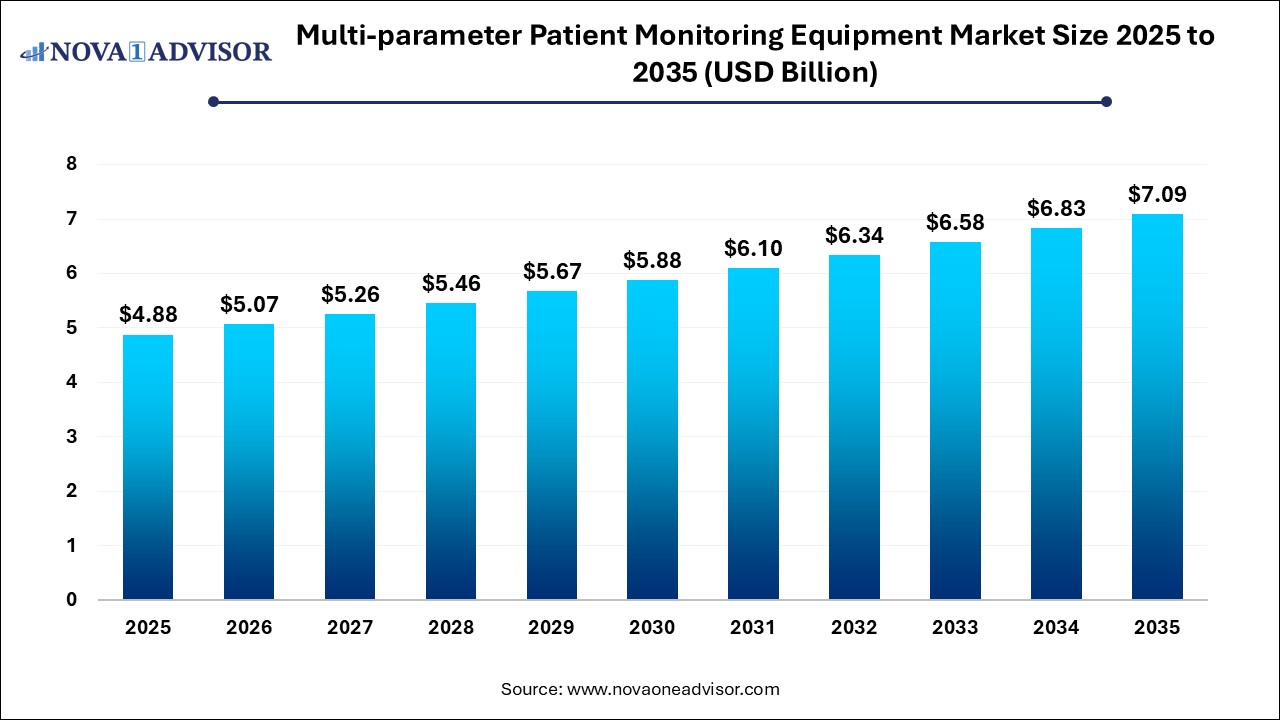
Market Key Takeaways
- The multi-parameter patient monitoring equipment market is witnessing strong growth driven by increasing prevalence of chronic diseases and rising demand for real-time patient monitoring.
- Technological advancements such as wireless monitoring, wearable devices, and AI integration are reshaping the market landscape.
- Hospitals remain the largest end-user segment, while home healthcare is emerging as the fastest-growing segment.
- High-acuity monitors dominate due to their extensive use in ICUs and emergency care settings.
- Asia Pacific is the fastest-growing regional market due to expanding healthcare infrastructure and large patient populations.
- The shift toward remote patient monitoring and telehealth is creating new growth avenues.
Market Overview
The multi-parameter patient monitoring equipment market plays a critical role in modern healthcare systems by enabling continuous tracking of vital physiological parameters such as heart rate, blood pressure, respiratory rate, oxygen saturation (SpOâ‚‚), and temperature. These devices are widely used across intensive care units (ICUs), operating rooms, emergency departments, and increasingly in home healthcare settings.
The growing burden of chronic diseases such as cardiovascular disorders, diabetes, and respiratory conditions has significantly increased the demand for continuous monitoring solutions. For instance, patients with heart failure require constant observation to prevent sudden deterioration, making multi-parameter monitors indispensable in both hospital and home settings.
Additionally, aging populations across developed and developing economies are contributing to increased hospital admissions and long-term care needs. Elderly patients often suffer from multiple comorbidities, necessitating advanced monitoring systems capable of tracking several parameters simultaneously.
Technological evolution is another key factor shaping the market. The integration of artificial intelligence (AI), Internet of Things (IoT), and cloud-based platforms has enabled smarter monitoring systems that can predict health deterioration and alert healthcare providers in real time. For example, modern monitors can analyze trends in vital signs and provide early warnings of sepsis or cardiac arrest.
The COVID-19 pandemic further accelerated market growth by highlighting the importance of continuous monitoring, especially in critical care environments. Hospitals worldwide expanded ICU capacities and adopted advanced monitoring equipment, creating long-term demand momentum.
Market Outlook
- Market Growth Overview: The multi-parameter patient monitoring equipment market is expected to grow significantly between 2025 and 2034, driven by the rising chronic diseases and aging populations, innovation in advanced technology in monitoring devices, and growing demand for portable and wearable devices.
- Sustainability Trends: Sustainability trends involve the energy-efficient and compact design, eco-friendly manufacturing and compliance, and circular economy approaches.
- Major Investors: Major investors in the market include Koninklijke Philips N.V., GE HealthCare, Medtronic, Shenzhen Mindray Bio-Medical Electronics, Nihon Kohden, and Masimo Corporation.
Major Trends in the Market
- Increasing adoption of wireless and wearable monitoring devices
- Integration of AI and predictive analytics in patient monitoring systems
- Growing demand for remote patient monitoring (RPM) and telehealth solutions
- Miniaturization and portability of monitoring equipment
- Rising use of cloud-based data storage and interoperability systems
- Expansion of home healthcare monitoring solutions
- Development of multi-functional devices combining diagnostics and monitoring
- Increased focus on patient comfort and non-invasive monitoring technologies
Multi-parameter Patient Monitoring Equipment Market Report Scope
| Report Coverage | Details |
| Market Size in 2026 | USD 5.07 Billion |
| Market Size by 2035 | USD 7.09 Billion |
| Growth Rate From 2026 to 2035 | CAGR of 3.8% |
| Base Year | 2025 |
| Forecast Period | 2026 to 2035 |
| Segments Covered | By Acuity Level,By End-user, Region |
| Market Analysis (Terms Used) | Value (USD Million/Billion) or (Volume/Units) |
| Regional Scope | North America; Europe; Asia Pacific; Central and South America; the Middle East and Africa |
| Key Companies Profiled | CAS Medical Systems, Inc., Contec Medical Systems Co., Ltd., Drägerwerk AG & Co. KGaA, GE Healthcare |
Market Driver: Rising Prevalence of Chronic Diseases
One of the primary drivers of the multi-parameter patient monitoring equipment market is the increasing prevalence of chronic diseases worldwide. Conditions such as cardiovascular diseases, diabetes, chronic obstructive pulmonary disease (COPD), and hypertension require continuous monitoring to manage complications and prevent acute episodes.
For example, cardiovascular diseases remain one of the leading causes of death globally. Patients with heart conditions often require continuous monitoring of heart rate, blood pressure, and oxygen levels. Multi-parameter monitors provide healthcare professionals with real-time data, enabling timely interventions and improving patient outcomes.
Moreover, the rise in lifestyle-related diseases due to sedentary habits, unhealthy diets, and stress has significantly increased the patient pool requiring monitoring. In countries like India and China, the growing middle-class population and urbanization have led to higher incidences of diabetes and hypertension.
Another contributing factor is the increasing adoption of preventive healthcare practices. Patients and healthcare providers are increasingly focusing on early diagnosis and continuous monitoring to reduce hospitalization costs and improve quality of life. This trend is particularly evident in developed regions where healthcare systems emphasize value-based care.
Market Restraint: High Cost of Advanced Monitoring Equipment
Despite strong growth prospects, the high cost associated with advanced multi-parameter patient monitoring systems remains a significant restraint. These devices often involve sophisticated technologies such as AI integration, wireless connectivity, and advanced sensors, which increase their overall cost.
For smaller healthcare facilities and hospitals in developing regions, the initial investment required to procure these systems can be prohibitive. In addition to the purchase cost, there are ongoing expenses related to maintenance, calibration, and staff training.
For example, a fully equipped ICU monitoring system can cost several thousand dollars per unit, making it challenging for rural hospitals or clinics with limited budgets to adopt such technologies. This creates a disparity in access to advanced healthcare solutions between urban and rural areas.
Furthermore, reimbursement challenges in certain healthcare systems can limit the adoption of advanced monitoring equipment. In regions where insurance coverage is limited or reimbursement policies are unclear, healthcare providers may hesitate to invest in high-cost equipment.
Market Opportunity: Expansion of Home Healthcare and Remote Monitoring
The rapid expansion of home healthcare and remote patient monitoring presents a significant opportunity for the multi-parameter patient monitoring equipment market. With increasing healthcare costs and hospital overcrowding, there is a growing shift toward decentralized care models.
Remote monitoring allows patients to be monitored in the comfort of their homes while still maintaining connectivity with healthcare providers. This is particularly beneficial for elderly patients, individuals with chronic conditions, and post-operative patients.
For instance, wearable multi-parameter monitors can track vital signs and transmit data to healthcare professionals in real time. If any abnormalities are detected, alerts can be sent तà¥à¤°à¤‚त, enabling timely intervention without requiring hospitalization.
The COVID-19 pandemic accelerated the adoption of remote monitoring solutions as healthcare systems sought to reduce physical contact and manage patient loads effectively. This trend is expected to continue as telehealth becomes a permanent component of healthcare delivery.
Additionally, advancements in mobile health applications and cloud-based platforms are enhancing the efficiency and scalability of remote monitoring solutions. Companies are increasingly developing user-friendly devices that integrate seamlessly with smartphones and healthcare systems.
Segmental Insights
By Acuity Level
How did the high-acuity monitors segment dominate the Multi-parameter Patient Monitoring Equipment market?
The high-acuity monitors segment is driven by integrating AI-driven analytics and wireless connectivity; these devices provide the real-time, complex hemodynamic data essential for immediate clinical decision-making. The high-value nature of these systems reflects their critical role in reducing hospital mortality rates within ICUs and operating theatres. The consistent demand from global hospital infrastructures for robust, multi-functional monitors ensures that high-acuity technology remains the foundational pillar of advanced patient care.
How did the low-acuity monitors segment expect to hold the fastest-growing Multi-parameter Patient Monitoring Equipment market in the coming years?
The low-acuity monitors segment is driven by the shift toward non-traditional settings, and wearable innovation is transforming patient monitoring into a proactive, continuous, and mobile experience. By integrating AI-driven analytics and IoT connectivity, these technologies enable earlier detection of clinical deterioration across medical-surgical units and home environments.
By End-user
How did the hospitals segment account for the largest share in the Multi-parameter Patient Monitoring Equipment market?
The hospitals segment is driven by the growth of the geriatric population; the hospital infrastructure remains the essential environment for the intensive, technology-integrated monitoring necessary to reduce mortality and improve patient outcomes. The concentration of ICUs and operating rooms, where specialized clinical staff utilize advanced multifunctional devices to manage high-acuity cases. The seamless integration of these monitors into electronic health records (EHR) optimizes clinical workflows and enhances data-driven decision-making.
How did the home healthcare segment expect to hold the fastest-growing Multi-parameter Patient Monitoring Equipment market in the coming years?
The home healthcare segment is driven by the integration of AI-driven wearable and remote patient monitoring technologies into home environments. By enabling continuous, real-time oversight of chronic conditions, these solutions offer a cost-effective and convenient alternative to traditional hospital stays, particularly for the expanding geriatric demographic. The favorable reimbursement policies and government initiatives are incentivizing healthcare providers to adopt home-based equipment to reduce the burden on clinical infrastructure.
By Region
Dominating Region: North America
North America dominates the market due to its advanced healthcare infrastructure, high healthcare expenditure, and early adoption of innovative technologies. The presence of leading medical device manufacturers and strong regulatory frameworks further supports market growth.
For example, hospitals in the United States are equipped with state-of-the-art monitoring systems that incorporate AI and predictive analytics. The widespread adoption of electronic health records and telehealth solutions also enhances the efficiency of patient monitoring systems.
Fastest Growing Region: Asia Pacific
Asia Pacific is the fastest-growing region driven by increasing healthcare investments, rising population, and growing prevalence of chronic diseases. Countries such as China and India are witnessing rapid expansion in healthcare infrastructure, creating significant demand for monitoring equipment.
For instance, government initiatives aimed at improving healthcare access in rural areas are driving the adoption of portable and affordable monitoring devices. Additionally, the growing middle-class population and increasing awareness of healthcare are contributing to market growth in the region.
Key Players in the Multi-parameter Patient Monitoring Equipment Market
- CAS Medical Systems, Inc.
CAS Medical Systems contributes to the market by focusing on non-invasive monitoring technology, notably through its FORE-SIGHT cerebral oximeter, which measures tissue oxygenation.
- Contec Medical Systems Co., Ltd.
Contec contributes to the market by manufacturing a broad range of cost-effective, portable multi-parameter monitors and peripheral devices like pulse oximeters. They hold a significant market position by offering ODM/OEM services and distributing their FDA-certified devices globally to both hospitals and home healthcare markets.
- Drägerwerk AG & Co. KGaA
Dräger contributes by providing advanced, integrated patient monitoring systems that connect to bedside monitors and IT systems to enhance clinical workflow across acute care departments.
- GE Healthcare
GE HealthCare contributes by delivering high-tech monitoring solutions like the CARESCAPE modular platforms that provide critical, real-time data for patient care in diverse care settings.
Multi-parameter Patient Monitoring Equipment Market Market Segment
By Acuity Level
- High-acuity Monitors
- Mid-acuity Monitors
- Low-acuity Monitors
By End-user
- Hospitals
- Home Health care
By Regions
- North America
- United States
- Canada
- Europe
- Germany
- United Kingdom
- Italy
- France
- Rest of EU
- Asia Pacific
- China
- India
- Japan
- Southeast Asia
- Rest of APAC
- Central & South America
- Brazil
- Argentina
- Rest of Central & South America
- Middle East and Africa
- UAE
- Saudi Arabia
- Rest of MEA
FAQ's

Proceed to Buy
Instant PDF delivery on confirmation

Multi-parameter Patient Monitoring Equipment Market Size to Reach USD 7.09 Bil...
 Request Customization
 Download Sample

Get a Sample of this Report
Multi-parameter Patient Monitoring Equipment Market