

Neonatal Thermoregulation Market Size, Share, Forecast Report, 2026-2035
 Status Published
 Category Healthcare


Content
Neonatal Thermoregulation Market Size and Growth 2026 to 2035
The global neonatal thermoregulation market size was estimated at USD 1,696.74 million in 2025 and is projected to hit around USD 3,467.87 million by 2035, growing at a CAGR of 7.41% during the forecast period from 2026 to 2035.
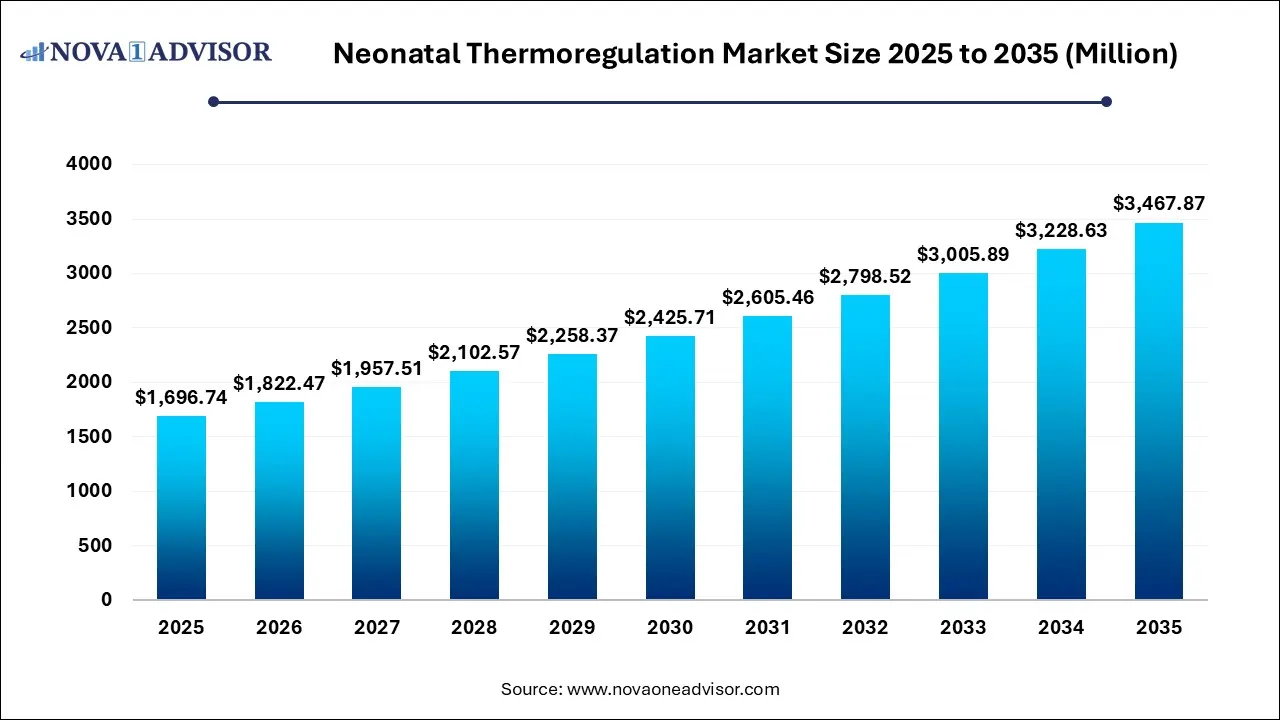
Market Overview
The neonatal thermoregulation market plays a critical role in modern neonatal healthcare by ensuring that newborn infants, especially premature and low-birth-weight babies, maintain optimal body temperature during the early stages of life. Thermoregulation is essential because newborns have underdeveloped physiological systems and limited capacity to regulate their own body heat. Inadequate temperature management can lead to complications such as respiratory distress, metabolic instability, infections, hypoglycemia, and increased mortality risk.
The market encompasses a broad range of products including neonatal warmers, incubators, and cooling systems designed to stabilize and monitor infant body temperature in clinical settings. These products are extensively utilized in neonatal intensive care units (NICUs), pediatric hospitals, maternity centers, and specialized neonatal clinics. The growing incidence of premature births worldwide is one of the major contributors to market demand. According to healthcare organizations across multiple countries, premature births continue to rise due to factors such as maternal age, chronic diseases, lifestyle disorders, and multiple pregnancies associated with assisted reproductive technologies.
Technological innovation has become a defining characteristic of the market. Modern neonatal thermoregulation systems are increasingly equipped with advanced sensors, automated temperature control systems, humidity regulation, integrated patient monitoring, and digital interfaces. These innovations improve treatment precision while reducing manual intervention by healthcare professionals. Furthermore, the integration of IoT-enabled monitoring systems is enhancing remote supervision and centralized neonatal care management.
Another significant market growth factor is the global emphasis on reducing neonatal mortality rates. Governments, healthcare organizations, and international agencies are investing heavily in neonatal healthcare infrastructure and awareness programs. Developing economies are expanding NICU capacities, improving rural healthcare access, and modernizing maternity care facilities. This is creating substantial opportunities for manufacturers of neonatal thermoregulation equipment.
The market is also influenced by increasing healthcare expenditure and rising adoption of specialized neonatal care services. Developed economies continue to invest in technologically advanced NICU systems, while emerging countries are witnessing higher procurement of affordable thermoregulation solutions for district hospitals and community healthcare centers.
Although the market demonstrates promising growth potential, certain challenges remain. High costs associated with advanced neonatal care equipment can limit adoption in low-income regions. Additionally, the shortage of trained neonatal specialists and technical personnel in developing healthcare systems continues to affect operational efficiency. Despite these limitations, the neonatal thermoregulation market is expected to maintain strong long-term growth due to ongoing innovation, expanding healthcare access, and increasing awareness regarding infant care standards.
Market Outlook
- Market Growth Overview: The global neonatal thermoregulation market is expected to grow significantly between 2025 and 2035, driven by the rising preterm births and hypothermia risk, integration of technological innovation, and growing healthcare infrastructure expansion.
- Sustainability Trends: Sustainability trends involve energy efficienct devicesand smart systems, sustainable materials and anufacturing, and shift toward reusable and upgradable components.
- Major Investors: Major investors in the market include GE HealthCare, Drägerwerk, Fisher & Paykel Healthcare, and Masimo.
How is AI Transforming the Neonatal Thermoregulation Market
Artificial intelligence is increasingly transforming the neonatal thermoregulation market by enhancing patient monitoring, improving treatment accuracy, and enabling predictive neonatal care. AI-powered systems are being integrated into neonatal incubators and warming devices to continuously analyze infant vital signs, temperature fluctuations, oxygen levels, and environmental parameters in real time. These technologies help healthcare professionals respond more rapidly to changes in neonatal conditions.
One of the most significant contributions of AI is predictive temperature management. Traditional systems often rely on manual adjustments by healthcare staff. AI-enabled systems, however, use machine learning algorithms to study infant behavior patterns, metabolic responses, and surrounding environmental conditions to automatically regulate temperature settings. This reduces the risk of hypothermia or hyperthermia and ensures greater thermal stability.
AI is also improving alarm management within neonatal intensive care units. Conventional NICU systems can produce frequent false alarms, contributing to caregiver fatigue. Intelligent monitoring systems are now capable of distinguishing between clinically significant events and non-critical fluctuations. This allows healthcare professionals to prioritize urgent cases more efficiently and improve neonatal care quality.
Another major development is the use of AI-driven analytics in neonatal cooling systems used for treating hypoxic-ischemic encephalopathy (HIE). These systems can optimize therapeutic cooling duration and intensity based on patient-specific data. By personalizing treatment, AI helps improve neurological outcomes and reduce long-term complications.
Remote monitoring capabilities are also expanding through AI integration. Connected neonatal thermoregulation systems can transmit real-time patient data to centralized hospital platforms or remote specialists. This is particularly valuable in rural or underserved regions where access to experienced neonatologists may be limited. AI-assisted telemedicine solutions are helping bridge healthcare gaps and improve neonatal survival rates.
Additionally, AI is supporting preventive maintenance of neonatal equipment. Predictive maintenance systems can identify equipment wear, sensor malfunction, or calibration issues before operational failures occur. This minimizes downtime and enhances device reliability in critical care environments.
As AI technologies continue to evolve, manufacturers are expected to focus on developing more intelligent, automated, and interoperable neonatal care systems that improve patient outcomes while reducing healthcare workload.
Neonatal Thermoregulation Market Report Scope
| Report Coverage | Details |
| Market Size in 2026 | USD 1,822.47 Million |
| Market Size by 2035 | USD 3,467.87 Million |
| Growth Rate From 2026 to 2035 | CAGR of 7.41% |
| Base Year | 2025 |
| Forecast Period | 2026 to 2035 |
| Segments Covered | By Product Type, By Modality, By End-user, By Region |
| Market Analysis (Terms Used) | Value (USD Million/Billion) or (Volume/Units) |
| Regional Scope | North America; Europe; Asia Pacific; Central and South America; the Middle East and Africa |
| Key Companies Profiled | GENERAL ELECTRIC COMPANY, Natus Medical Incorporated, Inspiration Healthcare Group plc., Koninklijke Philips N.V., Drägerwerk AG & Co. KGaA, Fisher & Paykel Healthcare, International Biomedical, Ltd., Atom Medical Corporation, Fanem Ltd, |
Segmental Insights
By Application
How did the incubator segment dominate the Global Neonatal Thermoregulation market?
The incubator segment is driven by the rising global rates of premature and low-birth-weight infants, which drive constant demand for advanced NICU incubators that provide essential, servo-controlled thermoregulation. These devices serve as the critical infrastructure, manage humidity, and provide sterile, isolated environments to minimize infection risk.
How did the radiant warmer segment expected to hold the fastest-growing Global Neonatal Thermoregulation market in the coming years?
The radiant warmer segment is driven by the expanding healthcare infrastructure and technological advancements in portable designs; this remains a vital, fast-growing pillar of neonatal care. Integration of smart sensors and automated, servo-controlled heating feedback loops ensures constant, precise thermal support without relying on infant mobility.
By End Use
How did the hospitals segment dominate the Global Neonatal Thermoregulation market?
The hospitals segment is driven by the need for a massive, continuous supply of specialized thermal equipment to manage critical preterm infants who cannot regulate their own body temperature. Strict institutional guidelines and clinical protocols mandate the use of these systems during all stages of neonatal care to prevent hypothermia.
How did the home care segment expected to hold the fastest-growing Global Neonatal Thermoregulation market in the coming years?
The home care segment is driven by the rise of lightweight, user-friendly, and portable devices, which have made neonatal thermoregulation safe and accessible outside traditional hospital settings. This advancement supports the growing trend of early hospital settings. By enabling continuous thermal care in a comfortable home environment, this segment enhances family bonding and significantly improves the overall quality of life.
By Product Type
How did the electric warmers segment dominate the Global Neonatal Thermoregulation market?
The electric warmers segment is driven by the ability to deliver rapid thermal stabilization, making them indispensable for immediate postnatal care in emergency delivery rooms before NICU transfer. With massive global investments to expand NICU and SNCU infrastructure, this segment continues to see a significant surge in procurement.
How did the chemical warmers segment expected to hold the fastest-growing Global Neonatal Thermoregulation market in the coming years?
The chemical warmers segment is driven by its offer of an affordable, electricity-free solution that provides continuous warmth in rural clinics, home births, and resource-limited regions. By eliminating high equipment costs and power dependency, it ensures accessible and life-saving neonatal care worldwide.
By Technology
How did the convectional heating segment dominate the Global Neonatal Thermoregulation market?
The convectional heating segment is driven by the cost-effectiveness related to advanced hybrid systems, makes them the global standard of care, accessible in both developed and developing regions. Driven by a steady rise in premature births, these devices remain a foundational requirement for hospitals and neonatal intensive care units.
How did the radiant heating segment expected to hold the fastest-growing Global Neonatal Thermoregulation market in the coming years?
The radiant heating segment is driven by integrating direct heating with smart sensors and phototherapy; manufacturers have driven widespread adoption of these systems across NICUs and specialty clinics. The precise and immediate thermal regulation is vital for managing the rising global numbers of premature infants born with severe health complications.
By Patient Type
How did the premature infants segment dominate the Global Neonatal Thermoregulation market?
The premature infants segment is driven by the growing need for prolonged NICU stay, which requires continuous, long-term utilization of advanced equipment, positioning this vulnerable patient population as driving the market growth. The rising global risk factors are pushing preterm birth rates to an estimated one in ten babies; immediate and precise thermal intervention is more critical than ever.
How did the low birth weight infants segment expected to hold the fastest-growing Global Neonatal Thermoregulation market in the coming years?
The low birth weight infants segment is driven by the integration of IoT and smart technologies into devices to ensure precise, non-invasive temperature monitoring. The massive capital injections into emerging markets, particularly across the Asia Pacific region, are expanding maternal healthcare infrastructure and accelerating equipment adoption.
By Regional
How did the North America region account for the largest share in the Global Neonatal Thermoregulation market?
North America is driven by the advanced NICU infrastructure and high healthcare expenditure, which facilitate the early adoption of premium thermoregulation technologies. The rising regional preterm birth rates ensure a steady, high demand for immediate and precise neonatal care solutions.
U.S. Global Neonatal Thermoregulation Market Trends
The U.S. growing prevalence of preterm births and the critical need for immediate thermal stabilization during golden hour drive continuous upgrades in advanced NICU infrastructure. The shift toward integrated, servo-controlled devices that automatically adjust heat output and combine warming with essential treatments, such as phototherapy. The rising adoption of IoT capabilities and wearable sensors enables continuous remote monitoring and seamless data transmission to electronic health records.
How did the Asia-Pacific region become the fastest-growing Global Neonatal Thermoregulation Market during the forecast period?
Asia Pacific’s high rates of premature births are driving demand for specialized neonatal thermal management and expanding healthcare infrastructure in countries such as China and India. Government-led initiatives and the rise of local manufacturers are significantly improving the accessibility of affordable, necessary thermoregulation devices.
China Global Neonatal Thermoregulation Market Trends
China’s rising NICU installations and heightened awareness of cold stress prevention, traditional neonatal incubators and radiant warmers continue to claim the largest revenue share. Meanwhile, portable and transport units are experiencing the fastest segment growth to ensure safe, continuous thermal support during crucial inter-hospital infant transfers.
How did Europe Hold A Notable Share in the Global Neonatal Thermoregulation Market?
Europe’s advanced healthcare infrastructure and high medical expenditures ensure the continuous adoption of sophisticated thermal management systems across major nations, such as Germany and the United Kingdom. A steady prevalence of premature and low-birth-weight deliveries fuels a constant demand for specialized, life-sustaining incubation systems.
Germany Global Neonatal Thermoregulation Market Trends
Germany’s conventional systems toward technologically advanced, smart incubators that feature remote monitoring and automated thermal adjustments. The portable and wearable sensors that provide continuous, non-invasive tracking while minimizing infant handling stress.
Key Players in the Global Neonatal Thermoregulation Market
- GENERAL ELECTRIC COMPANY: GE HealthCare manufactures advanced, hybrid neonatal beds like the Giraffe Carestation and OmniBed that control humidity, airflow, and heat to maintain neutral thermal environments.
- Natus Medical Incorporated: Natus supports global thermoregulation through integrated, microprocessor-controlled infant warmers and comprehensive NICU monitoring systems that help maintain patient body temperature.Their innovative portfolio of neonatal care solutions prioritizes precise thermal stability to assist in the growth and recovery of high-risk newborns.
- Inspiration Healthcare Group plc: This company develops and supplies critical care neonatal medical equipment, including specialized warming blankets and respiratory support devices, to over 75 countries.
Segments Covered in the Report
This report forecasts revenue growth at country levels and provides an analysis of the latest industry trends in each of the sub-segments from 2021 to 2035. For this study, Nova one advisor, Inc. has neonatal thermoregulation market.
By Product Type
- Warmer
-
- Wall Mount Warmer
- Radiant Warmers
- Neonatal Incubators
-
- Intensive Care Incubator
- Transport Incubator
- Neonatal Cooling Systems
By Modality
- Open
- Closed
By End-user
- Hospitals
- Pediatric and Neonatal Intensive Care Units
- Nursing Homes
- Others
By Region
- North America
- Europe
- Asia Pacific
- Latin America
- Middle East and Africa (MEA)
FAQ's

Proceed to Buy
Instant PDF delivery on confirmation

Neonatal Thermoregulation Market Size to Hit USD 3,467.87 Million by 2035
 Request Customization
 Download Sample

Get a Sample of this Report
Neonatal Thermoregulation Market