

North America Laboratory Animal Medicine Market Size, Share, and Trends 2026 to 2035
 Status Published
 Category Healthcare


Content
North America Laboratory Animal Medicine Market Summary
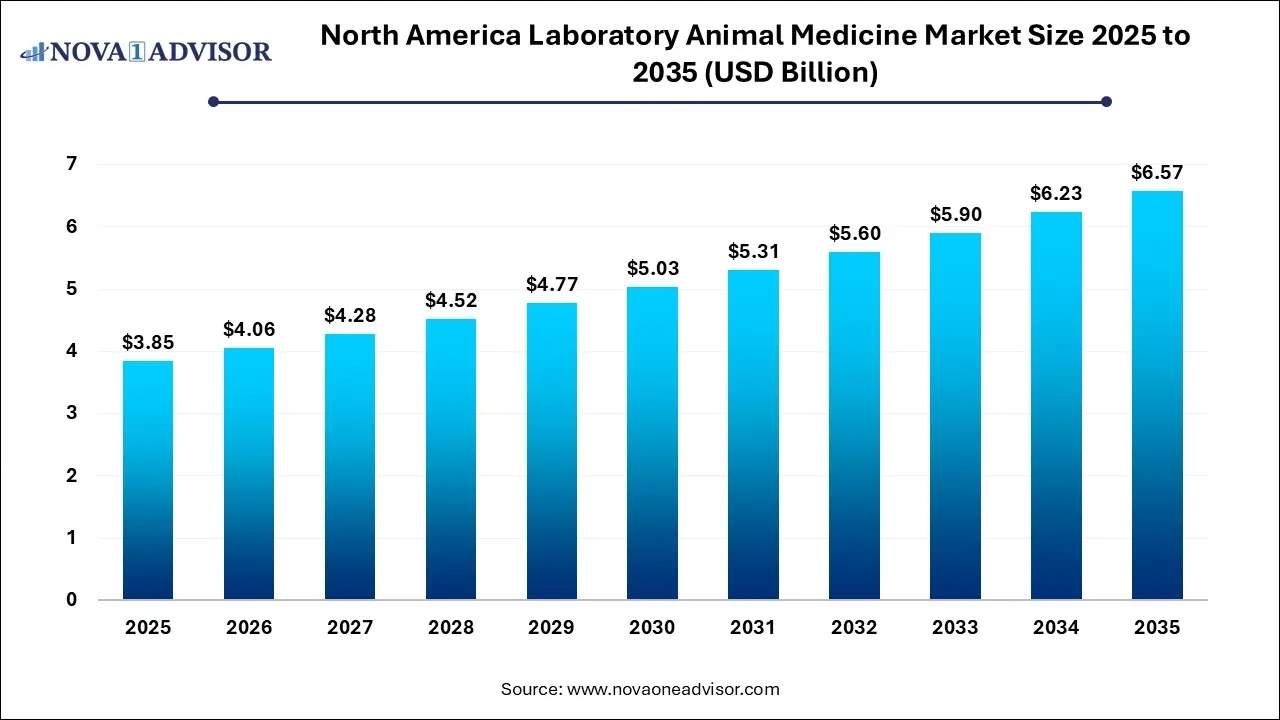
The North America laboratory animal medicine market size was estimated at USD 3.85 billion in 2025 and is projected to increase from USD 4.06 billion in 2026 to approximately USD 6.57 billion by 2035, growing at a CAGR of 5.49% from 2026 to 2035. The North America laboratory animal medicine market is driven by the rising prevalence of chronic diseases, necessitating extensive in vivo studies to develop new treatments, increased regulatory scrutiny regarding animal welfare, and high-quality, ethical care standards that require greater veterinary oversight and advanced animal models and medical care. Growing demand for specialized laboratory animal veterinarians, investment in research and development, and infrastructure.
Key Takeaways
- By product, the diagnostics & health surveillance products segment held a dominant position in the market with a share of 25% in 2025.
- By product, the therapeutics & preventive medicines segment is the fastest growing between 2026 and 2035.
- By animal mode, the rodents segment held a dominant position in the market with a share of 60% in 2025.
- By animal mode, the rabbits segment is the fastest growing between 2026 and 2035.
- By application, the disease surveillance & colony health monitoring segment accounted for a considerable revenue share of 20% in the market in 2025.
- By application, the preventive care & biosecurity segment is the fastest growing during 2026 and 2035.
- By consumer, the pharmaceutical & biopharmaceutical companies segment accounted for a considerable revenue share of 60% in the market in 2025.
Innovation Driving Transformation in the North America Laboratory Animal Medicine Market
North America Laboratory Animal Medicines comprises a specialized veterinary discipline focused on the health, welfare, diagnostics, and management of animals used in biomedical research, testing, and education. Benefits of this sector include enhanced data reproducibility, ensuring compliance with strict GLP standards, and providing specialized medical care that stabilizes animal models to improve the reliability of drug discovery and toxicology studies. The market growth is driven by the high capital investment in biopharmaceutical R&D, rising demand for disease-specific rodent models, and the expanding need for digital health monitoring and AI-driven analytics in pre-clinical research.
North America Laboratory Animal Medicine Market Trends
- Expansion of Genetically Engineered Precision Models
The rapid increase in development and adoption of genetically modified rodent models, particularly using CRISPR/Cas9 technology, has led to the ability to precisely simulate human disease. These sophisticated models are favored for oncological and neurological research as they provide greater translational relevance to human medicine, reducing late-stage clinical trial failures.
- Shift Toward Chronic Disease Management and Specialized Care
The laboratory animal medicine sector is experiencing a rise in chronic disease management and supportive care, with the need to study long-term conditions in laboratory animals. This involves increased use of specialized therapeutics, pain management, and nutritional support to maintain animal stability, ensuring study reliability.
- Expansion of GLP-Certified Research Infrastructure
There is a market trend toward GLP-certified labs that require frequent diagnostics and standardized preventive care. This shift increases healthcare intensity per animal, resulting in higher demand for advanced veterinary diagnostic consumables, such as serology and PCR test kits.
Key AI Integration in the North America Laboratory Animal Medicine Market
AI and ML are significantly transforming the North American laboratory animal medicine industry by accelerating the shift toward digitalized, high-efficiency research and diagnostics processes. In preclinical research, AI-driven predictive modeling and computational toxicology are increasingly used to simulate drug responses, aiding the 3Rs principles of animal testing. AI technologies, including computer vision and automated laboratory testing, are enhancing disease diagnosis accuracy, providing faster, more reliable results in studies involving rodent models.
North America Laboratory Animal Medicine Market Report Scope
| Report Coverage | Details |
| Market Size in 2026 | USD 4.06 Billion |
| Market Size by 2035 | USD 6.57 Billion |
| Growth Rate From 2026 to 2035 | CAGR of 5.49% |
| Base Year | 2025 |
| Forecast Period | 2026 to 2035 |
| Segments Covered | Product; Animal Model; Application; Customer; Country |
| Market Analysis (Terms Used) | Value (USD Million/Billion) or (Volume/Units) |
| Regional Scope | North America |
| Key Companies Profiled | Zoetis Services LLC; Boehringer Ingelheim International GmbH; Merck & Co., Inc.; Dechra; Elanco Animal Health; Kent Scientific Corporation; Harvard Apparatus; Starr; QIAGEN; Neogen Corporation; Mediso Ltd.; IITCINC; Thermo Fisher Scientific Inc.; Plas-Labs, Inc.; TSE Systems; CH Technologies (USA), Inc |
Market Dynamics
Driver
High Demand in Research and Development and Stringent Regulatory Standards
The increasing need for specialized animal models and advanced veterinary care, stringent regulatory standards mandated by agencies such as the USDA and the FDA, require strict compliance, which elevates healthcare intensity per animal and increases reliance on sophisticated diagnostics and surveillance tools. Stringent good laboratory practice certifications necessitate routine, documented health monitoring, driving recurring demand for diagnostics, therapeutic, and specialized housing systems.
Restraint
High Implementation Costs
The market growth is hindered by the substantial capital investment required for modern, compliant animal housing and maintenance, including rising stainless-steel cage prices and sophisticated monitoring devices, which increase the overall expense of preclinical trials. The financial burden is exacerbated by the rising costs of breeding specialized animal models, such as genetically modified rodents, which can cost thousands of dollars per unit, forcing smaller firms to explore less costly alternatives.
Opportunity
Genetically Modified Models
The enabling the development of highly specific, human-like disease models for cancer, neurodegenerative disorders, and metabolic diseases. The increasing precision of gene-editing technologies, such as CRISPR/Cas9, allows for tailored research tools that improve preclinical testing accuracy, accelerating drug discovery and reducing late-stage clinical failures. This surge in sophisticated, custom-designed models drives higher demand for specialized veterinary oversight, advanced health monitoring, and rigorous quality control in animal facilities.
Segment Insights
By Product Insights
Why Did the Diagnostics & Health Surveillance Products Segment Hold a 25% Share for the North America Laboratory Animal Medicine Market?
The diagnostics & health surveillance products segment held a dominant position in the market with a share of 25% in 2025, owing to the crucial need for health monitoring and diagnostics in laboratory animal research and testing. The growing adoption of rapid, sensitive molecular diagnostics and PCR-based surveillance tools for improved pathogen identification.
The therapeutics & preventive medicines segment held a 20% share of the market in 2025. Due to the importance of maintaining animal health through preventive and therapeutic measures. A high volume of animal studies focusing on chronic and degenerative diseases requires consistent use of therapeutics for research validity. The high demand for routine health management and stringent regulatory mandates.
The clinical care devices & equipment segment holds a 15% share of the market in 2025, with the growing demand for advanced medical devices in animal care. The shift to multitooth, chronic observation studies requires sustained, specialized care and precise, metered delivery of compounds using equipment such as ventilators and infusion pumps.
The clinical & welfare consumables segment held a 10% share of the market in 2025, due to its role in everyday animal welfare and care, but it’s smaller due to competition from other products. The advanced pharmaceutical, biotechnology, and academic research sectors require consistent, high-quality, and specialized consumables for preclinical studies and animal models.
The others products segment held a 30% share of the market in 2025, due to the most diverse, and includes niche or emerging products with high demand but lower individual market share. The increasing investment in high-throughput, automated facilities creates a demand for unique environmental controls and monitoring solutions that fall outside standard diagnostic categories.
By Animal Mode Insights
Why Did the Rodents Segment Lead the North America Laboratory Animal Medicine Market?
The rodents segment registered its dominance over the market with a share of 60% in 2025, owing to rodents being the most widely used species for preclinical trials and research due to cost-effectiveness and biological similarity to humans. The rise of genetically modified mouse and rat models, such as CRISPR/Cas9-based knockout models, enhances their utility in research.
The rabbits segment held the 15% share of the market in 2025, due to remain important for specific types of research, but is outnumbered by rodents. Rabbit health covering preventative care, digestive health, and skin care, is in high demand as research facilities invest in maintaining healthy, high-quality laboratory animals. Growing scientific and commercial relevance and its crucial role in biomedical research.
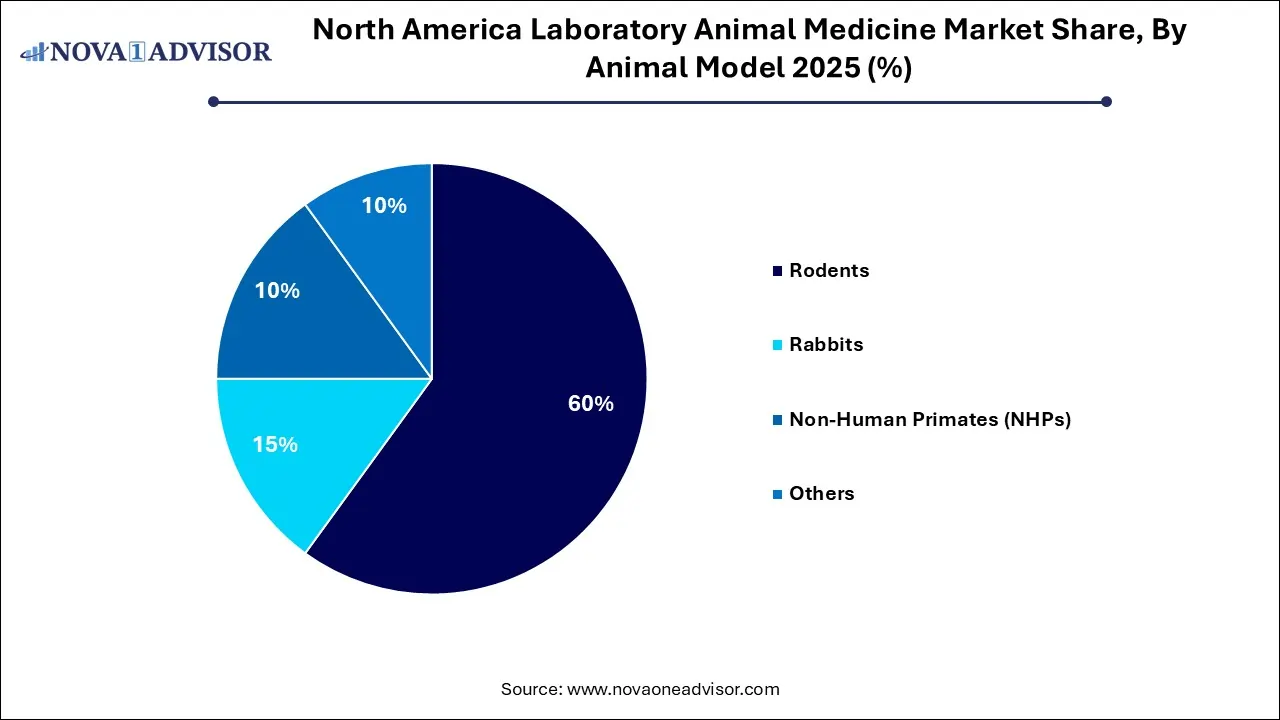
The non-human primates (NHPs) segment held a 16% share of the market in 2025 because of the advanced medical and neurological research, but are limited by ethical and cost factors. Increased focus on vaccines, neuroscience, oncology, and neuro-controlled prosthetics drives demand for advanced animal models.
The others segment held a 10% share of the market in 2025, with fewer species being used in research beyond rodents, rabbits, and primates. Stringent compliance requirements for GLP, which mandate meticulous health monitoring and specialized, high-frequency, nonroutine care, are increasing the demand for niche medicines, diagnostics, and tools.
By Application Insights
Why Did the Disease Surveillance & Colony Health Monitoring Segment Lead the North America Laboratory Animal Medicine Market?
The disease surveillance & colony health monitoring segment registered its dominance over the market with a share of 20% in 2025, owing to the essential need for maintaining the health of laboratory animals, driving its strong position in the market. Increasing investment in pharmaceutical research and development drives the demand for specialized, healthy research animals, necessitating robust health monitoring.
The preventive care & biosecurity segment held the 17% share of the market in 2025, with the application reflecting the growing importance of preventing disease in lab animals. Increasing sophistication in biomedical research demands consistent, reproducible results, which are only achievable with high-health status animals.
The perioperative care (Anesthesia, Analgesia, Surgical Support) segment held 22% share of the market in 2025, due to the rise in complex surgeries on animal models, particularly rodents, requires sophisticated anesthetic machines, ventilators, and surgical support tools, boosting market value. The high prevalence of longitudinal studies and stringent regulatory mandates drives the market growth.
The chronic disease management & supportive care segment held a 20% share of the market in 2025. With the increasing need for long-term care in research environments. Growing focus on humanized models and precision medicine requires sophisticated care to keep research models viable for longer periods. Increasing adoption of preventative and therapeutic focus and rising animal welfare awareness necessitate high-quality supportive care to manage chronic conditions during study trials.
The welfare & behavioral assessment segment held 10% share of the market in 2025, because it plays a significant role in animal care but is less critical than health surveillance or chronic disease care. Increased scientific understanding of animal sentience drives a shift toward assessing positive animal welfare states rather than just minimizing pain.
The end-of-life & euthanasia management segment held 3% share of the market in 2025, with its less emphasized but remains important for ethical research practices. Increased funding for drug research and development, particularly in biotechnology, drives up the number of animal studies requiring terminal procedures, leading to higher consumption of veterinary euthanasia agents.
The training, education & compliance support segment held 10% share of the market in 2025, due to the increasing adoption of 3Rs principles, which require ongoing training and specialized veterinary care, and high demand for validated, standardized protocols to ensure consistent research outcomes across facilities. Rising need to educate personnel on advanced handling, technologies, and ethical practices in laboratory animal science.
The others segment held 15% share of the market in 2025, because the diverse category includes emerging needs in the field of laboratory animal medicine. Rigorous FDA and institutional standards necessitate comprehensive, documented health monitoring and sophisticated diagnostic infrastructure.
By Consumer Insights
Why Did the Pharmaceutical & Biopharmaceutical Companies Segment Lead the North America Laboratory Animal Medicine Market?
The pharmaceutical & biopharmaceutical companies segment registered its dominance over the market with a share of 40% in 2025, owing to the growing demand for laboratory animal medicine due to their extensive use in clinical trials. The pharmaceutical companies heavily invest in creating novel drugs and biologics, requiring extensive animal models to test efficacy and safety before human trials. The presence of a large number of preclinical infrastructures.
The preclinical CROS & contract laboratories segment held the 30% share of the market in 2025, with the expansion in biologic, cell, and gene therapies, and personalized medicine necessitating specialized preclinical GLP toxicology and bioanalysis services, which are predominantly provided by CROs. The high volume outsourcing by drug developers, cost-efficient research and development, specialized infrastructure, and stringent regulatory mandates.
The academic & research institutions segment held 20% share of the market in 2025, due to the academic institutions' use of animal models for foundational, long-term biological studies and disease modeling. Increased adoption of complex genetically modified models requires specialized care, veterinary oversight, and specialized medication to drive the market growth.
The others segment held a 10% share of the market in 2025. The increasing use of digital monitoring and sensor-based welfare assessment is transforming laboratory procedures, making automated data capture essential. Increasing use of socialized, non-traditional veterinary treatments and high-end equipment in research environments accelerates the market growth.
By Country Insights
Why Did the U.S. Country Lead the North American Laboratory Animal Medicine Market?
The U.S. registered its dominance over the market with a share of 85% in 2025, owing to the extensive pharmaceutical, biotech, and research sectors in the U.S. The rapid adoption of AI-based diagnostics tools, digital health records, and sophisticated, centralized diagnostic networks ensures specialized, high-throughput testing. Increased awareness of laboratory animal health, coupled with substantial government funding, boosts the adoption of advanced diagnostics and veterinary pharmaceuticals and high regulatory standards.
The Canadian county held the 15% share of the market in 2025, with a strong framework and institutional oversight, which has increased the demand for specialized laboratory animal medicine professionals and high-quality lab material. The increasing complexity in research, Canadian governmental programs for animal health, along with strong intellectual property protections, have stringently tightened the animal health innovation landscape.
Recent Developments
- In January 2025, IDEXX Laboratories announced the launch of IDEXX Cancer Dx™, an affordable, blood-based diagnostic panel designed to detect canine lymphoma early in high-risk dogs, with availability in the U.S. and Canada starting. The test allows for early intervention, detects lymphoma before clinical signs appear, and is designed to integrate into routine wellness screenings to improve outcomes for dogs.
- In July 2025, Canadian Nuclear Laboratories (CNL) became the first institution in Canada to receive Good Laboratory Practices (GLP) certification for conducting radioactive, pre-clinical radiopharmaceutical research at its Chalk River campus. This SCC-accredited, FDA-recognized capability allows CNL to provide specialized testing services within its Biological Research Facility, positioning the lab as a key partner in the rapidly growing global radiopharmaceutical industry.
- In May 2025, Merck Animal Health announced an $895 million expansion of its De Soto, Kansas, facility, marking the company’s largest economic development project to date. The initiative includes an $860 million investment in manufacturing capacity for biologics and large molecule vaccines, along with $35 million for research and development, set to create 2,500 construction jobs and over 200 permanent roles by 2030.
North America Laboratory Animal Medicine Market Companies
- Zoetis Services LLC
- Merck & Co., Inc.
- Boehringer Ingelheim International GmbH
- Dechra
- Kent Scientific Corporation
- Elanco Animal Health
- Harvard Apparatus
- QIAGEN
- Starr
- Neogen Corporation
- Thermo Fisher Scientific Inc.
- IITCINC
- Plas-Labs, Inc.
- CH Technologies (USA), Inc
- TSE Systems
Segments Covered in the Report
This report forecasts revenue growth at country levels and provides an analysis of the latest industry trends in each of the sub-segments from 2021 to 2035. For this study, Nova one advisor, Inc. has segmented the North America laboratory animal medicine market.
By Product
- Diagnostics & Health Surveillance Products
-
- Serology & PCR Test Kits
- Microbiology & Parasitology Assays
- Clinical Chemistry & Hematology Reagents / Panels
- Others
- Therapeutics & Preventive Medicines
-
- Vaccines
- Anti-infectives (Antibiotics, Antivirals, Antifungals)
- Antiparasitics (Endo- & Ecto-parasite Control)
- Analgesics & Sedatives
- Anesthetics
- Anti-inflammatory & Supportive Care Drugs
- Others
- Clinical Care Devices & Equipment
-
- Animal Patient Monitoring Devices
- Anesthesia Machines & Vaporizers
- Ventilators & Respiratory Support Systems
- Infusion & Syringe Pumps
- Clinical Imaging & Diagnostic Devices
- Others
- Clinical & Welfare Consumables
-
- Needles, Syringes, Catheters & Vascular Access Sets
- Bandages, Wound Care & Surgical Consumables
- Disinfectants, Detergents & Sanitation Products
- Personal Protective Equipment (PPE) & Barrier Consumables
- Others
- Others Products
By Animal Model
- Rodents
- Rabbits
- Non-Human Primates (NHPs)
- Others
By Application
- Disease Surveillance & Colony Health Monitoring
- Preventive Care & Biosecurity
- Perioperative Care (Anesthesia, Analgesia, Surgical Support)
- Chronic Disease Management & Supportive Care
- Welfare & Behavioral Assessment
- End-of-Life & Euthanasia Management
- Training, Education & Compliance Support
- Others
By Customer
- Pharmaceutical & Biopharmaceutical Companies
- Preclinical CROs & Contract Laboratories
- Academic & Research Institutions
- Others
By Country
- U.S.
- Canada
FAQ's

Proceed to Buy
Instant PDF delivery on confirmation

North America Laboratory Animal Medicine Market Size to Hit USD 6.57 Billion b...
 Request Customization
 Download Sample

Get a Sample of this Report
North America Laboratory Animal Medicine Market