

Oncology Drug Market Size, Share, and Trends 2026 to 2035
 Status Published
 Category Healthcare


Content
Oncology Drug Market Size and Growth 2026 to 2035
The global oncology drugs market size was valued at USD 286.24 billion in 2025 and is projected to grow from USD 320.30 billion in 2026 to USD 881.11 billion by 2035, at a CAGR of 11.9% from 2026 to 2035.
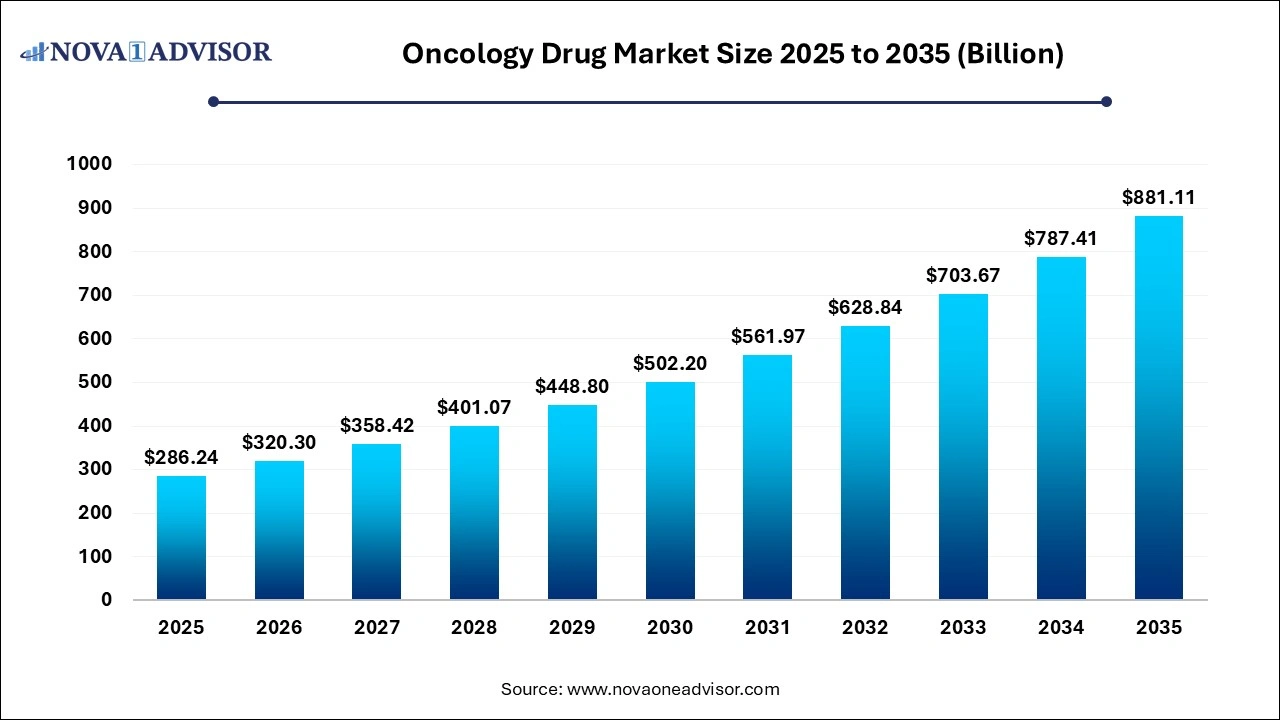
Key Takeaway
- By therapy type, the targeted therapy segment dominated the market with the largest share in 2025.
- By therapy type, the immunotherapy segment is expected to grow at the fastest CAGR over the forecast period.
- By indication type, the lung cancer segment dominated the market with the largest share in 2025.
- By region, North America dominated the market with the largest share in 2025.
Market Overview
The Oncology Drug Market includes pharmaceutical and biologic therapies used to treat cancer, spanning chemotherapy, targeted therapies, immunotherapies, hormonal therapies, antibody-drug conjugates, and cellular therapies. Market growth is supported by the rising global cancer burden, increasing diagnosis rates, expanding treatment access, and continued pharmaceutical investment in oncology research.
A major shift is the move toward precision oncology, where treatment selection is increasingly based on tumor biomarkers and molecular characteristics. Targeted therapies and biomarker-driven medicines are expanding treatment options across cancers such as lung and breast cancer, while successful therapies are increasingly being evaluated in earlier disease stages.
The market is also advancing toward personalized and next-generation treatments, including individualized cancer vaccines and combination therapies. Overall, competitive growth is increasingly shaped by clinical outcomes, biomarker specificity, treatment durability, safety, dosing convenience, and the ability to address larger patient populations across different stages of cancer.
Market Outlook
- Market Growth Overview: The global oncology drug market is expected to grow significantly between 2025 and 2035, driven by the increasing incidence of cancer across the globe.
- Sustainability Trends: Sustainability trends involve maintaining soaring financial costs, production eco-efficiency, and long-term clinical viability.
- Major Investors: Major investors in the market include Merck & Co., AstraZeneca, and Bristol-Myers Squibb.
How is AI Impacting The Global Oncology Drug Market?
Artificial intelligence (AI) is reshaping the market by driving early drug discovery, minimizing research costs, and transitioning the market towards precision medicine. Furthermore, computational models identify toxicity and stability issues much earlier, which reduces costly candidate failures during preclinical testing.
Major Trends in the Market
- Expansion of precision oncology: Treatment decisions increasingly depend on genomic and molecular characteristics rather than tumor location alone.
- Rapid growth of antibody-drug conjugates: ADCs are combining antibody targeting with potent cytotoxic payloads and expanding into multiple tumor types.
- Growth of immunotherapy combinations: Checkpoint inhibitors are increasingly combined with chemotherapy, targeted drugs, ADCs, vaccines, and other immune-modulating approaches.
- Personalized cancer vaccines: Individualized mRNA and neoantigen-based approaches are moving toward larger clinical studies.
- Earlier use of innovative therapies: Successful medicines are increasingly being tested in neoadjuvant and adjuvant settings.
- Biomarker-driven clinical trials: Pharmaceutical companies are increasingly designing trials around molecularly defined patient populations.
Oncology Drug Market Report Scope
| Report Coverage | Details |
| Market Size in 2026 | USD 320.30 Billion |
| Market Size by 2035 | USD 881.11 Billion |
| Growth Rate From 2026 to 2035 | CAGR of 11.9% |
| Base Year | 2025 |
| Forecast Period | 2026 to 2035 |
| Segments Covered | By Therapy Type, By Indication Type, By Region |
| Market Analysis (Terms Used) | Value (USD Million/Billion) or (Volume/Units) |
| Regional Scope | North America; Europe; Asia Pacific; Central and South America; the Middle East and Africa |
| Key Companies Profiled | F. Hoffmann-La Roche Ltd, Novartis AG, Bayer Ag,Merck & Co., Inc.,and Johnson & Johnson Services, Inc. among others |
Market Driver – Rising Global Cancer Burden and Treatment Demand
The growing global cancer burden, combined with improved screening, diagnosis, and treatment access, is increasing demand for oncology drugs. Longer patient survival and the availability of multiple treatment lines are also expanding opportunities for sequential and combination therapies. Advances in biomarker testing further support demand for targeted medicines.
Market Restraint – High Treatment Costs and Access Inequality
High prices for innovative oncology therapies can create significant reimbursement and affordability challenges. Complex biologics, cellular therapies, antibody-drug conjugates, and personalized treatments often require expensive manufacturing, testing, and delivery processes. Unequal access to advanced cancer care, particularly across lower-income markets, further limits market penetration.
Market Opportunity – Personalized and Biomarker-Driven Oncology
Personalized and biomarker-driven oncology offers substantial long-term growth potential. Targeted therapies, companion diagnostics, tumor-agnostic drugs, genomic testing, and personalized cancer vaccines are enabling treatment selection based on tumor biology rather than cancer location alone. AI can further support biomarker discovery, patient selection, and treatment-response prediction.
Segmental Insight
By Therapy Type
Why did the targeted therapy segment dominate the global oncology drug market?
The targeted therapy segment dominated the market with the largest share in 2025. The dominance of the segment can be attributed to the increasing adoption of biomarker-based treatment and precision medicine approaches. In addition, a surge in global cancer diagnosis volumes, especially in indications such as breast and lung cancer, generates much higher demand for personalized treatments.
How did the immunotherapy segment expected to hold the significantly growing global oncology drug market in the coming years?
The immunotherapy segment is expected to grow at the fastest CAGR over the forecast period. The growth of the segment can be credited to the increasing investments in immuno-oncology research and favourable reimbursement coverage policies. Also, major market players are heavily funding intensive research and clinical trials trying various precision oncology and combination regimens.
By Indication Type
Why did the lung cancer segment dominate the global oncology drug market?
The lung cancer segment dominated the market with the largest share in 2025. The dominance of the segment can be linked to the surge in molecular testing for biomarkers like ALK and PD-L1, along with the rise in adoption of personalized treatment options. Furthermore, a surge in healthcare spending and enhanced reimbursement structures in developing economies broaden access to new cancer drugs.
How did breast cancer segment expected to hold the significantly growing global oncology drug market in the coming years?
The breast cancer segment is expected to grow at the fastest CAGR during the projected period. The growth of the segment can be driven by ongoing innovations in HER2-targeted therapies and a surge in awareness and screening programs. Moreover, the extensive availability of new oral oncology medications and the expansion of telemedicine facilities can make treatments more accessible.
By Region
Why did the North American region account for the largest share of the global oncology drug market?
North America dominated the market with the largest share in 2025. The dominance of the region can be attributed to the presence of advanced healthcare infrastructure and growing adoption of immunotherapies and targeted therapy options. In addition, significant funding from public organizations such as the National Institutes of Health (NIH) and heavy investments by major players can fuel market growth further.
U.S. Global Oncology Drug Market Trends
The growth of the market in the country can be driven by the robust investments in precision medicine and oncology research coupled with the increasing cancer incidence. Also, optimized and fast-track review pathways by federal agencies help propel commercial availability for cutting-edge complex biologics and oncology drugs.
Why did the Asia-Pacific region become the fastest-growing global oncology drug market during the forecast period?
Asia Pacific is expected to grow at the fastest CAGR over the forecast period. The growth of the region can be credited to the increasing cancer prevalence and rising access to advanced oncology therapies in emerging economies such as China and India. Furthermore, the wide availability of cost-efficient biosimilars increases patient access to costly biologic drugs across developed economies.
- In November 2025, Pharmasyntez Group has established an oncology medication manufacturing facility in Cambodia. The initiative involves constructing a state-of-the-art pharmaceutical complex. It will facilitate the incremental transfer of drug production technology from the company’s Russian facilities.
China Global Oncology Drug Market Trends
The market in the country is growing due to the surge in the geriatric population, government policy support, and increasing cancer prevalence across the major cities. Moreover, drug developers are increasingly emphasising precision medicine, which attacks certain cancer cells while protecting healthy tissue.
Key Players in the Global Oncology Drug Market
- AstraZeneca (UK): A dominant player in targeted therapeutics, particularly for lung and breast cancers. Its blockbuster drug Tagrisso (osimertinib) leads the market for EGFR-mutated non-small cell lung cancer (NSCLC).
- Novartis (Switzerland): Novartis has heavily invested in expanding its oncology portfolio, notably through the €2.7 billion acquisition of MorphoSys AG to acquire advanced lymphoma therapies like tafasitamab.
- Johnson & Johnson / Janssen (US): It possesses a commanding footprint in hematological oncology (blood cancers), led by the massive blockbuster drug Darzalex (daratumumab) for multiple myeloma.
Recent Developments
- In June 2026, Dr. Reddy’s Laboratories has officially announced the first-to-market U.S. launch of Bosutinib Tablets (400 mg), which serve as the generic equivalent to Bosulif®, a cancer treatment developed by Pfizer subsidiary Wyeth.
Segments Covered in the Report
This report forecasts revenue growth at country levels and provides an analysis of the latest industry trends in each of the sub-segments from 2021 to 2035. For this study, Nova one advisor, Inc. has oncology drugs market.
By Therapy Type
- Chemotherapy
- Targeted Therapy
- Immunotherapy
By Indication Type
- Lung Cancer
- Stomach Cancer
- Colorectal Cancer
- Breast Cancer
- Prostate Cancer
By Region
- North America
- Europe
- Asia-Pacific
- Latin America
- Middle East & Africa (MEA)
FAQ's

Proceed to Buy
Instant PDF delivery on confirmation
 Request Customization
 Download Sample

Get a Sample of this Report
Oncology Drug Market