

Protein Assays Market Size, Share, and Trends 2026 to 2035
 Status Published
 Category Healthcare


Content
Protein Assays Market Summary
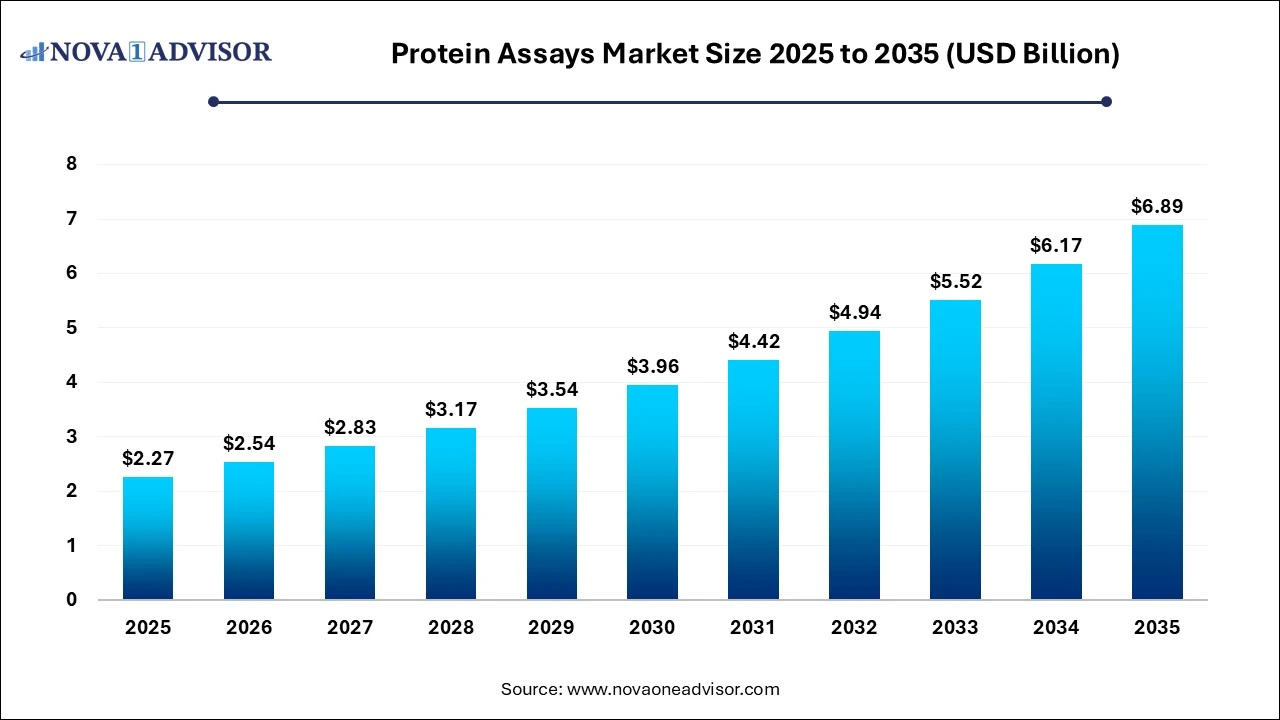
The global protein assays market size was estimated at USD 2.27 billion in 2025 and is projected to hit around USD 6.89 billion by 2035, growing at a CAGR of 11.75% during the forecast period from 2026 to 2035.
Market Key Takeaways:
- The Protein Assays market is experiencing significant growth due to increasing demand for diagnostic tools, drug discovery, and personalized medicine.
- AI is playing a transformative role by enhancing the precision and speed of protein analysis in various applications.
- Key trends include the development of high-throughput screening technologies, increasing research in personalized medicine, and a rise in disease-specific assays.
- The primary driver is the demand for efficient and accurate diagnostic tests in the pharmaceutical industry, while a restraint is the high cost of advanced protein assay kits.
- Opportunities lie in integrating AI and automation in assay development to improve scalability and efficiency.
Market Overview
The Protein Assays market is critical in the research and development of pharmaceuticals, diagnostics, and personalized medicine. Protein assays are laboratory methods used to measure the concentration of proteins in a given sample, which is a fundamental process for understanding disease mechanisms, drug efficacy, and therapeutic intervention. The increasing global focus on precision medicine, coupled with advances in biotechnology and pharmaceuticals, is fueling the demand for protein assays.
In recent years, there has been a significant rise in drug discovery activities, particularly in oncology, neurology, and immunology, which has driven the need for protein assays in the pharmaceutical and biotechnology industries. Moreover, the growing awareness of early disease detection, especially in conditions like cancer and cardiovascular diseases, is also contributing to the market's growth.
The Protein Assays market is characterized by a variety of product types, including kits, reagents, and instruments, each playing a crucial role in research and diagnostic applications. The market is highly competitive, with numerous players providing cutting-edge technologies to improve the accuracy and efficiency of protein assays. As a result, the market is poised to expand with the increasing application of protein assays in diverse fields such as drug discovery, disease diagnostics, and environmental monitoring.
Market Outlook
- Market Growth Overview: The global protein assays market is expected to grow significantly between 2025 and 2034, driven by the rising chronic disease prevalence, growing demand for personalized medicine, and high pharmaceutical and biotech research and development investment.
- Sustainability Trends: Sustainability trends involve eco-friendly manufacturing, energy-efficient equipment, and green lab solutions.
- Major Investors: Major investors in the market include Thermo Fisher Scientific, Bio-Rad Laboratories, and Merck KGaA.
How is AI Transforming the Protein Assays Market?
Artificial Intelligence (AI) is making a profound impact on the Protein Assays market by enhancing the speed, precision, and scalability of protein analysis. AI algorithms are being employed to interpret vast amounts of data generated through protein assays, significantly improving the ability to identify protein interactions, disease biomarkers, and therapeutic targets.
AI-driven systems enable more accurate analysis by learning from vast datasets and continuously improving the accuracy of protein measurements. For example, machine learning algorithms can now be used to predict the structure and function of proteins, which is crucial for drug discovery and disease modeling. These systems also provide faster results compared to traditional methods, reducing the time required to develop new therapies and diagnose diseases.
Moreover, AI applications are driving innovation in high-throughput screening methods, where massive numbers of samples are tested simultaneously, enabling pharmaceutical companies to identify promising drug candidates more efficiently. The integration of AI with protein assays is also expected to lead to more personalized treatment plans, as AI systems analyze patient-specific protein markers to recommend the most effective treatment options.
Major Trends in the Market
- Integration of AI in Protein Assays: The integration of AI technologies in protein assays is enhancing the precision, speed, and scalability of tests, improving outcomes in drug discovery and disease diagnostics.
- Rise in High-Throughput Screening: The adoption of high-throughput screening technologies is driving growth, as they enable the testing of large numbers of protein samples quickly, improving the efficiency of drug discovery.
- Increase in Personalized Medicine: The growing emphasis on personalized medicine, which tailors treatment to individual genetic profiles, is spurring the demand for protein assays to identify disease-specific biomarkers.
- Development of Disease-Specific Assays: Companies are increasingly developing protein assays that target specific diseases, such as cancer, cardiovascular disease, and neurodegenerative disorders, fueling market demand.
- Focus on Automation: Automation in protein assays is improving the efficiency and reproducibility of results, leading to faster diagnostic processes and reduced human error.
Protein Assays Market Report Scope
| Report Coverage | Details |
| Market Size in 2026 | USD 2.54 Billion |
| Market Size by 2035 | USD 6.89 Billion |
| Growth Rate From 2026 to 2035 | CAGR of 11.75% |
| Base Year | 2025 |
| Forecast Period | 2026 to 2035 |
| Segments Covered | By Product Type,By Application, By End User, Region |
| Market Analysis (Terms Used) | Value (USD Million/Billion) or (Volume/Units) |
| Regional Scope | North America; Europe; Asia Pacific; Central and South America; the Middle East and Africa |
| Key Companies Profiled | Thermo Fisher Scientific, Bio-Rad Laboratories, Agilent Technologies, Sigma-Aldrich (Merck Group), PerkinElmer, Abcam, Cell Signaling Technology, Promega Corporation, Cytiva, GE Healthcare |
Driver: Demand for Efficient and Accurate Diagnostic Tests
One of the primary drivers of the Protein Assays market is the increasing demand for efficient and accurate diagnostic tests. As the healthcare sector continues to prioritize early detection of diseases, particularly cancer, cardiovascular diseases, and neurodegenerative disorders, there is a growing need for protein assays that can provide reliable and precise results.
Protein assays enable the detection of biomarkers, which are critical for diagnosing various diseases and monitoring disease progression. With the growing emphasis on personalized medicine, healthcare providers are increasingly relying on protein assays to identify the specific proteins associated with a patient's condition. This shift toward more personalized, targeted treatments is contributing significantly to the market growth, as more healthcare providers and pharmaceutical companies adopt protein assays to improve patient outcomes.
The development of more accurate, high-sensitivity assays, especially those capable of detecting low-abundance proteins, is also driving market growth. These advances are essential for disease detection at earlier stages, which is critical for improving survival rates in diseases such as cancer.
Restraint: High Cost of Advanced Protein Assay Kits
Despite the growing demand, the high cost of advanced protein assay kits remains a significant restraint in the market. The development of sophisticated assays, especially those incorporating novel technologies like high-throughput screening and AI-driven systems, requires substantial investment in research, development, and manufacturing. These advanced assays are often priced higher, making them inaccessible to smaller laboratories and healthcare facilities, particularly in emerging markets.
Moreover, the maintenance and calibration of such high-tech instruments can add to the overall cost of protein assays, further limiting their widespread adoption. While the cost of protein assays is expected to decrease over time as technologies evolve and scale, the high initial cost remains a barrier to the broader implementation of advanced testing methods.
Opportunity: Growing Adoption of Automation in Protein Assays
One of the most promising opportunities in the Protein Assays market is the growing adoption of automation technologies. Automation is transforming laboratory workflows by reducing manual labor, increasing throughput, and minimizing human error. As laboratories and pharmaceutical companies strive to accelerate drug discovery and disease diagnostics, automation is becoming a key enabler of high-efficiency testing processes.
Automated systems, such as robotic liquid handlers and automated analyzers, allow for faster, more consistent sample processing, which is essential for high-throughput screening and large-scale clinical trials. The use of automated systems in conjunction with protein assays can significantly improve the overall efficiency of laboratories, reducing turnaround times and improving productivity. Furthermore, the integration of AI in automated systems can lead to even greater advancements in protein assays, offering real-time analysis and actionable insights.
This shift towards automation is expected to open up new market opportunities, particularly in high-demand sectors like pharmaceutical research, clinical diagnostics, and biotechnology.
Segmental Insights
By Product Type
How did the protein reagent segment dominate the Global Protein Assays market?
The protein reagent segment is driven by the high-volume consumables within the rapidly expanding field of precision diagnostics. By integrating high-sensitivity labelling with automated workflows, manufacturers are meeting the rigorous demands of modern clinical research. The sector is positioned for sustained long-term growth, driven by the continuous global investment in personalized healthcare solutions.
How did the kits segment expect to hold the fastest-growing Global Protein Assays market in the coming years?
The kits segment is driven by the integration of high-throughput automation and the escalating demand for large-molecule drug development. By providing standardized, high-sensitivity solutions that reduce operational complexity, manufacturers are securing deep integration into the global R&D and diagnostic value chains.
By Application
How did the drug discovery and development segment account for the largest share in the Global Protein Assays market?
The drug discovery and development segment is driven by the escalating focus on protein-based drug discovery, and the strategic expansion of specialized outsourcing partners is fundamentally driving the regional assay market. By integrating advanced quantification tools with localized clinical trial networks, Asia-Pacific and Latin American hubs are becoming vital to the global pharmaceutical supply chain.
The disease diagnosis segment accounts for the largest share in the Global Protein Assays market.
The disease diagnosis segment is driven by the convergence of high-sensitivity multiplexing and a global shift toward early-stage preventive diagnostics. By leveraging automated profiling to manage the rising burden of chronic diseases, manufacturers are securing essential roles within the modern clinical value chain. The sector is positioned for robust growth as protein-based insights become foundational to personalized, real-time patient care.
By End Use
How did the pharmaceutical and biotechnology industries segment account for the largest share in the Global Protein Assays market?
The pharmaceutical and biotechnology industries segment is driven by massive R&D spending and the industry-wide pivot toward complex biologic drug development. As pharmaceutical firms increasingly leverage the specialized capabilities of CROs and CDMOs, the demand for standardized, high-precision analytical tools continues to scale globally. The strategic corporate alliances ensure that protein-based insights remain the primary engine for innovation in modern medicine.
How did the hospital and clinics segment expect to hold the fastest-growing Global Protein Assays market in the coming years?
The hospitals and clinics segment is driven by a transition toward early detection and the rapid expansion of healthcare infrastructure in emerging markets. By integrating high-sensitivity automated platforms and decentralised point-of-care tools, hospitals are significantly enhancing their diagnostic precision and operational efficiency. The market is shifting toward a model of personalised, data-driven patient care where protein biomarkers serve as the foundational elements for clinical decision-making and therapeutic monitoring.
By Regional
How did the North America region account for the largest share in the Global Protein Assays market?
North America’s substantial public-private investments and the specialized requirements of a high-density biotechnological ecosystem. By leveraging advanced automated infrastructure to address the escalating prevalence of chronic diseases, these regions are successfully institutionalizing precision medicine.
U.S. Global Protein Assays Market Trends
The U.S. intensive investment in drug discovery and the production of therapeutic proteins. The rapid adoption of high-sensitivity detection methods and automated, high-throughput screening systems has significantly accelerated research workflows. A strategic focus on proteomics and biomarker identification is catalyzing the shift toward multiplexing, allowing for the simultaneous detection of multiple targets to enhance operational efficiency.
How did the Asia Pacific region hold the fastest-growing Global Protein Assays Market in the forecast period?
Asia Pacific’s intense investment in biopharmaceutical research and development across China and India is catalyzing a surge in demand for advanced protein expression and biomarker discovery tools. The rapid adoption of multiplex assays and automated high-sensitivity platforms is designed to facilitate early disease detection and personalized medicine.
China Global Protein Assays Market Trends
China’s shift toward targeted therapeutics and protein-based drug development. The integration of automation and microfluidics facilitates high-throughput screening while significantly reducing operational costs and enhancing analytical sensitivity. The market is experiencing a notable shift toward fluorescence-based assays, which are outperforming traditional colorimetric methods due to the escalating demand for high-precision quantification.
Key Players in the Global Protein Assays Market
- GE Healthcare
GE Healthcare (now part of Danaher/Cytiva) contributes to the market by providing advanced protein separation, purification, and analysis systems used heavily in biopharmaceutical development.
- Thermo Fisher Scientific
Thermo Fisher Scientific dominates the protein assay market with a comprehensive portfolio of reagents, kits (such as BCA and Bradford assays), and automated instrumentation for protein detection.
- Bio-Rad Laboratories Inc.
Bio-Rad Laboratories is a major contributor, particularly known for its widely used protein assay kits, including Bradford and Lowry-based kits, as well as pioneering droplet digital PCR (ddPCR) for sensitive protein studies.
Segments Covered in the Report
This report forecasts revenue growth at country levels and provides an analysis of the latest industry trends in each of the sub-segments from 2021 to 2035. For this study, Nova one advisor, Inc. has segmented the protein assays market.
By Product Type
- Kits
- Reagents
- Instruments and Accessories
By Application
- Drug Discovery and Development
- Disease Diagnosis
- Other Applications
By End User
- Pharmaceutical and Biotechnology Industries
- Hospitals and Clinics
- Other End Users
By Region
- North America
- Europe
- Asia Pacific
- Latin America
- Middle East and Africa (MEA)

Proceed to Buy
Instant PDF delivery on confirmation

 Request Customization
 Download Sample

Get a Sample of this Report
Protein Assays Market