

Protein Trends & Technologies Market Size, Share, and Trends 2026 to 2035
 Status Published
 Category Healthcare


Content
Protein Trends & Technologies Market Summary
The global protein trends & technologies market size was estimated at USD 7.25 billion in 2025 and is projected to hit around USD 15.22 billion by 2035, growing at a CAGR of 7.7% during the forecast period from 2026 to 2035.
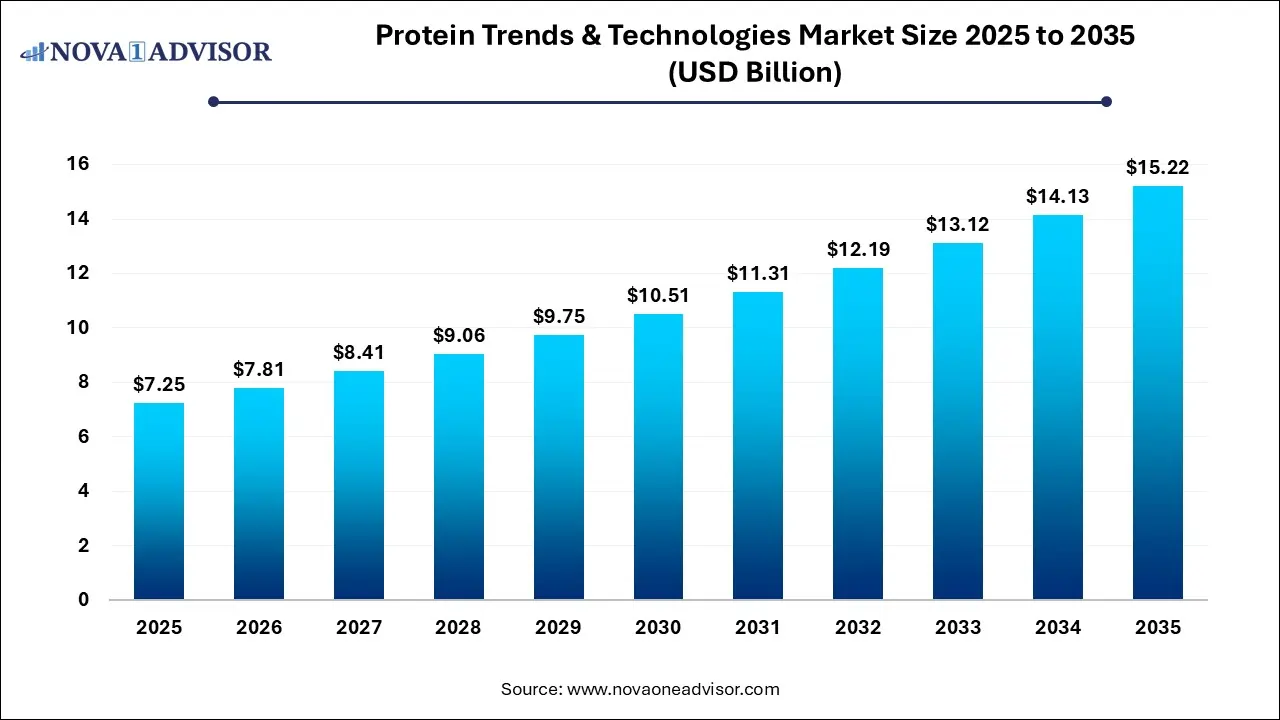
Market Overview
The Protein Trends & Technologies Market refers to the growing interest and investment in proteins derived from various sources such as plants, animals, and microorganisms, used in a wide range of industries including food and beverages, pharmaceuticals, and animal feed. Proteins play an essential role in human nutrition, and with the growing global demand for health-conscious, sustainable food products, the market for protein technologies has expanded substantially.
Proteins sourced from plants like peas, soy, and rice, as well as microbes like yeast and fungi, are being developed to cater to the rising demand for vegetarian, vegan, and sustainable dietary alternatives. Animal-based proteins, including whey and casein, remain significant in many applications, especially in the supplement and pharmaceutical industries. The growing awareness of sustainability and health benefits related to plant-based protein has further fueled this transformation in consumer diets.
Furthermore, protein technology has evolved, with new methods for protein extraction, fermentation, and purification, ensuring that protein products are of high quality and can be produced in scalable, cost-effective ways. With technological advancements such as the use of AI in the development and testing of protein-based products, the market is experiencing accelerated growth and innovation.
Market Outlook
- Market Growth Overview: The global protein trends & technologies market is expected to grow significantly between 2025 and 2034, driven by the rising health and immunity awareness, plant-based and alternative protein shift, and expansion of sport nutrition and functional foods.
- Sustainability Trends: Sustainability trends involve plant-based expansion, precision fermentation, and insect-based proteins.
- Major Investors: Major investors in the market include Nestlé S.A., Cargill, Inc., Archer Daniels Midland Company (ADM), Danone S.A., and Kerry Group plc.
How is AI Transforming the Protein Trends & Technologies Market
AI is playing a significant role in revolutionizing the Protein Trends & Technologies Market by accelerating protein research, improving production processes, and increasing product innovation. Artificial intelligence is being used in various ways, including the design of proteins with specific functionalities and enhancing the precision of protein extraction methods.
AI-enabled technologies can analyze large datasets quickly, helping researchers identify the most efficient methods for extracting proteins from plant, animal, and microbial sources. AI is also used to simulate protein folding and interactions, enabling the development of custom proteins tailored for specific applications, such as texturizing agents or emulsifiers.
In the food and beverage industry, AI-driven technologies are enabling manufacturers to develop new protein-based products that meet specific dietary needs, such as gluten-free, vegan, or high-protein foods. Machine learning models are being employed to optimize flavor profiles, texture, and nutritional content of new protein products, offering consumers healthier, better-tasting alternatives.
Moreover, AI technologies are enhancing supply chain management by predicting the demand for different types of proteins based on consumer preferences, environmental conditions, and other variables. This helps companies optimize their production lines, minimize waste, and reduce costs.
Major Trends in the Market
- Growing Demand for Plant-Based Proteins: As consumer interest in plant-based diets rises, plant-based proteins are becoming a dominant trend in the food and beverage sector, with products like plant-based meat and dairy alternatives leading the way.
- Technological Advancements in Protein Extraction: New and improved extraction methods, such as fermentation and enzyme technology, are making it easier to extract high-quality proteins from diverse sources.
- Personalized Nutrition: As health and wellness become increasingly personalized, there is a surge in demand for tailored protein supplements and foods that cater to individual nutritional needs.
- Sustainability: A growing focus on environmental sustainability is driving demand for microbial and plant-based protein sources, as they have a lower environmental footprint compared to animal-based proteins.
- Emerging Microbial Proteins: Protein derived from microorganisms such as yeast, fungi, and bacteria is becoming more popular due to its sustainability and ability to be produced efficiently at a large scale.
- Nutraceutical and Pharmaceutical Integration: Proteins are being integrated into nutritional supplements and pharmaceutical products, addressing increasing consumer demand for functional foods and therapies.
Protein Trends & Technologies Market Report Scope
| Report Coverage | Details |
| Market Size in 2026 | USD 7.81 Billion |
| Market Size by 2035 | USD 15.22 Billion |
| Growth Rate From 2026 to 2035 | CAGR of 7.7% |
| Base Year | 2025 |
| Forecast Period | 2026 to 2035 |
| Segments Covered | Application, Source, Form, Functionality, Region |
| Market Analysis (Terms Used) | Value (USD Million/Billion) or (Volume/Units) |
| Regional Scope | North America; Europe; Asia Pacific; Central and South America; the Middle East and Africa |
| Key Companies Profiled | Rigaku Corporation (Japan), Hampton Research Corp. (U.S.), Jena Bioscience GmbH (Germany), Thermo Fisher Scientific Inc. (U.S), Molecular Dimensions Ltd. (U.K.), Formulatrix, Inc. (U.S.), Bruker Corporation (U.S.), MiTeGen LLC (U.S.), Agilent Technologies, Inc., Bio-Rad Laboratories, Inc. (U.S.),, EMD Millipore (U.S.), Life Technologies Corporation (U.S.), Oxford Expression Technologies Ltd. (U.K), Qiagen N.V. (Germany), Takara Bio Inc. (Japan) |
Segmental Insights
By Application
How did the food and beverage segment account for the largest share in the Global Protein Trends & Technologies market?
The food and beverage segment is driven by the profound transformation as high-protein diets move from a niche athletic focus to a mainstream health essential. The powerful combination of innovative plant-based options, rapid technological advancements that maintain taste, and the rise of convenient RTD formats. The protein-ification of everyday foods reflects a global consumer base that is increasingly proactive about using nutrition as a functional tool for long-term wellness.
How did the nutraceuticals segment expect to hold the fastest-growing Global Protein Trends & Technologies market in the coming years?
The nutraceuticals segment is driven by the shift toward proactive wellness, where preventive care and personalized, AI-driven recommendations are becoming industry standards. This evolution is accelerated by the rise of clean-label, plant-based alternatives and the explosive growth of the functional beverage sector, catering to a more health-conscious and mobile consumer.
By Source
How did the plant-based segment account for the largest share in the Global Protein Trends & Technologies market?
The plant-based segment is driven by the global transition toward plant-based proteins is driven by a convergence of health-conscious lifestyles and a growing ethical commitment to environmental sustainability. This shift is made possible by breakthrough processing technologies that deliver superior taste and texture, allowing plant-derived products to compete directly with traditional animal proteins.
How did the animal-based segment expect to hold the fastest-growing Global Protein Trends & Technologies market in the coming years?
The animal-based segment is driven by the premiumization of pet food and sports nutrition, with key segments, such as whey and egg protein, seeing double-digit expansion rates. Geographically, the Asia-Pacific region is leading the surge, driven by rapid urbanization and increased consumer spending on health-focused products.
By Form
How did the powder segment dominate the Global Protein Trends & Technologies market?
The powder segment is driven by its exceptional logistics and stability, offering a cost-effective and globally distributable alternative to liquid formats. Its inherent versatility allows for high-protein customization across diverse applications, ranging from infant formula to specialized therapeutic diets. This market is further accelerated by a rising demand for variety, effectively capturing both the plant-based and traditional animal-protein consumer bases.
How did the liquid segment expect to hold the fastest-growing Global Protein Trends & Technologies market in the coming years?
The liquid segment is driven by the surging demand as advancements in stabilization technology resolve previous texture and shelf-life challenges, leading to a more premium consumer experience. The diversification of functional beverages, including protein-fortified coffees and dairy alternatives, aligns with on-the-go lifestyles.
By End Use
How did the dietary supplements segment dominate the Global Protein Trends & Technologies market?
The dietary supplements segment is driven by significant tailwind from a global shift toward preventative healthcare and proactive lifestyle management of sports nutrition and a surge in plant-based innovation, catering to both high-performance athletes and the expanding flexitarian demographic.
How did the sports nutrition segment expect to hold the fastest-growing Global Protein Trends & Technologies market in the coming years?
The sports nutrition segment is driven by the transition into a mainstream lifestyle sector, propelled by a strategic shift from elite athletics to a broader active-lifestyle demographic. The rapid e-commerce expansion and the diversification into plant-based innovations that prioritize flavour and functional variety. The highly dynamic industry is successfully leveraging digitalization and regional urbanization to normalize high-protein nutrition as a daily health essential.
By Regional
How did the North America region account for the largest share in the Global Protein Trends & Technologies market?
North America’s high consumer demand for functional foods and a widespread cultural shift toward plant-based alternatives. This expansion is underpinned by advanced extraction technologies and heavy R&D investments, particularly in the U.S., which ensure rapid product innovation and superior nutritional profiles.
U.S. Global Protein Trends & Technologies Market Trends
The U.S. is fundamentally shifting toward a multi-source ecosystem that balances sustainability with high-performance nutrition. The rapid growth of plant-based proteins and better-for-you functional foods is supported by advanced processing technologies like high-moisture extrusion and AI-driven analysis. The rise of hybrid products and a focus on complete amino acid profiles ensure that these new alternatives meet rigorous nutritional standards while satisfying mainstream consumer taste.
How did the Asia Pacific region hold the fastest-growing Global Protein Trends & Technologies Market in the forecast period?
Asia Pacific’s rising health consciousness and a significant cultural pivot toward plant-based alternatives in major hubs, such as China and Japan. This expansion is heavily supported by robust government initiatives and fortification programs that enhance regional food security and production standards. The explosion of direct-to-consumer e-commerce has revolutionized accessibility, allowing brands to scale quickly while reaching a massive, fitness-oriented millennial demographic.
China Global Protein Trends & Technologies Market Trends
China’s strategic shift toward domestic consumption and premium, clean-label products like hydrolysed whey. While the initial plant-based meat surge has stabilized, the industry is seeing a massive influx of investment into cellular agriculture and fermentation technologies to ensure long-term food security. This shift is supported by advanced analytical tools, such as mass spectrometry and protein chips, which guarantee the high purity and functionality required for specialized nutritional applications.
Key Players in the Global Protein Trends & Technologies Market
- Rigaku Corporation
Rigaku is a leader in protein crystallography, providing advanced X-ray diffraction systems (like the XtaLAB Synergy series) and software essential for determining the three-dimensional atomic structures of biological macromolecules.
- Hampton Research Corp.
Hampton Research serves the structural biology community by offering a vast catalog of specialized crystallization screening kits, reagents, and tools used to grow protein crystals for X-ray diffraction.
- Jena Bioscience GmbH
Jena Bioscience provides comprehensive tools for protein crystallography, including specialized crystallization screens (JBScreen) and innovative additives like Crystal Glue to stabilize fragile protein crystals.
Segments Covered in the Report
This report forecasts revenue growth at country levels and provides an analysis of the latest industry trends in each of the sub-segments from 2021 to 2035. For this study, Nova one advisor, Inc. has segmented the protein trends & technologies market.
By Form
- Powder
- Liquid
- Granular
By Source
- Plant-Based
- Animal-Based
- Microbial
By Application
- Food and Beverage
- Nutritional Supplements
- Animal Feed
- Pharmaceuticals
By Functionality
- Texturizing Agent
- Emulsifier
- Foaming Agent
- Thickening Agent
By Region
- North America
- Europe
- Asia Pacific
- Latin America
- Middle East and Africa (MEA)
FAQ's

Proceed to Buy
Instant PDF delivery on confirmation

Protein Trends & Technologies Market Size to Hit USD 15.22 Billion by 2035
 Request Customization
 Download Sample
Warning: Trying to access array offset on value of type null in /home/multiwpmr/public_html/report-details.php on line 1145

Get a Sample of this Report
Protein Trends & Technologies Market