

Pulmonary Drug Delivery Systems Market (By Product: Dry Powder Inhalers, Nebulizers, Metered Dose Inhalers, and Accessories; By Indication: COPD, Asthma, Cystic Fibrosis, Allergic Rhinitis, and Others; By Distribution Channel: Hospital Pharmacy, Retail Pharmacy, and E-Commerce) - Global Industry Analysis, Size, Share, Growth, Trends, Regional Outlook, and Forecast 2026 – 2035
 Status Published
 Category Healthcare


Content
Pulmonary Drug Delivery Systems Market Size and Growth 2026 to 2035
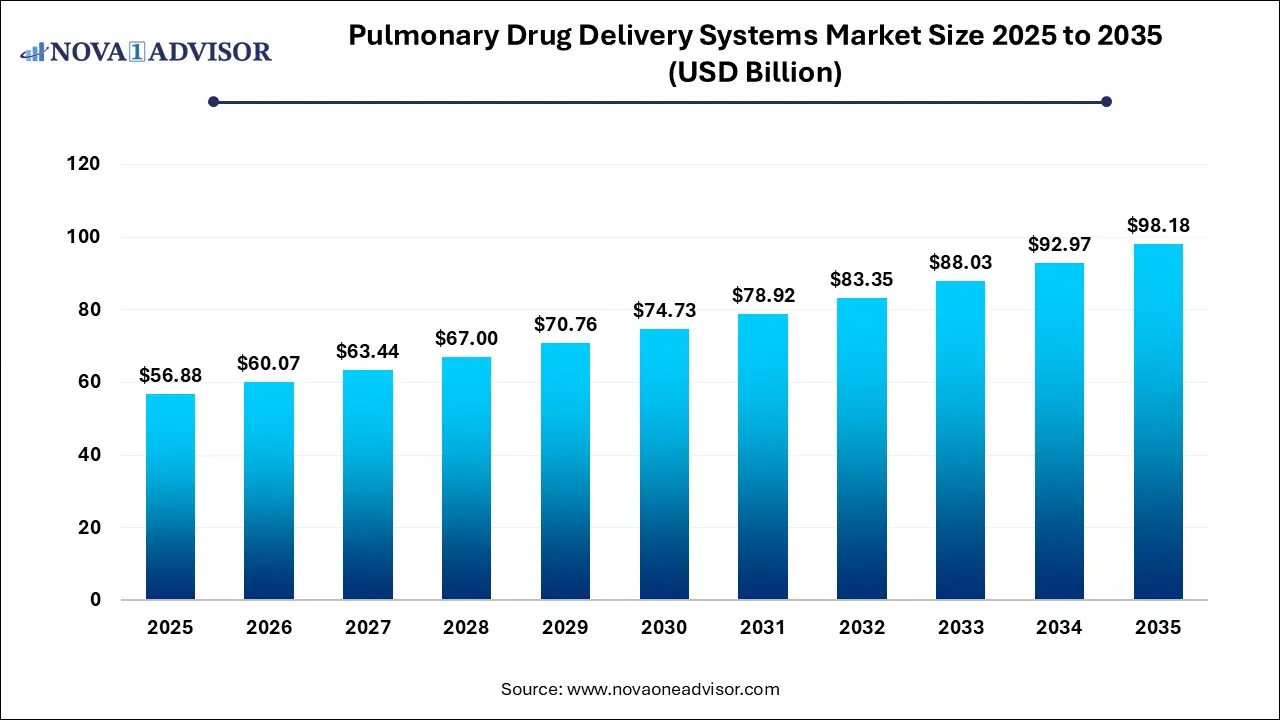
The global pulmonary drug delivery systems market size was exhibited at USD 56.88 billion in 2025 and is projected to hit around USD 98.18 billion by 2035, growing at a CAGR of 5.61% during the forecast period 2026 to 2035.
Key Takeaways:
- Pulmonary Drug Delivery Systems Market Size in the U.S. 2026 To 2035
- Metered dose inhalers segment garnered a market share of around 66% in 2025 and dominated the global pulmonary drug delivery systems market.
- Asthma was the leading segment based on the indication, in 2025
- Depending upon the distribution channel, the hospital pharmacy segment dominated the global pulmonary drug delivery systems market in 2025.
Growth Factors
Pulmonary drug delivery system is a targeted drug delivery in which a part of the drug is directed towards the targeted site or the respiratory tract. Simply, the pulmonary drug delivery systems is a device used for administration of drugs through the pulmonary route for the treatment of various respiratory diseases. The rising prevalence of respiratory diseases such as chronic obstructive pulmonary disease, asthma, and cystic fibrosis is the primary reason behind the burgeoning demand for the pulmonary drug delivery systems across the globe. According to the World Health Organization, COPD caused around 3.23 million deaths in 2019 and it was the third leading cause of death across the globe. Moreover, around 262 million people across the globe were affected with asthma in 2019, and it caused 461,000 deaths in the same year. Asthma is commonly prevailed among the children population. The rising pollution levels, extended exposure to harmful gases, exposure to tobacco smoke, fumes, and chemicals are some of the major reasons behind the increasing prevalence of respiratory diseases. As per the World Health Organization, around 90% of the people breathe pollutant air and around 7 million people die every year due to indoor and outdoor pollution. Therefore, the alarming rise in the number of pulmonary diseases and deaths associated with it is expected to spur the demand for the pulmonary drug delivery systems all over the globe.
The surging awareness regarding the pulmonary diseases and the availability of various pulmonary drug delivery devices is supporting the market growth. The easy availability of pulmonary drug delivery devices in the retail pharmacies and the e-pharmacies is expected to have a positive impact on the market. Moreover, the increased research & development activities has encouraged the development of innovative drug delivery systems and the new product launches by the market players is poised to have a significant effect on the demand for the pulmonary drug delivery systems across the globe. For instance, in October 2018, Philips launched a potable mesh nebulizer named InnoSpire Go. It is a portable, hand-held, and small-sized, and light-weight nebulizer that can administer drugs in just few minutes. Therefore, the presence of top manufacturers and their innovative product offerings are playing a significant role in the market growth.
Market Outlook
- Market Growth Overview: The pulmonary drug delivery systems market is expected to grow significantly between 2025 and 2034, driven by the rising respiratory diseases and pollution, growing home healthcare and self-administration, and the development of sophisticated drug formulations.
- Sustainability Trends: Sustainability trends involve next-generation propellants, propellant-free alternatives, and design for circularity.
- Major Investors: Major investors in the market include AstraZeneca, GlaxoSmithKline (GSK), Novartis AG, Boehringer Ingelheim, and Cipla Inc.
How AI is Impacting the Pulmonary Drug Delivery Systems Market
AI and ML are significantly accelerating the pulmonary drug delivery systems industry by speeding up the development process from drug delivery formulation. These technologies allow researchers to analyse vast datasets, optimizing particle size and drug-excipient interactions to enhance the efficacy of dry powder inhalers and nebulizers, particularly in treating chronic respiratory diseases, such as asthma and COPD. By leveraging predictive analytics, companies can create smart drug delivery devices, such as those employing Internet of Things sensors, to provide real-time patient monitoring and personalized dosage adjustment.
Pulmonary Drug Delivery Systems Report Scope
| Report Coverage | Details |
| Market Size in 2026 | USD 60.07 Billion |
| Market Size by 2035 | USD 98.18 Billion |
| Growth Rate From 2026 to 2035 | CAGR of 5.61% |
| Base Year | 2025 |
| Forecast Period | 2026-2035 |
| Segments Covered | Product, Indication, Distribution Channel, Region |
| Market Analysis (Terms Used) | Value (US$ Million/Billion) or (Volume/Units) |
| Regional Scope | North America; Europe; Asia Pacific; Central and South America; the Middle East and Africa |
| Key Companies Profiled | Philips Respironics, GlaxoSmithKline PLC, BoehringerIngelheim GmbH, TevaPharmaceutical Industries Ltd., 3M Healthcare, PARI GmbH, F. Hoffmann-La Roche AG, Gilbert Technologies, AstraZeneca PLC, Omron Healthcare, Inc. |
Market Driver
Rising Prevalence of Respiratory Diseases
The increasing prevalence of respiratory diseases is the primary driver of the pulmonary drug delivery systems market. Factors such as air pollution, smoking, occupational hazards, and changing lifestyles have significantly contributed to the growing incidence of conditions like asthma and COPD.
For instance, urbanization and industrialization have led to increased exposure to pollutants, which are major risk factors for respiratory diseases. In developing countries, poor air quality and limited access to healthcare further exacerbate the problem.
Pulmonary drug delivery systems provide an effective solution by delivering medication directly to the lungs, ensuring rapid relief and improved disease management. This is particularly important for chronic conditions such as COPD, where long-term treatment is required.
Additionally, the aging population is more susceptible to respiratory diseases, driving demand for these systems. Elderly patients often require easy-to-use devices, which has led to increased adoption of nebulizers and advanced inhalers.
Market Restraint
Improper Usage and Lack of Patient Adherence
One of the major challenges in the pulmonary drug delivery systems market is improper usage of inhalation devices and low patient adherence. Many patients, particularly the elderly and children, find it difficult to use inhalers correctly, which can reduce treatment effectiveness.
Incorrect inhalation techniques can lead to inadequate drug delivery, resulting in poor disease control and increased healthcare costs. Studies have shown that a significant percentage of patients do not use inhalers as prescribed, which negatively impacts outcomes.
Additionally, lack of awareness and training among patients and healthcare providers further contributes to this issue. In some regions, limited access to healthcare education exacerbates the problem.
Although smart inhalers and training programs are being introduced to address this challenge, widespread adoption remains limited due to cost and accessibility constraints.
Market Opportunity
Integration of Digital Health and Smart Drug Delivery Systems
The integration of digital health technologies presents a significant opportunity for the pulmonary drug delivery systems market. Smart inhalers equipped with sensors and connectivity features can track usage patterns, monitor adherence, and provide real-time feedback to patients and healthcare providers.
For example, connected inhalers can send reminders to patients, ensuring timely medication intake. They can also generate data that helps physicians adjust treatment plans based on patient behavior and response.
The use of mobile applications and cloud-based platforms further enhances the capabilities of these systems, enabling remote monitoring and telehealth integration. This is particularly beneficial for managing chronic respiratory conditions.
As healthcare systems increasingly adopt digital solutions, the demand for smart pulmonary drug delivery systems is expected to grow significantly, creating new opportunities for market players.
By Product Insights
Metered dose inhalers segment garnered a market share of around 66% in 2022 and dominated the global pulmonary drug delivery systems market. The key market players and their innovative metered dose inhalers have gained traction among the resulting in the dominance of this segment across the globe. The higher product acceptance among the consumers coupled with the increasing rise in the prevalence of pulmonary diseases has fostered the growth of the metered dose inhalers segment.
On the other hand, the nebulizers is expected to be the fastest-growing segment during the forecast period. Nebulizers offers various benefits such as favorable reimbursements, comfort, and easy administration of large doses, which makes it suitable for emergency and at-home use. Hence, this segment is expected to gain rapid traction in the foreseeable future.
By Indication Insights
Asthma was the leading segment based on the indication, in 2025. Asthma is a major non-communicable disease that affects both children and adults, as per the WHO. Rapid urbanization and changing lifestyle is a major reason behind the rising prevalence of asthma. The rising awareness regarding the management of asthma and easy availability of the pulmonary drug delivery systems has fueled the growth of this segment over the past years.
The allergic rhinitis is expected to grow at a moderate rate during the forecast period. The surging uses of dry powder inhalers, nasal sprays, and allergy shots for the treatment of allergic rhinitis is boosting the revenues of this segment. Furthermore, the rising prevalence of allergic rhinitis among the population is boosting the growth of this segment.
By Distribution Channel Insights
Depending upon the distribution channel, the hospital pharmacy segment dominated the global pulmonary drug delivery systems market in 2022. Hospitals provide quick treatments, east reimbursements, and extensive care, which has contributed towards the dominance of this segment. Moreover, wider availability of the pulmonary drug delivery devices in the hospital pharmacy makes it a popular choice among the patients.
E-commerce is estimated to be the most opportunistic segment during the forecast period. The rising penetration of internet, increasing adoption of smart devices, growing penetration of the online pharmacies across the globe, and quick home delivery services provided by them are the major factors that are expected to drive the growth of this segment in the forthcoming years.
By Region
North America dominated the market due to advanced healthcare infrastructure, high prevalence of respiratory diseases, and strong adoption of advanced technologies. The presence of major pharmaceutical and medical device companies further supports market growth in the region.
Government initiatives and favorable reimbursement policies also contribute to the widespread adoption of pulmonary drug delivery systems. Additionally, increasing awareness about respiratory diseases drives demand.
U.S. Pulmonary Drug Delivery Systems Market Trends
The U.S.’s rising respiratory disease prevalence and environmental factors accelerate the shift toward decentralized care. The move from traditional MDIs to high -growth digital smart inhalers and efficient vibrating mesh technologies that prioritize patient adherence. As care transitions into home-based settings, the integration of AI-driven monitoring ensures these portable devices deliver clinical-grade precision and improved long-term health outcomes.
China Pulmonary Drug Delivery Systems Market Trends
China’s rapidly aging population and the long-term respiratory consequences of high urbanization and air pollution levels. The shift toward digitally integrated and high-efficiency devices to manage these chronic conditions within a strained healthcare infrastructure. Chinas critical hub for large-scale manufacturing and the adoption of advanced respiratory therapeutic technologies.
Asia Pacific is the fastest-growing region driven by rising pollution levels, increasing healthcare expenditure, and growing awareness about respiratory health. Countries such as China and India are experiencing a surge in respiratory diseases, creating significant demand for these systems.
The expansion of healthcare infrastructure and government initiatives to improve healthcare access are further supporting market growth. As the region continues to develop, it is expected to offer substantial opportunities for market players.
Supply Chain Analysis of the Pulmonary Drug Delivery System Market
R&D and Formulation Development
This stage involves designing new active pharmaceutical ingredients and advanced formulations designed for inhaled administration, such as dry powders or novel propellant-free formulations.
- Key Players: AstraZeneca, GlaxoSmithKline (GSK), Boehringer Ingelheim, Novartis, Vectura Group, Chiesi Farmaceutici.
Device Engineering and Manufacturing
This stage involves the technical engineering of inhaler devices and nebulizers, focusing on actuation, dosage consistency, and patient-friendly designs. Innovations such as vibrating-mesh nebulizers and digital/smart add-ons that track patient usage are currently dominating this segment's R&D.
- Key Players: Koninklijke Philips, PARI GmbH, Omron Healthcare, Aptar Pharma, H&T Presspart, 3M.
Regulatory Affairs and Approvals
This critical stage involves obtaining approvals from regulatory bodies such as the FDA and EMA for new devices, generic inhalers, and novel propellant transitions.
- Key Players: GSK, AstraZeneca
Distribution and Marketing
This stage includes logistics, marketing, and the distribution of inhalers to end-users through hospital pharmacies, retail outlets, and e-commerce platforms.
- Key Players: Cardinal Health, AmerisourceBergen
Key Players in the Pulmonary Drug Delivery Systems Market
- Philips Respironics
Philips Respironics contributes to the pulmonary drug delivery market by providing advanced nebulizer technology, including portable vibrating-mesh nebulizers that enhance drug delivery efficiency for home care.
- GlaxoSmithKline PLC (GSK)
GSK is a leader in pulmonary drug delivery with its Ellipta dry powder inhaler (DPI) platform, facilitating once-daily, single-inhaler triple therapy for asthma and COPD.
- Boehringer Ingelheim GmbH
Boehringer Ingelheim, a pioneer in respiratory therapies for over 100 years, contributes through its innovative Respimat Soft Mist™ Inhaler, which provides precise medication delivery for COPD and asthma.
- Teva Pharmaceutical Industries Ltd.
Teva specializes in respiratory care by offering both branded and generic inhalation products, including its breath-activated RespiClick maintenance inhalers for asthma.
Segments Covered in the Report
This report forecasts revenue growth at global, regional, and country levels and provides an analysis of the latest industry trends in each of the sub-segments from 2021 to 2035. For this study, Nova one advisor, Inc. has segmented the global Pulmonary Drug Delivery Systems market.
By Product
- Dry Powder Inhalers
- Nebulizers
- Metered-Dose Inhalers
- Accessories
By Indication
- COPD
- Asthma
- Cystic Fibrosis
- Allergic Rhinitis
- Others
By Distribution Channel
- Retail Pharmacy
- Hospital Pharmacy
- E-Commerce
By Region
- North America
- Europe
- Asia-Pacific
- Latin America
- Middle East & Africa (MEA)
FAQ's

Proceed to Buy
Instant PDF delivery on confirmation

Pulmonary Drug Delivery Devices Market Size to Hit USD 98.18 Billion by 2035
 Request Customization
 Download Sample

Get a Sample of this Report
Pulmonary Drug Delivery Systems Market