

Pulmonary Function Testing Market Size, Share, and Trends 2026 to 2035
 Status Published
 Category Healthcare


Content
Pulmonary Function Testing Market Size and Growth 2026 to 2035
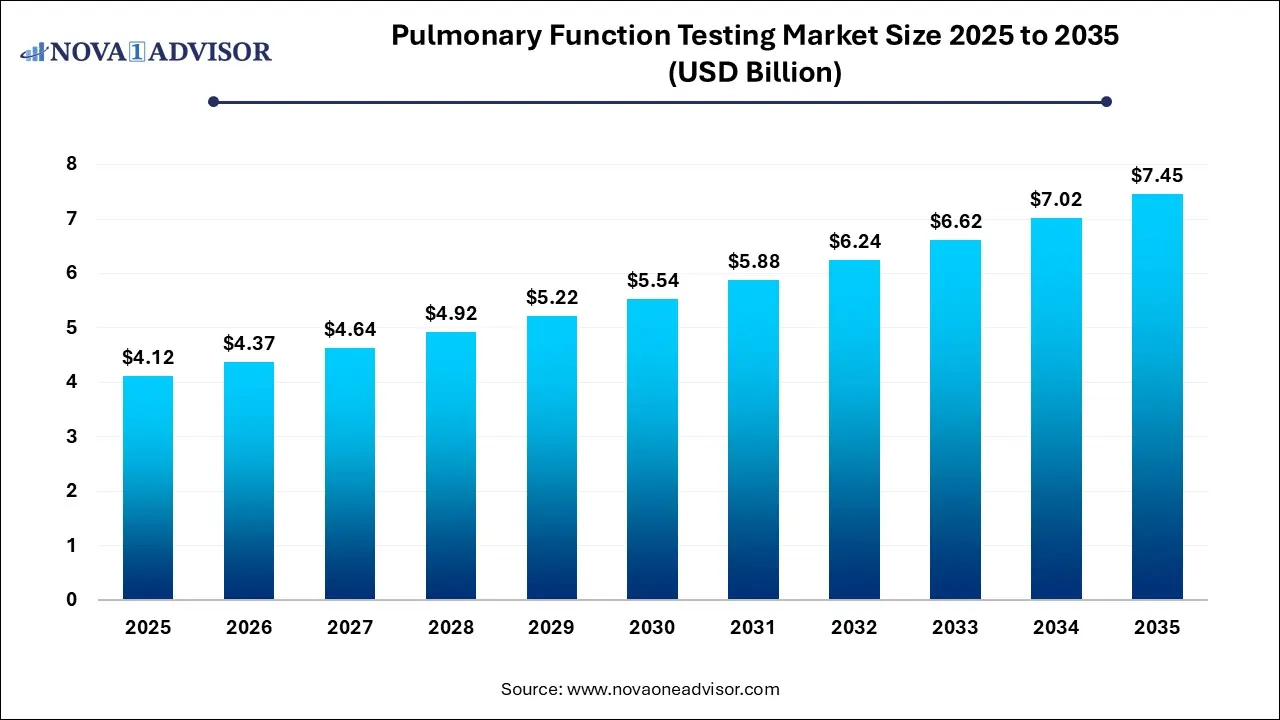
The global pulmonary function testing market size was estimated at USD 4.12 billion in 2025 and is projected to hit around USD 7.45 billion by 2035, growing at a CAGR of 6.11% during the forecast period from 2026 to 2035.
Market Key Takeaways
- The pulmonary function testing (PFT) market is expanding steadily due to the increasing prevalence of respiratory diseases such as COPD and asthma.
- Spirometry remains the most widely used and dominant test type across clinical settings.
- Portable PFT systems are witnessing rapid adoption due to rising demand for point-of-care and home-based diagnostics.
- Hospitals and clinical laboratories account for the largest market share, driven by higher patient volumes and advanced infrastructure.
- Software integration and digital health platforms are becoming essential components of modern PFT systems.
- North America leads the market, while Asia Pacific is emerging as the fastest-growing region due to rising healthcare investments.
- AI-enabled diagnostic tools are enhancing accuracy, workflow efficiency, and predictive capabilities in respiratory care.
Market Overview
The pulmonary function testing (PFT) market plays a critical role in the diagnosis, monitoring, and management of respiratory diseases. These tests measure lung capacity, airflow, and gas exchange efficiency, helping clinicians evaluate lung health and detect abnormalities. With the global burden of respiratory diseases increasing significantly, PFT systems have become indispensable tools in modern healthcare.
Chronic respiratory conditions such as chronic obstructive pulmonary disease (COPD), asthma, and interstitial lung diseases are among the leading causes of morbidity and mortality worldwide. Urbanization, air pollution, smoking prevalence, and occupational hazards are key contributors to this rise. For instance, in densely populated urban areas, prolonged exposure to pollutants has led to a surge in asthma and chronic bronchitis cases, thereby increasing the need for regular pulmonary assessments.
Pulmonary function testing is widely used across hospitals, diagnostic laboratories, and outpatient clinics. These tests are not only essential for diagnosing diseases but also for assessing disease progression and evaluating treatment effectiveness. For example, spirometry is routinely used to monitor asthma patients and adjust medication accordingly.
Technological advancements have significantly improved the accuracy and usability of PFT systems. Modern devices are equipped with digital interfaces, real-time data analytics, and connectivity features that allow integration with electronic health records (EHRs). This has enhanced clinical decision-making and patient management.
Furthermore, the COVID-19 pandemic underscored the importance of respiratory health monitoring. Post-COVID complications, including reduced lung capacity and long-term respiratory impairment, have increased the demand for pulmonary testing. This has created a sustained need for PFT systems in both clinical and home settings.
Market Outlook
- Market Growth Overview: The global pulmonary function testing market is expected to grow significantly between 2025 and 2035, driven by the rising prevalence of respiratory disease, increasing aging population, and expansion of telehealth and home testing.
- Sustainability Trends: Sustainability trends involve green manufacturing and materials, energy efficient and portability, and value-based care.
- Major Investors: Major investors in the market include Vyaire Medical, Inc., MGC Diagnostics Corporation, COSMED srl, ndd Medizitek AG, and Schiller AG.
How is AI Transforming the Pulmonary Function Testing Market?
Artificial Intelligence (AI) is playing a transformative role in the pulmonary function testing market by enhancing diagnostic accuracy, automating workflows, and enabling predictive healthcare.
AI-powered algorithms can analyze spirometry and other PFT data with high precision, identifying patterns that may not be easily detectable by human interpretation. For instance, AI can differentiate between obstructive and restrictive lung diseases by analyzing airflow curves and lung volumes. This reduces diagnostic errors and ensures early detection of conditions such as COPD.
In clinical settings, AI integration helps automate report generation and interpretation. Instead of manually analyzing test results, clinicians can rely on AI-driven systems to provide instant insights and recommendations. This is particularly beneficial in high-volume hospitals where time efficiency is critical.
Another significant application of AI is in remote monitoring. Portable PFT devices integrated with AI can track patient data in real time and alert healthcare providers to any abnormalities. For example, asthma patients using home spirometry devices can receive early warnings of exacerbations, enabling timely intervention.
AI is also enabling predictive analytics in respiratory care. By analyzing historical patient data, AI models can predict disease progression and hospitalization risks. This allows healthcare providers to implement preventive measures, improving patient outcomes and reducing healthcare costs.
Major Trends in the Market
- Growing adoption of portable and handheld PFT devices
- Increasing integration of AI and machine learning in diagnostics
- Rising demand for home-based and remote respiratory monitoring
- Expansion of telemedicine and digital health platforms
- Development of cloud-connected PFT systems
- Increasing focus on early diagnosis and preventive healthcare
- Technological advancements in spirometry and gas exchange testing
- Rising use of wearable respiratory monitoring devices
- Growth in post-COVID respiratory assessment programs
- Increasing investments in emerging healthcare markets
Pulmonary Function Testing Market Report Scope
| Report Coverage | Details |
| Market Size in 2026 | USD 4.37 Billion |
| Market Size by 2035 | USD 7.45 Billion |
| Growth Rate From 2026 to 2035 | CAGR of 6.11% |
| Base Year | 2025 |
| Forecast Period | 2026 to 2035 |
| Segments Covered | Type, Test Type, Component, Application, End User, Region |
| Market Analysis (Terms Used) | Value (USD Million/Billion) or (Volume/Units) |
| Regional Scope | North America; Europe; Asia Pacific; Central and South America; the Middle East and Africa |
| Key Companies Profiled | COSMED srl, Vyaire Medical, Inc, Schiller, Medical Equipment Europe GmbH, Medical Electronic Construction, ECO MEDICS AG, CHEST M.I., Inc, MGC Diagnostic Corporation, and Medical Technologies |
Segmental Insights
By Type
How did the complete PFT systems segment dominate the Global Pulmonary Function Testing market?
The complete PFT systems segment is driven by the urgent need to manage surging patient volumes for asthma and COPD. These integrated platforms offer all-in-one diagnostic capabilities, such as plethysmography and gas analysis, that are essential for accurately assessing complex respiratory illnesses. Enhanced by advanced digital connectivity and superior accuracy, complete systems remain the clinical standard over smaller devices.
How did the portable PFT systems segment expect to hold the fastest-growing Global Pulmonary Function Testing market in the coming years?
The portable PFT systems segment is driven by the transition toward decentralized care is accelerating the global adoption of portable PFT systems, empowering patients with remote and home-based respiratory monitoring. Enhanced by Bluetooth and cloud connectivity, these devices allow for seamless data sharing and improved diagnostic accuracy via AI-driven analytics. Their compact design has significantly increased accessibility within small clinics and independent centers, providing a cost-effective alternative to stationary units.
By Test Type
How did the spirometry segment account for the largest share in the Global Pulmonary Function Testing market?
The spirometry segment is driven by the integration of wireless and smart devices is revolutionizing the segment by delivering lab-grade accuracy in convenient, portable formats suitable for both clinics and home monitoring. This technological shift is particularly critical for the aging population, who require frequent and accessible screening to manage chronic lung conditions. The transition to digitalized, handheld solutions ensures that spirometry continues to dominate the market through enhanced reliability and patient ease of use.
How did the lung volume segment expect to hold the fastest-growing Global Pulmonary Function Testing market in the coming years?
The lung volume segment is driven by the critical need for precise lung volume measurements to assess disease severity. Modern advancements in body plethysmography have significantly improved the accuracy of calculating residual volume, offering a level of detail that standard spirometry cannot provide. This shift toward comprehensive patient evaluation makes lung volume testing an essential component of the diagnostic process in advanced respiratory care.
By Component
How did the hardware segment account for the largest share in the Global Pulmonary Function Testing market?
The hardware segment is driven by the innovation in compact and user-friendly devices is bridging the gap between hospital-grade accuracy and the growing demand for portable occupational and home care solutions. The continuous advancement of these tools ensures a robust infrastructure for the routine monitoring and early detection of industrial and chronic lung diseases.
How did the services segment expect to hold the fastest-growing Global Pulmonary Function Testing market in the coming years?
The services segment is driven by the integration of cloud-based analytics is transforming the sector, enabling real-time data interpretation and secure storage as remote and home-based monitoring becomes more prevalent. The heightened focus on preventative maintenance ensures that point-of-care diagnostics remain accurate and reliable, fulfilling the strict regulatory requirements of modern respiratory care.
By Application
How did the chronic obstructive pulmonary diseases segment account for the largest share in the Global Pulmonary Function Testing market?
The chronic obstructive pulmonary diseases segment is driven by the aging population and rising environmental hazards, necessitating more frequent diagnostic interventions and post-operative assessments. The integration of IoT-enabled smart devices and rapid testing hardware is revolutionizing how these chronic conditions are monitored, shifting care toward more efficient, data-driven solutions. As routine testing becomes a critical pillar of respiratory healthcare, the market is expanding to accommodate the high-volume needs of both hospitals and decentralized clinics.
How did the restrictive lung diseases segment expect to hold the fastest-growing Global Pulmonary Function Testing market in the coming years?
The restrictive lung diseases segment is driven by the escalating global prevalence of intestinal lung diseases and fibrosis is driving a critical need for high-precision diagnostics tools to monitor declining lung functionality. Technological breakthroughs in advanced plethysmography have significantly enhanced the accuracy of identifying restrictive patterns that traditional spirometry may overlook. This demand is further amplified by a growing geriatric population and proactive early diagnosis initiatives, particularly in occupational health settings.
By End User
How did the hospital/clinical laboratory segment account for the largest share in the Global Pulmonary Function Testing market?
The hospital/clinical laboratory segment is driven by the significant investment in sophisticated PFT infrastructure, including advanced plethysmography, allows for high-precision diagnostics that smaller facilities cannot replicate. By offering integrated clinical services, hospitals provide a comprehensive diagnostic pathway that combines lung function testing with imaging and laboratory analysis. This concentration of advanced technology and medical expertise ensures that hospitals remain the critical hub for the standardized management of COPD, asthma, and fibrosis.
How did the diagnostics laboratories segment expect to hold the fastest-growing Global Pulmonary Function Testing market in the coming years?
The diagnostics laboratories segment is driven by the integration of AI-assisted interpretation and digital spirometry is significantly enhancing accuracy for complex assessments, such as gas diffusion and lung volume. The shift toward decentralized care, where portable devices enable high-quality respiratory diagnostics in regional and community settings. As emerging markets in the Asia-Pacific build out their diagnostic infrastructure, these labs are becoming the primary engines for the early detection and management of chronic lung diseases.
Key Players in the Global Pulmonary Function Testing Market
- COSMED srl contributes to the global pulmonary function testing (PFT) market by providing a comprehensive range of diagnostic devices, including the Quark PFT and Pony FX, known for their accuracy in assessing lung function, metabolic health, and body composition.
- Vyaire Medical, Inc. is a leading player in the respiratory diagnostics market with a robust portfolio, including Vyntus SPIRO and MasterScreen, which are highly recognized for their precision and integration capabilities within hospital-grade systems.
- Schiller AG strengthens the market by producing advanced cardiopulmonary diagnostics, notably the SpiroScout which utilizes ultrasonic technology for calibration-free spirometry and superior flow measurement.
- Medical Equipment Europe GmbH specializes in high-precision, computer-based spirometers and diagnostic devices like the smart pft USB to improve the accuracy and efficiency of lung volume and flow measurements.
Segments Covered in the Report
This report forecasts revenue growth at country levels and provides an analysis of the latest industry trends in each of the sub-segments from 2021 to 2035. For this study, Nova one advisor, Inc. has segmented the pulmonary function testing market.
By Type
- Complete PFT Systems
- Portable PFT Systems
By Test Type
- Spirometry
- Lung Volume
- Gas Exchange Testing
- Maximal Voluntary Ventilation
- Oxygen Titration Test
- High Altitude Simulation Testing
- Others
By Component
- Software
- Hardware
- Services
By Application
- Chronic Obstructive Pulmonary Disease
- Asthma
- Chronic Shortness of Breath
- Restrictive Lung Disease
By End User
- Hospital/Clinical Laboratories
- Diagnostics Laboratories
By Region
- North America
- Europe
- Asia Pacific
- Latin America
- Middle East and Africa (MEA)
FAQ's

Proceed to Buy
Instant PDF delivery on confirmation

Pulmonary Function Testing Market Size to Hit USD 7.45 Billion by 2035
 Request Customization
 Download Sample

Get a Sample of this Report
Pulmonary Function Testing Market