

Rapid Sterility Testing Market Size, Share, and Trends 2026 to 2035
 Status Published
 Category Healthcare


Content
Rapid Sterility Testing Size and Growth 2026 to 2035
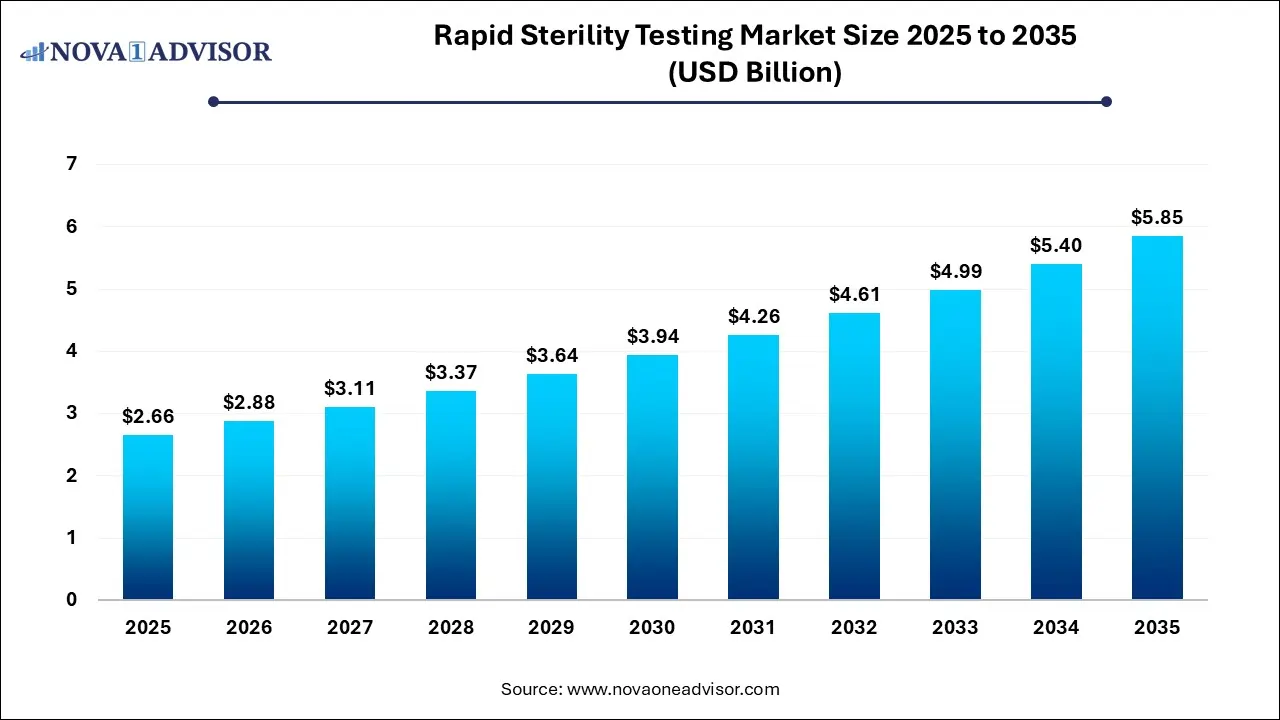
The global rapid sterility testing market size was estimated at USD 2.66 billion in 2025 and is projected to hit around USD 5.85 billion by 2035, growing at a CAGR of 8.2% during the forecast period from 2026 to 2035.
Market Key Takeaways
- The rapid sterility testing market is experiencing strong growth due to increasing demand for faster product release in pharmaceutical and biologics manufacturing.
- Traditional sterility testing methods are being gradually replaced by rapid microbiological methods (RMMs) to improve efficiency and reduce turnaround time.
- Kits & reagents dominate the market due to their recurring usage and high demand across laboratories.
- ATP bioluminescence is gaining traction as a fast and sensitive testing technology.
- Pharmaceutical and biological manufacturing remains the largest application segment.
- North America leads the market, while Asia Pacific is emerging as the fastest-growing region due to expanding pharmaceutical production.
- Automation, digitalization, and AI integration are reshaping sterility testing workflows.
Market Overview
The rapid sterility testing market is a critical component of quality control in pharmaceutical, biotechnology, and medical device industries. Sterility testing ensures that products such as injectable drugs, vaccines, biologics, and implantable medical devices are free from viable microorganisms before they reach patients. Traditionally, sterility testing methods have required incubation periods of up to 14 days, which can delay product release and increase inventory holding costs.
Rapid sterility testing methods have emerged as a transformative solution to this challenge. These methods significantly reduce testing time, often delivering results within hours or a few days, thereby enabling faster product release. This is particularly important in industries where time-to-market is crucial, such as vaccine production and personalized medicine.
For example, during the production of cell and gene therapies, the shelf life of products can be extremely short. Waiting for traditional sterility test results is not feasible in such cases. Rapid sterility testing allows manufacturers to ensure product safety without compromising on timelines.
The increasing complexity of biologics manufacturing has further driven the demand for advanced sterility testing methods. Biologics are highly sensitive to contamination, and even minor microbial presence can compromise product efficacy and safety. As a result, manufacturers are investing heavily in rapid and reliable testing technologies.
Additionally, regulatory agencies are gradually encouraging the adoption of rapid microbiological methods (RMMs) to improve product quality and reduce risks. This has created a favorable environment for market growth.
Market Outlook
- Market Growth Overview: The global rapid sterility testing market is expected to grow significantly between 2025 and 2035, driven by the increased outsourcing of QC testing to contract research manufacturing organizations boost demand for rapid, efficient services, booming biopharmaceutical sectors, and stringent regulatory compliance.
- Sustainability Trends: Sustainability trends involve green testing practices, automation and AI for resource efficiency, and continuous manufacturing process.
- Major Investors: Major investors in the market include Thermo Fisher Scientific Inc., bioMérieux SA, Charles River Laboratories, Merck KGaA, and Danaher Corporation.
How is AI Transforming the Rapid Sterility Testing Market?
Artificial Intelligence (AI) is playing a pivotal role in transforming the rapid sterility testing market by enhancing detection accuracy, automating workflows, and enabling predictive quality control.
AI-powered systems can analyze large volumes of microbiological data to identify contamination patterns and predict potential risks. For instance, in ATP bioluminescence testing, AI algorithms can interpret luminescence signals with greater precision, distinguishing between true microbial contamination and background noise. This reduces false positives and improves reliability.
In manufacturing environments, AI is being integrated with automated sterility testing systems to monitor processes in real time. Sensors and imaging technologies generate continuous data streams, which AI models analyze to detect anomalies. For example, if contamination is detected in a production batch, AI systems can immediately alert operators and recommend corrective actions.
Another important application of AI is in process optimization. By analyzing historical data, AI can identify factors that contribute to contamination, such as environmental conditions or equipment performance. This enables manufacturers to implement preventive measures and improve overall process efficiency.
AI is also facilitating digital twins in sterility testing workflows. These virtual models simulate testing processes, allowing companies to optimize protocols before implementation. This is particularly useful in scaling up production or introducing new products.
Furthermore, AI-driven automation reduces the need for manual intervention, minimizing human error and improving consistency. This is especially valuable in high-throughput laboratories where efficiency and accuracy are critical.
Major Trends in the Market
- Increasing adoption of rapid microbiological methods (RMMs)
- Growing demand for real-time contamination detection
- Shift toward automation and digital sterility testing systems
- Rising use of ATP bioluminescence technology
- Expansion of biologics and cell & gene therapy manufacturing
- Integration of AI and machine learning in quality control
- Development of portable sterility testing devices
- Increasing regulatory support for alternative testing methods
- Growth in outsourced testing services
- Rising focus on continuous manufacturing processes
Rapid Sterility Testing Market Report Scope
| Report Coverage | Details |
| Market Size in 2026 | USD 2.88 Billion |
| Market Size by 2035 | USD 5.85 Billion |
| Growth Rate From 2026 to 2035 | CAGR of 8.2% |
| Base Year | 2025 |
| Forecast Period | 2026 to 2035 |
| Segments Covered | Product, Technology, Application, Region |
| Market Analysis (Terms Used) | Value (USD Million/Billion) or (Volume/Units) |
| Regional Scope | North America; Europe; Asia Pacific; Central and South America; the Middle East and Africa |
| Key Companies Profiled | Charles River Laboratories, Inc. (US), Gibraltar Laboratories (US), Merck KGaA (Germany), Rapid Micro Biosystems, Inc. (US), bioMérieux (France), Eurofins Scientific (Luxembourg), Becton, Dickinson and Company (US), FOCUS Laboratories (US), Sartorius AG (Germany), and Thermo Fisher Scientific (US) |
Segmental Insights
By Product
How did the kits and reagents segment dominate the Global Rapid Sterility Testing market?
The kits and reagents segment is driven by the shift toward high-sensitivity kits and reagents is driven by the need for standardized, validated solutions that meet stringent FDA and EMA regulatory standards. As the biopharmaceutical sector expands into complex cell and gene therapies, these consumables provide the reproducibility and speed necessary for accelerated product release cycles. The high recurring demand and ease of use associated with these ready-to-use kits minimize manual variability and ensure consistent sterility assurance across global manufacturing pipelines.
How did the services segment expect to hold the fastest-growing Global Rapid Sterility Testing market in the coming years?
The services segment is driven by the increasing complexity of advanced therapy medicinal products and biologics drive a massive transition toward outsourcing sterility testing to specialized service providers. By leveraging CDMOs and CROs, manufacturers can access validated rapid microbiological methods without the high capital expenditure of maintaining in-house, isolator-equipped facilities. These partnerships also bridge the critical skilled labor shortage, ensuring stringent regulatory compliance and faster time-to-market for short-shelf-life products.
By Technology
How did the membrane filtration segment account for the largest share in the Global Rapid Sterility Testing market?
The membrane filtration segment is driven by the major pharma copies, membrane filtration remains the superior choice for accurately detecting low-level contamination while effectively neutralizing inhibitory preservatives. The integration of automated, closed-loop systems has significantly enhanced procedural safety, reducing human error and contamination risks in high-volume testing environments. The rapid expansion of biopharmaceutical and vaccine production continues to cement this technology as a critical component for ensuring stringent sterility assurance and regulatory compliance.
How did the ATP bioluminescence segment expect to hold the fastest-growing Global Rapid Sterility Testing market in the coming years?
The ATP bioluminescence segment is driven by the high sensitivity and compatibility with membrane filtration make it an ideal bridge for manufacturers transitioning to modernized, high-throughput workflows. The technology is becoming indispensable for cell and gene therapies, where rapid sterility assurance is critical for time-sensitive patient treatments. As regulatory bodies like the FDA and EMA move toward science-driven standards, this method is poised to become a cornerstone of rapid microbiological monitoring.
By Application
How did the pharmaceutical and biological manufacturing segment account for the largest share in the Global Rapid Sterility Testing market?
The pharmaceutical and biological manufacturing segment is driven by the leveraging automated testing instruments, manufacturers are significantly improving procedural accuracy while meeting the high-efficiency demands of personalized medicine. The increasing trend of outsourcing to specialized labs allows pharmaceutical firms to maintain rigorous safety standards without the overhead of in-house testing facilities.
How did the medical device manufacturing segment expect to hold the fastest-growing Global Rapid Sterility Testing market in the coming years?
The medical device manufacturing segment is driven by the shift toward advanced testing to combat healthcare-associated infections and ensure the safety of complex implants. By adopting rapid microbiological methods (RMMs), manufacturers are drastically reducing release cycles from weeks to days, significantly improving operational throughput. The increasing reliance on outsourced specialized labs allows device makers to access high-throughput technologies while maintaining compliance for the growing single-use device market.
Key Players in the Global Rapid Sterility Testing Market
- Charles River Laboratories, Inc.: Provides the Celsis® detection platform, using automated ATP-bioluminescence to offer rapid, regulatory-ready microbial detection for pharmaceuticals and biologics. Their services specifically cater to short shelf-life drug products, like cell and gene therapies, enabling faster turnaround times compared to traditional methods.
- Gibraltar Laboratories: Offers specialized contract testing services, including rapid sterility testing, to ensure compliance for medical devices and pharmaceutical manufacturers. They provide crucial validation studies for accelerated methods that help improve quality control efficiency for biological products.
- Merck KGaA: Contributes by providing advanced microbial detection systems and sterile filtration technologies that enable shorter sterility testing cycles.
Segments Covered in the Report
This report forecasts revenue growth at country levels and provides an analysis of the latest industry trends in each of the sub-segments from 2021 to 2035. For this study, Nova one advisor, Inc. has segmented the rapid sterility testing market.
By Product
- Kits & Reagents
- Instruments
- Services
By Technology
- Membrane Filtration
- ATP Bioluminescence
- Others
By Application
- Pharmaceutical and Biological Manufacturing
- Medical Device Manufacturing
- Others
By Region
- North America
- Europe
- Asia Pacific
- Latin America
- Middle East and Africa (MEA)
FAQ's

Proceed to Buy
Instant PDF delivery on confirmation

Rapid Sterility Testing Market Size to Hit USD 5.85 Billion by 2035
 Request Customization
 Download Sample

Get a Sample of this Report
Rapid Sterility Testing Market