

Single-use Filtration Assemblies Market Size, Share, and Trends 2026 to 2035
 Status Published
 Category Healthcare


Content
Single-use Filtration Assemblies Market Size and Growth 2026 to 2035
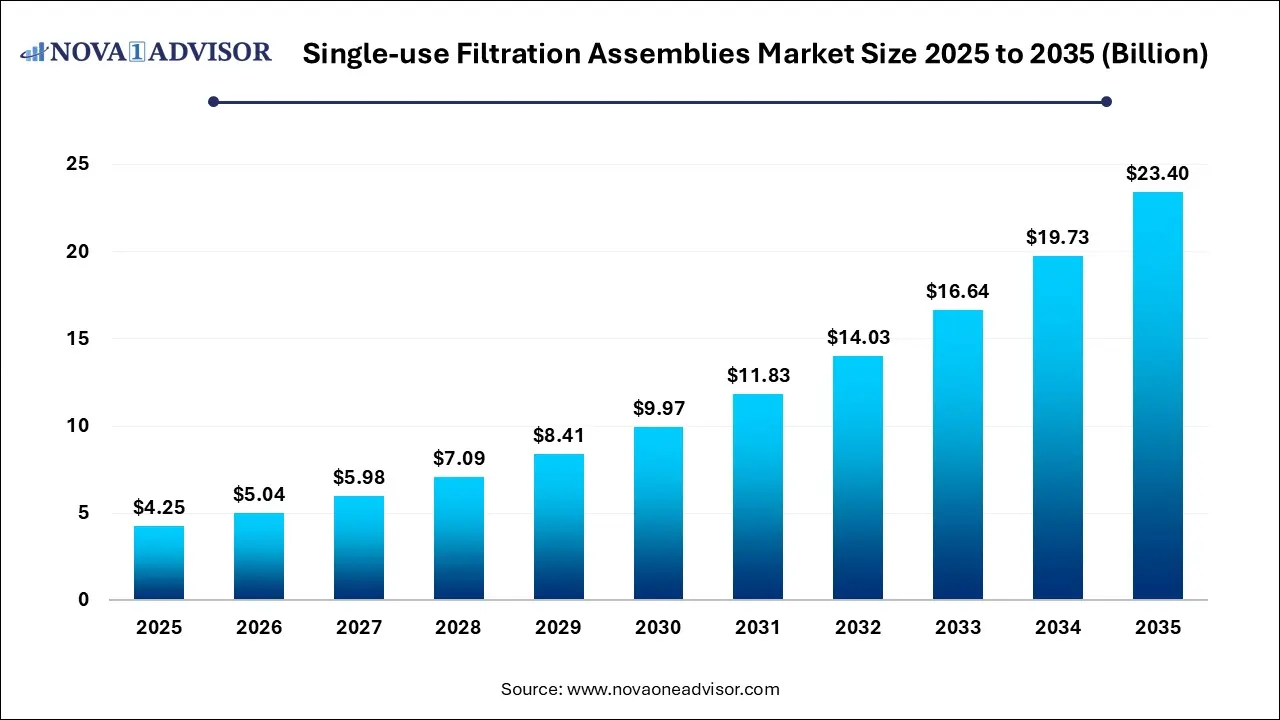
The single-use filtration assemblies market size was estimated at USD 4.25 billion in 2025 and is projected to increase from USD 5.04 billion in 2026 to approximately USD 23.40 billion by 2035, growing at a CAGR of 18.6% from 2026 to 2035. The Latin America region held a dominant position in the market with a share of 40.00% in 2025. The single-use filtration assemblies’market is driven by the rising demand for biologics and biosimilars, cross-contamination elimination and sterility assurance, enhanced operational efficiency, and cost minimization.
Key Takeaways
- By type, the membrane filtration segment held a dominant position in the market with a share of 45.00% in 2025.
- By type, the depth filtration segment is the fastest growing between 2026 and 2035.
- By application, the bioprocessing/biopharmaceuticals segment held a dominant position in the market with a share of 45.00% in 2025.
- By application, the pharmaceuticals manufacturing segment is the fastest growing between 2026 and 2035.
- By product, the filters segment held a dominant position in the market with a share of 24.00% in 2025.
- By product, the cartridges segment is the fastest growing between 2026 and 2035.
- By region, the Latin America region held a dominant position in the market with a share of 40.00% in 2025.
Innovation Driving Transformation in the Single-use Filtration Assemblies Market
Single-use filtration assemblies comprise pre-assembled, pre-sterilized, disposable filtration systems, including filters, housings, and tubing, used primarily in biopharmaceutical, food, and laboratory processes. These assemblies offer significant advantages such as preventing cross-contamination, eliminating the need for costly cleaning validation, reducing facility downtime, and increasing operational flexibility. The market growth is driven by the expanding footprint of contract manufacturing organizations and increasingly stringent regulatory requirements for sterile drug manufacturing.
Single-use Filtration Assemblies Market Trends
- Transition to Agile, Plug-and-Play Architectures
Biopharmaceutical companies are increasingly moving toward fully customized and pre-assembled filtration systems tailored to unique manufacturing workflows. These ready-to-use configurations drastically reduce assembly times, mitigate human error, and allow for rapid project changeovers in fast-paced contract manufacturing operations.
- Adoption of Industry 4.0 and Smart Bioprocessing
The industry is witnessing a significant shift toward smart manufacturing, where single-use assemblies are integrated with advanced biosensors and digital monitoring platforms. This technological advancement allows real-time data tracking of critical parameters, such as pressure and flow rates, ultimately enhancing process control and consistency.
- Material Science Innovation for Advanced Risk Mitigation
Leading manufacturers are heavily investing in research regarding material compatibility to reduce the presence of extractables and leachables. These robust, next-generation polymers ensure high product purity and compliance with the stringent quality standards required for delicate biopharmaceuticals and personalized medicines.
Key AI Integration in the Single-use Filtration Assemblies Market
AI and ML are transforming the single-use filtration assemblies industry by driving predictive analytics and advanced process automation. By continuously analyzing data such as pressure, flow rate, and historical batch metadata, ML models can anticipate filter fouling and optimize membrane lifespans. This real-time monitoring minimizes costly batch failures and prevents unexpected downtime in biopharmaceutical manufacturing workflows. Bioprocess facilities are increasing their operational efficiency and product yield while meeting strict regulatory and compliance requirements
Single-use Filtration Assemblies Market Report Scope
| Report Coverage | Details |
| Market Size in 2026 | USD 5.04 Billion |
| Market Size by 2035 | USD 23.40 Billion |
| Growth Rate From 2026 to 2035 | CAGR of 18.6% |
| Base Year | 2025 |
| Forecast Period | 2026 to 2035 |
| Segments Covered | Type, Application, Product |
| Market Analysis (Terms Used) | Value (US$ Million/Billion) or (Volume/Units) |
| Regional Scope | North America; Europe; Asia Pacific; Central and South America; the Middle East and Africa |
| Key Companies Profiled | Sartorius AG; 3M Purification; Danaher; Repligen Corporation; Merck Millipore; Cellab; Medela; Thermo Fisher Scientific, Inc.; MEISSNER FILTRATION PRODUCTS, INC.; DrM, Dr. Mueller AG |
Market Dynamics
Driver
Rising Biologics and Vaccine Demand
The eliminating time-consuming cleaning, sterilization, and validation steps, enabling manufacturers to rapidly turn around batches and scale up operations. Because these disposable systems significantly reduce the risk of cross-contamination compared to traditional stainless-steel setups, they are highly favored for producing sensitive therapeutic agents. The growing prevalence of infectious diseases continues to propel the widespread adoption of these filtration technologies within modern biopharmaceutical facilities.
Restrain
Extractables and Leachable
The market growth is hindered by creating significant safety, efficacy, and regulatory concerns for biopharmaceutical manufacturers. Trace amounts of chemical compounds migrating from plastic filtration components into drug products can alter protein stability, cause toxicity, or lead to costly regulatory delays. To mitigate these risks, companies face heavy compliance burdens, such as those dictated by USP standards, and time-intensive material characterization.
Opportunity
Contract Manufacturing Outsourcing
The enabling biopharmaceutical developers to scale production without massive capital investments in stainless-steel infrastructure. CMOs heavily adopt disposable, pre-sterilized filtration technologies because they drastically reduce cleaning validation, minimize contamination risks, and allow for rapid facility turnaround between diverse client projects. As pharmaceutical companies increasingly outsource their downstream processing to meet the booming global demand for biologics and vaccines, CMOs' reliance on these ready-to-use systems creates compounding volume demands.
Segment Insights
By Type Insights
Why Did the Membrane Filtration Segment Hold a 45.00% Share for the Single-use Filtration Assemblies Market?
The membrane filtration segment held a dominant position in the market with a share of 45.00% in 2025. Owing to its superior sterility assurance, high filtration efficiency, regulatory acceptance, and extensive use in biologics manufacturing. The rapid product changeovers in multi-product facilities which is major draw for contract manufacturing organizations.
The depth filtration segment held a 28.00% share of the market in 2025, with shifting away from traditional stainless-steel setups to pre-sterilized disposable formats, eliminating the costly downtime and extensive validation protocols required for clean-in-place operations. The inherent modularity of these single-use assemblies unlocks seamless scalability, allowing biopharmaceutical developers to easily adjust to varying batch sizes and changing commercial demands.
The centrifugation segment held a 17.00% share of the market in 2025, eliminating traditional clean-in-place and steam-in-place validation cycles; these disposable systems drastically compress operational downtime and streamline rapid multi-product changeovers for contract manufacturing organizations. Embedding this gentle, scalable technology into the bioprocessing pipeline guarantees the strict contamination control and operational agility required to successfully manufacture next-generation cell and gene therapies.
The other sequencing types segment held a 10.00% share of the market in 2025, with rapid proliferation of complex biopharmaceutical modalities, such as monoclonal antibodies and cell therapies, driving a critical shift toward specialized, multi-step sterile filtration assemblies that go beyond standard configurations.
By Application Insights
Why Did the Bioprocessing/Biopharmaceuticals Segment Hold a 45.00% Share for the Single-use Filtration Assemblies Market?
The bioprocessing/biopharmaceuticals segment held a dominant position in the market with a share of 45.00% in 2025. Owing to rapid growth in biologics manufacturing, increasing vaccine production, and widespread adoption of single-use technologies. Single-use systems eliminate sterilization; biomanufacturers experience significantly faster turnaround times between production batches, saving both capital and operational costs.
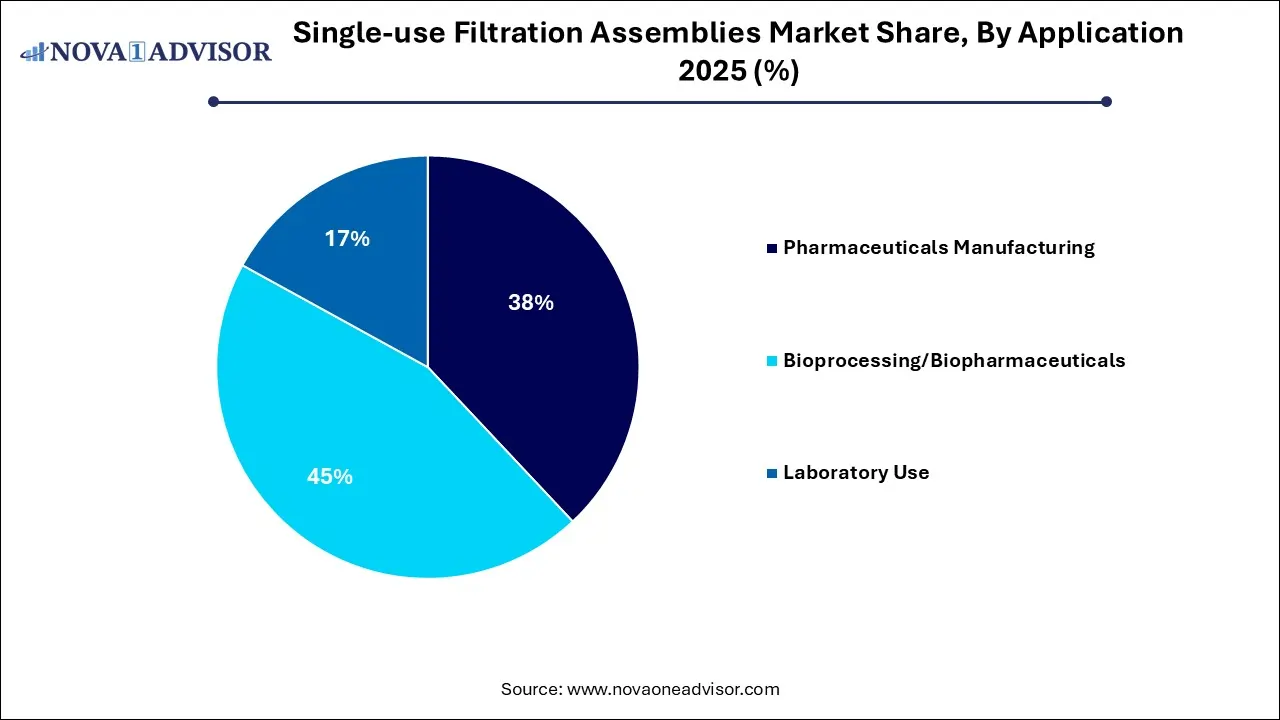
The pharmaceuticals manufacturing segment held a 38.00% share of the market in 2025, with surging production of complex biologics and biosimilars driving biopharma pipelines to rely heavily on the strict sterility provided by advanced single-use filtration assemblies. By utilizing pre-sterilized, disposable microfiltration configurations, manufacturing facilities completely eliminate the risk of batch-to-batch cross-contamination while easily satisfying rigid regulatory purity standards.
The laboratory use segment held a 17% share of the market in 2025, owing to the adoption of single-use filtration assemblies within research and clinical laboratories, which removes the need for extensive cleaning and sterilization validations, drastically compressing turnaround times between diverse experimental batches.
By Product Insights
Why Did the Filters Segment Lead the Single-use Filtration Assemblies Market?
The filters segment registered its dominance over the market with a share of 24.00% in 2025, owing to their essential role across virtually all single-use filtration workflows and production stages. They protect operators from directly handling cytotoxic fluid, buffers with extreme pH levels, and harsh cleaning agents.
The membranes segment held a 22.00% share of the market in 2025, with increasing demand for high-performance sterile filtration in biologics and advanced therapy manufacturing. They are heavily utilized in tangential flow filtration and microfiltration, which are crucial for purifying biomolecules and harvesting bioreactor yields.
The cartridges segment held a 18.00% share of the market in 2025, with the rapid expansion of monoclonal antibodies, vaccines, and cell therapies requiring robust microbial and particulate control that validated, aseptic, single-use filtration cartridges easily deliver. Embedding scalable, high-purity filtration configurations into the manufacturing pipelines transforms fill-finish and bioprocessing workflows into highly flexible, compliant, and cost-efficient production engines.
The cassettes segment held a 11.00% share of the market in 2025, due to increased adoption of continuous bioprocessing and downstream purification technologies. Elimination of the need for cleaning validation for time-consuming clean-in-place and steam-in-place operations, alongside the necessary cleaning validation.
The manifold segment held a 10.00% share of the market in 2025, due to combining multiple fluid streams without the need for complex, hard-piped stainless steel infrastructure. These pre-sterilized, closed-system assemblies eliminate manual connections, lowering the risk of leaks and batch cross-contamination while ensuring absolute sterility for high-value biologics.
The syringes segment held an 8.00% share of the market in 2025, due to utilizing pre-sterilized, closed-system configurations, laboratory researchers can extract process samples with total precision while completely protecting the primary production batch from airborne contamination. This disposable design allows research facilities and vaccine pipelines to completely avoid the heavy capital, labor, and validation expenses required for autoclaving traditional hardware.
The others segment held a 7.00% share of the market in 2025, due to rapid expansion of specialized cell and gene therapies and personalized medicine, which is driving biopharma manufacturing to transition away from rigid, standardized hardware toward highly customized fluid-handling trains. Integrating versatility, smaller-scale bioprocessing solutions guarantee the absolute sterility, contamination prevention, and operational agility required to successfully scale next-generation therapeutic pipelines.
By Regional Insights
Why Did the North America Region Lead the Single-use Filtration Assemblies Market?
The North America region registered its dominance over the market with a share of 40.00% in 2025, owing to the presence of leading biopharma companies, extensive biologics production capacity, and high adoption of single-use technologies. Favorable and streamlined approval pathways by agencies such as the U.S. FDA for innovative manufacturing and personalized therapies incentivize the rapid adoption of disposable, contamination-free equipment.
U.S. Surgical Suture Market Trends
U.S. has evolving healthcare reimbursement models that disincentivize outpatient suture-removal visits in favor of naturally degrading biomaterials. To actively reduce surgical-site infections, hospitals are aggressively transitioning to single-strand monofilament designs and next-generation antimicrobial coatings, such as silver nanoparticles, to replace legacy braided multifilament threads.
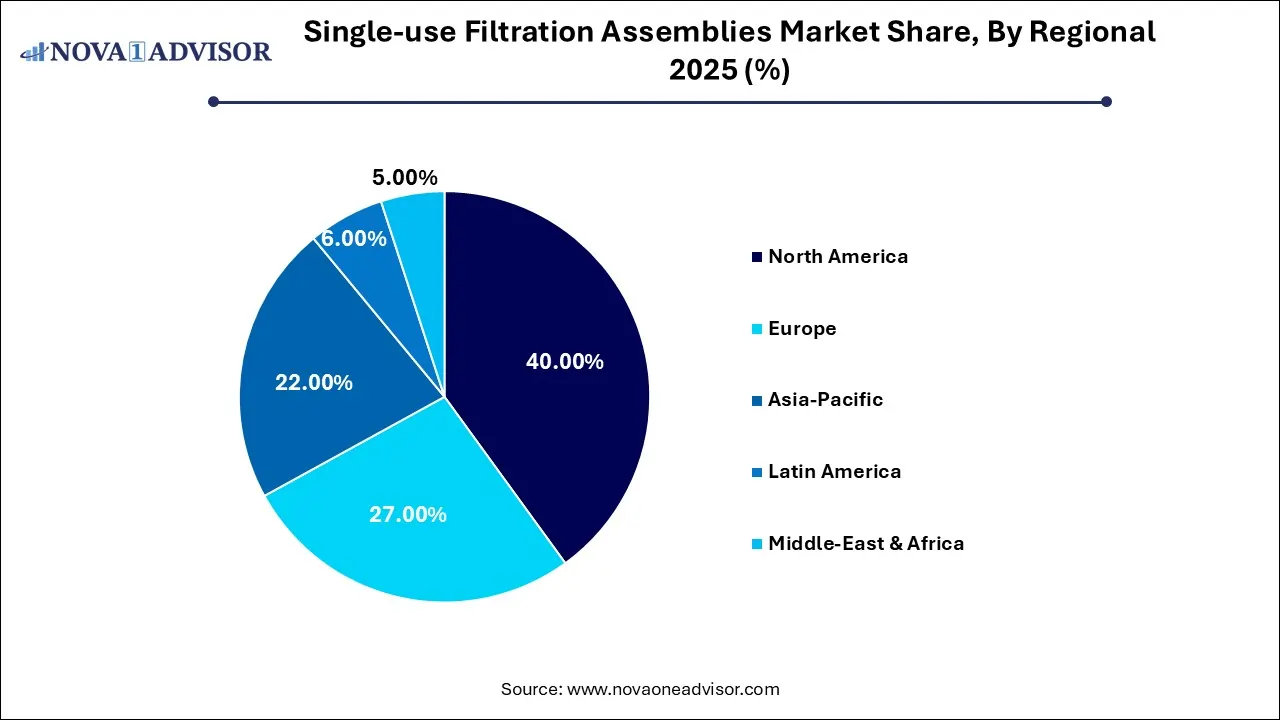
The Europe region held the 27.00% share of the market in 2025, due to the strict European Medicines Agency mandates that demand exceptional sterility and fully validated quality control across bioprocessing pipelines. To easily maintain compliance, the region's prominent manufacturing hubs are aggressively replacing legacy stainless-steel lines with disposable assemblies to completely eliminate batch cross-contamination risks and costly cleaning validation cycles.
U.K. Surgical Suture Market Trends
The U.K.'s strict postoperative cost-containment goals position modern absorbable sutures as an indispensable foundation for standard hospital wound care. The heightened national focus on infection control and patient safety is driving a strong clinical uptick in the adoption of specialized antibacterial-coated and barbed sutures.
The Asia Pacific segment held a 22.00% share of the market in 2025, due to rapid biologics manufacturing expansion, increasing contract manufacturing activity, and growing healthcare infrastructure investments. A massive patient population and strong local demand for affordable biosimilars and vaccines drive manufacturers toward flexible, scalable, and disposable filtration systems to speed up time-to-market.
China Surgical Suture Market Trends
China’s eliminating manual knot-tying and follow-up removal visits; these advanced designs significantly minimize surgical time, maximize tension consistency, and reduce the risk of localized tissue trauma. The rapid procedural shift toward knotless, self-retaining sutures highlights a massive technological modernization across China's surgical wound closure market.
The Latin America region held a 6.00% share of the market in 2025, due to a surge in regional demand for biologics and biosimilars, forcing localized manufacturing hubs to embrace adaptable and scalable production methods. By transitioning from legacy stainless steel systems to pre-sterilized disposable filtration assemblies, regional facilities eliminate costly cleaning downtime and batch cross-contamination risks while accelerating overall turnaround times.
The MEA region held a 5.00% share of the market in 2025, due to the plug-and-play architecture of these disposable technologies, which allows the Middle East to build highly cost-effective, contamination-free, and agile pharmaceutical pipelines with minimal upfront capital.
Some of the prominent players in the Single-use Filtration Assemblies Market include
- Sartorius AG
- 3M Purification
- Danaher
- Repligen Corporation
- Merck Millipore
- Cellab
- Medela
- Thermo Fisher Scientific, Inc.
- MEISSNER FILTRATION PRODUCTS, INC.
- DrM, Dr. Mueller AG
Recent Developments
- In October 2025, Avantor has launched a next-generation sterile sampling platform and pre-engineered PUPSIT assemblies designed to enhance bioprocessing efficiency, reduce contamination risk, and streamline compliance [1]. The comprehensive suite includes new needle-free (NFSS) and exact volume (EVSS) sampling systems alongside existing technologies to provide flexible, closed-path solutions for manufacturing from clinical to commercial scale.
- In February 2026, AdvantaPure rolled out its new EcoFlex sustainable thermoplastic elastomer (TPE) tubing. This weldable, lower-carbon fluid-path component allows manufacturers to build highly customizable filtration assemblies with a greatly reduced ecological footprint.
Segments Covered in the Report
This report forecasts revenue growth at global, regional, and country levels and provides an analysis of the latest industry trends in each of the sub-segments from 2021 to 2035. For this study, Nova one advisor, Inc. has segmented the global Single-use Filtration Assemblies market.
By Type
- Membrane Filtration
- Tangential Flow Filtration (TFF)
- Ultra/Diafiltration
- Micro-Filtration
- Direct Flow Filtration (DFF) /Dead-end Filtration /Normal Flow Filtration
- Tangential Flow Filtration (TFF)
- Depth Filtration
- Centrifugation
- Others
By Application
- Pharmaceuticals Manufacturing Market
- Bioprocessing/Biopharmaceuticals Market
- Laboratory Use
By Product
- Filters
- Cartridges
- Membranes
- Manifold
- Cassettes
- Syringes
- Others
By Region
- North America
- Europe
- Asia-Pacific
- Latin America
- Middle East & Africa (MEA)
FAQ's

Proceed to Buy
Instant PDF delivery on confirmation

Single-use Filtration Assemblies Market Size to Hit USD 23.40 Billion by 2035
 Request Customization
 Download Sample

Get a Sample of this Report
Single-use Filtration Assemblies Market