

Small Molecule Innovator API CDMO Market Size, Share, and Trends 2026 to 2035
 Status Published
 Category Healthcare


Content
Small Molecule Innovator API CDMO Market Size and Growth 2026 to 2035
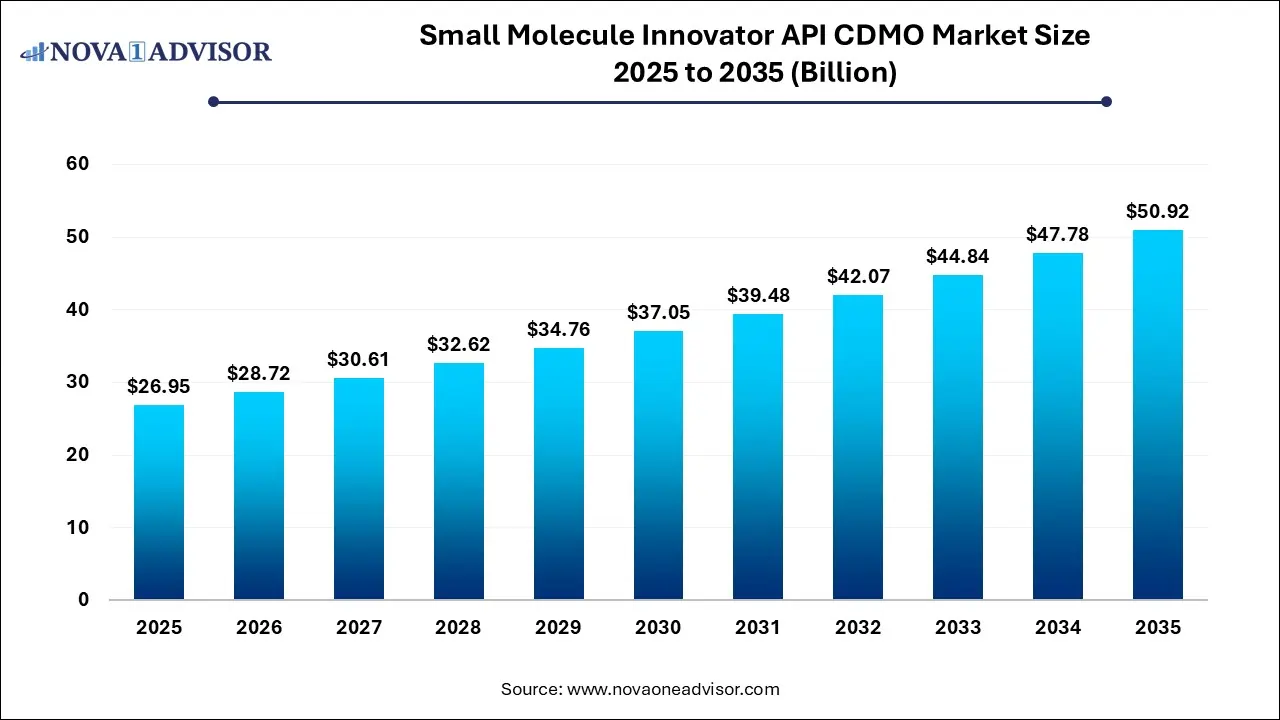
The small molecule innovator API CDMO market size was estimated at USD 26.95 billion in 2025 and is projected to increase from USD 28.72 billion in 2026 to approximately USD 50.92 billion by 2035, growing at a CAGR of 6.57% from 2026 to 2035. The North America region held a dominant position in the market with a share of 38% in 2025. The small molecule innovator API CDMO market is driven by the rising complexity of drug pipelines, increasing volume of new molecular entities entering preclinical and clinical phases, which has intensified the demand for scalable, reliable API production, and emerging focus on cost optimization and core competencies.
Key Takeaways
- By stage type, the commercial segment held a dominant position in the market with a share of 50% in 2025.
- By stage type, the clinical segment is the fastest growing between 2026 and 2035.
- By customer type, the pharmaceutical segment held a dominant position in the market with a share of 68% in 2025.
- By customer type, the biotechnology segment is the fastest growing between 2026 and 2035.
- By therapeutic area, the oncology segment held a dominant position in the market with a share of 28% in 2025.
- By therapeutic area, the cardiovascular diseases segment is the fastest growing between 2026 and 2035.
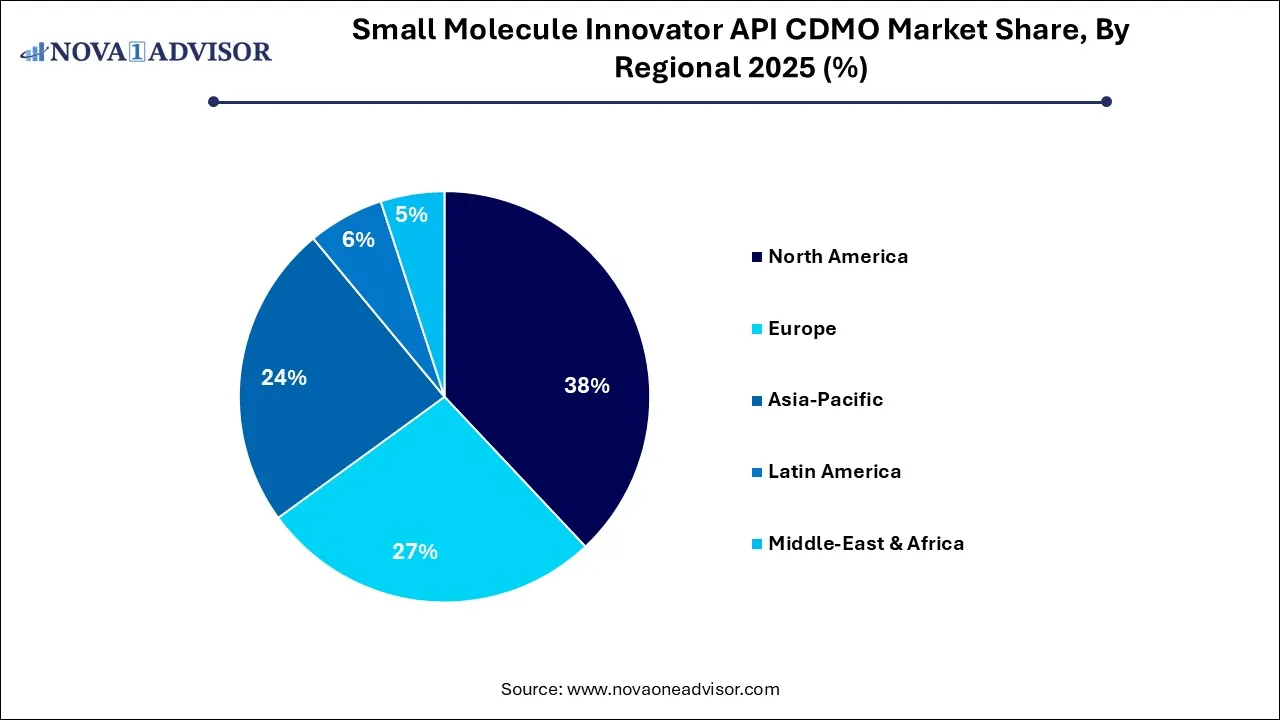
- By region, the North America region held a dominant position in the market with a share of 38% in 2025.
Innovation Driving Transformation in the Small Molecule Innovator API CDMO Market
Small molecule innovator API CDMOs comprise specialized contract organizations that develop and manufacture novel active pharmaceutical ingredients for drug discovery pipelines. Partnering with these CDMOs benefits applications across oncology, rare diseases, and chronic therapies by providing vital scalability, regulatory compliance, and advanced manufacturing capabilities without heavy capital investment. Key advantages include accelerated time-to-market, cost-effective oral bioavailability, and reliable intracellular targeting.
Small Molecule Innovator API CDMO Market Trends
- Supply Chain Security and Geographic Diversification
In the wake of global disruptions, pharmaceutical sponsors are heavily focusing on reshoring and dual-sourcing API manufacturing to build resilient supply chains. CDMOs are expanding their multi-regional footprints and localizing production in regions such as North America and Europe to hedge against logistical risks.
- Accelerating Demand for High-Potency APIs
The oncology pipelines continue to expand rapidly, driving a major spike in the need for specialized high-containment manufacturing. CDMOs must invest in advanced containment technologies and precise handling capabilities to safely process these complex, targeted therapeutics from clinical to commercial scale.
- Integration of Sustainable Manufacturing and Green Chemistry
Environmental, social, and governance mandates are critical selection criteria for pharmaceutical companies outsourcing their API production. CDMOs are actively adopting green chemistry practices, such as bio-catalysis, solvent recycling, and waste reduction, to align with these eco-friendly initiatives and regulatory pressures.
Key AI Integration in the Small Molecule Innovator API CDMO Market
AI and ML are transforming the small molecule innovator API CDMO industry by driving predictive process optimization and autonomous synthetic design. CDMOs utilize these technologies to accelerate route scouting, maximize manufacturing yields, and conduct predictive maintenance to reduce costly production downtime. AI enhances early-stage ADMET profiling, helping innovators rapidly filter out poor drug candidates before scale-up. Integrating these algorithms into contract manufacturing streamlines development timelines and drives the adoption of continuous manufacturing practices.
Small Molecule Innovator API CDMO Marke Report Scope
| Report Coverage | Details |
| Market Size in 2026 | USD 28.72 Billion |
| Market Size by 2035 | USD 50.92 Billion |
| Growth Rate From 2026 to 2035 | CAGR of 6.57% |
| Base Year | 2025 |
| Forecast Period | 2026 to 2035 |
| Segments Covered | Stage Type, Customer Type, Therapeutic Area, Region |
| Market Analysis (Terms Used) | Value (USD Million/Billion) or (Volume/Units) |
| Regional Scope | North America; Europe; Asia Pacific; Central and South America; the Middle East and Africa |
| Key Companies Profiled | Lonza Group Ltd.; Novo Holdings (Catalent, Inc.); Thermo Fisher Scientific, Inc.; Siegfried Holding AG; Recipharm AB; CordenPharma International; Samsung Biologics; Labcorp; Ajinomoto Bio-Pharma Services; Piramal Pharma Solutions; Jubilant Life Sciences (Jubilant Biosys Limited); WuXi AppTec Co., Ltd. |
Market Dynamics
Driver
Increasing Outsourcing
The allowing pharmaceutical and biotech firms to convert heavy fixed capital expenditures into variable costs. Drug sponsors increasingly rely on external CDMOs to access specialized expertise, flexible manufacturing capabilities, and compliant facilities, which significantly speed up lab-to-market timelines. By delegating complex chemistry and scale-up manufacturing, innovators can strictly focus their internal resources on core research and development.
Restrain
High Capital Expenditures
The market growth is hindered by imposing massive upfront costs for advanced facilities and extended return-on-investment cycles. Building specialized infrastructure,s uch as high-potency API suites and contunious manufacturing lines, requires tens of million in initial outlays, consuming operating cash flows. This steep financial barrier limits market entry for smaller CDMOs that lack deep pockets.
Opportunity
Advanced Manufacturing Technologies
By integrating tools, CDMOs can tackle complex chemical syntheses and highly potent APIs (HPAPIs) with better batch consistency and real-time quality control. Ultimately, this technical superiority accelerates drug development timelines, empowering CDMOs to act as strategic, full-service partners to emerging biotech firms; they capture a larger share of the expanding pharmaceutical outsourcing market.
Segment Insights
By Stage Type Insights
Why Did the Commercial Segment Hold a 50% Share for the Small Molecule Innovator API CDMO Market?
The commercial segment held a dominant position in the market with a share of 50% in 2025. Owing to commercial manufacturing generating recurring high-volume production demand from approved therapies, to long-term supply contracts, larger batch sizes, and stable revenue streams. The surge in targeted therapies, especially highly potent active pharmaceutical ingredients used in oncology, requires highly complex containment infrastructure.
The clinical segment held a 32% share of the market in 2025, with the clinical-stage projects requiring specialized manufacturing and regulatory support. The high demand for complex small molecule APIs in oncology and neurology requires advanced formulation development, pushing innovator companies to rely on CDMOs equipped with cutting-edge technologies.
The preclinical segment held an 18% share of the market in 2025, with the elimination of steep laboratory infrastructure costs for early-stage candidates prone to clinical attrition. This operational shift is heavily accelerated by the escalating molecular complexity of novel therapies, including highly potent APIs (HPAPIs) that demand the advanced, high-containment infrastructure specialized CDMOs possess.
By Consumer Type Insights
Why Did the Pharmaceutical Segment Hold a 68% Share for the Small Molecule Innovator API CDMO Market?
The pharmaceutical segment held a dominant position in the market with a share of 68% in 2025. Owing to the extensive outsourcing budgets, large-scale commercial programs, and robust product pipelines. By outsourcing development, innovator companies reduce operational risks and accelerate the time it takes to get drugs from clinical trials to the market.
The biotechnology segment held a 32% share of the market in 2025, with the operational shift allowing innovators to tap into the advanced containment systems and specialized chemical expertise required to synthesize complex small molecules, such as targeted cancer therapeutics and high-potency APIs (HPAPIs). Partnering with established contract organizations drastically compresses the time required to advance compounds from preclinical stages into clinical trials while ensuring seamless compliance with strict regulatory frameworks.
By Therapeutic Area Insights
Why Did the Oncology Segment Lead the Small Molecule Innovator API CDMO Market?
The oncology segment registered its dominance over the market with a share of 28% in 2025, owing to intensive R&D activity and expanding cancer drug pipelines, high clinical trial volumes, premium drug pricing, and continuous innovation. It focused APIs often involve complex synthesis that requires specialized CDMO process engineering.
The cardiovascular diseases segment held a 15% share of the market in 2025, with surging global prevalence of cardiovascular diseases establishing a massive, high-volume patient population requiring continuous maintenance medication, such as statins, antihypertensives, and anticoagulants. To manage this intensive demand and navigate impending patent cliffs efficiently, pharmaceutical firms heavily outsource large-scale cardiovascular API manufacturing to CDMOs to lower baseline operational costs.
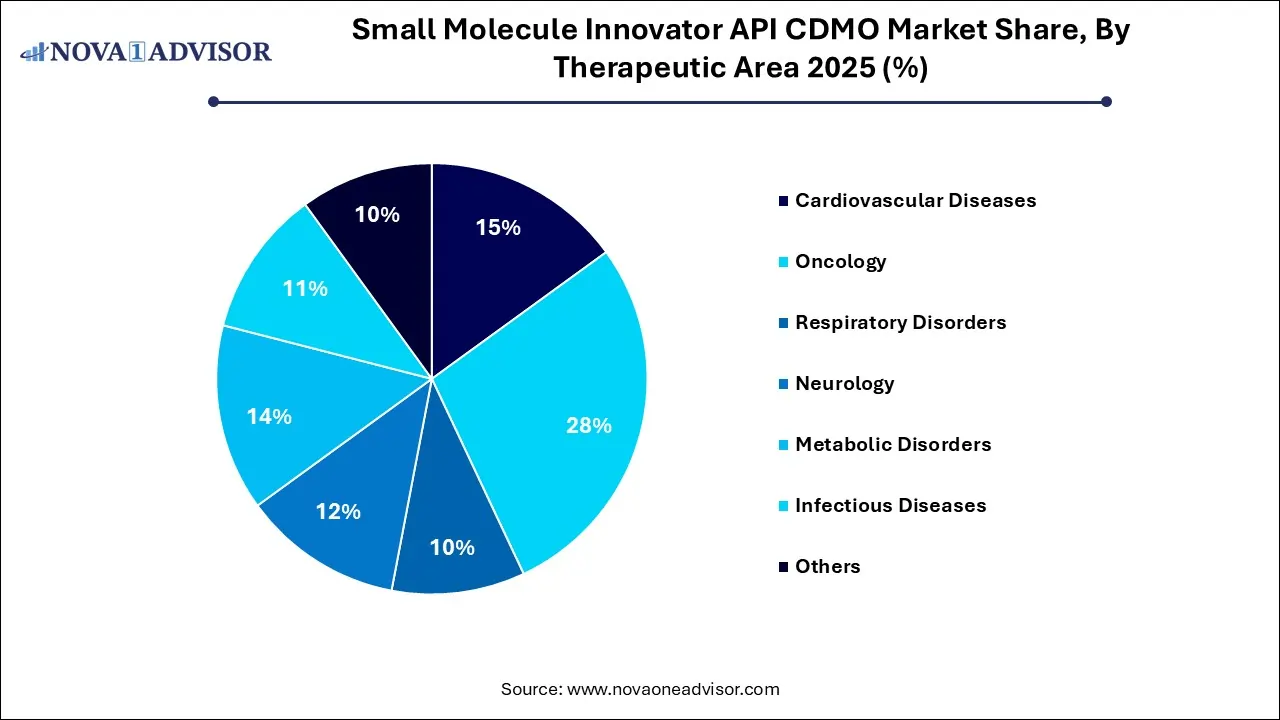
The respiratory disorders segment held a 10% share of the market in 2025, due to the high prevalence of respiratory conditions, such as asthma and COPD, requires continuous therapeutic innovation, driving major investments into small-molecule clinical pipelines. To support these pipelines, pharmaceutical innovators heavily rely on CDMOs for specialized manufacturing expertise and containment facilities required to produce complex delivery platforms.
The neurology segment held a 12% share of the market in 2025; the complex design of neurological APIs requires highly targeted molecular specificity to cross the blood-brain barrier and treat debiting neurodegenerative diseases, forcing pharmaceutical companies rely on specialized CDMO process development. The partnering with contract manufacturers allows innovators to access advanced custom synthesis and precise analytical controls, effectively accelerating their speed-to-market for vital CNS treatments.
The metabolic disorder segment held a 14% share of the market in 2025, due to the surging global burden of chronic metabolic conditions, such as obesity, diabetes, and cardiovascular diseases requires accessible, long, term oral small-molecule therapies. To advance complex clinical pipelines targeting metabolic dysfunction, innovator pharmaceutical companies increasingly outsource to CDMOs to access specialized expertise in process scale-up and advanced manufacturing.
The infectious diseases segment held a 11% share of the market in 2025, owing to rising threat of dynamic viral and bacterial pathogens necessitates constant research and rapid development of new therapeutics to address an ever-present medical need. This clinical pressure is intensified by the alarming rise of antimicrobial resistance (AMR), forcing pharmaceutical and biotech companies to continuously accelerate their R&D efforts.
The others segment hold a 10% share of the market in 2025, with the highly specialized APIs tailored for personalized medicine, early-stage research, and rare disease clinical trials. To advance these novel molecular entities, academic research centers frequently collaborate with emerging biotech centers frequently collaborate with emerging biotech startups, outsourcing flexible manufacturing and specialized synthesis to capable CDMOs.
By Regional Insights
Why Did the North America Region Lead the Small Molecule Innovator API CDMO Market?
The North America region registered its dominance over the market with a share of 38% in 2025, owing to strong pharmaceutical innovation, extensive outsourcing activity, and a large concentration of drug developers, to substantial R&D spending, regulatory expertise, and mature CDMO infrastructure. Recent reshoring trends and efforts to localize supply chains have significantly boosted domestic contract manufacturing.
U.S. Surgical Suture Market Trends
The U.S. has a rapid transition toward absorbable materials, such as polyglycolic acid, incentivized by Medicare fee schedule cuts to eliminate costly post-operative removal visits and lower infection risks. The rising popularity of barbed sutures, which eliminates knot-tying to compress crucial operating room times by six to nine minutes per procedure.
The Europe region held the 27% share of the market in 2025, due to the advanced manufacturing hubs in Germany and Switzerland, which maintain global dominance in specialized synthetic chemistry and high-potency API (HPAPI) processing. This technical infrastructure directly supports the region’s accelerating surge in clinical research and early-stage oncology pipelines, which demand highly sophisticated external manufacturing capabilities.
U.K. Surgical Suture Market Trends
The U. K’s clinical adoption heavily favours antimicrobial and barbed sutures to reduce postoperative infections and shorten procedure times, particularly in the growing field of minimally invasive surgery. Monofilament, in particular, is seeing rapid traction for its low tissue drag, while overall demand is driven by high-precision orthopaedic and cardiovascular needs.
The Asia Pacific segment held a 24% share of the market in 2025, due to cost advantages, expanding production capacity, skilled workforce availability, and increasing regulatory compliance. The proactive government incentives and national modernization frameworks are driving heavy foreign direct investment into complex synthesis and advanced continuous manufacturing corridors.
China Surgical Suture Market Trends
China’s rise in minimally invasive and robotic surgeries necessitates specialized, small-gauge monofilament and knotless suturing devices designed to navigate tight anatomical spaces safely. The hospitals are aggressively adopting advanced antibacterial-coated options to minimize the risk of bacterial colonization and surgical-site infections.
The Latin America region held a 6% share of the market in 2025, with the growing burden of chronic diseases, increasing regional drug pipelines, and demand for contract manufacturers upgrading, with frameworks such as Brazil’s ANVISA adopting international standards to support complex API development.
The MEA region held a 5% share of the market in 2025, due to aggressively investing to reduce their heavy dependency on imported pharmaceuticals by offering lucrative incentives, such as preferential procurement and tax deferments to attract contract manufacturers. The rapid strengthening and harmonization of local regulatory frameworks have significantly elevated international confidence in the quality and compliance of locally synthesized active pharmaceutical ingredients.
Small Molecule Innovator API CDMO Market Companies
- Lonza Group Ltd.
- Thermo Fisher Scientific, Inc.
- Novo Holdings (Catalent, Inc.)
- Siegfried Holding AG
- CordenPharma International
- Recipharm AB
- Samsung Biologics
- Ajinomoto Bio-Pharma Services
- Labcorp
- Piramal Pharma Solutions
- WuXi AppTec Co., Ltd.
- Jubilant Life Sciences (Jubilant Biosys Limited)
Recent Developments
- In September 2025, Thermo Fisher Scientific completed its acquisition of Sanofi's state-of-the-art sterile fill-finish and packaging facility in Ridgefield, New Jersey. This strategic transaction expands the existing partnership between the two companies and injects significant new domestic sterile manufacturing capacity into the U.S. pharmaceutical supply chain.
- In May 2025, Radyus Research and Eurofins CDMO Alphora announced a strategic partnership to create an integrated, end-to-end drug development solution for global biotech companies. The collaboration combines Radyus’s expertise in preclinical strategy and regulatory planning with Eurofins Alphora’s GMP manufacturing capabilities to reduce operational handoffs and accelerate development from lead optimization to clinical proof-of-concept.
Segments Covered in the Report
This report forecasts revenue growth at country levels and provides an analysis of the latest industry trends in each of the sub-segments from 2021 to 2035. For this study, Nova one advisor, Inc. has small molecule innovator API CDMO market.
By Stage Type
- Preclinical
- Clinical
-
- Phase I
- Phase II
- Phase III
- Commercial
By Customer Type
- Pharmaceutical
-
- Small
- Medium
- Large
- Biotechnology
-
- Small
- Medium
- Large
By Therapeutic Area
- Cardiovascular Diseases
- Oncology
- Respiratory Disorders
- Neurology
- Metabolic Disorders
- Infectious Diseases
- Others
By Regional
- North America
- Europe
- Asia Pacific
- Latin America
- Middle East and Africa (MEA)
FAQ's

Proceed to Buy
Instant PDF delivery on confirmation

Small Molecule Innovator API CDMO Market Size to Hit USD 50.92 Billion by 2035
 Request Customization
 Download Sample

Get a Sample of this Report
Small Molecule Innovator API CDMO Market