

Smart Medical Devices Market Size, Share, Forecast Report, 2026-2035
 Status Published
 Category Healthcare


Content
Smart Medical Devices Market Size and Growth 2026 to 2035
The global smart medical devices market size was valued at USD 114.78 billion in 2026 and is projected to grow from USD 129.49 billion in 2027 to USD 339.63 billion by 2035, at a CAGR of 12.81% from 2026 to 2035.
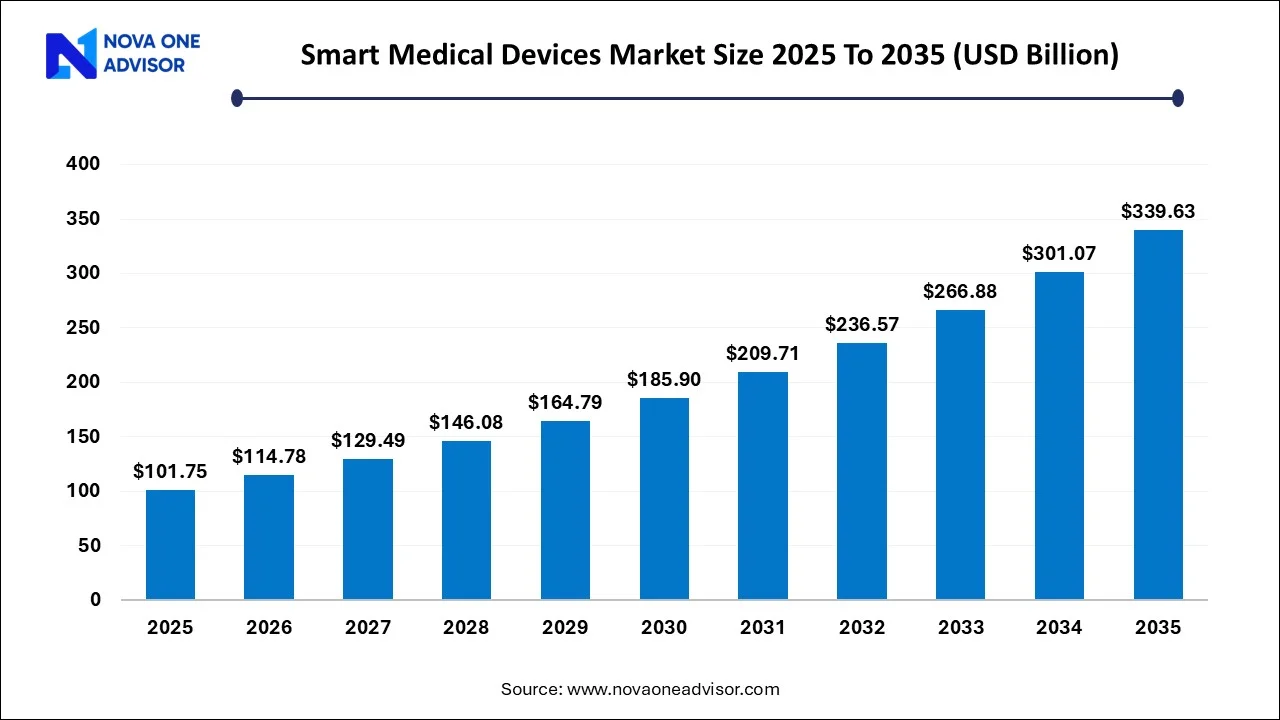
Key Takeaway
- By product, the therapeutic devices segment dominated the market and accounted for the largest revenue share in 2025.
- By product, the diagnostic and monitoring devices segment is anticipated to witness the fastest CAGR over the forecast period.
- By distribution, the pharmacies segment dominated the market and accounted for the largest revenue share in 2025.
- By end user, the hospital segment dominated the market and accounted for the largest revenue share in 2025.
- By region, North America accounted for the largest revenue share in 2025.
Market Overview
The global smart medical devices market represents one of the fastest-evolving segments within the healthcare technology industry. Smart medical devices are connected healthcare tools capable of collecting, transmitting, analyzing, and storing health-related information to support clinical decision-making and patient management. These devices leverage advanced technologies such as sensors, wireless connectivity, cloud computing, artificial intelligence, machine learning, and mobile applications to deliver real-time health insights.
Healthcare systems worldwide are undergoing a fundamental transformation driven by rising healthcare costs, aging populations, increasing chronic disease prevalence, and growing demand for personalized care. Smart medical devices are playing a pivotal role in addressing these challenges by enabling continuous monitoring, early diagnosis, preventive interventions, and remote patient management.
The market encompasses a broad range of products including wearable cardiac monitors, smart glucose monitoring systems, connected inhalers, intelligent infusion pumps, remote patient monitoring platforms, smart insulin delivery systems, and AI-enabled diagnostic imaging equipment. These devices are increasingly being integrated into hospital networks, outpatient settings, and home healthcare environments.
The COVID-19 pandemic accelerated the adoption of digital health technologies, creating a lasting impact on healthcare delivery models. During the pandemic, healthcare providers rapidly adopted remote monitoring solutions to manage patients while minimizing physical interactions. This shift highlighted the value of connected medical devices in maintaining continuity of care and improving patient outcomes.
Furthermore, advancements in semiconductor technologies, miniaturized sensors, wireless communication protocols, and battery efficiency have significantly improved device performance and usability. As healthcare providers continue to focus on value-based care models, smart medical devices are becoming essential tools for improving clinical outcomes while reducing healthcare expenditures.
The increasing emphasis on patient-centric healthcare is also contributing to market expansion. Patients today are more engaged in managing their health and seek technologies that provide real-time insights, personalized recommendations, and convenient access to medical information. Smart medical devices fulfill these requirements by empowering individuals to actively participate in their healthcare journey.
Market Outlook
- Market Growth Overview: The global smart medical devices market is expected to grow significantly between 2025 and 2035, driven by the rising chronic disease management and aging population, rising healthcare expenditure, and growing focus on preventative healthcare.
- Sustainability Trends: Sustainability trends involve circular economy and device reprocessing, eco-friendly and smart materials, and energy-efficient power solutions.
- Major Investors: Major investors in the market include Medtronic, Abbott Laboratories, Johnson & Johnson, Siemens Healthineers, GE HealthCare, and Philips.
How AI is Impacting the Global Smart Medical Devices Market?
AI and ML are revolutionizing the global smart medical devices industry by driving massive, exponential growth and fuelling advanced product innovation. These technologies enhance diagnostic accuracy, enable personalized treatment, and automate workflows to reduce clinician fatigue. They empower continuous remote patient monitoring and early disease detection, actively shifting healthcare delivery from reactive treatment to proactive, precision care.
Smart Medical Devices Market Report Scope
| Report Coverage | Details |
| Market Size in 2026 | USD 114.78 Billion |
| Market Size by 2035 | USD 339.63 Billion |
| Growth Rate From 2026 to 2035 | CAGR of 12.81% |
| Forecast Period | 2026 to 2035 |
| Segments Covered | Product, Distribution, End-use, Region |
| Market Analysis (Terms Used) | Value (USD Million/Billion) or (Volume/Units) |
| Regional Scope | North America; Europe; Asia Pacific; Central and South America; the Middle East and Africa |
| Key Companies Profiled | Abbott Laboratories; Medtronic plc; F. Hoffmann-La Roche Ltd; Dexcom, Inc.; Masimo;Dräger Group (Drägerwerk AG & Co. KGaA); Shenzhen Ztsense Hi Tech Co., Ltd; Smartcardia; Microlife Corporation; Beurer GmbH; Adherium; Ascensia Diabetes Care Holdings AG; LifeScan, Inc.; AgaMatrix, Inc.; ARKRAY, Inc; i-SENS, Inc. ; ACON Laboratories, Inc.;NIPRO CORPORATION; Garmin; Fourth Frontier Technologies Private Limited; Nonin; Sensoria; Sonova; WS Audiology; Demant A/S; |
Segmental Insights
By Product
How did the therapeutic devices segment dominate the Global Smart Medical Devices market?
The therapeutic devices segment is driven by the rise of telehealth, which has transformed self-administered home therapies into an essential component of modern, physician-monitored remote healthcare. Advanced IoT and AI integrations accelerate the shift by enabling devices to adjust therapeutic interventions using real-time patient metrics dynamically. These combined forces solidify the market dominance of therapeutic devices by merging active treatment with continuous digital innovation.
How did the diagnostic and monitoring devices segment expected to hold the fastest-growing Global Smart Medical Devices market in the coming years?
The diagnostic and monitoring devices segment is driven by the rising global burden of chronic diseases, which necessitates physiological tracking, which smart devices efficiently deliver through real-time vital metrics. Technological innovations in wearables and AI complement this need by transforming medical-grade monitoring into compact, consumer-friendly tools capable of predicting critical health anomalies. This shift directly supports the broader transition toward remote healthcare, reducing hospital strain and lowering patient costs outside clinical settings.
By Distribution
How did the pharmacies segment dominate the Global Smart Medical Devices market?
The pharmacies segment is driven by offering immediate, in-person access to critical diagnostic and therapeutic devices. The trusted pharmacist delivers personalized guidance on operating complex, non-invasive health technologies safely. As remote care expands, physical and digital pharmacy chains cement their role as central hubs connecting patients to continuous preventive tracking.
How did the online channels segment expected to hold the fastest-growing Global Smart Medical Devices market in the coming years?
The online channels segment is driven by allowing consumers to seamlessly browse, compare prices, and order medical devices directly from home. The major tech and health manufacturers are expanding direct-to-consumer sales strategies through their own dedicated online stores. The massive e-commerce retailers complement this ecosystem by offering extensive, localized product portfolios ranging from continuous glucose monitors to smartwatches.
By End User
How did the hospital segment dominate the Global Smart Medical Devices market?
The hospital segment is driven by streamlining workflows and minimizing manual errors; these smart technologies significantly improve operational efficiency while reducing overall healthcare costs. The rising cybersecurity threats and the shift toward personalized medicine compel these institutions to invest heavily in secure, centralized digital healthcare ecosystems.
How did the home healthcare segment expected to hold the fastest-growing Global Smart Medical Devices market in the coming years?
The home healthcare segment is driven by continuous glucose monitors and portable infusion pumps, which empower providers to manage chronic conditions remotely, ensuring prompt clinical interventions without hospital readmission. This remote management is paired with user-friendly, consumer-grade wearables that allow individuals to actively track and manage their preventive health and daily fitness parameters. This shift aligns with value-based care priorities, heavily reducing hospital strain and lowering patient out-of-pocket costs while minimizing exposure to hospital-acquired infections.
By Regional
How did the North America region account for the largest share in the Global Smart Medical Devices market?
North America is driven by seamless integration of smart devices with electronic health records, paving the way for predictive analytics and advanced remote patient monitoring. The region’s high prevalence of chronic diseases and aging population have skyrocketed demand for continuous, home-based diagnostic systems. Supportive regulatory bodies and favourable, value-based reimbursement frameworks further accelerate this market by incentivizing healthcare providers to adopt AI-driven and IoT-enabled technologies.
U.S. Global Smart Medical Devices Market Trends
The U.S. is integrating artificial intelligence directly into diagnostic wearables, enabling predictive alerts that detect health issues before they require acute hospitalization. This capability enhances remote patient monitoring and EHR interoperability, bridging the gap between clinical settings and home care while streamlining workflows. To combat rising medical device expenses, manufacturers must demonstrate both clinical and systemic economic efficiencies to hospital executives focused on value-based care.
How did the Asia-Pacific region become the fastest-growing Global Smart Medical Devices Market during the forecast period?
Asia Pacific is driven by progressive regulatory changes and streamlined medical software approvals that allow these next-generation algorithmic devices to reach regional patient populations much more quickly. High smartphone penetration and widespread 5G networks across Japan, South Korea, and China provide the vital technological infrastructure needed for seamless, remote data transmission.
China Global Smart Medical Devices Market Trends
China’s widespread high-speed internet infrastructure that seamlessly connects remote clinics to top-tier urban hospitals via telemedicine networks. A decisive shift toward domestic manufacturing allows local firms to produce surgical and rehabilitation robotics that achieve clinical outcomes fully comparable to imported global models.
How Did Europe Hold A Notable Share in the Global Smart Medical Devices Market?
Europe’s robust infrastructure is heavily supported by national initiatives, such as Germany’s Digital Healthcare Act and a standardized EU medical device regulation framework that streamlines the reimbursement and deployment of secure, AI-powered diagnostic platforms. These technologies directly address the continent's rapidly aging population and rising chronic disease rates, driving an immense regional demand for automated home-care monitoring systems.
Germany Global Smart Medical Devices Market Trends
Germany’s shift toward decentralized, patient-centric remote patient monitoring in Germany is enabling effective chronic disease management and reducing hospital burdens. This ecosystem is bolstered by AI-driven predictive diagnostics, high adoption of connected wearable devices, and supportive regulatory initiatives from the Federal Ministry of Health and BfArM.
Key Players in the Global Smart Medical Devices Market
- Abbott Laboratories
Abbott revolutionizes diabetes care and cardiovascular management through market-leading continuous glucose monitors (like the FreeStyle Libre) and smart implantable pacemakers.
- Medtronic plc
As a global leader in medical technology, Medtronic provides advanced smart insulin pumps, implantable neurostimulators, and remote-monitored cardiac devices. By integrating cloud-based analytics and AI, their smart therapeutic devices empower proactive, continuous patient care across more than 150 countries.
- F. Hoffmann-La Roche Ltd
Roche contributes to the smart medical device ecosystem by developing advanced in vitro diagnostics, medical software, and insights-driven digital health platforms.
Segments Covered in the Report
This report forecasts revenue growth at country levels and provides an analysis of the latest industry trends in each of the sub-segments from 2021 to 2035. For this study, Nova one advisor, Inc. has smart medical devices market.
By Product
- Diagnostics and Monitoring Devices
- Blood Glucose Monitors
- Pulse Oximeters
- Breath Analyzers
- Medical Tricorders
- Blood Pressure Monitors
- Smart Thermometers
- Heart Rate Monitors
- Smart Contact Lenses
- Glucose Monitoring
- Intraocular Pressure Monitoring
- Smart Clothing
- Embedded Health Sensors
- Fitness Monitoring
- Wearable ECG Monitors
- Chest Straps
- Patches
- Therapeutic Devices
- Portable Oxygen Concentrators & Ventilators
- Insulin Pumps
- Hearing Aids
- Neurostimulation Devices
- Spinal Cord Stimulation
- Deep Brain Stimulation
- Transcranial Magnetic Stimulation
- Smart Inhalers
- Asthma & COPD Management
- Connected Inhalers with Data Tracking
- Smart Drug Delivery Systems
- Wearable Injectors
- Implantable Drug Delivery Devices
By Distribution
- Pharmacies
- Online Channel
- Direct-to-Consumer (DTC)
- Others (Hypermarkets, Specialty Retailers)
By End-use
- Hospitals
- Clinics
- Home Care
- Others (Sports, Fitness Centers, Assisted Living)
By Region
- North America
- Europe
- Asia Pacific
- Rest of the world
FAQ's

Proceed to Buy
Instant PDF delivery on confirmation

Smart Medical Devices Market Size to Hit USD 339.63 Billion by 2035
 Request Customization
 Download Sample

Get a Sample of this Report
Smart Medical Devices Market