

Stable Isotope Labeled Compounds Market by Type (Carbon 13, D, Oxygen 18, N15), Application (Research, Clinical Diagnostics, Industrial), End User (Pharmaceutical & Biopharmaceutical Companies, Academic institute)- Global Industry Analysis, Share, Growth, Regional Outlook And Forecasts, 2026-2035
 Status Published
 Category Healthcare


Content
Stable Isotope Labeled Compounds Market Size and Growth 2026 to 2035
The global Stable Isotope Labeled Compounds market gathered revenue around USD 322.24 million in 2025 and market is set to grow USD 441.55 million by the end of 2035 and is estimated to expand at a modest CAGR of 3.2% during the prediction period 2026 to 2035. The growth of this market is driven majorly by the increase in research activities in the pharmaceutical and biotechnology sector, rising proteomics research, and the rising prevalence of cancer. However, the high cost of stable isotope-labeled compounds is expected to restrain the growth of this market during the forecast period.
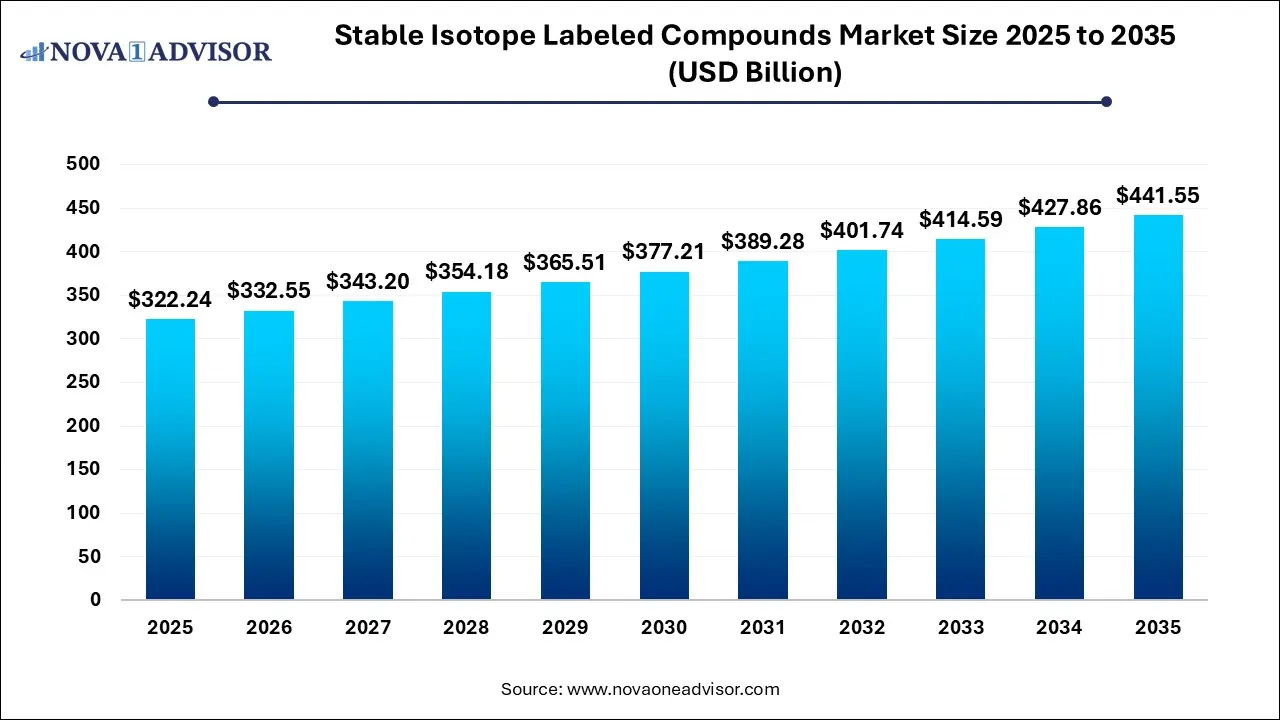
Market Key Takeaways
- The stable isotope labeled compounds market is experiencing steady growth driven by advancements in pharmaceutical research, clinical diagnostics, and environmental studies.
- Increasing demand for precision medicine and tracer-based studies is a major catalyst for market expansion.
- Carbon-13 and Deuterium isotopes dominate due to their extensive application in drug development and metabolic studies.
- North America remains the leading regional market, while Asia Pacific is emerging as the fastest-growing region due to expanding healthcare infrastructure and research investments.
- Pharmaceutical and biotechnology companies represent the largest end-user segment, reflecting the increasing reliance on isotope labeling in drug discovery and development.
Market Overview
The stable isotope labeled compounds market revolves around non-radioactive isotopes incorporated into molecules to trace chemical, biological, and environmental processes. Unlike radioactive isotopes, stable isotopes such as Carbon-13, Deuterium, Nitrogen-15, and Oxygen-18 do not decay over time, making them safer and more suitable for long-term studies.
These compounds are widely used in pharmaceutical research, metabolomics, proteomics, clinical diagnostics, environmental tracking, and industrial applications. For instance, stable isotopes are extensively used in drug metabolism studies to understand how compounds behave within biological systems. In clinical diagnostics, isotopes such as Carbon-13 are used in breath tests to diagnose infections like Helicobacter pylori.
The market is witnessing a surge in demand due to the increasing complexity of drug development pipelines and the growing emphasis on personalized medicine. Stable isotopes enable precise tracking of biochemical pathways, improving the accuracy of experimental outcomes. Additionally, technological advancements in mass spectrometry and nuclear magnetic resonance (NMR) spectroscopy have significantly enhanced the utility of these compounds.
Another key factor contributing to market growth is the expansion of research activities in emerging economies. Governments and private institutions are investing heavily in life sciences research, thereby increasing the consumption of stable isotope labeled compounds.
Major Trends in the Market
- Rising adoption of stable isotopes in precision medicine and personalized therapies
- Increasing use of isotope labeling in metabolomics and proteomics research
- Growing application in environmental and food safety testing
- Technological advancements in analytical instruments such as LC-MS and NMR
- Expansion of contract research organizations (CROs) utilizing isotope-labeled compounds
- Increasing demand for non-radioactive tracing techniques over radioactive alternatives
- Development of customized isotope-labeled compounds for specific research applications
- Strategic collaborations between isotope manufacturers and pharmaceutical companies
Stable Isotope Labeled Compounds Market Report Scope
| Report Coverage | Details |
| Market Size in 2026 | USD 332.55 Million |
| Market Size by 2035 | USD 332.55 Million |
| Growth Rate From 2026 to 2035 | CAGR of 3.2% |
| Base Year | 2025 |
| Base Year | 2026 to 2035 |
| Segments Covered | By Type, By Application, By End User, By Geography |
| Market Analysis (Terms Used) | Value (USD Million/Billion) or (Volume/Units) |
| Regional Scope | North America; Europe; Asia Pacific; Central and South America; the Middle East and Africa |
| Key Companies Profiled | include PerkinElmer Inc. (US), Merck KGaA (Germany), Cambridge Isotope Laboratories, Inc. (US), URENCO Limited (UK), IsoSciences, LLC (US), Medical Isotopes, |
Market Driver: Growing Demand in Pharmaceutical and Biotechnology Research
One of the primary drivers of the stable isotope labeled compounds market is the increasing demand from pharmaceutical and biotechnology industries. Drug development is becoming increasingly complex, requiring detailed insights into pharmacokinetics, metabolism, and toxicity. Stable isotope labeling plays a crucial role in these studies by enabling precise tracking of drug molecules within biological systems.
For example, deuterium-labeled drugs are gaining traction due to their improved metabolic stability. Deuterated compounds can slow down the rate of drug metabolism, leading to enhanced efficacy and reduced dosing frequency. This has led to the emergence of deuterated drugs as a new class of therapeutics, further boosting demand for stable isotopes.
Additionally, isotope-labeled compounds are widely used in clinical trials to study drug absorption, distribution, metabolism, and excretion (ADME). These studies are critical for regulatory approvals and ensuring drug safety. As the global pharmaceutical pipeline continues to expand, the demand for stable isotope labeled compounds is expected to grow significantly.
Market Restraint: High Cost of Production and Limited Availability
Despite the growing demand, the market faces a significant restraint in the form of high production costs and limited availability of certain isotopes. The production of stable isotopes requires specialized facilities, advanced technology, and significant energy input, making it a capital-intensive process.
For instance, the enrichment of isotopes such as Carbon-13 and Nitrogen-15 involves complex separation techniques that are both time-consuming and expensive. This leads to high product costs, which can limit adoption, especially among smaller research institutions and laboratories with budget constraints.
Moreover, the supply chain for stable isotopes is relatively concentrated, with a limited number of manufacturers globally. Any disruption in production or supply can lead to price volatility and shortages. This can hinder research activities and delay projects, particularly in regions that rely heavily on imports.
Market Opportunity: Expansion in Emerging Economies
A significant opportunity in the stable isotope labeled compounds market lies in the expansion of research and healthcare infrastructure in emerging economies. Countries in Asia Pacific and Latin America are investing heavily in biotechnology, pharmaceuticals, and academic research.
For example, nations such as China and India are witnessing rapid growth in pharmaceutical manufacturing and clinical research activities. Government initiatives aimed at promoting innovation and research are further driving demand for advanced tools such as isotope-labeled compounds.
Additionally, the increasing focus on environmental monitoring and food safety in these regions is creating new avenues for market growth. Stable isotopes are used to trace contaminants, study ecological systems, and verify food authenticity. As awareness and regulatory requirements increase, the demand for these compounds is expected to rise significantly.
Segmental Insights
By Type
How did the deuterium segment dominate the Stable Isotope Labeled Compounds market?
The deuterium segment is driven by its critical role in optimizing ADME studies, where they enhance drug metabolic resistance and half-life. Their inherent safety and cost-effectiveness compared to heavier isotopes streamline laboratory workflows and reduce development overheads. As research expands into environmental tracing and advanced industrial applications, the versatile and scalable nature of deuterium continues to solidify its leading position in the stable isotope market.
How did the carbon-13 segment expect to hold the fastest-growing Stable Isotope Labeled Compounds market in the coming years?
The carbon-13 segment is driven by its transition from specialized research to mainstream clinical diagnostics, particularly through non-invasive breath tests for H pylori and metabolic disorders. The surge in pharmaceutical R&D in new drug applications now utilizes Carbon-13 for precise pharmacokinetic and tracer studies. The Asia-Pacific region has emerged as a key growth hub, fueled by intensive industrialization and a burgeoning biotech sector in China and India.
By Application
How did the research segment account for the largest share in the Stable Isotope Labeled Compounds market?
The research segment is driven by the growth of the intensive integration of stable isotopes into pharmaceutical and biotech R&D for critical pharmacokinetics and bioequivalence studies. The rising precision requirements in metabolic flux analysis and proteomics, where high-resolution mass spectrometry and NMR spectroscopy have become indispensable. North America maintains its global lead through a robust infrastructure of contract research organizations (CROs) and significant government-backed scientific funding.
How did the clinical diagnostics segment expect to hold the fastest-growing Stable Isotope Labeled Compounds market in the coming years?
The clinical diagnostics segment is driven by the rise of personalized medicine, where labelled compounds are vital for metabolic profiling and biomarker discovery in oncology. The rapid expansion of the clinical diagnostics integration of stable isotopes as internal standards in LC-MS/MS for high precision patient monitoring and drug concentration measurements. The increasing prevalence of chronic diseases is cementing the role of these isotopes in hospitals as essential components for early detection and effective long-term disease management.
By End User
How did the pharmaceutical and biotechnology companies segment account for the largest share in the Stable Isotope Labeled Compounds market?
The pharmaceutical and biotechnology companies segment is driven by the surging research and development investments in oncology and complex diseases, where stable isotopes are critical for validating drug safety and efficacy. The integration of these compounds into proteomics and metabolomics is driving the next wave of innovation in biomarker discovery and personalized medicine. The industry's reliance on these precise analytical tools makes this segment the primary engine for growth within the stable isotope market.
How did the hospitals and diagnostic centers segment expect to hold the fastest-growing Stable Isotope Labeled Compounds market in the coming years?
The hospitals and diagnostic centers segment is driven by the integration of Carbon-13 and Nitrogen-15 into routine metabolic profiling and PET imaging. This growth is accelerated by the shift toward precision medicine, where stable isotopes provide the non-radioactive safety and high sensitivity required for long-term patient monitoring. Strengthening reimbursement frameworks in the U.S. and Japan is making isotope-based assays economically viable for large-scale clinical adoption.
Key Players in the Stable Isotope Labeled Compounds Market
- PerkinElmer Inc. provides a wide range of labeled compounds, focusing heavily on application in metabolic research, drug discovery, and molecular imaging. Their products are crucial for high-throughput screening and clinical diagnostics using advanced mass spectrometry techniques.
- Merck KGaA operates a major segment through Sigma-Aldrich (including Isotec), offering a comprehensive portfolio of stable isotope-labeled compounds for scientific research and industrial application.
- Cambridge Isotope Laboratories, Inc. is a global leader, recognized as the largest manufacturer and supplier of stable isotopes, specializing in high-purity stable isotopes.
- URENCO Limited is a key player, utilizing its advanced centrifuge technology to produce high-quality stable isotopes for medical, industrial, and scientific research purposes. Their contribution is vital to the supply chain of non-radioactive isotopes used in nuclear medicine and diagnostic imaging applications.
Recent Developments
- March 2025: A leading isotope manufacturer announced the expansion of its Carbon-13 production facility to meet rising global demand in pharmaceutical research.
- January 2025: A biotechnology company launched a new line of deuterium-labeled compounds designed for advanced drug discovery applications.
- November 2024: A major collaboration between a pharmaceutical company and a research institute focused on developing isotope-based diagnostic tools for cancer detection.
- September 2024: An isotope supplier introduced customized labeling services to cater to the growing demand for specialized research compounds.
- July 2024: A global chemical company invested in expanding its stable isotope production capabilities in Asia Pacific to strengthen regional supply chains.
Stable Isotope Labeled Compounds Market Segments
This research report offers market revenue, sales volume, production assessment and prognoses by classifying it on the basis of various aspects including product type, application/end-user, and region. Further, this research study investigates market size, production, consumption and its development trends at global, regional, and country level for period 2021 to 2035 and covers subsequent region in its scope:
By Type
- Deuterium
- Carbon-13
- Oxygen-18
- Nitrogen-15
- Other Stable Isotopes
By Application
- Research
- Clinical Diagnostics
- Industrial
- Other Applications
By End User
- Pharmaceutical and Biotechnology Companies
- Academic & Research Institutes
- Hospitals and Diagnostic Centers
- Other End Users
By Geography
North America
- U.S.
- Canada
Europe
- Germany
- France
- United Kingdom
- Rest of Europe
Asia Pacific
- China
- Japan
- India
- Southeast Asia
- Rest of Asia Pacific
Latin America
- Brazil
- Rest of Latin America
Middle East & Africa (MEA)
- GCC
- North Africa
- South Africa
- Rest of Middle East & Africa
FAQ's

Proceed to Buy
Instant PDF delivery on confirmation

Stable Isotope Labeled Compounds Market Size to Hit USD 441.55 Billion by 2035
 Request Customization
 Download Sample

Get a Sample of this Report
Stable Isotope Labeled Compounds Market