

Surgical Blades Market Size, Share, Forecast Report, 2026 - 2035
 Status Published
 Category Healthcare


Content
Surgical Blades Market Size and Growth 2026 to 2035
The global surgical blades market size was valued at USD 233.25 million in 2025 and is projected to grow from USD 245.85 million in 2026 to USD 394.66 million by 2035, at a CAGR of 5.4% from 2026 to 2035.
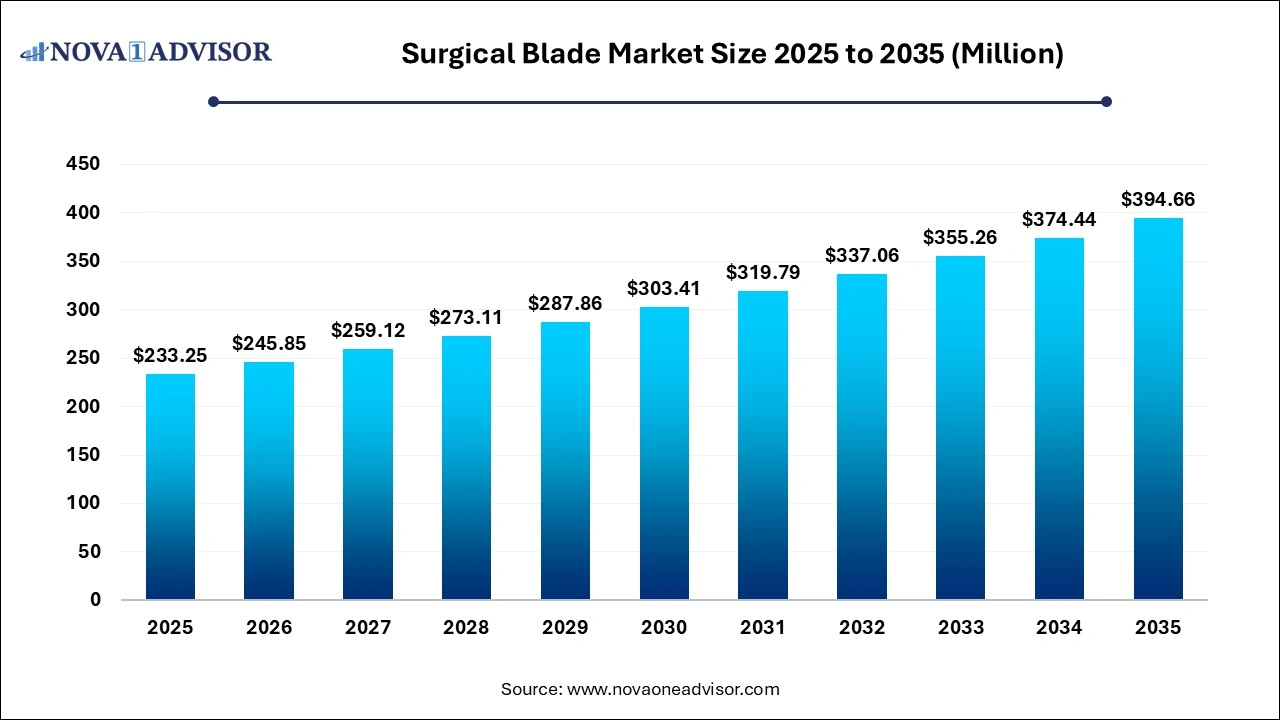
Key Takeaway
- By product: The stainless-steel segment dominated the market with the largest share in 2025 and is expected to grow at the fastest CAGR over the forecast period.
- By material, the sterile segment dominated the market with the largest share in 2025 and is expected to grow at the fastest CAGR over the forecast period.
- By end user, the hospital segment dominated the market with the largest share in 2025.
- By region, North America dominated the market with the largest share in 2025.
Market Overview
The Surgical Blades Market covers disposable and reusable-compatible blades used for tissue incision and dissection across general and specialized procedures. Product differentiation is driven by material composition, sharpness, edge geometry, consistency, corrosion resistance, sterilization, packaging, safety, and handle compatibility.
Stainless steel and carbon steel remain important material categories, with manufacturers offering different blade configurations to meet clinical requirements. Demand is supported by continuous surgical volumes across general surgery, orthopedics, dentistry, obstetrics, dermatology, reconstructive procedures, podiatry, and other specialties.
The market also benefits from recurring replacement demand, particularly as healthcare providers increasingly use single-use sterile instruments to support infection-control practices and procedural efficiency. Although minimally invasive surgery can reduce reliance on conventional scalpel blades in some procedures, blades remain relevant across open, microsurgical, reconstructive, hybrid, and access-related applications.
As a mature medical-device segment, future market development is expected to focus on blade performance, precision, safety, sustainability, handle compatibility, and supply reliability rather than simply expanding product variety.
Market Outlook
- Market Growth Overview: The global surgical blades market is expected to grow significantly between 2025 and 2035, driven by the growing number of surgical procedures across the globe.
- Sustainability Trends: Sustainability trends involve growing emphasis on reducing medical waste and adopting eco-friendly and biodegradable materials.
- Major Investors: Major investors in the market include Hill-Rom (Welch Allyn/Aspen Surgical), B. Braun Melsungen AG, Swann-Morton, Feather Safety Razor Co., and Surgical Specialties Corporation.
How is AI Impacting The Global Surgical Blades Market?
Artificial intelligence (AI) is reshaping the market by transitioning demand towards minimally invasive and robotic-assisted procedures. AI also increases the surgical volume and standardizes intraoperative workflows. Furthermore, AI-guided navigation systems enhance surgical precision to minimize misplaced incisions, which in turn establishes increased performance standards for specialized micro-blades and ultrasonic scalpel attachments.
Major Trends in the Market
- Increasing preference for single-use surgical blades: Hospitals continue to prioritize convenient, ready-to-use instruments that reduce reprocessing requirements and simplify operating-room workflows.
- Greater emphasis on edge consistency: Manufacturers are investing in precision grinding and quality-control systems to maintain predictable cutting performance.
- Growth of safety-oriented scalpel systems: Safety handles, blade-removal systems, and controlled disposal solutions are receiving greater attention because of sharps-injury risks.
- Expansion of ambulatory surgery: Increasing procedure volumes in ASCs are supporting demand for compact, standardized, and easy-to-manage surgical consumables.
- Material optimization: Manufacturers continue to balance stainless steel's corrosion resistance with carbon steel's sharpness and edge characteristics.
Surgical Blades Market Report Scope
| Report Coverage | Details |
| Market Size in 2026 | USD 245.85 Million |
| Market Size by 2035 | USD 394.66 Million |
| Growth Rate From 2026 to 2035 | CAGR of 5.4% |
| Base Year | 2025 |
| Forecast Period | 2026 to 2035 |
| Segments Covered | Product, Material, End Use, Region |
| Market Analysis (Terms Used) | Value (USD Million/Billion) or (Volume/Units) |
| Regional Scope | North America; Europe; Asia Pacific; Central and South America; the Middle East and Africa |
| Key Companies Profiled | Medtronic Plc; Johnson & Johnson Service, Inc.; Conmed Corporation; Integra LifeSciences; Smith & Nephew; Becton, Dickinson and Company (BD); B. Braun Melsungen Ag; Cadence Inc; Integer Holdings Corporation; Olympus Corporation; Stryker; Boston Scientific Corporation; Erbe Elektromedizin Gmbh; 3M Healthcare |
Market Driver
Rising surgical procedure volumes and demand for precision are driving the Surgical Blades Market. Growing access to healthcare, aging populations, expansion of specialty procedures, and increasing ambulatory surgery volumes generate recurring demand for surgical blades. Consistent sharpness, predictable cutting performance, and application-specific blade geometries further support demand across general surgery, dentistry, ophthalmology, orthopedics, reconstructive surgery, and other specialties.
Market Restraint
Pricing pressure and product commoditization remain key challenges. Standard surgical blades are relatively mature products, encouraging hospitals and procurement organizations to emphasize unit cost, volume discounts, supply reliability, and existing supplier agreements. Regional competition can further intensify price pressure, while sterilization, packaging, quality assurance, and regulatory requirements add to manufacturing costs.
Market Opportunity
Advanced materials, specialty blades, precision manufacturing, and emerging healthcare markets offer significant opportunities. Manufacturers can target higher-value applications such as microsurgery, ophthalmology, dentistry, and reconstructive procedures through improved edge geometry and material performance. Automated grinding, machine-vision inspection, localized manufacturing, and sustainable packaging can further strengthen competitiveness, particularly across Asia-Pacific and other developing healthcare markets.
Segmental Insights
By Product
Why did the stainless-steel segment dominate the global surgical blades market?
The stainless-steel segment dominated the market with the largest share in 2025 and is expected to grow at the fastest CAGR over the forecast period. The dominance and growth of the segment can be attributed to their extensive adoption and proven efficiency in different surgical procedures. In addition, it is widely selected for general surgery, plastic surgery, and specialized tissue dissection due to its reliable tactile feedback, leading to segment growth soon.
By Material
Why did the sterile segment dominate the global surgical blades market?
The sterile segment dominated the market with the largest share in 2025 and is expected to grow at the fastest CAGR over the forecast period. The dominance and growth of the segment can be linked to the growing emphasis on infection control and innovation in sterilization technologies. Also, the growing transition toward outpatient and cosmetic procedures is driving a continuous increase in the daily consumption of disposable, pre-sterilized surgical blades.
By End Use
Why did the hospital segment dominate the global surgical blades market?
The hospital segment dominated the market with the largest share in 2025. The dominance of the segment can be attributed to its key role in the healthcare system and growing demand for high-grade surgical instruments. Furthermore, the integration of precision-manufactured, specialty-coated, and high-grade stainless steel or ceramic blades is used extensively for complex surgical procedures.
How did the ambulatory surgical centers segment expected to hold the significantly growing global surgical blades market in the coming years?
The ambulatory surgical centers segment is expected to grow at the fastest CAGR over the study period. The growth of the segment can be due to their cost-effective, convenient, and efficient alternative to conventional hospital-based surgeries. Moreover, the implementation of expanded insurance coverage and the introduction of novel Current Procedural Terminology (CPT) codes facilitate enhanced reimbursement frameworks for specialized outpatient interventions.
By Region
Why did the North American region account for the largest share of the global surgical blades market?
North America dominated the market with the largest share in 2025. The dominance of the region can be attributed to the presence of cutting-edge healthcare infrastructure, technological innovations, and high surgical procedure volumes. In addition, stricter rules on workplace safety drive hospitals to use protective guards so medical workers avoid accidental cuts.
U.S. Global Surgical Blades Market Trends
The growth of the market in the country can be driven by the increasing volume of surgical procedures and the rise in the geriatric population across major cities. Also, U.S. medical facilities are transitioning to safety-engineered scalpels in line with stringent Occupational Safety and Health Administration (OSHA) workplace safety mandates.
Why did the Asia-Pacific region become the fastest-growing global surgical blades market during the forecast period?
Asia Pacific is expected to grow at the fastest CAGR over the forecast period. The growth of the region can be credited to the growing healthcare expenditure and the presence of innovative healthcare infrastructure in emerging economies such as China and India. Furthermore, surgical facilities are becoming increasingly accessible due to rapid healthcare modernization, substantial investments in hospital infrastructure, and the expansion of universal healthcare coverage by governments.
China Global Surgical Blades Market Trends
The market in the country is growing due to the ongoing technological innovations in medical facilities and the growing number of surgical procedures. Moreover, the expansion of the middle class, disregarded by increased disposable income levels, generates substantial market demand for both aesthetic and reconstructive surgical procedures.
Key Players in the Global Surgical Blades Market
- Feather Safety Razor Co.: A premier Japanese manufacturer globally respected for producing ultra-sharp cutting edges. Utilizing advanced blade technologies, they cater to standard general surgeries as well as micro-procedures in ophthalmology and neurosurgery.
- Aspen Surgical: A key player in the US market focused on operating room disposables. Aspen Surgical maintains aggressive growth by manufacturing extensive lines of safety scalpels, blades, and fluid management products optimized for rapid room turnover.
- Hu-Friedy Mfg. Co., LLC: A global leader in the dental surgery market. They capture highly focused market share by offering micro-blades and precision instruments designed for oral, periodontal, and maxillofacial surgical procedures.
Recent Developments
- In July 2026, Johnson & Johnson announced that the U.S. Food and Drug Administration granted De Novo market authorization for the OTTAVA™ Robotic Surgical System, establishing it as the premier table-integrated soft-tissue robotic platform. This regulatory clearance sanctions its clinical utilization across a broad spectrum of general surgical interventions.
Segments Covered in the Report
This report forecasts revenue growth at country levels and provides an analysis of the latest industry trends in each of the sub-segments from 2021 to 2035. For this study, Nova one advisor, Inc. has surgical blades market.
By Product
- Stainless steel
- High-grade carbon steel
- Others
By Material
- Sterile
- Non-sterile
By End Use
- Hospitals
- Clinics
- Ambulatory Surgical Centers
By Region
- North America
- Europe
- Asia-Pacific
- Latin America
- Middle East & Africa (MEA)
FAQ's

Proceed to Buy
Instant PDF delivery on confirmation

Surgical Blades Market Size to Exceed USD 394.66 Million by 2035
 Request Customization
 Download Sample

Get a Sample of this Report
Surgical Blades Market