

Surgical Stapling Devices Market (By Product; By Type; By End-use; By Region) - Global Industry Analysis, Share, Growth, Regional Outlook and Forecasts, 2026-2035
 Status Published
 Category Healthcare


Content
Surgical Stapling Devices Market Size, Share and Trends 2026 to 2035
The global surgical stapling devices market size was exhibited at USD 6.78 billion in 2025 and is projected to hit around USD 16.51 billion by 2035, growing at a CAGR of 9.31% during the forecast period 2026 to 2035.
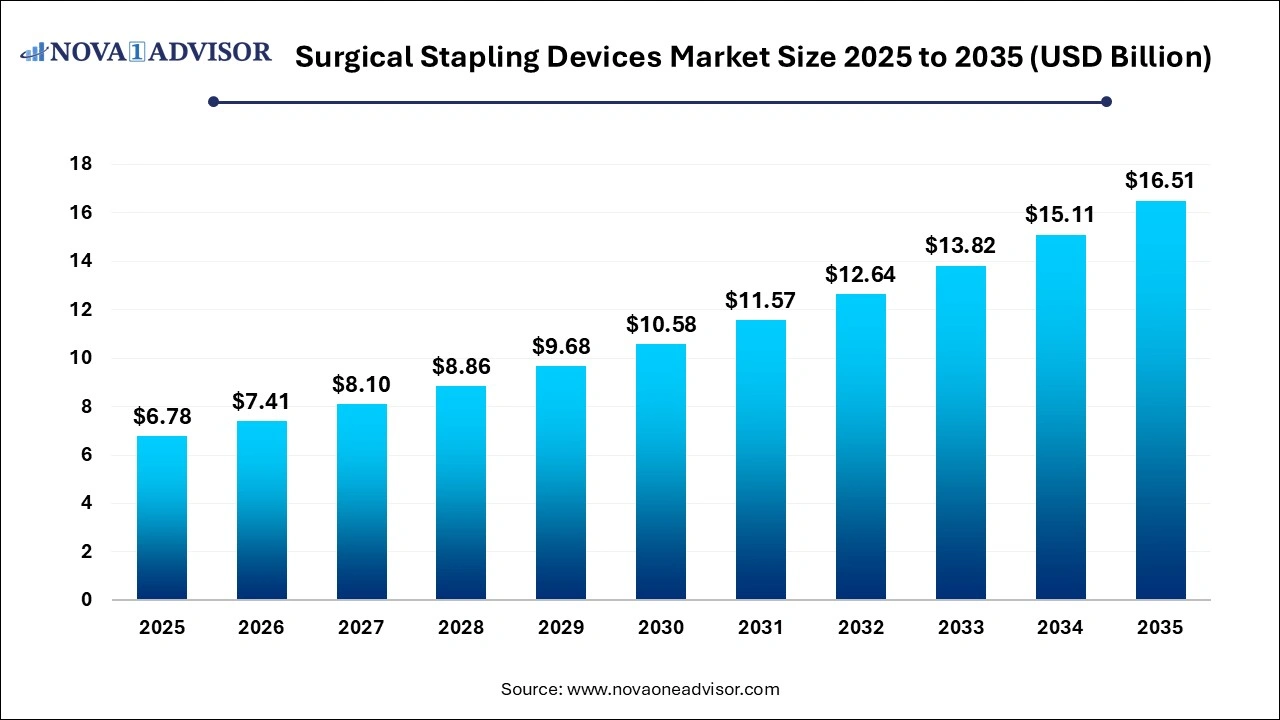
Surgical Stapling Devices Market Key Pointers
- Manual surgical stapling devices dominated the market in terms of revenue in 2022, owing to its increasing demand across the globe.
- Powered stapling devices allow surgeons to perform large number of surgeries in emergency wards, thereby anticipated to capture significant market share in 2022.
- There is an increasing demand for disposable devices due to heightened concerns for communicable infections.
- Hospitals segment dominated the market in 2022 owing to increasing number of surgeries across all hospitals.
- North America dominated the overall market in terms of revenue in 2022, owing to introduction of powered staples, and soaring need for tissue and wound management.
Surgical Stapling Devices Market Outlook
- Market Growth Overview: The surgical stapling devices market is expected to grow significantly between 2025 and 2034, driven by the rising popularity of minimally invasive surgeries, the rising geriatric population, and the increasing rate of obesity, fueling demand for bacteria procedures and weight-loss surgeries, which heavily utilize staples.
- Sustainability Trends: Sustainability trends involve a shift toward reusable and hybrid systems, eco-friendly materials and design, and smart technology for sustainability.
- Major Investors: Major investors in the market include Medtronic plc, Johnson & Johnson, B. Braun SE, and CONMED Corporation.
Surgical Stapling Devices Market Report Scope
| Report Coverage | Details |
| Market Size in 2026 | USD 7.41 Billion |
| Market Size by 2035 | USD 16.51 Billion |
| Growth Rate from 2026 to 2035 | CAGR of 9.31% |
| Base year | 2025 |
| Forecast period | 2026 to 2035 |
| Segments covered | By Product, By Type, By End-use |
| Regional scope | North America; Europe; Asia Pacific; Central and South America; the Middle East and Africa |
| Key companies profiled | HAAG-STREIT GROUP; Olympus Corp.; Leica Microsystems; B. Braun Melsungen Inc.; Accurate Surgical & Scientific Instruments Corp.; Surtex Instruments Ltd.; Scanlan International; Carl Zeiss AG; KLS Martin Group; Topcon Corp.; Integra LifeSciences |
Surgical Stapling Devices Market Regional Insights
By Product Insights
How did the Manual Surgical Staplers Segment Dominate the Surgical Stapling Devices Market?
The manual surgical staplers segment is driven by its cost-effectiveness and reliability in both resource-limited and high-volume clinical settings. Their intuitive design and independence from power sources made them the preferred choice for a vast range of gastrointestinal and gynecological procedures globally. The massive demand in emerging economies, where expanding healthcare infrastructure prioritizes accessible, high-performance tools.
How did the Powered Surgical Staplers Segment Expect to Hold the Fstest-Growing Surgical Stapling Devices Market in the Coming Years?
The powered surgical staplers segment is driven by the integration with robotic-assisted platforms and smart technology. The rising volume of complex surgeries for obesity and cancer by offering consistent staple formation and significantly reduced tissue trauma. Despite their higher cost, the shift toward improved clinical outcomes and enhanced patient safety made them the preferred choice for modern operating rooms. The synergy between automation and robotic surgery solidified powered staplers as the future standard for high-precision surgical intervention.
By Type Insights
How did the disposable surgical staplers segment account for the largest share in the Surgical Stapling Devices market?
The disposable surgical staplers segment is driven by offering unparalleled safety and infection control, effectively eliminating the risk of cross-contamination. Their adoption is driven by the global boom in minimally invasive surgery, where the demand for rapid, sterile, and high-precision closing devices is critical. The integration of motorized and intelligent technologies into single-use platforms solidified their position as the gold standard for modern surgical safety.
How did the Reusable Surgical Staplers Segment Expect to Hold the Fastest-Growing Surgical Stapling Devices Market in the Coming Years?
The reusable surgical staplers segment is driven by its superior long-term cost-effectiveness for budgets; these devices now offer the durability and sterilization efficiency required for high-volume general surgeries. The global surge in chronic disease procedures necessitates reliable and sustainable surgical tools. Ultimately, the shift toward maximizing institutional ROI without compromising performance solidified the reusable segment's rapid market expansion.
By End-Use Insights
How did the Hospitals Segment Account for the Largest Share in the Surgical Stapling Devices Market?
The hospitals segment is driven by the surge in bariatric and general procedures for chronic conditions; these institutions utilize their large-scale budget for the bulk procurement of advanced powered staplers. The rapid modernization of healthcare infrastructure in emerging economies further accelerated surgical volumes and institutional adoption. The hospital’s ability to integrate expensive, cutting-edge technology with high-volume patient care solidified its market leadership.
How did the Ambulatory Surgical Centers Segment Expect to Hold the Fastest-Growing Surgical Stapling Devices Market in the Coming Years?
The ambulatory surgical centers segment is driven by a stringent shift toward outpatient minimally invasive surgeries. The high-precision, cost-effective alternatives to traditional inpatient hospital stays. The rapid adoption of user-friendly, advanced stapling technologies has enabled higher procedure volumes in shorter timeframes. The migration of specialized orthopedic and cardiovascular procedures to ASCs solidified their role as the most dynamic growth engine in the surgical stapling market.
Key Players in the Surgical Stapling Devices Market
- HAAG-STREIT GROUP: Haag-Streit contributes to the broader surgical visualization market by providing high-precision surgical microscopes essential for complex, fine-tissue surgeries where stapling devices are employed.
- Olympus Corp: Olympus provides advanced imaging systems, such as endoscopes and surgical cameras, which are crucial for visualizing internal surgical sites during minimally invasive stapling procedures.
- Leica Microsystems: Leica Microsystems enhances surgical performance in the market by offering advanced visualization tools, including neurosurgical and ophthalmic microscopes with 3D/4K capabilities. Their high-resolution imaging systems help surgeons perform complex tasks with high precision, complementing the use of surgical staplers in delicate procedures.
- B. Braun Melsungen Inc: B. Braun provides a comprehensive portfolio of wound closure products, including manual and mechanical staplers, under its Aesculap division.
FAQ's

Proceed to Buy
Instant PDF delivery on confirmation

Surgical Stapling Devices Market Size to Worth Around USD 16.51 Bn by 2035
 Request Customization
 Download Sample

Get a Sample of this Report
Surgical Stapling Devices Market