

Syringe and Needle Market Size, Share, Growth, Report 2026 to 2035
 Status Published
 Category Healthcare


Content
Syringe and Needle Market Size and Growth 2026 to 2035
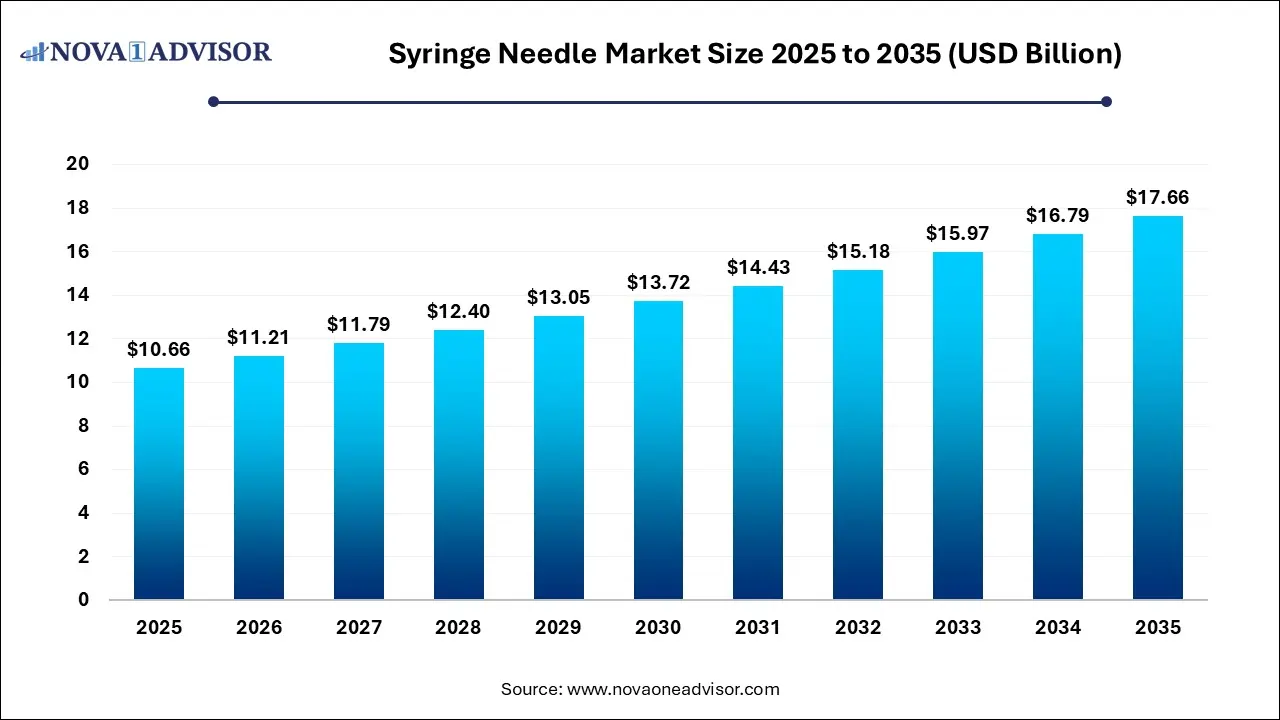
The global syringe and needle market size was estimated at USD 10.66 billion in 2025 and is projected to hit around USD 17.66 billion by 2035, growing at a CAGR of 5.18% during the forecast period from 2026 to 2035.
Market Overview
The Syringe and Needle Market consists of medical devices designed to deliver medication, draw fluids, and conduct diagnostic or therapeutic procedures. Syringes and needles are indispensable in healthcare settings, serving applications ranging from vaccination campaigns to cardiovascular diagnostics, orthopedic therapies, and home‑based chronic disease management. Products extend from simple single‑use syringes to advanced safety devices that reduce needlestick injuries.
Globally, demand for syringes and needles has surged due to several interlinked factors: increased chronic disease prevalence (e.g., diabetes, cardiovascular disease), larger vaccination drives (including adult immunizations), expanding home healthcare delivery, and a shift toward minimally invasive diagnostic and therapeutic procedures.
The COVID‑19 pandemic further underscored the essential role of these products worldwide. Billions of doses required global vaccination infrastructure, making syringes and safety needles one of the most produced and distributed medical devices in history.
Modern syringe markets are also shaped by strict regulatory standards, with agencies such as the U.S. FDA (Food and Drug Administration) and European Medicines Agency (EMA) requiring documented quality, sterility, and safety profiles.
Importantly, healthcare providers increasingly prefer safety‑engineered syringes designed to prevent accidental needlestick injuries due to both worker safety regulations and cost avoidance related to needlestick‑associated infections.
Market Outlook
- Market Growth Overview: The global syringe and needle market is expected to grow significantly between 2025 and 2035, driven by the rising chronic diseases, expanding immunization programs, and innovation in prefilled syringes.
- Sustainability Trends: Sustainability trends involve eco-friendly and biodegradable materials, the rise of reusable syringes in specific niches, and dose-optimization and low-dead-space syringes.
- Major Investors: Major investors in the market include Becton, Dickinson and Company (BD), Terumo Corporation, Cardinal Health, B. Braun, and Hindustan Syringes & Medical Devices (HMD).
How AI is Transforming the Syringe and Needle Market
Artificial Intelligence (AI) is subtly yet significantly reshaping key aspects of the syringe and needle ecosystem from manufacturing to supply chain management and product quality assurance.
AI‑Assisted Production Quality Control
In modern high‑volume syringe manufacturing plants, AI‑enabled visual inspection systems now examine each component with machine‑level precision to detect defects such as micro‑cracks, incorrect dimensions, contamination, or irregular packaging. This level of automation improves defect detection rates far beyond human inspection capabilities.
For example, in 2025, a major medical device manufacturer reported a reduction in product rejection rates by more than 40% using AI‑guided optical scanning systems during production. These systems not only find inconsistencies but also learn from prior production runs, enhancing defect prediction.
Predictive Maintenance
AI predictive maintenance algorithms forecast machine failures before they occur. In the context of syringe and needle production, where high‑precision molding and cutting equipment operate 24/7, predictive AI analytics minimize unplanned downtime, increase output reliability, and reduce maintenance costs. This translates to better factory utilization and more stable supply levels for hospitals and clinics.
AI‑Enabled Supply Chain Optimization
Supply chains for syringes and needles span multiple countries, often involving raw material suppliers (e.g., plastic polymer producers), manufacturing hubs, and distribution networks reaching healthcare facilities worldwide. AI demand forecasting tools analyze historical sales, public health campaigns, seasonal patterns (like influenza seasons), and logistics constraints to predict product needs months ahead, reducing stockouts and wastage.
One case study highlights a regional supplier that integrated AI demand forecasting, enabling improved allocation of inventory across warehouses in North America and Europe resulting in a 20% reduction in emergency shipments and freight costs.
Syringe and Needle Market Report Scope
| Report Coverage | Details |
| Market Size in 2026 | USD 11.21 Billion |
| Market Size by 2035 | USD 17.66 Billion |
| Growth Rate From 2026 to 2035 | CAGR of 5.18% |
| Base Year | 2025 |
| Forecast Period | 2026 to 2035 |
| Segments Covered | By Type, By Application, By Usability, By End use, Region |
| Market Analysis (Terms Used) | Value (USD Million/Billion) or (Volume/Units) |
| Regional Scope | North America; Europe; Asia Pacific; Central and South America; the Middle East and Africa |
| Key Companies Profiled | DeRoyal, Albert David Ltd, B. Braun Melsungen AG, Terumo Corporation, Connecticut Hypodermics Inc., Insulet, Septodont, Medtronic, BD, Schott AG, Cardinal Health, and Smiths Medical. |
Segmental Insights
By Type
How did the blood collection syringe and needles segment dominate the Global Syringe and Needle market?
The blood collection syringe and needles segment is driven by the tightening healthcare regulations, favouring safety-engineered and retractable needle systems, which are successfully driving up average revenue per unit, securing this consumable, highly resilient, and value-driven market. The massive operational value is continuously sustained by routine blood monitoring for a growing global population managing diabetes, cardiovascular disorders, and chronic infections.
How did the ophthalmic syringes and needles segment expect to hold the fastest-growing Global Syringe and Needle market in the coming years?
The ophthalmic syringes and needles segment is driven by an aging population and increased screen time, that have triggered a surge in conditions, such as cataracts and diabetic retinopathy. To manage these delicate ocular disorders, the clinical preference has shifted heavily toward minimally invasive intravitreal injections and targeted microsurgery.
By Application
How did the general surgery segment dominate the Global Syringe and Needle market?
The general surgery segment is driven by the continuous volume of routine and emergency interventions worldwide, establishing syringes and needles as indispensable consumables for anaesthesia administration, fluid extraction, and medication delivery. The strict global infection control mandates favour single-use, multi-layered functional disposable to actively eliminate cross-contamination and surgical side infections.
How did the diagnostic segment expect to hold the fastest-growing Global Syringe and Needle market in the coming years?
The diagnostic segment is driven by the ongoing decentralization of healthcare, fueling the institutional need for accessible, easy-to-use syringe technologies optimized for point-of-care testing and on-site sample collection. The engineering of specialized syringes for minimally invasive diagnostics, such as fluid biopsies, ensures rapid, high-accuracy biological extraction, cementing these consumables as a foundational pillar of modern diagnostic infrastructure.
By Usability
How did the disposable segment dominate the Global Syringe and Needle market?
The disposable segment is driven by the tightening workplace safety regulations mandating retractable and needle-shielding mechanisms to protect healthcare professionals from needlestick injuries, securing disposable syringes as an indispensable, high-volume cornerstone of global medical infrastructure. The manufacturing shifts toward low-cost, medical-grade polypropylene optimize high-volume production and seamless gamma-sterilization, bypassing the intensive labor and energy expenses of reusable alternatives.
How did the reusable segment expect to hold the fastest-growing Global Syringe and Needle market in the coming years?
The reusable segment is driven by the significant lowering of operational and procedural expenses within high-volume laboratory settings and chronic care environments. This reusable architecture finds highly stable, recurring utility within specialized veterinary sectors and chronic pen-injector therapies, establishing a resilient and sustainable niche alongside the high-volume disposable incomes.
By Regional
How did the North America region account for the largest share in the Global Syringe and Needle market?
North America is driven by aggressive federal and state mandates that strictly require safety-engineered and auto-disposable configurations to protect healthcare professionals from severe blood-borne infections. This legal framework operates alongside an expansive healthcare infrastructure of ambulatory care centers and hospitals, ensuring consistently high daily procedure volumes and rapid adoption of advanced, smart syringe innovations.
U.S. Global Syringe and Needle Market Trends
The U.S.’s booming popularity of injectable biologics, such as GLP-1 weight management treatments, which demand specialized autoinjectors and stainless-steel barrels capable of handling high-viscosity formulations. The expansion of home healthcare for chronic diseases, such as diabetes and oncology, is shifting procedures from centralized hospitals to decentralized consumer channels.
How did the Asia Pacific region hold the fastest-growing Global Syringe and Needle Market in the forecast period?
Asia Pacific’s aging regional demographic and rising diabetes rates, which require a high volume of daily, self-administered therapies, such as insulin and prefilled injections. The expanding access to advanced clinical facilities and the rising utilization of complex, high-viscosity biologics ensure that specialized, infection-resistant needle systems will continue to serve as a high-margin growth driver across the developing Asian region.
China Global Syringe and Needle Market Trends
China’s increasingly strict domestic occupational safety regulations and a nationwide focus on preventing clinical cross-contamination. This high-volume consumption is heavily supported by the country's status as a global manufacturing engine, with local facilities producing tens of billions of conventional and safety units annually to feed both domestic healthcare expansions and massive international export demands.
Key Players in the Global Syringe and Needle Market
- DeRoyal
DeRoyal contributes to the global syringe and needle market by manufacturing specialized, safety-engineered hypodermic devices that prioritize clinician and patient safety. Their diverse product lines are designed to reduce accidental needlestick injuries and enhance overall infection control in hospitals and clinical settings.
- Albert David Ltd
Albert David Ltd plays a significant role as a prominent Indian pharmaceutical manufacturer, producing millions of disposable syringes and high-quality hypodermic needles daily. Their cost-effective, globally certified production helps meet the high-volume demand for single-use injection devices across domestic and emerging international markets.
- B. Braun Melsungen AG
B. Braun supports global healthcare by engineering advanced, biocompatible infusion and injection systems, including eco-friendly disposable syringes and precise needle technologies.
Segments Covered in the Report
This report forecasts revenue growth at country levels and provides an analysis of the latest industry trends in each of the sub-segments from 2021 to 2035. For this study, Nova one advisor, Inc. has syringe and needle market.
By Type
- Blood Collection Syringe and Needles
- Ophthalmic Syringe and Needles
- Bone Marrow Syringe and Needles
- Catheter Syringe and Needles
- Dental Syringe and Needles
- Epidural Syringe and Needles
- Av Fistula Syringe and Needles
- Pen Syringe and Needles
- Intravenous Syringe and Needles
- Spinal Anesthesia Syringe and Needles
- Suture Syringe and Needles
- Others
By Application
- General Surgery
- Diagnostic
- Respiratory
- Orthopedics
- Cardiovascular
- Dental
- Neurology
- Ophthalmology
- Urology
- Others
By Usability
- Disposable
- Reusable
By End User
- Hospitals & Clinics
- Diagnostic Centers
- Home Care
- Others
By Region
- North America
- Europe
- Asia Pacific
- Latin America
- Middle East and Africa (MEA)

Proceed to Buy
Instant PDF delivery on confirmation

Syringe and Needle Market Size to Hit USD 17.66 Billion by 2035
 Request Customization
 Download Sample

Get a Sample of this Report
Syringe and Needle Market