

Tamiflu (Oseltamivir Phosphate) Market Size, Share, and Trends 2026 to 2035
 Status Published
 Category Healthcare


Content
Tamiflu (Oseltamivir Phosphate) Market Size and Growth 2026 to 2035
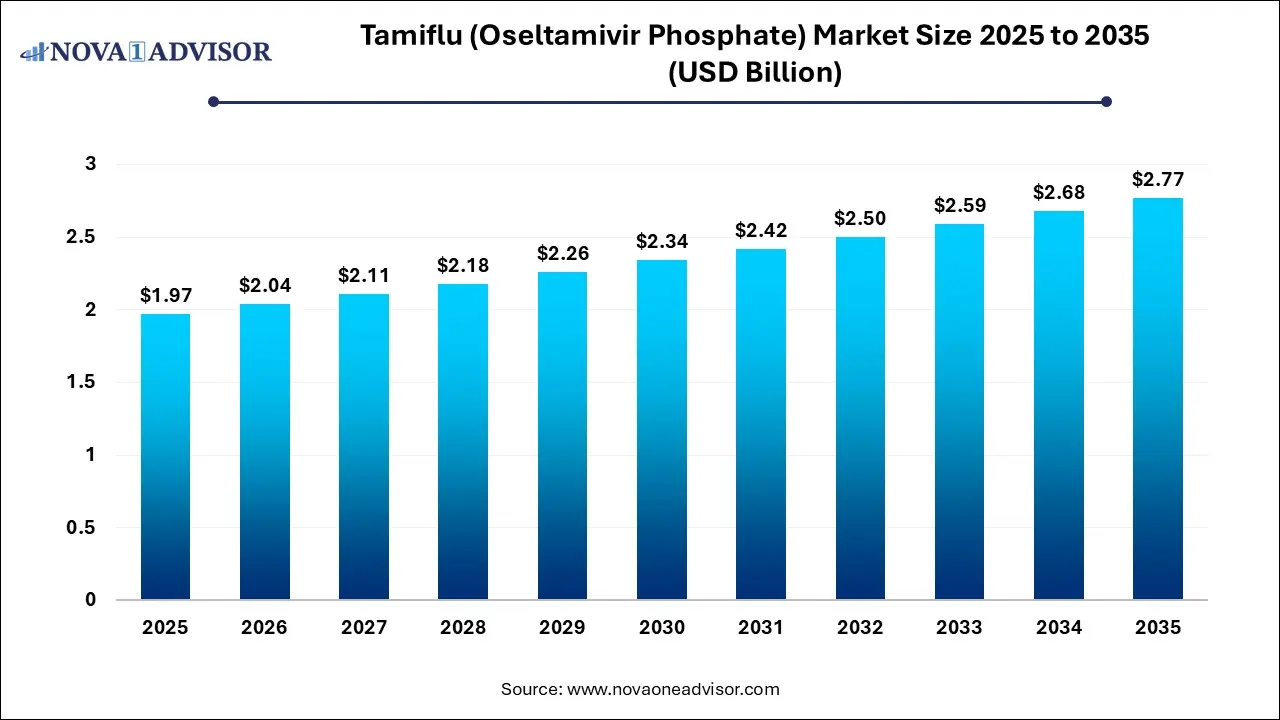
The global tamiflu (Oseltamivir Phosphate) market size was estimated at USD 1.97 billion in 2025 and is projected to hit around USD 2.77 billion by 2035, growing at a CAGR of 3.5% during the forecast period from 2026 to 2035.
Market Overview
The Tamiflu (Oseltamivir Phosphate) market represents a vital segment within the global antiviral drugs industry. Oseltamivir phosphate is a neuraminidase inhibitor widely prescribed for the prevention and treatment of influenza A and influenza B infections. The drug gained global recognition during influenza outbreaks such as H1N1 swine flu and continues to be included in pandemic preparedness programs across multiple countries. The market has evolved from being heavily dependent on branded products to a more diversified structure involving generic manufacturers, government procurement programs, and regional pharmaceutical suppliers.
The increasing incidence of seasonal influenza remains one of the primary factors driving market demand. Every year, millions of influenza cases are reported worldwide, placing substantial burden on healthcare systems. Influenza-associated hospitalizations and mortality are particularly high among elderly populations, children, pregnant women, and immunocompromised individuals. As a result, antiviral drugs such as Tamiflu continue to play a critical role in reducing disease severity, hospitalization rates, and complications.
The market also benefits from heightened awareness regarding viral respiratory infections following the COVID-19 pandemic. Governments and healthcare agencies have become more proactive in maintaining antiviral stockpiles and improving infectious disease preparedness. Pharmaceutical companies are investing in enhanced manufacturing capabilities and supply chain resilience to avoid shortages during outbreaks. This has increased the strategic importance of oseltamivir-based therapeutics in national healthcare frameworks.
Another important market dynamic is the growing availability of generic oseltamivir formulations. Patent expirations in several regions enabled multiple pharmaceutical manufacturers to enter the market with affordable alternatives. This has significantly improved accessibility in emerging economies where healthcare affordability remains a critical concern. Generic competition has also intensified pricing pressure, compelling companies to focus on distribution efficiency, formulation innovation, and regional expansion.
The demand for Tamiflu products is further influenced by changing climatic conditions and global mobility patterns. Increasing international travel contributes to faster transmission of influenza strains across borders. Urbanization and population density in developing economies also create favorable conditions for viral spread. Consequently, healthcare authorities increasingly emphasize early diagnosis and rapid antiviral intervention to minimize public health impact.
The market landscape includes multinational pharmaceutical companies, regional generic manufacturers, hospital procurement organizations, and government agencies. Partnerships between public health institutions and pharmaceutical companies remain crucial during emergency influenza outbreaks. In addition, advancements in rapid diagnostic technologies are supporting timely prescription of antiviral medications, thereby positively influencing market growth.
Market Outlook
- Market Growth Overview: The global Tamiflu (Oseltamivir Phosphate) market is expected to grow significantly between 2025 and 2035, driven by the rising prevalence of influenza A and B, the proliferation of strategic generic drug availability, and innovation in drug formulations.
- Sustainability Trends: Sustainability trends involve biocatalytic manufacturing, circular supply chain, and eco-friendly packaging.
- Major Investors: Major investors in the market include F. Hoffmann-La Roche Ltd., Cipla, Lupin, NATCO Pharma, Teva Pharmaceutical Industries, and Zydus Cadila.
How is AI Transforming the Tamiflu (Oseltamivir Phosphate) Market
Artificial intelligence is increasingly reshaping the Tamiflu market through improvements in disease forecasting, antiviral drug discovery, supply chain optimization, and patient management systems. AI-driven epidemiological models are now capable of predicting influenza outbreaks by analyzing weather conditions, mobility data, hospital admissions, social media activity, and historical infection trends. These predictive systems enable healthcare authorities and pharmaceutical companies to anticipate spikes in antiviral demand and optimize inventory planning.
AI-powered surveillance platforms are helping governments identify emerging influenza strains with greater speed and accuracy. Machine learning algorithms can process massive genomic datasets to detect viral mutations that may influence drug resistance or transmissibility. This capability is becoming highly valuable for pharmaceutical companies involved in antiviral research and vaccine coordination programs. Early detection of resistant influenza strains also allows manufacturers to adjust production strategies and improve treatment protocols.
In pharmaceutical manufacturing, AI is improving operational efficiency and reducing production downtime. Predictive maintenance systems monitor manufacturing equipment to identify potential failures before disruptions occur. This ensures uninterrupted production of Tamiflu and generic oseltamivir products during periods of elevated demand. AI-enabled quality control systems are also helping companies maintain regulatory compliance and product consistency.
Drug development processes are becoming more streamlined through AI-assisted molecular modeling and clinical trial analytics. Researchers are using artificial intelligence to identify improved antiviral compounds and evaluate combination therapies that could complement oseltamivir treatment. AI platforms can analyze clinical outcomes from thousands of patients to determine effectiveness patterns, side effects, and resistance trends.
AI is also transforming distribution and retail pharmacy operations. Intelligent demand forecasting systems allow pharmacies and hospitals to manage antiviral inventories more effectively, especially during influenza seasons. Telemedicine platforms integrated with AI symptom assessment tools are encouraging earlier diagnosis and prescription fulfillment, particularly through online pharmacies. This digital healthcare transformation is expanding patient access to Tamiflu products globally.
Furthermore, healthcare providers are leveraging AI-driven decision support systems to guide antiviral prescriptions based on patient history, risk factors, and local influenza activity. These systems help improve treatment accuracy while reducing unnecessary antiviral use, thereby supporting antimicrobial stewardship initiatives.
Tamiflu (Oseltamivir Phosphate) Market Report Scope
| Report Coverage | Details |
| Market Size in 2026 | USD 2.04 Billion |
| Market Size by 2035 | USD 2.77 Billion |
| Growth Rate From 2026 to 2035 | CAGR of 3.5% |
| Base Year | 2025 |
| Forecast Period | 2026 to 2035 |
| Segments Covered | By Drug Type, By Dosage Form, By Indication, By Distribution Channel, By Region |
| Market Analysis (Terms Used) | Value (USD Million/Billion) or (Volume/Units) |
| Regional Scope | North America; Europe; Asia Pacific; Central and South America; the Middle East and Africa |
| Key Companies Profiled | F.Hoffmann-La Roche Ltd., NATCO Pharma Limited, Tea Pharmaceutical Industries Ltd., LUPIN Limited, Amneal Pharmaceuticals LLC, Zydus Cadila, Sun Pharmaceutical Industries Ltd., Alembic Pharmaceuticals Limited, Mylan N.V., |
Segmental Insights
By Drug Type
Branded Segment Dominated the Market
The branded segment dominated the Tamiflu market due to strong physician confidence, established clinical efficacy, and widespread global recognition associated with original branded formulations. Branded Tamiflu products have historically been preferred during pandemic outbreaks because healthcare agencies and hospitals often prioritize clinically established antivirals for emergency procurement. Governments in developed economies maintain stockpiles of branded products to ensure treatment consistency and regulatory assurance during influenza emergencies.
Branded manufacturers also benefit from extensive distribution networks and long-standing relationships with healthcare institutions. In many regions, branded Tamiflu products continue to be perceived as premium therapeutic options with reliable quality standards. Strong marketing presence, physician familiarity, and established treatment guidelines contribute to sustained demand despite increasing generic competition. The segment remains particularly dominant in developed healthcare markets such as North America and Europe.
Generic Segment is the Fastest Growing
The generic segment is witnessing the fastest growth due to affordability advantages and increasing healthcare cost containment efforts. Following patent expirations, multiple pharmaceutical companies entered the market with generic oseltamivir formulations, significantly expanding treatment accessibility across emerging economies. Generic products are increasingly adopted by hospitals, public health agencies, and retail pharmacies aiming to reduce treatment expenses.
The growth of generic antivirals is especially strong in Asia Pacific and Latin America where healthcare affordability remains a key purchasing factor. Governments are also encouraging generic drug adoption to improve healthcare coverage and reduce pharmaceutical expenditure. As regulatory frameworks strengthen and manufacturing quality improves, confidence in generic oseltamivir products continues to rise globally.
By Dosage Form
How did the capsules segment account for the largest share in the Global Tamiflu (Oseltamivir Phosphate) market?
The capsules segment is driven by its convenience, precise pre-measured dosing, and exceptional solid-state stability that guarantees an extended shelf life for crucial national pandemic stockpiles. The entry of major generic manufacturers, such as Cipla and Teva, following patent expirations has dramatically driven down manufacturing costs while maximizing global market penetration.
How did the suspension segment expect to hold the fastest-growing Global Tamiflu (Oseltamivir Phosphate) market in the coming years?
The suspension segment is driven by the targeted expansion of oseltamivir suspension formulas that address critical medical gaps by providing precise, adaptable dosing for vulnerable patient populations, including infants, the elderly, and the immunocompromised. The multifaceted focus on specialized demographic and high-growth territories ensures sustained market expansion for oral liquid formulations.
By Indication
How did the Influenza A segment account for the largest share in the Global Tamiflu (Oseltamivir Phosphate) market?
The influenza A segment is driven by its rapid cross-species transition, severe clinical complications from dominant strains, such as H1N1 and H3N2, and its unique ability to trigger global pandemics. The resulting high hospitalization rates necessitate immediate, robust therapeutic interventions, establishing oseltamivir as the definitive clinical standard for reducing viral severity and duration.
How did the Influenza B segment expect to hold the fastest-growing Global Tamiflu (Oseltamivir Phosphate) market in the coming years?
The influenza B segment is driven by the reliable broad-spectrum efficacy in inhibiting viral replication across both influenza A and influenza B strains. Regulatory approval for early treatment and prophylaxis across diverse paediatric and adult demographics further strengthens its status as an indispensable staple in global healthcare distribution networks.
By Distribution Channel
How did the retail pharmacies segment account for the largest share in the Global Tamiflu (Oseltamivir Phosphate) market?
The retail pharmacies segment is driven by its vast geographic footprint and immediate local access, which allows patients to acquire treatments within the critical early window of flu symptoms. The expansion of the original patients has led to a proliferation of affordable generic alternatives across neighbourhood drugstores, significantly lowering financial barriers for consumers.
How did the online pharmacies segment expect to hold the fastest-growing Global Tamiflu (Oseltamivir Phosphate) market in the coming years?
The online pharmacies segment is driven by the integration of telemedicine platforms that allow influenza patients to obtain virtual clinical consultations and fulfil antiviral prescriptions entirely from home. These digital channels drive high consumer adoption by offering aggressive pricing structures, direct discount coupons, and subscription models that consistently undercut traditional retail storefronts.
By Regional
How did the North America region account for the largest share in the Global Tamiflu (Oseltamivir Phosphate) market?
North America’s high seasonal influenza prevalence and proactive public health strategies mandate large-scale stockpiling by agencies, such as the U.S. HHS and CDC, for pandemic readiness. This consistent institutional demand is supported by substantial healthcare expenditure and an advanced distribution infrastructure across the U.S. and Canada, which facilitates rapid patient access to both premium and generic antiviral treatments.
U.S. Global Tamiflu (Oseltamivir Phosphate) Market Trends
The U.S. generic dominance and a shift toward over-the-counter distribution models that lower cost barriers and accelerate patient access doing peak lessons. The introduction of paediatric-friendly liquid formulations alongside the persistent market dominance of stable, high-volume oral capsules.
How did the Asia Pacific region hold the fastest-growing Global Tamiflu (Oseltamivir Phosphate) Market in the forecast period?
Asia Pacific’s high population densities and dense urban centers across countries, such as India and China, which inherently elevate transmission risks and create continuous demand for robust antiviral treatments. This high disease burden is accompanied by rapid economic growth and rising disposable incomes, which enable broader clinical access and allow patients to afford necessary antiviral therapies.
China Global Tamiflu (Oseltamivir Phosphate) Market Trends
China has established clinical efficacy and deeply entrenched hospital prescription protocols. While oseltamivir remains the foundational volume leader for seasonal flu management, these rising next-generation therapeutics are rapidly redefining premium clinical preferences across Chinese healthcare networks.
How did the Europe Experience Hold a Notable Share of the Global Tamiflu (Oseltamivir Phosphate) Market
Europe’s proactive healthcare policies mandate substantial strategic national stockpiles of capsule and bulk powder formats for pandemic readiness. The robust healthcare infrastructure and highly regional expenditure guarantee rapid, efficient drug distribution through established hospital and retail pharmacy networks during peak flu seasons.
U.K. Global Tamiflu (Oseltamivir Phosphate) Market Trends
The U.K.’s high consumer preference for over-the-counter and pharmacy-prescribed alternatives allows individuals to manage and shorten the duration of influenza symptoms at home. While household consumption claims a massive volume share, hospital pharmacies continue to dominate overall market value due to the intensive therapeutic management required for high-risk and severe clinical cases.
Key Players in the Global Tamiflu (Oseltamivir Phosphate) Market
- F. Hoffmann-La Roche Ltd.
As the original patent holder and developer of Tamiflu, Roche established the drug's foundation and continues to dominate the branded antiviral market. Their ongoing production, strategic government stockpiling agreements, and brand recognition anchor global influenza preparedness.
- NATCO Pharma Limited
NATCO contributes to the market by successfully challenging patents to produce affordable, high-quality generic versions of Tamiflu. By aggressively pursuing complex generic approvals, they increase global accessibility and drive down healthcare costs in major regions like the United States and emerging markets.
- Teva Pharmaceutical Industries Ltd.
Teva significantly expands worldwide patient access to Tamiflu by manufacturing and distributing generic formulations on a massive scale.
Recent Developments
- In March 2026, Roche announced continued investments in global antiviral supply chain resilience to strengthen preparedness for seasonal influenza surges and future pandemic risks.
- In January 2026, Teva Pharmaceutical Industries expanded its generic antiviral portfolio distribution across emerging markets to improve accessibility to cost-effective influenza therapies.
- In November 2025, Alvogen reported enhanced manufacturing capacity for generic oseltamivir products to address increasing seasonal demand in Asia Pacific and Europe.
- In September 2025, Sandoz strengthened its hospital distribution partnerships for antiviral medications across multiple European healthcare systems.
- In July 2025, Natco Pharma announced expanded production initiatives for generic oseltamivir formulations targeting government procurement programs.
- In May 2025, Sun Pharmaceutical Industries enhanced its respiratory and antiviral therapeutic distribution network in developing economies.
Segments Covered in the Report
This report forecasts revenue growth at country levels and provides an analysis of the latest industry trends in each of the sub-segments from 2021 to 2035. For this study, Nova one advisor, Inc. has tamiflu (Oseltamivir Phosphate) market.
By Drug Type
- Branded
- Generic
By Dosage Form
- Capsule
- Suspension
By Indication
- Influenza A
- Influenza B
- Others
By Distribution Channel
- Hospital Pharmacies
- Retail Pharmacies
- Online Pharmacies
- Others
By Region
- North America
- Europe
- Asia Pacific
- Latin America
- Middle East and Africa (MEA)
FAQ's

Proceed to Buy
Instant PDF delivery on confirmation

Tamiflu (Oseltamivir Phosphate) Market Size to Hit USD 2.77 Billion by 2035
 Request Customization
 Download Sample

Get a Sample of this Report
Tamiflu (Oseltamivir Phosphate) Market