

Textile Implants Market Size, Share, and Trends 2026 to 2035
 Status Published
 Category Healthcare


Content
Textile Implants Market Size and Growth 2026 to 2035
The global textile implants market size was valued at USD 21.95 billion in 2025 and is projected to grow from USD 23.23 billion in 2026 to USD 38.61 billion by 2035, at a CAGR of 5.81% from 2026 to 2035.
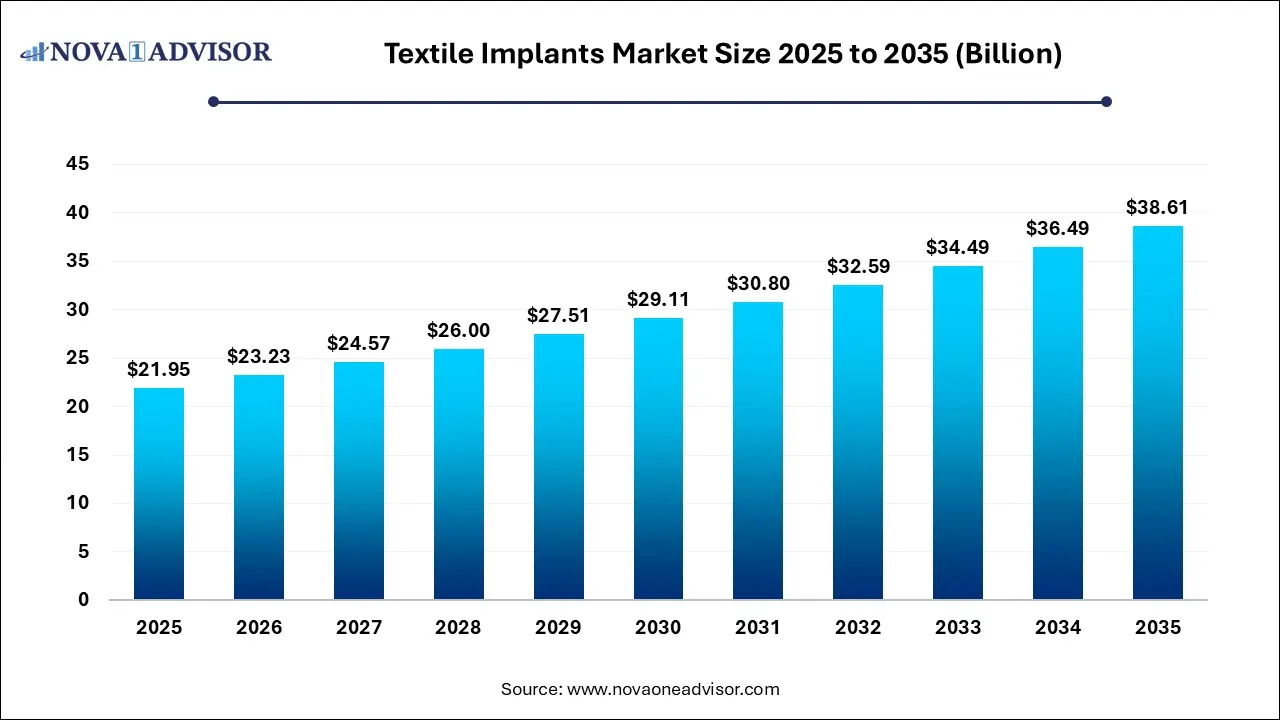
Key Takeaway:
- By product type, the synthetic textile implants segment dominated the market and accounted for the largest revenue share in 2025.
- By product type, the resorbable polymers segment fastest growing in the market in 2025.
- By application, the cardiovascular segment dominated the market and accounted for the largest revenue share in 2025.
- By end user, the hospitals and clinics segment dominated the market and accounted for the largest revenue share in 2025.
- By region, North America accounted for the largest revenue share in 2025.
Market Overview
The textile implants market is experiencing steady growth due to the increasing adoption of advanced implantable biomaterials in hernia repair, cardiovascular procedures, orthopedic surgeries, wound care, and reconstructive applications. Textile implants, manufactured using natural and synthetic fibers through weaving, knitting, braiding, and nonwoven technologies, provide excellent mechanical strength, flexibility, and biocompatibility. Growing healthcare investments, rising surgical volumes, and continuous innovation in bioresorbable and hybrid textile materials are supporting market expansion. Additionally, the emergence of patient-specific implants and minimally invasive surgical techniques is accelerating demand for next-generation textile implant solutions worldwide.
Market Outlook
- Market Growth Overview: The global textile implants market is expected to grow significantly between 2025 and 2035, driven by the rising chronic diseases, aging demographic, and minimally invasive procedures.
- Sustainability Trends: Sustainability trends involve biodegradable scaffolds, bioactive integration, and green manufacturing.
- Major Investors: Major investors in the market include Medtronic, Johnson & Johnson (Ethicon), B. Braun, W.L. Gore & Associates, and Boston Scientific Corporation.
How AI is Impacting the Global Textile Implants Market?
AI and ML are revolutionizing the global textile implants industry by optimizing the design and production of highly specialized, biocompatible medical fabrics. ML algorithms evaluate vast datasets to predict patient-specific structural needs, enabling the creation of customized, structurally complex implants. AI-driven automation and computer vision ensure unprecedented precision during the manufacturing of these life-saving devices, drastically reducing defect rates and material waste. These intelligent systems also streamline complex supply chains, guaranteeing just-in-time delivery for scheduled surgical procedures worldwide.
Textile Implants Market Report Scope
| Report Coverage | Details |
| Market Size in 2026 | USD 23.23 Billion |
| Market Size by 2035 | USD 38.61 Billion |
| Growth Rate From 2026 to 2035 | CAGR of 5.81% |
| Base Year | 2025 |
| Forecast Period | 2026 to 2035 |
| Segments Covered | By Product Type, By Application, By End-User, By Region |
| Market Analysis (Terms Used) | Value (USD Million/Billion) or (Volume/Units) |
| Regional Scope | North America; Europe; Asia Pacific; Central and South America; the Middle East and Africa |
| Key Companies Profiled | SERAG-WIESSNER GmbH & Co. KG Zum Kugelfang, LARS (France), Johnson and Johnson, Neoligaments (UK), Surgicraft Inc., Cousin Biotech (France), Xenotech, Orthomed S.A.S. (France), WL Gore, FX Solutions (France), Aran Biomedical, Shanghai PINE&POWER Biotech (China), Mathys AG Bettlach (Switzerland), Other |
Market Driver
Increasing Surgical Procedures and Rising Prevalence of Chronic Diseases
The growing number of surgical procedures worldwide, driven by aging populations and the increasing incidence of hernias, cardiovascular diseases, diabetes, and orthopedic disorders, is significantly boosting demand for textile implants. Their superior strength, flexibility, and tissue compatibility make them the preferred choice for tissue repair and reconstruction across multiple surgical specialties.
Market Restraint
Stringent Regulatory Approval and Clinical Validation Requirements
The textile implants market faces challenges due to rigorous regulatory standards for implantable medical devices. Extensive biocompatibility testing, long clinical trials, and strict quality requirements increase product development costs and prolong commercialization timelines, particularly for innovative implant materials.
Market Opportunity
Growing Adoption of Regenerative Medicine and Tissue Engineering
Advancements in regenerative medicine are creating new opportunities for textile implants as bioactive scaffolds for tissue repair and regeneration. The development of biodegradable polymers, nanofiber structures, and patient-specific implant designs is expanding applications in orthopedic repair, vascular grafts, wound healing, and reconstructive surgery, supporting long-term market growth.
Segmental Insights
By Product Type
How did the synthetic textile implants segment dominate the Global Textile Implants market?
The synthetic textile implants segment is driven by the superior mechanical properties and established regulatory pathways that secure synthetic implants as the definitive revenue engine of the global market. Synthetic materials, such as polyethylene terephthalate, polypropylene, and polytetrafluoroethylene, offer unmatched durability and high tensile strength for permanent medical implants.
How did the resorbable polymers segment expect to hold the fastest-growing Global Textile Implants market in the coming years?
The resorbable polymers segment is driven by the innovation in 3D bioprinting and scaffolding, which allow textile implants to mimic natural soft tissue and encourage native cell regeneration. By functioning as drug-eluting matrices, these polymers offer a dual-action therapeutic approach that dispenses localized medication over extended periods.
By Application
How did the cardiovascular segment dominate the Global Textile Implants market?
The cardiovascular segment is driven by the utilization of durable polymers, such as Dacron and ePTFE, alongside targeted, local drug-release mechanisms. These advanced textile implants significantly improve long-term surgical effectiveness at the implant site. The manufacturing evolution aligns with a rising global burden of chronic cardiovascular disorders, which drives an exponential demand for vascular grafts, synthetic stents, and heart valves.
How did the hernia repair products segment expect to hold the fastest-growing Global Textile Implants market in the coming years?
The hernia repair products segment is driven by the integration of innovative meshes with modern absorbable fixation devices, which minimizes complications to ensure highly successful, minimally invasive soft-tissue repairs. The expanding advanced biological options that lower chronic pain risks, alongside lightweight synthetic meshes engineered to prevent internal organ adhesions.
By End User
How did the hospitals and clinics segment dominate the Global Textile Implants market?
The hospitals and clinics segment is driven by the hospitals providing the essential multidisciplinary infrastructure needed for continuous post-operative monitoring to minimize tissue rejection risks and manage long-term patient complications. The majority of complex implant procedures require highly controlled, sterile environments and advanced surgical equipment primarily found in established hospital settings.
How did the ambulatory surgical centers segment expect to hold the fastest-growing Global Textile Implants market in the coming years?
The ambulatory surgical centers segment is driven by the integration of these innovative 3D-printed scaffolds and advanced textile implants, which significantly shorten recovery times to boost overall patient throughput. The expanding CMS site-of-service approvals are allowing these centers to perform complex cardiovascular and spinal interventions under highly favorable reimbursement guidelines.
By Regional
How did the North America region account for the largest share in the Global Textile Implants market?
North America is driven by the overlapping demographic, technological, and financial strength secure North America as a dominant powerhouse in the global medical textiles industry. The significant government and private healthcare funding allows hospitals and ambulatory surgical centers to widely adopt premium, advanced biomedical implant solutions.
U.S. Global Textile Implants Market Trends
The U.S. is stringent government and private healthcare funding system that allows hospitals and ambulatory surgical centers to widely adopt premium, advanced biomedical implant solutions. The overlapping demographic, technological, and financial strengths secure North America as a dominant powerhouse in the global medical textiles industry.
How did the Asia-Pacific region become the fastest-growing Global Textile Implants Market during the forecast period?
Asia Pacific is driven by the heavy investments by regional governments to boost advanced nonwoven fabric production and improve local healthcare systems, which are successfully accelerating both innovation and market adoption. The aging demographic and a rising prevalence of chronic conditions have necessitated a higher volume of surgical procedures and long-term implant solutions across the region.
China Global Textile Implants Market Trends
China’s shift toward regenerative medicine by integration of artificial intelligence allows for highly personalized implant designs that match a patient's exact anatomical needs to improve surgical success rates. With aggressive government funding and tightening regulatory compliance, domestic firms are rapidly upgrading their R&D to reduce import reliance and secure regional export dominance.
How Did Europe Hold A Notable Share in the Global Textile Implants Market?
Europe’s favorable government regulations and subsidies facilitate robust public-private collaborations, fueling R&D breakthroughs in regenerative medicine where textile scaffolds are integrated with stem cells to promote natural tissue healing. The incorporation of AI and IoT technologies into these implants enables smart, real-time physiological monitoring and highly personalized treatments.
Germany Global Textile Implants Market Trends
Germany’s industry is shifting toward biodegradable textile fibers that naturally dissolve after healing to eliminate secondary removal surgeries. Germany's strong engineering base is pushing the market toward smart implantables embedded with sensor technologies and connected to AI-driven diagnostics for real-time post-operative monitoring.
Key Players in the Global Textile Implants Market
- SERAG-WIESSNER GmbH & Co. KG
SERAG-WIESSNER develops a diverse portfolio of resorbable and non-absorbable textile implants, including hernia meshes, urological slings, and cardiovascular loops. Their specialized synthetic textiles, such as SERAMESH, are designed to minimize foreign body reactions while maximizing tissue adhesion and patient comfort.
- LARS (Ligament Advanced Reinforcement System)
LARS specializes in advanced synthetic ligament prostheses used in orthopedic reconstruction, particularly for ruptured anterior cruciate ligaments (ACL) and rotator cuffs. Their polyethylene terephthalate (PET) textile fibers are designed to imitate natural ligaments, providing immediate mechanical stability while serving as a scaffold for tissue ingrowth.
- Johnson & Johnson
Through its Ethicon and DePuy Synthes medical divisions, Johnson & Johnson is a major industry leader that produces a wide range of surgical meshes and implantable fabrics.
Segments Covered in the Report
This report forecasts revenue growth at country levels and provides an analysis of the latest industry trends in each of the sub-segments from 2021 to 2035. For this study, Nova one advisor, Inc. has textile implants market.
By Product Type
- 2D implantable forms
- 3D implantable forms
- Natural textile implants
- Synthetic textile implants
- Polyamide
- Polyester
- Polyethylene
- Polypropylene
- Resorbable polymers
- Non-resorbable polymers
By Application
- Hernia repair products
- Cardiovascular
- Sports medicine
- Diabetic wound care
- Ophthalmology
- Breast Reconstruction
By End-User
- Hospitals & Clinics
- Ambulatory Surgical Centers
- Others
By Region
- North America
- Europe
- Asia-Pacific
- Latin America
- Middle East & Africa (MEA)
FAQ's

Proceed to Buy
Instant PDF delivery on confirmation

 Request Customization
 Download Sample

Get a Sample of this Report
Textile Implants Market