

U.S. AI-driven Diabetic Retinopathy Screening Market Size, Share, and Trends 2026 to 2035
 Status Published
 Category Healthcare


Content
U.S. AI-driven Diabetic Retinopathy Screening Market Size and Growth 2026 to 2035
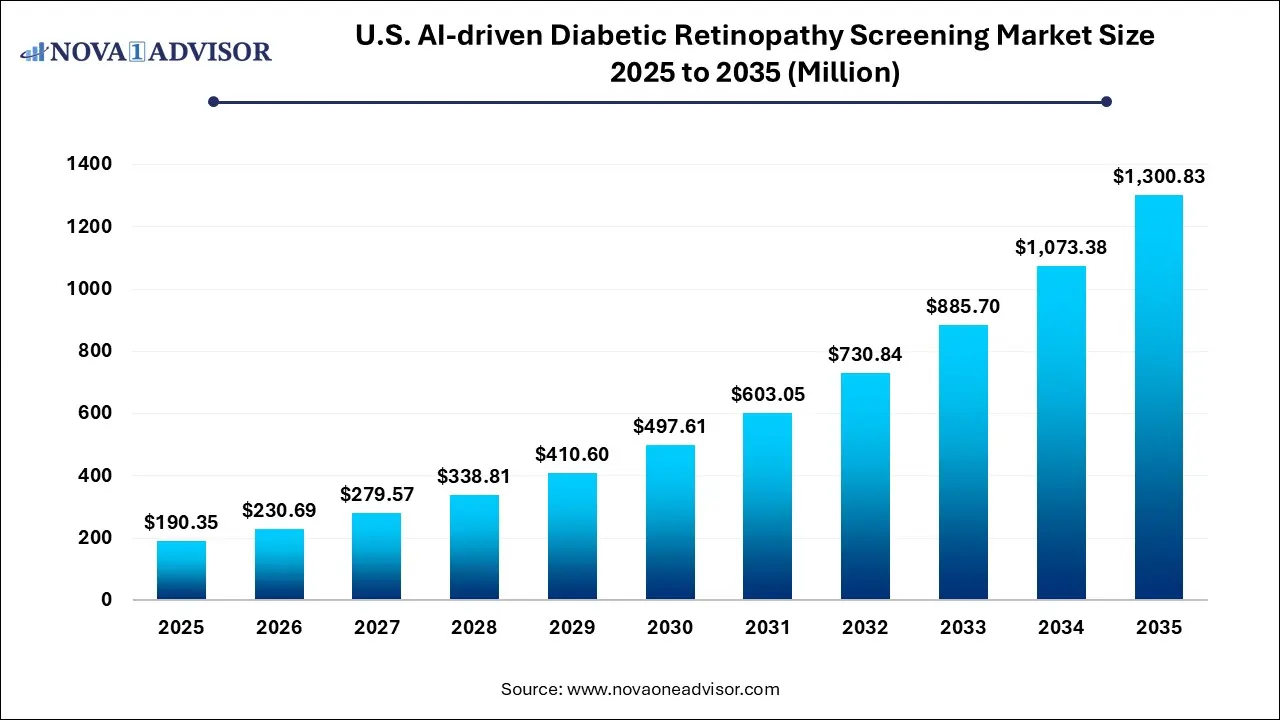
The U.S. AI-driven diabetic retinopathy screening market size was estimated at USD 190.35 million in 2025 and is projected to increase from USD 230.69 million in 2026 to approximately USD 1,300.83 million by 2035, growing at a CAGR of 21.19% from 2026 to 2035. The U.S. AI-driven diabetic retinopathy screening market is driven by the compounding diabetes crisis and an acute shortage of specialized physicians; the traditional, fragmented eye exam model is being rapidly replaced. Backed by rigorous FDA approvals, targeted federal grant initiatives, such as AIM-HI, and a highly lucrative reimbursement structure via CPT code 92229, autonomous AI systems are fundamentally redesigning the economies of preventative healthcare.
Key Takeaways
- By component, the software segment held a dominant position in the market with a share of 58.00% in 2025.
- By component, the hardware segment is the fastest growing between 2026 and 2035.
- By deployment mode, the cloud-based segment held a dominant position in the market with a share of 48.00% in 2025.
- By deployment mode, the on-premise segment is the fastest growing between 2026 and 2035.
- By screening, the autonomous AI screening segment held a dominant position in the market with a share of 44.00% in 2025.
- By screening, the AI-assisted screening segment is the fastest growing between 2026 and 2035.
- By end-use, the primary care settings segment held a dominant position in the market with a share of 33.00% in 2025.
Innovation Driving Transformation in the U.S. AI-driven Diabetic Retinopathy Screening Market
U.S. AI-driven diabetic retinopathy screening comprises the software and autonomous systems that analyze retinal images to detect signs of eye disease in diabetic patients. By providing point-of-care results in primary care clinics, these technologies offer the major advantage of eliminating the need for visits to specialized ophthalmologists. Additionally, applications in telehealth enable convenient, scalable screenings that improve patient compliance and reduce preventable vision loss. The escalating diabetes epidemic primarily drives the market’s rapid expansion, favorable reimbursement policies for AI procedures, and a widespread shortage of eye care specialists.
U.S. AI-driven Diabetic Retinopathy Screening Market Trends
- Primary Care Decentralization
Traditional eye exams require separate referrals and visits to specialized clinics, leading to less than 50% patient compliance. AI systems allow primary care physicians, endocrinologists, and pediatricians to perform retinal screening in the office during a routine diabetes check-up.
- Increased Use of Autonomous AI Systems
The U.S. market is unique as it features fully FDA-cleared autonomous AI systems that evaluate images without a specialist’s supervision. These autonomous diagnostic programs give an immediate assessment, vastly improving workflow efficiency and ensuring patients receive diagnoses before leaving the clinic.
- Favorable Reimbursement Pathways
Widespread clinical adoption of AI has been heavily supported by specialized billing codes, such as the dedicated Medicare CPT 92229 code for autonomous AI interpretation. This creates a reliable revenue stream for primary care providers, incentivizing them to integrate retinal imaging hardware and software directly into their existing practices.
U.S. AI-driven Diabetic Retinopathy Screening Market Report Scope
| Report Coverage | Details |
| Market Size in 2026 | USD 230.69 Million |
| Market Size by 2035 | USD 1,300.83 Million |
| Growth Rate From 2026 to 2035 | CAGR of 21.19% |
| Base Year | 2025 |
| Forecast Period | 2026 to 2035 |
| Segments Covered | Component, Deployment Mode, Screening, End use |
| Market Analysis (Terms Used) | Value (USD Million/Billion) or (Volume/Units) |
| Key Companies Profiled | Eyenuk, Inc.; Digital Diagnostics Inc.; AEYE Health.; Optomed; IRIS (Intelligent Retinal Imaging Systems); RETINA-AI Health, Inc.; iCare; RetinaRisk (by Risk Medical Solutions); BeamMed Inc. |
Market Dynamics
Driver
Surging Diabetes Prevalence
Autonomous AI-driven systems are adopted to decentralize eye examinations directly into primary care and community clinics, bypassing the need for specialized grading. This workflow shift provides immediate, point-of-care results that significantly improve patient screening compliance during routine visits. The expansion of dedicated AI reimbursement codes, such as Medicare’s CPT 92229, creates predictable revenue, encouraging widespread clinical investment in these vision-preserving platforms.
Restraint
Implementation and Training Costs
The market growth is hindered by healthcare systems facing significant upfront capital expenditures for purchasing specialized fundus cameras and licensing autonomous AI diagnostic software. Integrating these novel AI systems with legacy electronic health record frameworks involves complex and extensive infrastructure modifications. Extensive ongoing staff training is also required to ensure clinical personnel can properly operate the devices, capture gradable retinal images, and manage patient workflows without disrupting daily operations.
Opportunity
Primary Care Integration
The enabling point-of-care, same-visit testing. By embedding autonomous AI systems into routine diabetes check-ups, clinics improve patient compliance and drastically reduce the need for separate specialist referrals. Favorable Medicare reimbursement policies, such as the AI-specific CPT code 92229, further incentivize primary care providers to adopt these technologies without needing ophthalmologist oversight. Ultimately, this decentralization expands access to care in underserved communities and aligns with national value-based care objectives.
Segment Insights
By Component Insights
Why Did the Software Segment Hold a 58.00% Share for the U.S. AI-driven Diabetic Retinopathy Screening Market?
The software segment held a dominant position in the market with a share of 58.00% in 2025. Owing to its central role in image interpretation, recurring licensing revenues, continuous AI upgrades, and growing demand for scalable diagnostic platforms. The diagnostic algorithms are deployed via cloud-based software, making it straightforward for healthcare networks to integrate AI results directly into existing electronic health records systems.
The hardware segment held a 27.00% share of the market in 2025, with the rapid convergence of portable imaging hardware, seamless digital infrastructure upgrades, and decentralized screening models fundamentally disrupting the U.S. healthcare landscape. By embedding user-friendly diagnostic tools directly into non-specialist settings, such as rural clinics and pharmacies, providers are effectively overcoming critical specialist shortages.
The services segment held a 15.00% share of the market in 2025, due to the strategic expansion of robust reimbursement models coupled with decentralized clinical workflows, which is fundamentally redefining diabetic eye care economics. By shifting the diagnostic burden to primary care and remote facilities, the healthcare system achieves significantly higher patient throughput and operational volume.
By Deployment Mode Insights
Why Did the Cloud-Based Segment Hold a 48% Share for the U.S. AI-driven Diabetic Retinopathy Screening Market?
The cloud-based segment held a dominant position in the market with a share of 48% in 2025. Owing to lower upfront costs, easier scalability, seamless updates, and growing acceptance of remote healthcare technologies. This integrates smoothly with existing electronic health record systems and teleophthalmology networks, allowing primary care doctors to perform screening during standard diabetic checkups.
The on-premises segment held a 38.00% share of the market in 2025, due to the localized infrastructure eliminating inter-network dependency, ensuring uninterrupted, zero-latency diagnostic workflows even during critical network outages. The direct integration into internal networks streamlines secure EHR syncing and accelerates high-volume processing of high-resolution retinal images.
The hybrid segment held a 14% share of the market in 2025, due to gaining momentum as providers seek enhanced data security while leveraging cloud efficiency and interoperability. It is easy for providers to integrate screening results with local electronic health records and regional teleophthalmology networks.
By Screening Insights
Why Did Autonomous AI Screening Segment Hold a 44.00% Share for the U.S. AI-driven Diabetic Retinopathy Screening Market?
The autonomous AI screening segment held a dominant position in the market with a share of 44.00% in 2025. Owing to FDA-supported adoption, reduced specialist burden, faster diagnosis, and improved access in underserved settings. It compensates for the unequal distribution and growing shortage of retinal specialists; AI independently grades images and diagnostic capabilities into general practices.
The AI-assisted screening segment held a 36.00% share of the market in 2025, due to the integration of autonomous diagnostic systems effectively neutralizing the acute shortage of eye care specialists while successfully managing the rising prevalence of diabetes. By delivering immediate, point-of-care results during routine visits, these FDA-authorized platforms eliminate external referral bottlenecks and drastically improve patient compliance.
The teleophthalmology-based screening segment held a 20.00% share of the market in 2025 due to decoupling clinical image capture from urban specialist analysis; teleophthalmology effectively bridges the geographic care gap for rural and underserved diabetic populations. The integration of autonomous AI acts as an optimized triage filter, alleviating specialist burdens and generating immense cost efficiencies for large health systems.
By End Use Insights
Why Did the Primary Care Settings Segment Hold a 33% Share for the U.S. AI-driven Diabetic Retinopathy Screening Market?
The primary care settings segment held a dominant position in the market with a share of 33% in 2025, as they serve as the first point of contact for diabetic patients and enable convenient point-of-care screening. Implementing AI at the point of care helps family practitioners boost these quality metrics and meet population health objectives.
The hospitals segment held a 28.00% share of the market in 2025, due to the high imaging throughput, which optimizes resource utilization and comfortably justifies the capital investment in advanced diagnostic hardware and software. By capturing referable diabetic retinopathy during multidisciplinary patient visits, hospitals can immediately route high-risk cases to on-site retinal specialists.
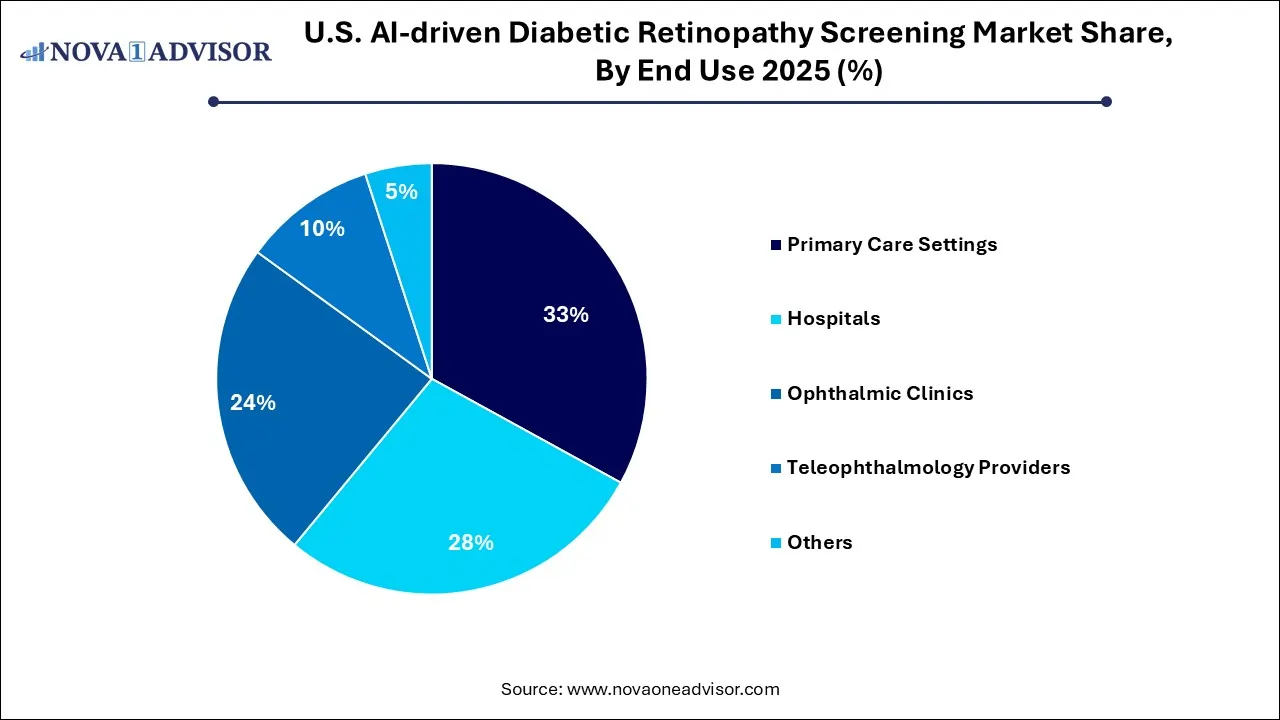
The ophthalmic clinics segment held a 24.00% share of the market in 2025 due to the deployment of autonomous AI within specialized ophthalmic clinics, which maximizes the diagnostic utility of existing high-resolution fundus and OCT imaging infrastructure. Leveraging dedicated CPT 922229 reimbursement pathways transforms these specialized screenings into highly lucrative and operationally scalable service lines.
The teleophthalmology providers segment held a 10.00% share of the market in 2025 due to the positioning of portable imaging hardware directly within primary care clinics; teleophthalmology providers successfully eliminate traditional specialist bottlenecks and expand care access. The dedicated Medicare CPT 922229 reimbursement codes provide a highly predictable and lucrative revenue model for local facilities.
The others segment held a 5.00% share of the market in 2025 due to the leveraging accessible cloud deployment ensures seamless scaling and rapid, centralized image analysis across vast distributed healthcare networks. These interconnected dynamics eliminate traditional specialist bottlenecks and transform routine check-ups into highly efficient, high-volume population health ecosystems.
Recent Developments
- In July 2025, AEYE Health has partnered with Ford Medical to distribute AEYE-DS, the first FDA-cleared, fully autonomous AI retinal screening solution, to pharmacies nationwide for rapid diabetic retinopathy detection. The solution enables on-the-spot diagnostics via portable cameras without pupil dilation, utilizing existing CPT coding for reimbursement in non-acute settings.
- In May 2024, Optomed USA introduced the Optomed Aurora AEYE, the first FDA-cleared handheld AI fundus camera for on-the-spot detection of more than mild diabetic retinopathy in primary care settings [1]. Featuring 92%-93% sensitivity and 89%-94% specificity, the device aims to bridge the eye exam gap for diabetic patients with results in about 60 seconds.
U.S. AI-driven Diabetic Retinopathy Screening Market Companies
- Eyenuk, Inc.
- AEYE Health
- Digital Diagnostics Inc.
- Optomed
- RETINA-AI Health, Inc.
- IRIS (Intelligent Retinal Imaging Systems)
- iCare
- BeamMed Inc.
- RetinaRisk (by Risk Medical Solutions)
Segments Covered in the Report
This report forecasts revenue growth at country levels and provides an analysis of the latest industry trends in each of the sub-segments from 2021 to 2035. For this study, Nova one advisor, Inc. has U.S. AI-driven diabetic retinopathy screening market.
By Component
- Software
- Hardware
- Services
By Deployment Mode
- Cloud-Based
- On-Premise
- Hybrid
By Screening
- Autonomous AI Screening
- AI-Assisted Screening
- Teleophthalmology-Based Screening
By End Use
- Primary Care Settings
- Hospitals
- Ophthalmic Clinics
- Teleophthalmology Providers
- Others
FAQ's

Proceed to Buy
Instant PDF delivery on confirmation

U.S. AI-driven Diabetic Retinopathy Screening Market Size to Hit USD 1,300.83 ...
 Request Customization
 Download Sample

Get a Sample of this Report
U.S. AI-driven Diabetic Retinopathy Screening Market