

U.S. AI In Spine Surgery Market Size, Share, and Trends 2026 to 2035
 Status Published
 Category Healthcare


Content
U.S. AI in Spine Surgery Market Size, Share, Growth, Report 2026 to 2035
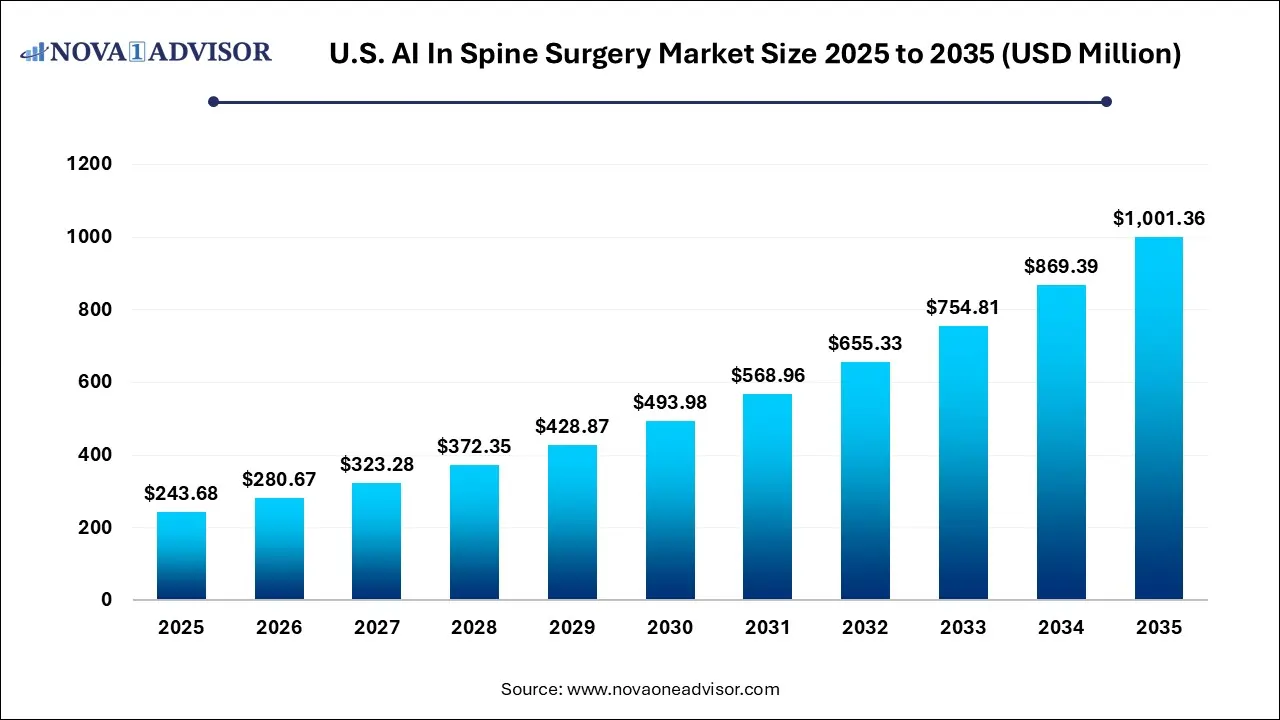
The U.S. AI in spine surgery market size was estimated at USD 243.68 million in 2025 and is projected to increase from USD 280.67 million in 2026 to approximately USD 1,001.36 million by 2035, growing at a CAGR of 15.18% from 2026 to 2035. The U.S. AI in spine surgery market is driven by the rising demand for minimally invasive procedures and the widespread adoption of robotic-assisted surgery systems, which integrate AI for improved accuracy and real-time guidance. and optimize hospital workflows and reduce the high costs associated with revision surgeries.
Key Takeaways
- By functionality, the pre-op planning & personalization segment held a dominant position in the market with a share of 40% in 2025.
- By functionality, the intraoperative guidance/navigation / AR segment is the fastest growing between 2026 and 2035.
- By application, the spinal fusion segment accounted for a considerable revenue share of 35% in the market in 2025.
- By application, the microdiscectomy segment is the fastest growing during 2026 and 2035.
- By end-use, the hospitals segment is the dominant in the U.S. AI in spine surgery market with a share of 60% in 2025.
Innovation Driving Transformation in the U.S. AI In Spine Surgery Market
U.S. AI in spine surgery comprises the integration of machine learning, robotic-assisted surgical platforms, and augmented reality to enhance precision in complex procedures. The application of advanced software for preoperative planning, intraoperative guidance, and postoperative prognosis offers significant benefits, including increased accuracy in pedicle screw placement, reduced radiation exposure for both surgeons and patients, and improved restoration of sagittal balance. Applications span from automated image interpretation (CT/MRI) and patient-specific implant design to real-time, AI-driven surgical navigation during lumbar and cervical fusions. The market growth is driven by the high prevalence of degenerative spine conditions and the rising demand for minimally invasive, outpatient procedures in ambulatory surgery centres.
U.S. AI In Spine Surgery Market Trends
- Preoperative Planning & Personalized Implant Generation
The shift toward AI-driven diagnostic studies that automate vertebral segmentation and spinal alignment analytics. The integration of these AI insights with 3D-printed, patient-specific implants ensures a custom fit that reduces revision rates and improves sagittal balance.
- Rapid Adoption of AI-Enabled Robotics and Navigation
Robotic-assisted surgical platforms are being covered with AI to provide real-time, high-precision guidance for pedicle screw placements. These AI systems improve workflow efficiency by enabling automatic segmentation of anatomical structures from imaging, reducing manual screw trajectory adjustment.
- Intraoperative Augmented Reality and Mixed Reality
AI-powered AR headsets are becoming more common, allowing surgeons to visualize 3D anatomical overlays directly onto the patient during surgery. These tools help identify the correct operative level and trajectory in minimally invasive procedures, reducing radiation exposure from excessive X-ray usage.
U.S. AI in Spine Surgery Market Report Scope
| Report Coverage | Details |
| Market Size in 2026 | USD 280.67 Million |
| Market Size by 2035 | USD 1,001.36 Million |
| Growth Rate From 2026 to 2035 | CAGR of 15.18% |
| Base Year | 2025 |
| Forecast Period | 2026 to 2035 |
| Segments Covered | Functionality, Application, End use |
| Market Analysis (Terms Used) | Value (USD Million/Billion) or (Volume/Units) |
| Key Companies Profiled | Globus Medical; Medtronic; Orthofix (7D Surgical tech); Augmedics; DePuy Synthes (Johnson & Johnson MedTech); Carlsmed; Surgical Theater, Inc. |
Market Dynamics
Driver
High Prevalence of Degenerative Spinal Conditions
The increasing the procedural volume of complex spinal fusion and decompression surgeries. As the aging U.S. population experiences higher incidences of these disorders, surgeons are turning to AI-powered preoperative planning and predictive analytics to enhance surgical precision and optimize implant positioning. AI technologies help reduce complications and revisions and optimize implant positioning. AI technologies help reduce complications and revision rates, addressing the need for better long-term outcomes in degenerative cases. The integration of AI with robotic-assisted platforms and advanced navigation systems is fueling market growth by enabling minimally invasive techniques that offer faster recovery times, which is critical for treating degenerative conditions.
Restraint
High Implementation and Infrastructure Costs
The market growth is hindered by the creation of a substantial financial barrier for hospitals and surgical centers. The adoption of advanced AI-powered robotic systems and imaging technology requires high upfront capital investments, alongside ongoing expenses for maintenance and software upgrades, limiting uptake primarily to large, well-funded institutions. Integrating these complex AI platforms with existing electronic health records (EHRs) and ensuring compatibility across multiple vendors adds further technical and financial strain to already tight institutional budgets.
Opportunity
Expansion into Ambulatory Surgical Centers
Enabling the shift of routine, minimally invasive, and outpatient cases away from traditional hospital settings. ASCs focus on cost-effectiveness and efficiency, driving demand for specialized AI tools that enhance procedural precision, preoperative planning, and 3D imaging, often without the need for extensive capital investments found in large hospitals. The rise in physician-owned ASCs encourages the adoption of advanced technologies like augmented reality (AR) and robotics to improve patient outcomes and same-day discharge capabilities.
Segment Insights
By Functionality Insights
Why Did the Pre-op Planning & Personalization Segment Hold a 40% Share for the U.S. AI in Spine Surgery Market?
The pre-op planning & personalization segment held a dominant position in the market with a share of 40% in 2025, owing to the rising adoption of predictive planning and personalized surgical approaches, rising demand for minimally invasive surgery. Machine learning helps clinicians select the best approach and anticipate challenges, lowering postoperative complications.
The intraoperative guidance/navigation / AR segment held a 40% share of the market in 2025. Due to its superior accuracy and reduced complications, reduced radiation exposure, workflow optimization, and decreased cognitive load. They facilitate minimally invasive surgery and high adoption in hospitals, and integration with robotic and AI diagnostics.
The diagnostic decision support segment held a 20% share of the market in 2025, with a role that is supportive rather than procedural, limiting rapid expansion. Increased regulatory approval for AI-powered diagnostics for spinal imaging encourages clinical adoption, predictive analytics for risk assessment, and pre-surgical planning enhancement.
By Application Insights
Why Did the Spinal Fusion Segment Lead the U.S. AI In Spine Surgery Market?
The spinal fusion segment registered its dominance over the market with a share of 35% in 2025, owing to the growing maturity and shift toward less invasive alternatives. AI integration with robotic platforms offers superior precision in navigating complex anatomy during spinal fusion. Advanced healthcare infrastructure supported by favorable reimbursement policies for innovative spinal procedures.
The microdiscectomy segment held the 16% share of the market in 2025, due to increasing outpatient adoption and precision benefits from AI tools. The shift toward outpatient and minimally invasive spinal surgery accelerated the need for AI to guide small incisions, reducing tissue damage and accelerating recovery.
The laminectomy segment held a 15% share of the market in 2025 because of consistent clinical need but limited innovation-driven growth. AI aids in planning optimal surgical pathways and evaluating stenosis severity before operating, driving efficiency in the surgical planning phase.
The lumbar decompression (Non-fusion) segment held a 14% share of the market in 2025, with the strong shift toward minimally invasive, motion-preserving treatments. The integration of AI with robotics reduces radiation exposure and enhances the precision of instrument placement during non-fusion decompression procedures.
The laminotomy segment held a 10% share of the market in 2025, due to the consistent clinical need but limited innovation-driven growth. The integration of AI assists in predicting patient outcomes and navigating clinical areas, increasing adoption by surgeons to improve the efficiency of decompression surgeries. Growing focus on minimally invasive and high procedural volume.
The other segment is held 10% share of the market in 2025, as these procedures remain specialized with limited volume contribution. The adoption of minimally invasive surgeries, the diversification of AI applications, and the integration of new technologies.
By End Use Insights
Why did the Hospitals Segment hold a 55% Share for the U.S. AI in Spine Surgery Market?
The hospitals segment led the market with a share of 60% in 2025, due to the integration of AI into robotic-assisted surgery platforms, such as those from Medtronic, with high adoption rates in hospital settings. The growing shift toward value-based care, high surgical volume for acute and complex spinal surgeries, which are increasingly supported by AI diagnostics and intraoperative navigation.
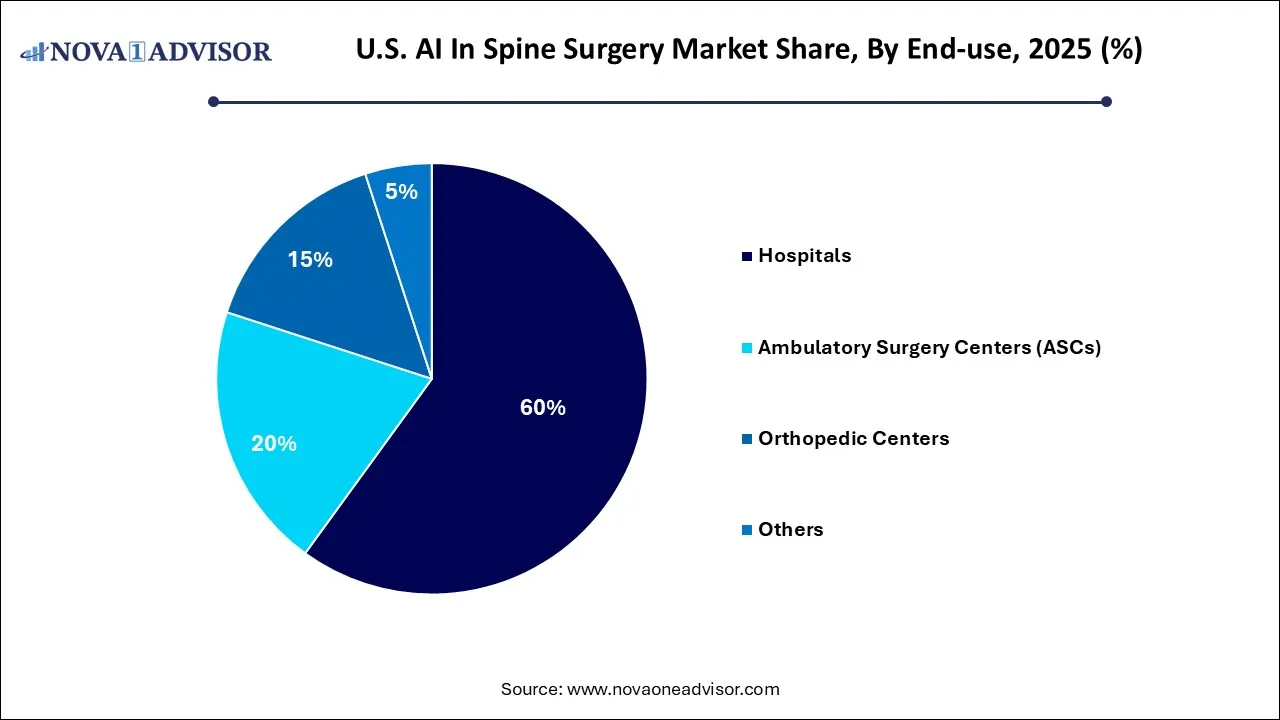
The ambulatory surgery centers (ASCs) segment held a 20% share of the market in 2025, with the cost efficiency and increasing minimally invasive spine procedures. The introduction of portable, AI-integrated navigation systems makes it easier for ASCs to adopt high-tech tools without massive infrastructure upgrades.
The orthopedic centers segment held a 15% share of the market in 2025, due to the specialized digital operating rooms and integrated imaging systems necessary for implementing AI-driven navigational and operative tools. The high procedure volume, growing need for precision and safety, and enhanced workflow efficiency.
The other segment held 5% share of the market in 2025, with a slow expansion through innovation and alternative care models. Growing transition to personalized care and rising need for efficiencies. Increased FDA-cleared AI applications for preoperative imaging and surgical navigation are being widely adopted in clinical settings.
Recent Developments
- In April 2025, Proprio received FDA 510(k) clearance for its Paradigm platform, marking the first AI-driven system to provide real-time, 3D, and segmental intraoperative measurements during surgery. This technology, adopted by institutions like Duke Health and UW Medicine, enables surgeons to achieve precise, radiation-free navigation while instantly verifying surgical goals, effectively reducing the need for post-operative revision surgeries.
- In October 2025, Surgical Theater secured FDA 510(k) clearance for its next-generation SyncAR® Spine platform, which uses AI to integrate MRI and CT data directly into the operating room for real-time surgical guidance. This, combined with Advanced Decompression Planning and voxel-level drill tracking, bridges the gap between preoperative planning and intraoperative execution.
- In November 2025, Proprio partnered with the Harms Study Group (HSG) to create a research collaborative that integrates AI-powered, real-time intraoperative data from the Paradigm™ platform with HSG’s global outcomes registry. This partnership aims to enhance data quality and enable new research into surgical optimization, outcomes prediction, and the economics of spine deformity care.
U.S. AI In Spine Surgery Market Companies
- Globus Medical
- Orthofix (7D Surgical tech)
- Medtronic
- Augmedics
- Carlsmed
- DePuy Synthes (Johnson & Johnson MedTech)
- Surgical Theater, Inc.
U.S. AI in Spine Surgery Market Report Segmentation
By Functionality
- Pre-op planning & personalization (alignment/planning, patient-specific constructs)
- Intraoperation guidance / navigation / AR / digital execution
- Diagnostic decision support
By Application
- Spinal Fusion
- Microdiscectomy
- Laminectomy
- Laminotomy
- Lumbar decompression (non-fusion)
- Other
By End Use
- Hospitals
- Ambulatory Surgery Centers (ASCs)
- Orthopedic Centers
- Others
FAQ's

Proceed to Buy
Instant PDF delivery on confirmation

U.S. AI In Spine Surgery Market Size to Hit USD 1,001.36 Million by 2035
 Request Customization
 Download Sample
Warning: Trying to access array offset on value of type null in /home/multiwpmr/public_html/report-details.php on line 1146

Get a Sample of this Report
U.S. AI In Spine Surgery Market