

U.S. Business-to-Business E-commerce Market Size, Share, and Trends 2026 to 2035
 Status Published
 Category Information & Communications Technology


Content
U.S. Business-to-Business E-commerce Market Size, Share, Growth, Report 2026 to 2035
The U.S. business-to-business e-commerce market size was estimated at USD 2,435 million in 2025 and is projected to increase from USD 2,788.08 million in 2026 to approximately USD 9,430.92 million by 2035, growing at a CAGR of 14.5% from 2026 to 2035. The U.S. business-to-business e-commerce market is driven by the integration of B2B optimized embedded fintech, the democratization of native enterprise-grade software, and a growing shift toward rep-free self-service sourcing.
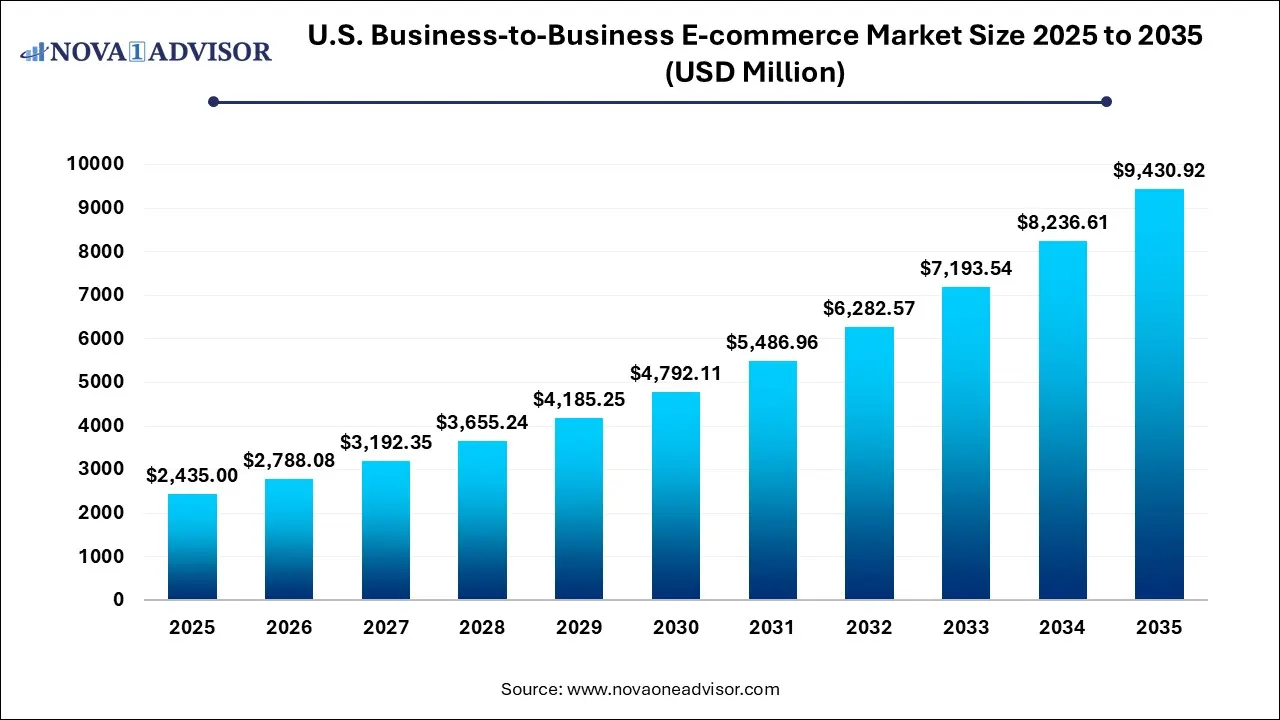
Key Takeaways
- By deployment, the intermediary-oriented segment held a dominant position in the market with a share of 25% in 2025.
- By deployment, the supplier-oriented segment is the fastest-growing between 2026 and 2035.
- By enterprise size, the large enterprises segment held a dominant position in the market with a share of 62.0% in 2025.
- By enterprise size, the small and medium enterprise segment is the fastest growing between 2026 and 2035.
- By application, the home and kitchen segment held a dominant position in the market with a share of in 2025.
- By application, the consumer electronics segment is the fastest-growing between 2026 and 2035.
Innovation Driving Transformation in the U.S. Business-to-Business E-commerce Market
U.S. business-to-business e-commerce comprises companies selling goods, services, or information to other organizations online. This digital marketplace benefits enterprises by streamlining bulk procurement, reducing operational expenses, and enabling faster, error-free transactions. These platforms are widely used across the manufacturing, wholesale, and SaaS sectors to manage complex negotiations and customized pricing. The market growth is driven by the rising demand for digital-first procurement and the urgent need for supply chain resilience.
U.S. Business-to-Business E-commerce Market Trends
- Consumer Centric Digital Commerce Ecosystem
Modern B2B buyers increasingly expect the same speed and convenience they experience in their personal lives. As a result, businesses are heavily investing in optimized mobile applications and customized self-service portals that allow buyers to track orders and manage accounts independently.
- Composable Architecture and Headless Commerce Deployment
Instead of rigid monolithic systems, B2B brands are adopting composable architecture. This approach separates the front end from the back end, enabling businesses to easily connect their e-commerce platforms with existing ERP, CRM, and PIM systems for maximum scalability.
- Strategic Integration of Enterprise B2B Marketplaces
To capture a wider audience, more manufacturers and wholesale distributors are leveraging third-party B2B marketplaces. Selling on established marketplace platforms expands reach while simplifying the purchasing process for procurement managers.
Key AI Integration in the U.S. Business-to-Business E-commerce Market
AI and ML are transforming the U.S. B2B e-commerce industry by streamlining operations and enabling hyper-personalized buying experiences. Sellers use intelligent algorithms for automated, contract-specific pricing and predictive inventory forecasting, which drastically reduces manual workloads and purchasing errors. Conversational AI and agentic commerce are beginning to autonomously manage routine reorders and provide real-time, 24/7 customer support. These advancements help distributors and manufacturers meet growing buyer demands while driving significant revenue growth.
U.S. Business-to-Business E-commerce Marke Report Scope
| Report Coverage | Details |
| Market Size in 2026 | USD 2,788.08 Million |
| Market Size by 2035 | USD 9,430.92 Million |
| Growth Rate From 2026 to 2035 | CAGR of 14.5% |
| Base Year | 2025 |
| Forecast Period | 2026 to 2035 |
| Segments Covered | By Deployment, By Enterprise Size, By Application |
| Market Analysis (Terms Used) | Value (USD Million/Billion) or (Volume/Units) |
| Key Companies Profiled | Amazon Business, eBay Business Supply, Alibaba Group, ThomasNet, Shopify Plus, Wayfair Professional, NuORDER, Newegg Business, Joor, B2B Wholesale Central |
Driver
Integration of ERP and Back-end
Integrating ERP and back-end systems with digital storefronts eliminates data silos and automates complex supply chain workflows, significantly reducing fulfillment errors and manual data entry. This seamless synchronization empowers B2B buyers with real-time inventory visibility and accurate, account-specific pricing. By streamlining this logistics, U.S. businesses can scale operations efficiently, cut operational costs, and deliver the reliable omnichannel experiences their clients demand.
Restraint
Complex Backend Architecture
The market growth is hindered by the creation of severe integration bottlenecks between digital storefronts and legacy systems like ERPs. This fragmentation causes delayed inventory updates, pricing errors, and sluggish order processing, which frustrate corporate buyers. Maintaining overly rigid or bloated monolithic codebases drains critical financial and development resources. Consequently, companies struggle to rapidly scale their operations or adopt innovative, API-first features.
Opportunity
B2B Marketplaces
The centralizing highly fragmented supply chains. They allow businesses to seamlessly discover, compare, and purchase bulk inventory without traditional offline negotiations. By offering self-service procurement, automated approval workflows, and integrated payment terms, these platforms lower operational costs and broaden reach. They provide a modernized digital infrastructure that makes B2B transactions as efficient as consumer retail.
Segment Insights
By Deployment Insights
Why Did the Intermediary-Oriented Segment Hold a 25% Share for the U.S. Business-to-Business E-commerce Market?
The intermediary-oriented segment held a dominant position in the market with a share of 25% in 2025. Owing to the widespread adoption of intermediary B2B platforms is fundamentally reshaping modern trade by centralizing supplier networks and streamlining the procurement lifecycle. By integrating seamlessly with enterprise ERP and CRM systems, these marketplaces eliminate operational inefficiencies, reduce manual overhead, and optimize supply chain transparency.
The supplier-oriented segment held a 41% share of the market in 2025, with the centralized data capture empowering enterprise sellers with granular behavioral insights and predictive forecasting capabilities, driving long-term strategic resilience and optimized inventory management. By automating complex workflows, such as dynamic catalog management and multi-tiered fulfilment, these solutions significantly drive down operational overhead while maximizing supply chain efficiency.
The buyer-oriented segment held a 34% share of the market in 2025, as the integration of AI-driven analytics equips procurement teams with predictive inventory visibility and granular demand data, optimizing the entire supply chain lifecycle. The model significantly reduces procurement costs by centralizing multi-vendor quote requests and enabling dynamic, volume-based contract negotiations for both enterprises and SMEs.
By Enterprise Size Insights
Why Did the Large Enterprise Segment Hold a 62.0% Share for the U.S. Business-to-Business E-commerce Market?
The large enterprise segment held a dominant position in the market with a share of 62.0% in 2025. Owing to the leverage of substantial capital to deploy robust digital commerce architectures, integrating advanced AI and enterprise resource planning systems to achieve end-to-end technological synchronization. These specialized B2B platforms efficiently manage complex supply chain workflows, automating multi-layered vendor approval matrices and providing real-time, cross-divisional inventory tracking.
The small & medium enterprise segment held a 38.0% share of the market in 2025. By leveraging automated procurement platforms, these agile organizations achieve highly cost-effective sourcing for vital operational assets, effectively leveling the playing field with larger corporate entities. Their decentralized structures allow SMEs to rapidly pivot to niche market segments and deploy tailored, dynamic pricing strategies far faster than bureaucratic competitors.
By Application Insights
Why Did the Home and Kitchen Segment Lead the U.S. Business-to-Business E-commerce Market?
The home and kitchen segment registered its dominance over the market with a share of in 2025, owing to the surge in travel, remote work, and hybrid office environments, which led hostels, restaurants, and corporate facilities to regulatory updates, renovations, and restock their spaces. The growing demand for eco-friendly goods and smart, IoT-enabled appliances.
The consumer electronics segment held 18% share of the market in 2025, with the hybrid workforce models, which require businesses to deploy, provision, and manage comprehensive remote-office infrastructure via digital procurement channels. The enabling corporate account structures, volume-based discounting, and automated reordering parameters are directly integrated into the buying workflow.
The industrial & science segment held the 16% share of the market in 2025, due to the deployment of machine learning models and predictive AI within these platforms that automate complex multi-vendor negotiations and surface highly customized product catalogs, driving unprecedented operational precision. The industry-wide mandate for digital transformation, manufacturers and laboratories systematically digitize their sourcing pipelines to minimize operational overhead and accelerate institutional lead times.
The healthcare segment held the 11% share of the market in 2025 because of the rapidly developing procurement infrastructure, deploying centralized B2B e-commerce architectures to eliminate manual purchasing inefficiencies, administrative errors, and critical supply delays. The advanced portals empower medical device manufacturers and variable volume-discounts matrices, and deliver customized client pricing at scale.
The clothing segment held the share of the market in 2025. Due to the migration away from error-prone manual paperwork and physical catalogs, the apparel sector dramatically enhances ordering precision, compresses production timelines, and eliminates substantial administrative and logistical overhead. This comprehensive B2B digitalization empowers brands to harmonize wholesale operations with volatile direct-to-consumer demand, leveraging real-time data integration to maintain fluid, omnichannel market responsiveness.
The beauty and personal care segment held the share of the market in 2025, due to the independent retailers, small pharmacies, salons, and spas that rely on digital B2B platforms for bulk procurement. B2B vendors provide tailored credit terms, bundled promotions, and digital loyalty programs that simplify purchasing for smaller regional vendors.
The sports apparel segment held the share of the market in 2025, due to the dominant global sports brands migrating toward digitized distribution models, leveraging automated platforms to seamlessly manage regional retail alliances, optimizing independent merchant networks, and capture shifting consumer preferences, such as the athleisure boom. The comprehensive digital integration mitigates traditional distribution friction, empowering bulk purchasers with instantaneous inventory visibility and highly optimized order lifecycles.
The books and stationery segment held the share of the market in 2025, due to the inherent scale of digital commerce, which enables organizations to natively negotiate volume-based institutional discounting and execute personalized, custom-branded material configurations for corporate onboarding and large-scale enterprise events. The deep integration of advanced logistics tracking and automated reordering parameters optimizes supply chain predictability, driving down administrative overhead while maintaining total operational continuity.
The automotive segment held the 12% share of the market in 2025, due to the commercial fleets and repair shops requiring immediate access to replacement components. B2B e-commerce platforms offer real-time inventory visibility and localized fulfillment to keep operations running.
The others segment held the share of the market in 2025, due to the specialized market aggregation, direct-to-manufacturer procurement, and modular architecture. Industry-specific digital marketplaces are capturing significant transaction volumes by natively embedding sector compliance, product certifications, and tailored catalogs that broad horizontal aggregators cannot replicate.
Recent Developments
- In April 2026, Shopify expanded its native B2B features to all merchant plans, allowing users on Basic, Grow, and Advanced tiers to manage wholesale and DTC on one platform with no plugins. This update, previously limited to Shopify Plus, introduces features like company profiles, custom catalogs, and volume discounts to boost self-serve orders.
- In June 2025, NASDAQ-listed EPWK HOLDINGS LTD. officially launched EPWK International, debuting an English-language platform (intl.epwk.com) to expand its creative crowdsourcing services globally.
U.S. Business-to-Business E-commerce Market Companies
- Amazon Business
- eBay Business Supply
- Alibaba Group
- ThomasNet
- Shopify Plus
- Wayfair Professional
- NuORDER
- Newegg Business
- Joor
- B2B Wholesale Central
Segments Covered in the Report
This report forecasts revenue growth at country levels and provides an analysis of the latest industry trends in each of the sub-segments from 2021 to 2035. For this study, Nova one advisor, Inc. has U.S. Business-to-Business E-commerce Market.
By Deployment
- Supplier-Oriented
- Buyer-Oriented
- Intermediary-Oriented
By Enterprise Size
- Small & Medium Enterprise
- Large Enterprise
By Application
- Home & Kitchen
- Consumer Electronics
- Industrial & Science
- Healthcare
- Clothing
- Beauty & Personal Care
- Sports Apparel
- Books & Stationery
- Automotive
- Others
FAQ's

Proceed to Buy
Instant PDF delivery on confirmation

U.S. Business-to-Business E-commerce Market Size to Hit USD 9,430.92 Million b...
 Request Customization
 Download Sample

Get a Sample of this Report
U.S. Business-to-Business E-commerce Market