

U.S. Dental Bone Grafts And Substitutes Market Size, Share, and Trends 2026 to 2035
 Status Published
 Category Healthcare


Content
U.S. Dental Bone Grafts And Substitutes Market Summary
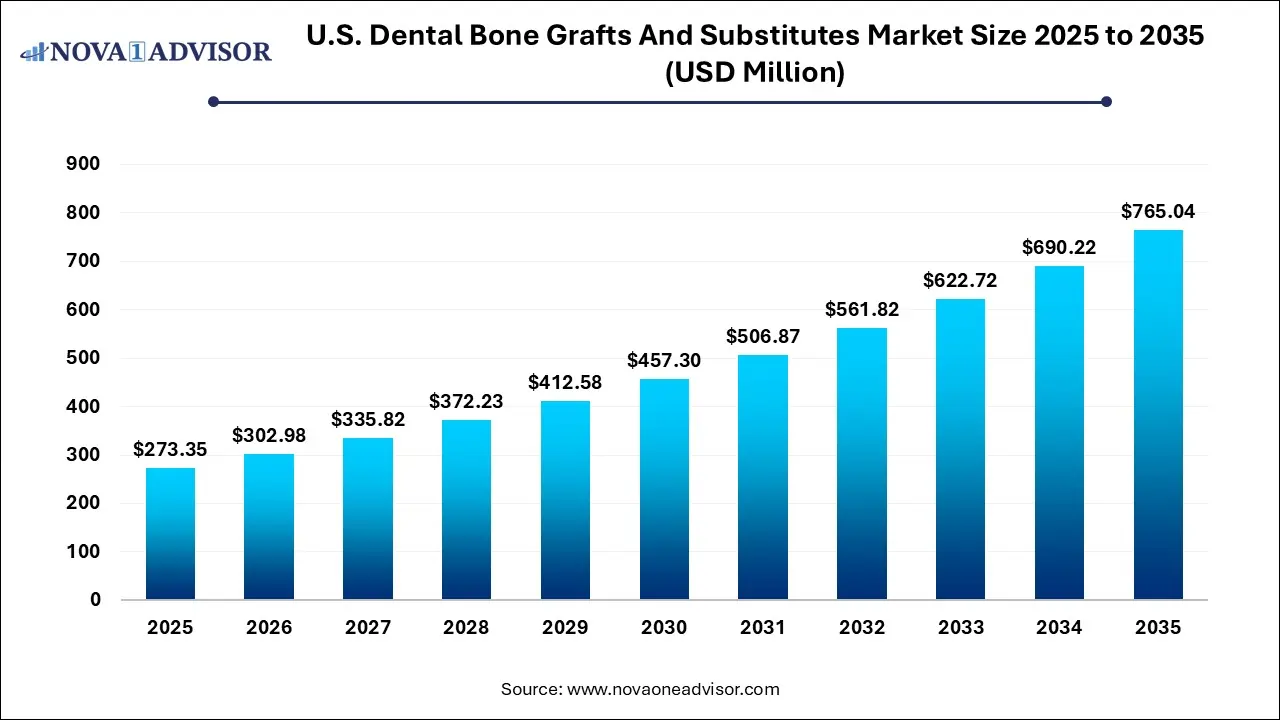
The U.S. dental bone grafts and substitutes market size was estimated at USD 273.35 million in 2025 and is projected to increase from USD 302.98 million in 2026 to approximately USD 765.04 million by 2035, growing at a CAGR of 10.84% from 2026 to 2035. The U.S. dental bone grafts and substitutes market is driven by the rising dental implant popularity, innovation in regenerative materials, including synthetic bone grafts, rising demand for improved aesthetic appearances, and the rise in facial trauma cases.
Key Takeaways
- By material type, the allograft segment held a dominant position in the market with a share of 30% in 2025.
- By material type, the autograft segment is the fastest growing between 2026 and 2035.
- By application, the ridge augmentation segment accounted for a considerable revenue share of 25% in the market in 2025.
- By application, the periodontal defect regeneration segment is the fastest growing during 2026 and 2035.
- By end-use, the hospitals segment is the dominant in the U.S. dental bone grafts and substitutes market with a share of 55% in 2025.
Innovation Driving Transformation in the U.S. Dental Bone Grafts And Substitutes Market
U.S. dental bone grafts and substitutes comprise natural and synthetic materials used to regenerate alveolar bone loss following tooth extraction, trauma, or periodontal diseases. These substitutes are crucial for providing a stable, biocompatible scaffold for new bone growth, ultimately enhancing the long-term success of dental implants and restoring jaw volume. Market growth is driven by an aging population requiring restorative dentistry, the rising prevalence of periodontal diseases, and the adoption of minimally invasive procedures.
U.S. Dental Bone Grafts And Substitutes Market Trends
- Rapid Adoption of Socket Preservation Procedures
Socket preservation is aimed at minimizing bone loss immediately after tooth extraction. This preventative approach has become standard practice, as it maintains alveolar ridge volume and simplifies future implant placement, driving high demand for particulate grafting materials.
- Digital Integration in Graft Planning and 3D-Printed Scaffolds
The convergence of CBCT imaging and 3D printing is enabling the creation of customized, patient-specific scaffolds that fit defects perfectly, enhancing integration and reducing surgery time. Digital workflows, including AI-facilitated bone segmentation, allow for more precise planning, which helps reduce required graft volumes.
- Rising Use of Biologics and Combination Products
The growing trends toward bundled products, where bone graft materials are combined with barrier membranes and platelets, in a single package. These advanced materials, including demineralized bone matrix and stem-cell-enhanced grafts, are designed to accelerate healing, improve bone quality, and simplify clinical workflows.
Key AI Integration in the U.S. Dental Bone Grafts And Substitutes Market
AI and ML are transforming the U.S. dental bone grafts and substitutes industry by enhancing precision in diagnostics, material selection, and surgical planning. AI algorithms analyze CBCT scans to accurately identify bone density and anatomical structures, allowing for tailored, patient-specific graft selection and improved treatment success rates. The integration of AI with 3D printing enables the creation of highly customized, bioresorbable graft materials that fit exact patient defects, reducing healing times. AI-powered robotic-assisted surgery provides real-time guidance during grafting, improving accuracy and reducing post-operative complications.
U.S. Dental Bone Grafts And Substitutes Market Report Scope
| Report Coverage | Details |
| Market Size in 2026 | USD 302.98 Million |
| Market Size by 2035 | USD 765.04 Million |
| Growth Rate From 2026 to 2035 | CAGR of 10.84% |
| Base Year | 2025 |
| Forecast Period | 2026 to 2035 |
| Segments Covered | Material Type, Application, End-use |
| Market Analysis (Terms Used) | Value (USD Million/Billion) or (Volume/Units) |
| Key Companies Profiled | Avtec Surgical; Dentsply Sirona; Geistlich Pharma; BioHorizons; ZimVie Inc.; Institut Straumann AG; Osteogenics Biomedical; botiss N.A. Inc. (Straumann Group USA); Implant Direct Corporation; DentiumUSA; LifeNet Health |
Market Dynamics
Driver
Rising Demand for Dental Implants
The aging population and increasing aesthetic awareness in the dental bone graft and implant procedures require bone augmentation for stability. AS dental implants become the preferred long-lasting solutions for tooth loss, the resulting need for ridge augmentation, sinus lifts, and socket preservation to support these implants has led to a surge in the utilization of graft materials. The expansion of bone graft substitutes is essential to rebuild jawbone volume lost due to rapid resorption after tooth extraction, ensuring successful implant placement.
Restraint
Limited Insurance Coverage
The market growth is hindered by the fact that most insurance plans categorize these necessary regenerative procedures as elective or cosmetic. Due to this classification, many patients are forced to bear high out-of-pocket costs, which discourages them from proceeding with essential periodontal or implant-related bone grafting treatments. This financial burden creates a two-tier system where advanced, high-performance graft materials become inaccessible to a large portion of the population. The high costs limit the overall procedural volume and slow the adoption rate of new, premium regenerative products, thus constraining the market's growth potential.
Opportunity
Developments of Synthetic Alternatives
The offering of safe, readily available, and cost-effective alternatives to traditional xenografts and allografts. These advanced synthetic materials, such as bioactive ceramics and calcium phosphates, eliminate concerns related to donor site morbidity, immunogenicity, and potential disease transmission, thereby increasing patient acceptance. Innovation in 3D printing enables the creation of highly customized, patient specific graft that improve surgical precision and success rates, which enhances the appeal for both dentists and patients.
Segment Insights
By Material Type Insights
Why Did the Allograft Segment Hold a 30% Share for the U.S. Dental Bone Grafts and Substitutes Market?
The allograft segment held a dominant position in the market with a share of 30% in 2025, owing to its availability, ease of use, and lower surgical risk compared to autografts. It reduces the need for a second surgical site to harvest bone; patients experience less pain, fewer complications, and faster healing times. It is widely used in socket preservation, periodontal repair, and ridge augmentation.
The autograft segment held a 25% share of the market in 2025. Due to its high acceptance and effectiveness in promoting healing, though it is limited by surgical complexity. It offers the best results in healing because they avoid the immune response or disease transmission risks associated with allogenic grafts.
The synthetic segment held a 25% share of the market in 2025, with the increasing demand for customizable, cost-effective solutions, though they are still catching up in terms of biological performance. High demand in procedures, increasing cases of periodontal diseases, and increased research and developments to advanced bio ceramics, nanotechnology, and 3D printing techniques, which enhance better mimicry of native bone structure.
The xenograft segment held a 20% share of the market in 2025, because of the availability, ease of use, and lower surgical risk compared to autografts. High clinical success and predictability, no secondary surgical sites, and the rising prevalence of periodontal diseases and the high demand for dental implants in efficient bone void fillers.
By Application Insights
Why Did the Ridge Augmentation Segment Lead the U.S. Dental Bone Grafts And Substitutes Market?
The ridge augmentation segment registered its dominance over the market with a share of 25% in 2025, owing to the high demand for implants and reconstructive surgeries in dental care. The rising cases of tooth extraction and alveolar bone atrophy require augmentation to regain jaw function and aesthetics.
The periodontal defect regeneration segment held the 21% share of the market in 2025, due to growing demand as dental professionals increasingly focus on treating periodontal diseases that affect a large portion of the population. The rapid adoption of dental implants, which often require bone grafts to fill voids or defects, has increased the demand for regenerative materials. Increased public awareness regarding oral health and a demand for enhanced aesthetics toward regenerative treatments.
The sinus lift segment held a 20% share of the market in 2025 because of gaining ground as more patients seek upper jaw dental solutions, but its growth is slower than that of ridge augmentation. Increased prevalence of tooth loss and periodontal disease in the elderly population requires more grafting interventions and minimalist approaches.
The socket preservation segment held a 19% share of the market in 2025, with the increasing use of implants and the need for preserving jawbone integrity post-extraction. It is widely used by both general dentists and specialists due to its reliable, straightforward, and cost-effective nature compared to future, more complex regenerative treatments.
The implant bone regeneration segment held a 15% share of the market in 2025, due to the growth as the demand for dental implants increases, driving regenerative technologies forward. The development of advanced technology in biomaterials, growing patient awareness regarding oral health, tooth aesthetics, and functional, long-lasting teeth drive the demand for specialized, high-end regeneration treatments.
By End Use Insights
Why Did the Hospitals Segment Hold a 55% Share for the U.S. Dental Bone Grafts and Substitutes Market?
The hospitals segment led the market with a share of 55% in 2025, due to its ability to handle complex surgeries and offer a wider range of advanced dental procedures. The surge in dental implant popularity, combined with the need to treat injuries from cancer, often links dental work with general surgical procedures performed in hospital settings.
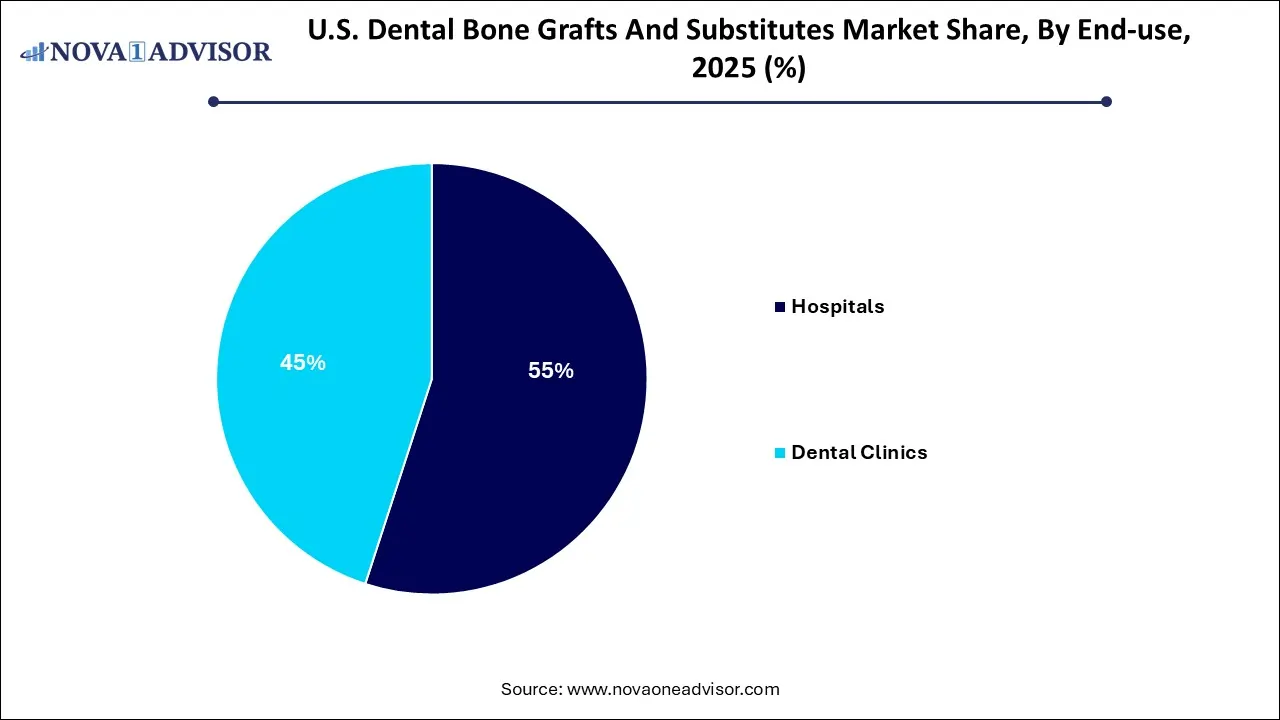
The dental clinics segment held a 45% share of the market in 2025, with the growing role in providing efficient and cost-effective dental care with specialized services, particularly in urban areas. They are highly accessible, facilitating easy access to dental care, growing number of private and group practice dental clinics allows for specialized care for patients needing bone regeneration, strengthening market share.
U.S. Dental Bone Grafts and Substitutes Market Companies
- Avtec Surgical
- Geistlich Pharma
- Dentsply Sirona
- BioHorizons
- Institut Straumann AG
- ZimVie Inc.
- Osteogenics Biomedical
- Implant Direct Corporation
- botiss N.A. Inc (Straumann Group USA)
- LifeNet Health
- DentiumUSA
Recent Developments
- In February 2025, LifeNet Health launched OraGen®, the first viable dental bone allograft designed to combine osteogenicity, osteoconductivity, and osteoinduction for enhanced bone regeneration in procedures like sinus and ridge augmentation. Processed within 72 hours and thawing in under five minutes, this new graft offers improved cell viability and clinical efficiency, available in the U.S. through a partnership with Salvin Dental Specialties.
- In October 2025, Geistlich introduced Bio-Gide® Forte, a new resorbable collagen membrane designed for enhanced stability and easier handling in complex dental cases. Available in North America as robust membrane provides improved rigidity when hydrated for precise, flexible adaptation to bone contours.
- In January 2025, NovaBone Products has entered a strategic partnership with BEGO to launch its bioactive, osteostimulative Dental Putty with Cartridge Dispenser in the European market at IDS 2025 in Cologne. This collaboration leverages BEGO’s distribution network to introduce the advanced, minimally invasive grafting technology to European dental professionals.
U.S. Dental Bone Grafts And Substitutes Market Segment
By Material Type
- Autograft
- Allograft
-
- Demineralized Bone Matrix
- Others
- Xenograft
- Synthetic
By Application
- Ridge Augmentation
- Sinus Lift
- Periodont Defect Regeneration
- Implant Bone Regeneration
- Socket Preservation
By End-use
- Hospitals
- Dental Clinics
FAQ's

Proceed to Buy
Instant PDF delivery on confirmation

U.S. Dental Bone Grafts And Substitutes Market Size to Hit USD 765.04 Million ...
 Request Customization
 Download Sample

Get a Sample of this Report
U.S. Dental Bone Grafts And Substitutes Market