

U.S. Fluorescence Microscopy Market Size, Share, and Trends 2026 to 2035
 Status Published
 Category Healthcare


Content
U.S. Fluorescence Microscopy Market Size and Growth 2026 to 2035
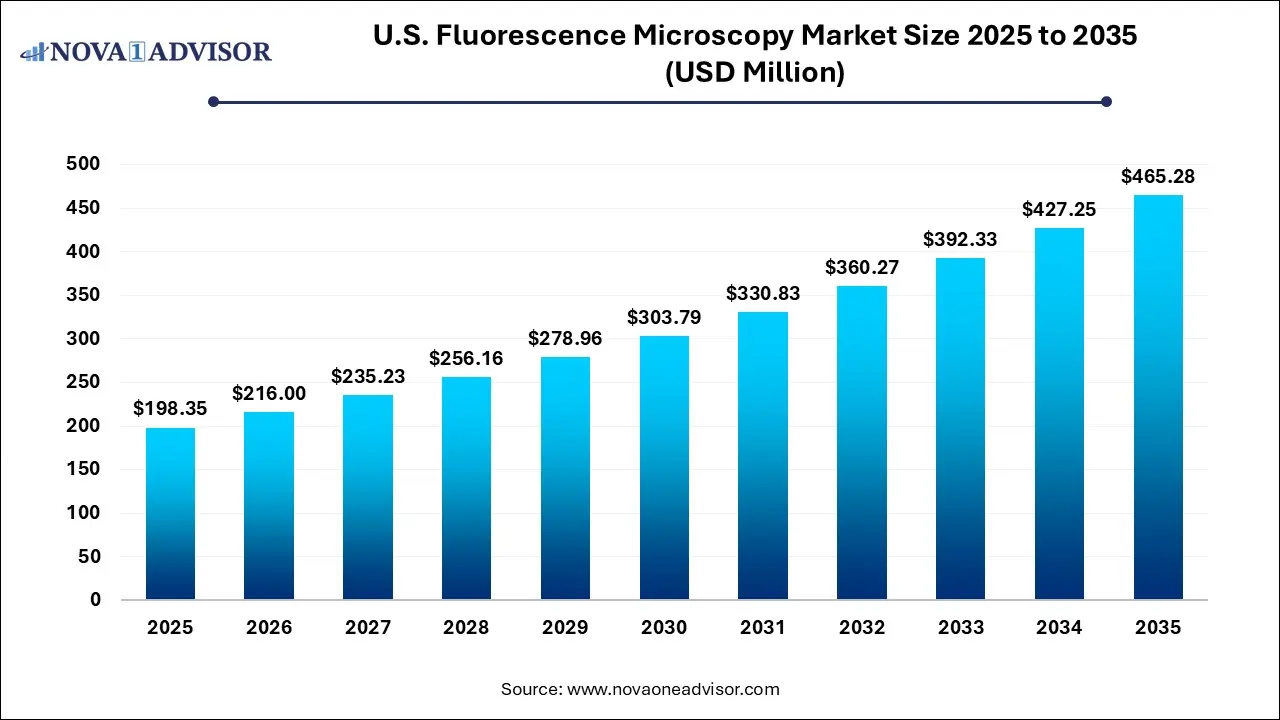
The U.S. fluorescence microscopy market size was estimated at USD 198.35 million in 2025 and is projected to increase from USD 216.00 million in 2026 to approximately USD 465.28 million by 2035, growing at a CAGR of 8.9% from 2026 to 2035. The U.S. fluorescence microscopy market is driven by the rising investment in drug discovery and molecular research, which requires advanced visualization tools, boosting demand, and increased use of fluorescence in cancer detection and personalized medicine necessitates precise, high-resolution imaging, and the rise in disease prevalence.
Key Takeaways
- By type, the upright fluorescence microscopy segment held a dominant position in the market with a share of 55% in 2025.
- By type, the inverted fluorescence microscopy segment is the fastest growing between 2026 and 2035.
- By application, the life science segment accounted for a considerable revenue share of 40% in the market in 2025.
- By application, the material science segment is the fastest growing during 2026 and 2035.
Innovation Driving Transformation in the U.S. Fluorescence Microscopy Market
U.S. fluorescence microscopy comprises a highly sophisticated sector focused on high-precision optical instruments that utilize emitted fluorescent light to visualize sub-cellular structures invisible under standard high-magnification microscopy. The benefits of fluorescence microscopy include exceptional molecular specificity through targeted labeling, high-contrast imaging of dynamic live-cell processes, and the capability for multi-channel, multi-color imaging, all of which are essential in cell biology, neuroscience, and pharmaceutical drug discovery. The market growth is driven by rising investments in biomedical research, a surge in demand for personalized medicine, and the rapid adoption of super-resolution and AI-driven imaging technologies.
Key AI Integration in the U.S. Fluorescence Microscopy Market
AI and ML are transforming the U.S. fluorescence microscopy industry by replacing manual image analysis with automated, deep-learning algorithms, resulting in significantly faster and more accurate cell segmentation and biomarker quantification. AI is driven by the need for high-throughput screening in pharmaceutical research and development and advanced clinical diagnostics. Technologies such as convolutional neural networks are now used to reduce image noise, reconstruct images in 3D, and even perform virtual labeling to circumvent expensive staining procedures, thereby increasing efficiency and reducing phototoxicity.
U.S. Fluorescence Microscopy Market Trends
- AI-Driven Operational Efficiency and Data Optimization
AI algorithms are becoming deeply embedded in fluorescence microscopy systems to automate image segmentation, denoising, and patient recognition. This integration reduces manual error and significantly accelerates the speed and accuracy of data processing in research, particularly for analyzing complex data, such as cellular images.
- Expansion of Super-Resolution Imaging Techniques
The acceleration of super-resolution microscopy, including techniques such as STED, PALM, and STORM, allows researchers to overcome the diffraction limit. This technology provides unprecedented nanoscale insights into cellular processes, making it essential for advancement in neuroscience and molecular research.
- Rising Demand For Live-Cell Imaging and High-Content Screening
The researchers shift towards real-time observation of dynamic cellular processes, driving the adoption of specialized live-cell imaging systems. These systems, often combined with high-throughput screening, allow for high-volume imaging of living cells and tissues without causing significant phototoxicity.
U.S. Fluorescence Microscopy Market Report Scope
| Report Coverage | Details |
| Market Size in 2026 | USD 216.00 Million |
| Market Size by 2035 | USD 465.28 Million |
| Growth Rate From 2026 to 2035 | CAGR of 8.9% |
| Base Year | 2025 |
| Forecast Period | 2026 to 2035 |
| Segments Covered | Type, Application, Region |
| Market Analysis (Terms Used) | Value (USD Million/Billion) or (Volume/Units) |
| Key Companies Profiled | Zeiss Group; Bruker Corporation; Thermo Fisher Scientific, Inc.; Nikon Corporation; Olympus Corporation; Leica Microsystems; KEYENCE CORPORATION; ECHO |
Market Dynamics
Driver
Increasing Research and Development Spending
This fuels the demand for advanced, high-resolution imaging tools required for complex life science studies, such as genomics, oncology, and neuroscience. Substantial federal funding from the National Institutes of Health and rising private investment in biotechnology research enable laboratories to adopt state-of-the-art super-resolution and confocal microscopy systems to gain deeper cellular insights. The high research and development budgets encourage academic-industry collaborations, resulting in faster development and adoption of AI-powered imaging and automated fluorescence technologies that enhance accuracy in drug discovery and diagnosis.
Restraint
High Capital Costs
The market growth is hindered by the limitations of resolution among small-scale research labs and academic institutions with restricted budgets. The steep upfront investments for these sophisticated instruments, which often feature advanced optics and specialized components, create substantial financial barriers to entry and expansion. The high operational expenses, including maintenance, specialized software, and necessary infrastructure upgrades (like vibration control), add to the overall cost of ownership, causing many facilities to delay or cancel purchases.
Opportunity
Integration of Digital Pathology
The enabling high-throughput, automated scanning of complex molecular assays, such as FISH and multiplexed immunofluorescence. By converting transient fluorescent signals into stable, high-resolution digital images, laboratories can store, share, and analyze samples without the issue of signal fading, which is inherent in traditional fluorescence microscopy. The rising demand for precision medicine, particularly in oncology for marker quantification, drives the need for advanced imaging systems that can be integrated with AI, allowing for more objective and reproducible results than manual methods.
Segment Insights
By Type Insights
Why Did the Upright Fluorescence Microscopy Segment Hold a 55% Share for the U.S. Fluorescence Microscopy Market?
The upright fluorescence microscopy segment held a dominant position in the market with a share of 55% in 2025, owing to the limited suitability for live-cell imaging compared to inverted systems. The high concentration of biopharmaceutical firms researching cellular mechanism directly increases demand for standard, reliable upright systems.
The inverted fluorescence microscopy segment held a 45% share of the market in 2025. Due to the rising demand for real-time cellular analysis in drug discovery and life sciences. High investment in life science research and development by the U.S. National Institute of Health supports the procurement of specialized instruments. The integration of digital capabilities, high-content screening, and super-resolution techniques.
By Application Insights
Why Did the Life Science Segment Lead the U.S. Fluorescence Microscopy Market?
The life science segment registered its dominance over the market with a share of 40% in 2025, owing to the continuous funding, strong biotech activity, and widespread research applications. The development of superior tools, such as super-resolution and light sheet microscopy, allows researchers to observe cellular structures with unprecedented clarity, fostering a high-tech demand cycle. It is essential for disease diagnosis and management, and the rapid adoption of personalized medicine.
The medical science segment held the 18% share of the market in 2025, due to the growing investment in life sciences and biomedical research from institutions and private firms, driving the need for sophisticated imaging. The focus on tailored medicines and molecular studies necessitates high-definition visualization tools, enhancing growth. The slight decline as semiconductor and nanotech applications growing at a faster pace.
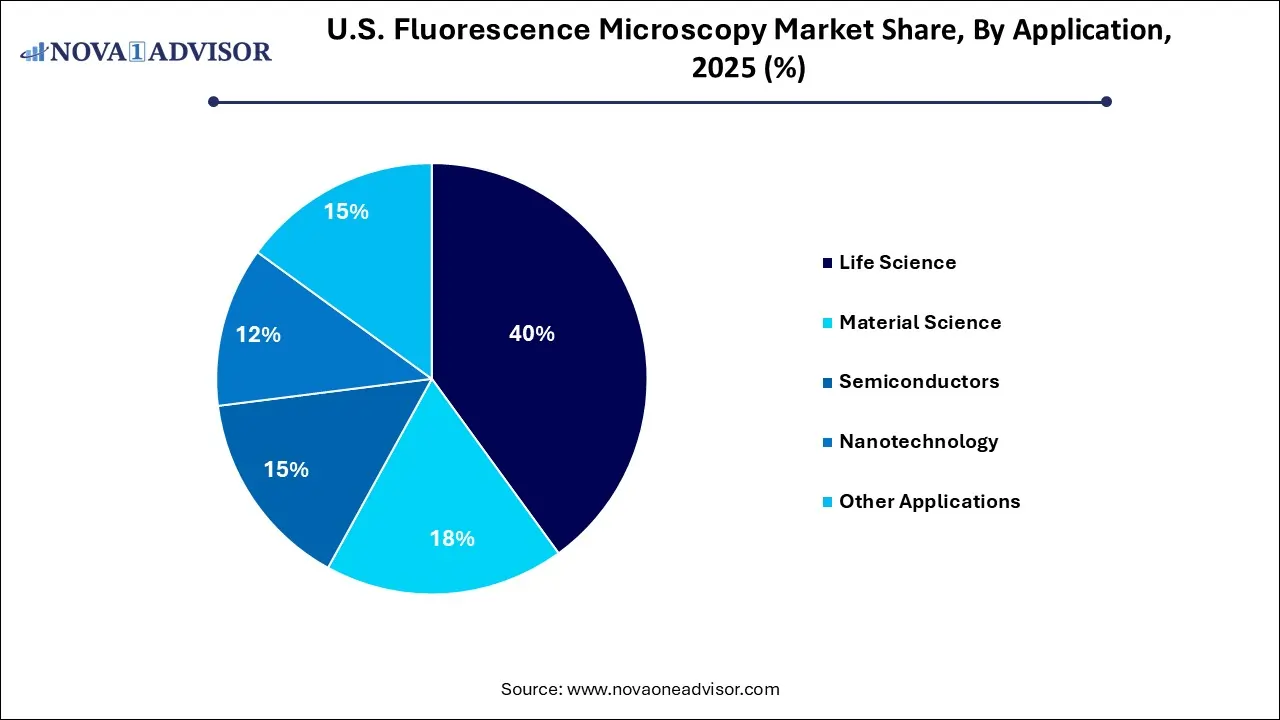
The semiconductors segment held a 15% share of the market in 2025 because of increasing U.S. chip manufacturing and quality control needs. Innovation in nanotechnology and IC manufacturing requires advanced electron and fluorescence microscopy for inspecting atomic-level structures. Rapid expansion of complex semiconductor production requires high-precision, automated imaging to improve manufacturing yields.
The other applications segment held a 15% share of the market in 2025, with the expansion of the niche and less scalable applications. Development of a semiconductor-based component, the high-throughput automated imaging, paired with AI-based defect detection and software, has reinforced the dominance of semiconductor-related applications.
The nanotechnology segment held a 12% share of the market in 2025, due to expanding research in advanced materials and nano-engineering. The rapid adoption of super-resolution and confocal microscopy in material science and nanotechnology enables precise observation at the molecular level.
By Regional Insights
Why Did the West U.S Region Hold a 25% Share of the U.S. Fluorescence Microscopy Market?
The west U.S. region led the market with a share of 70% in 2025, due to strong innovation ecosystems, but sees slight share dilution as other regions grow. The strong semiconductor sector in the West heavily utilizes fluorescence microscopy for defect inspection and quality control, contributing to industrial market growth. The research institutes and academic centers in the region prioritize cutting-edge biomedical research, requiring high-end fluorescence imaging tools for tissue and molecular analysis.
The Northeast region held a 22% share of the market in 2025. With the concentration of top universities, research labs, and pharma companies for drug development, pharmaceutical innovation, and clinical research. The strong presence of academic laboratories and commercial biotech firms leads to high adoption rates of advanced imaging tools, which are widely used in cell biology and developmental biology research.
The Southeast region held 20% share of the market in 2025, due to the rapid expansion of chip fabrication facilities and industrial investments. Strong investment in healthcare infrastructure and rapid adoption of automated digital imaging solutions drive market growth.
The Midwest region held a 18% share of the market in 2025, as the heavy industrial innovation created a robust demand for industrial-grade, durable imaging systems. The high concentration of academic institutions fosters extensive research activities requiring advanced, yet cost-effective, microscopy. Increasing private investments and government initiatives for healthcare and lab facilities are driving the adoption of laboratory biological microscopes.
The Southwest region held a 15% share of the market in 2025, due to the rapid expansion of chip fabrication facilities and industrial investments. The region benefits from high-quality imaging needs in institutions focusing on cell biology, neuroscience, and drug discovery research.
U.S. Fluorescence Microscopy Market Companies
- Zeiss Group
- Thermo Fisher Scientific, Inc.
- Bruker Corporation
- Nikon Corporation
- Leica Microsystems
- Olympus Corporation
- ECHO
- KEYENCE CORPORATION
Recent Developments
- In October 2024, CrestOptics and Leica Microsystems launched a collaborative imaging system, the THUNDER Imager Cell Spinning Disk, combining CrestOptics’ CICERO spinning disk unit with Leica’s THUNDER platform to enhance 3D live-cell imaging for challenging samples. Launched at Neuroscience, the partnership integrates Computational Clearing and automated features, such as Adaptive Immersion and SmartCORR, to streamline high-resolution workflows.
- In November 2024, CrestOptics and Tomocube announced a strategic partnership to launch the HT-X1™ Plus, the first commercially available platform integrating holotomography (HT) with spinning-disk confocal technology. This system provides high-resolution 3D, label-free biophysical imaging alongside sensitive, aligned 3D fluorescence data to enable non-invasive, complete analysis of live cells
- In January 2026, PRAGUE, CZ, Researchers at the Institute of Organic Chemistry and Biochemistry (IOCB) of the Czech Academy of Sciences announced a significant advancement in live-cell imaging with the development of a new class of target-activated fluorescent probes. Led by Milan Vrábel and Tomáš Slanina, in collaboration with Péter Kele’s chemical biology group, the team has successfully engineered "smart" labels that remain dark until they reach their specific molecular destination.
U.S. Fluorescence Microscopy Market Report Segmentation
By Type
- Upright Fluorescence Microscopy
- Inverted Fluorescence Microscopy
By Application
- Life Science
- Material Science
- Semiconductors
- Nanotechnology
- Other Applications
By Region
- West
- Southwest
- Southeast
- Midwest
- Northeast
FAQ's

Proceed to Buy
Instant PDF delivery on confirmation

U.S. Fluorescence Microscopy Market Size to Hit USD 465.28 Million by 2035
 Request Customization
 Download Sample

Get a Sample of this Report
U.S. Fluorescence Microscopy Market