

U.S. Non-Invasive Cancer Diagnostics Market Size, Share, and Trends 2026 to 2035
 Status Published
 Category Healthcare


Content
U.S. Non-Invasive Cancer Diagnostics Market Summary
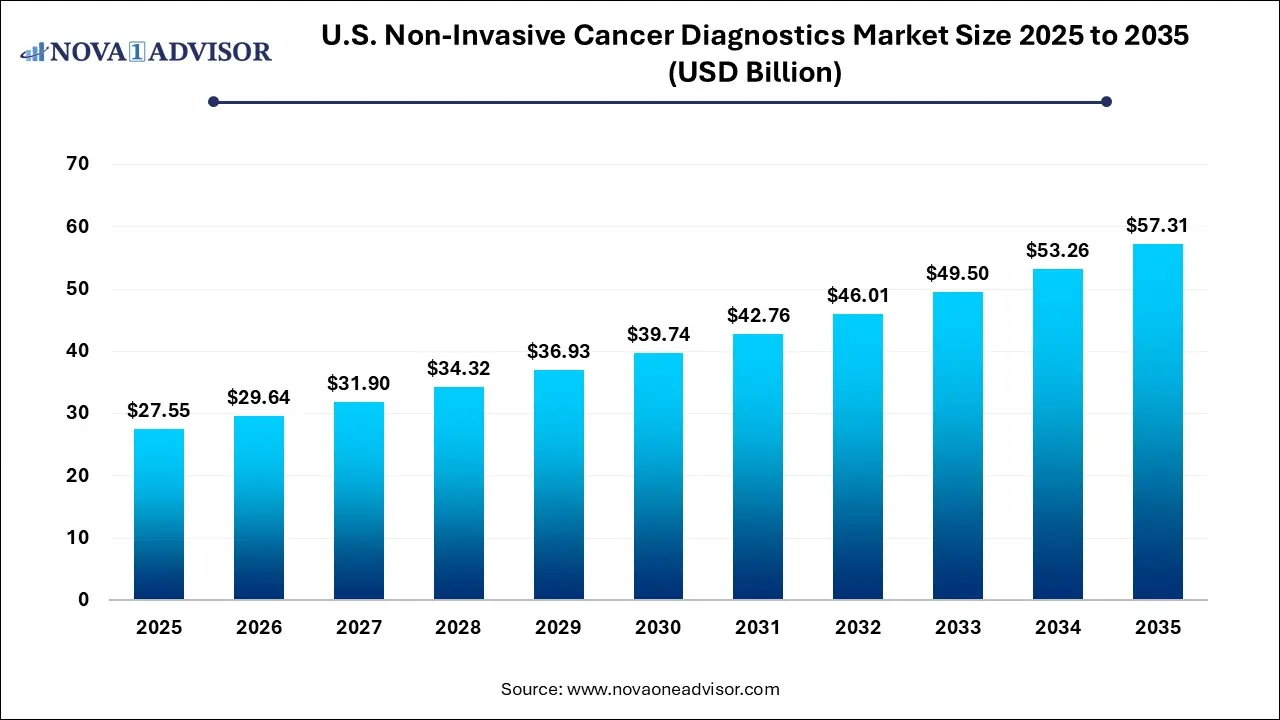
The U.S. non-invasive cancer diagnostics market size was estimated at USD 27.55 billion in 2025 and is projected to increase from USD 29.64 billion in 2026 to approximately USD 57.31 billion by 2035, growing at a CAGR of 7.6% from 2026 to 2035. The U.S. non-invasive cancer diagnostics market is driven by the increasing cancer prevalence and aging demographics, innovation in artificial intelligence imaging and multi-omics, and growing government support and healthcare infrastructure.
Key Takeaways
- By product, the consumables segment held a dominant position in the market with a share of 41% in 2025.
- By product, the instruments segment is the fastest-growing between 2026 and 2035.
- By technology, the imaging segment held a dominant position in the market with a share of 49% in 2025.
- By technology, the liquid biopsy segment is the fastest growing between 2026 and 2035.
- By indication, the lung cancer segment held a dominant position in the market with a share of 18% in 2025.
- By indication, the breast cancer segment is the fastest-growing between 2026 and 2035.
- By end-user, the hospitals segment held a dominant position in the market with a share of 53% in 2025.
Innovation Driving Transformation in the U.S. Non-Invasive Cancer Diagnostics Market
U.S. non-invasive cancer diagnostics comprise advanced screening technologies, such as liquid biopsies, that detect tumors without surgical tissue excision. These methods provide significant advantages across oncology, offering highly accurate, early-stage identification, drastically reduced patient discomfort, and elimination of tissue-biopsy infection risks. They enable real-time monitoring of tumor mutations and treatment efficiency. The market growth is driven by escalating prevalence of cancer, a favorable reimbursement system, and heavy integration of AI technologies; the regional industry is experiencing continuous expansion.
U.S. Non-Invasive Cancer Diagnostics Market Trends
- Liquid Biopsy and Circulating Biomarker Advancements
Liquid biopsies are transforming oncology by allowing clinicians to detect cancer and monitor treatment responses through simple blood draws instead of surgical tissue extractions. These tests screen for circulating tumor DNA and circulating tumor cells, providing a safer and less uncomfortable experience while enabling earlier replacement monitoring.
- Multi-Cancer Early Detection Tests
A significant shift is occurring toward MCED technologies, which can scan for dozens of different cancer types simultaneously from a single blood sample. By integrating multi-omics with sophisticated algorithms, these breakthrough tests aim to catch tumors at their earliest, most treatable stages before symptoms even appear.
- Next Generation Sequencing and Genetic Testing
The scalable adoption of NGS technologies allows healthcare providers to conduct highly detailed genomic profiling of patients without invasive procedures. This trend not only aids in non-invasive diagnosis but also helps identify specific genetic mutations to tailor personalized, highly targeted therapy.
Key AI Integration in the U.S. Non-Invasive Cancer Diagnostics Market
AI and ML are driving the U.S. non-invasive cancer diagnostics industry by earlier and more accurate disease detection. By rapidly analyzing complex medical imaging and genomic data, these technologies identify subtle biomarkers and indicators long before clinical symptoms present. Companies such as DELFI diagnostics are already utilizing ML to process cell-free DNA and detect tumor-related signatures from simple blood draws, minimizing the need for invasive tissue biopsies.
U.S. Non-Invasive Cancer Diagnostics Market Report Scope
| Report Coverage | Details |
| Market Size in 2026 | USD 29.64 Billion |
| Market Size by 2035 | USD 57.31 Billion |
| Growth Rate From 2026 to 2035 | CAGR of 7.6% |
| Base Year | 2025 |
| Forecast Period | 2026 to 2035 |
| Segments Covered | Product, Technology, Indication, and End User |
| Market Analysis (Terms Used) | Value (USD Million/Billion) or (Volume/Units) |
| Key Companies Profiled | Abbott Laboratories; GE HealthCare; Siemens Healthineers AG; Koninklijke Philips N.V.; Canon Medical Systems; F. Hoffmann-La Roche Ltd; Illumina, Inc.; Guardant Health, Inc.; Thermo Fisher Scientific Inc.; FONAR Corporation |
Driver
Advancements in Liquid Biopsies
The enabling of safer, faster, and more patient-friendly alternatives to traditional surgical tissue biopsies. By analyzing circulating tumor DNA and tumor cells from a simple blood draw, these methods allow for early disease detection and comprehensive genomic profiling. They are minimally invasive, and liquid biopsies facilitate real-time treatment monitoring and cancer recurrence tracking without subjecting patients to surgical risks.
Restraint
High Cost of Instruments
The market growth is hindered by the steep capital expenses, which create significant barriers to entry for smaller hospitals, clinics, and independent laboratories. The healthcare facilities face challenges in adopting cutting-edge diagnostic technologies without substantial financial strain. This cost burden ultimately restricts patients' access and hampers broader clinical integration of non-invasive testing methods.
Opportunity
Point-of-Care and At-Home Testing
The decentralized screening and reducing reliance on clinical facilities. Platforms such as AI-powered blood tests and FDA-cleared self-collection kits remove geographic and logistical barriers to early detection. These accessible, patient-centric solutions lower the threshold for routine preventive screening, which boosts overall testing participation rates. As a result, companies are launching advanced multi-cancer detection platforms to meet this surging consumer demand.
Segment Insights
By Product Insights
Why Did the Consumables Segment Hold a 41% Share for the U.S. Non-Invasive Cancer Diagnostics Market?
The consumables segment held a dominant position in the market with a share of 41% in 2025. Owing to it repeatedly required for every diagnostic procedure, creating continuous demand across healthcare settings. The transition toward minimally invasive, blood-based tumor detection. Analyzing circulating tumor DNA and RNA requires specialized, high-volume assay kits and sample preparation consumables, boosting their usage frequency.
The instruments segment held a 34% share of the market in 2025, with the strategic convergence of high-throughput pathology instruments, capital-intensive liquid biopsy infrastructure, and AI-driven diagnostic software compelling U.S. oncology networks to rapidly modernize their analytical capabilities. The laboratory proactively integrates these sophisticated modalities to capture a dominant share, optimize clinical throughput, and lead the shifting paradigm toward early-stage, precision cancer care.
The kits & reagents segment held a 25% share of the market in 2025, as it is essential for testing accuracy, but their usage volume remains lower than broad consumable demand. The transition toward minimally invasive procedures relies completely on specialized assay kits for accuracy.
By Technology Insights
Why Did the Imaging Segment Hold a 49% Share for the U.S. Non-Invasive Cancer Diagnostics Market?
The imaging segment held a dominant position in the market with a share of 49% in 2025. Owing to the most established and widely adopted cancer diagnostic approach in hospitals and diagnostic centers. The integration of clinical artificial intelligence into imaging systems allows for far greater diagnostic accuracy and early lesion detection.
The liquid biopsy segment held a 26% share of the market in 2025, with its minimally invasive nature, early detection capability, and growing adoption in precision oncology. FDA approvals of companion diagnostic tests, such as Foundation One liquid CDx and guardant360 CDx, have accelerated clinical adoption.
The immunoassay segment held 25% share of the market in 2025, with the superior sensitivity in isolating classic oncology biomarkers allowing clinical laboratories to efficiently manage high-volume population screening with minimal manual error. These affordable, highly accurate testing kits seamlessly compliment emerging liquid biopsy workflow by verifying circulating tumor proteins alongside molecular data.
By Indication Insights
Why Did the Lung Cancer Segment Lead the U.S. Non-Invasive Cancer Diagnostics Market?
The lung cancer segment registered its dominance over the market with a share of 18% in 2025, owing to the high disease prevalence and increasing adoption of low-dose CT screening programs. It is essential for monitoring treatment responses, detecting resistance mutations, and tracking minimal residual disease.
The breast cancer segment held the 17% share of the market in 2025, with extensive awareness programs, routine screening initiatives, and high testing rates among women. The shift away from generalized treatments toward personalized medicine maximizes survival rates and treatment efficacy.
The colorectal cancer segment held the 13% share of the market in 2025, due to rising screening adoption and increasing incidence among aging populations. Innovation in molecular diagnostics and genomic sequencing, specifically microfluidics and RNA/DNA biomarker identification, pushed the sensitivity of non-invasive CRC tests.
The prostate cancer segment held the 11% share of the market in 2025, because advanced liquid biopsies, CTC tracking, and gene-expression profiling are successfully replacing invasive tissue sampling, shifting the clinical paradigm toward safer, proactive disease management. The integration of favorable economies and advanced molecular insights ensures accessible, low-risk, and highly personalized care pathways for a massive patient demographic.
The blood cancer segment held the 10% share of the market in 2025, due to the increasing use of advanced molecular diagnostics and precision medicine approaches. Screening detects asymptomatic blood tumors at early, highly treatable stages.
The liver cancer segment held the 8% share of the market in 2025, due to the replacement of painful surgical tissue biopsies with highly accurate liquid biopsies and AI-driven imaging, healthcare providers are drastically reducing patient risk and recovery times while boosting clinical throughput. The integration of these rapid, comfortable, and highly sensitive diagnostic tools enables earlier intervention, optimizing long-term survival rates for a rapidly expanding patient demographic.
The cervical cancer segment held the 7% share of the market in 2025, due to the extensive insurance coverage and coverage and coverage and reimbursement for cervical screening, reducing out-of-pocket costs and encouraging higher participation rates. Widespread consumer awareness regarding women’s health has made routine testing a standard of care for early detection of pre-cancerous lesions.
The skin cancer segment held the 9% share of the market in 2025, due to the high prevalence of skin disorders and growing awareness of melanoma detection. Robust health campaigns emphasizing annual dermatological checks have increased early-stage screening rates, directly boosting the demand for fast, non-invasive testing options.
The others segment held the 7% share of the market in 2025, due to the integration of these cost-effective, highly convenient diagnostic frameworks, which is driving rapid market penetration and establishing a more accessible, preventative care paradigm.
By End User Insights
Why Did the Hospitals Segment Lead the U.S. Non-Invasive Cancer Diagnostics Market?
The hospitals segment registered its dominance over the market with a share of 53% in 2025, owing to the possess advanced imaging infrastructure, skilled professionals, and high patient inflow. The sheer number of cancer diagnostic procedures taking place in these centralized settings naturally drives higher consumable usage and test volumes.
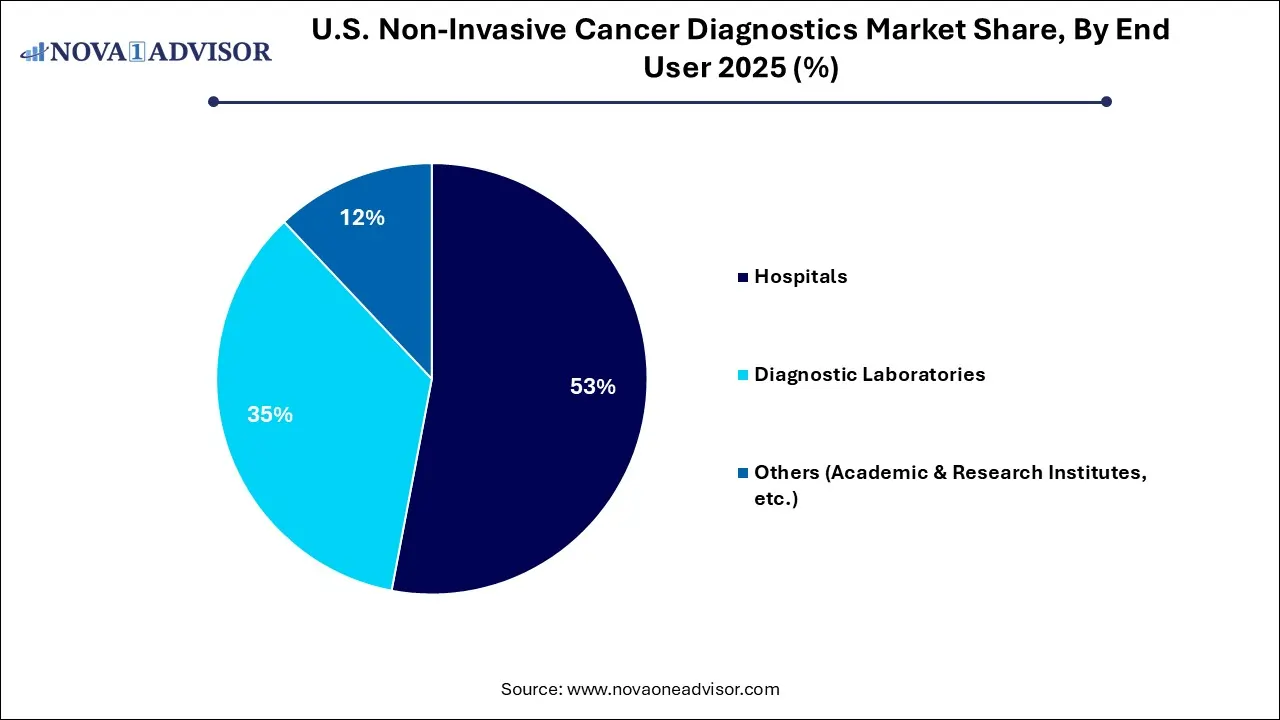
The diagnostic laboratories segment held the 35% share of the market in 2025, with the increasing outsourcing of specialized cancer diagnostics. The strong clinical trend of outsourcing specialized, multi-gene, and liquid biopsy assays to centralized or independent diagnostic laboratories rather than running them in-house at local hospitals.
The others segment held the 12% share of the market in 2025, due to its primary focus on research and innovation rather than high-volume commercial testing. Continuous innovation in digital health, AI-based health monitoring devices, and molecular testing kits has made it highly feasible for robust cancer screening to move outside the traditional hospital or clinical laboratory environment.
Recent Developments
- In May 2026, Guardant Health has received FDA approval for its Guardant360 Liquid CDx, a comprehensive, AI-powered liquid biopsy panel that integrates genomic and epigenomic insights to detect cancer from a blood draw. With a 100x larger genomic footprint than its predecessor, the test improves sensitivity and accelerates clinical decision-making for patients with advanced cancer.
- In February 2026, Quest Diagnostics (NYSE: DGX), a leading global provider of diagnostic information services, officially announced the commercial launch of Quest Flow Cytometry MRD for Myeloma. This novel blood test utilizes advanced, next-generation flow cytometry techniques to assess measurable residual disease (MRD) in individuals diagnosed with multiple myeloma.
- In March 2026, Illumina and Labcorp vastly expanded their precision oncology partnership to co-commercialize complementary liquid and tissue biopsy assays. Their joint focus is on building distributed in-vitro diagnostic (IVD) frameworks to bring advanced genomic testing to community health systems and underserved regions.
U.S. Non-Invasive Cancer Diagnostics Market Companies
- Abbott Laboratories
- Siemens Healthineers AG
- GE HealthCare
- Koninklijke Philips N.V.
- F. Hoffmann-La Roche Ltd
- Canon Medical Systems
- Illumina, Inc
- Thermo Fisher Scientific Inc.
- Guardant Health, Inc.
- FONAR Corporation
Segments Covered in the Report
This report forecasts revenue growth at country levels and provides an analysis of the latest industry trends in each of the sub-segments from 2021 to 2035. For this study, Nova one advisor, Inc. has U.S. non-invasive cancer diagnostics market.
By Product
- Instruments
-
- Pathology-based Instruments
-
-
- Polymerase Chain Reaction (PCR) Instruments
- Next-generation Sequencing (NGS) Instruments
- Microarrays
-
-
- Imaging Instruments
-
-
- Magnetic Resonance Imaging (MRI)
- Computed Tomography (CT)
- Positron Emission Tomography (PET)
- Mammography
- Others (Ultrasound, etc.)
-
- Consumables
- Kits & Reagents
By Technology
- Imaging
- Liquid Biopsy
- Immunoassay
By Indication
- Lung Cancer
- Breast Cancer
- Colorectal Cancer
- Prostate Cancer
- Blood Cancer
- Liver Cancer
- Cervical Cancer
- Skin Cancer
- Others (Thyroid Cancer, etc.)
By End User
- Hospitals
- Diagnostic Laboratories
- Others (Academic & Research Institutes, etc.)
FAQ's

Proceed to Buy
Instant PDF delivery on confirmation

U.S. Non-Invasive Cancer Diagnostics Market Size to Hit USD 57.31 Billion by 2...
 Request Customization
 Download Sample

Get a Sample of this Report
U.S. Non-Invasive Cancer Diagnostics Market