

U.S. Radiofrequency Ablation Devices For Pain Management Market Size, Share, and Trends 2026 to 2035
 Status Published
 Category Healthcare


Content
U.S. Radiofrequency Ablation Devices For Pain Management Market Size and Growth 2026 to 2035
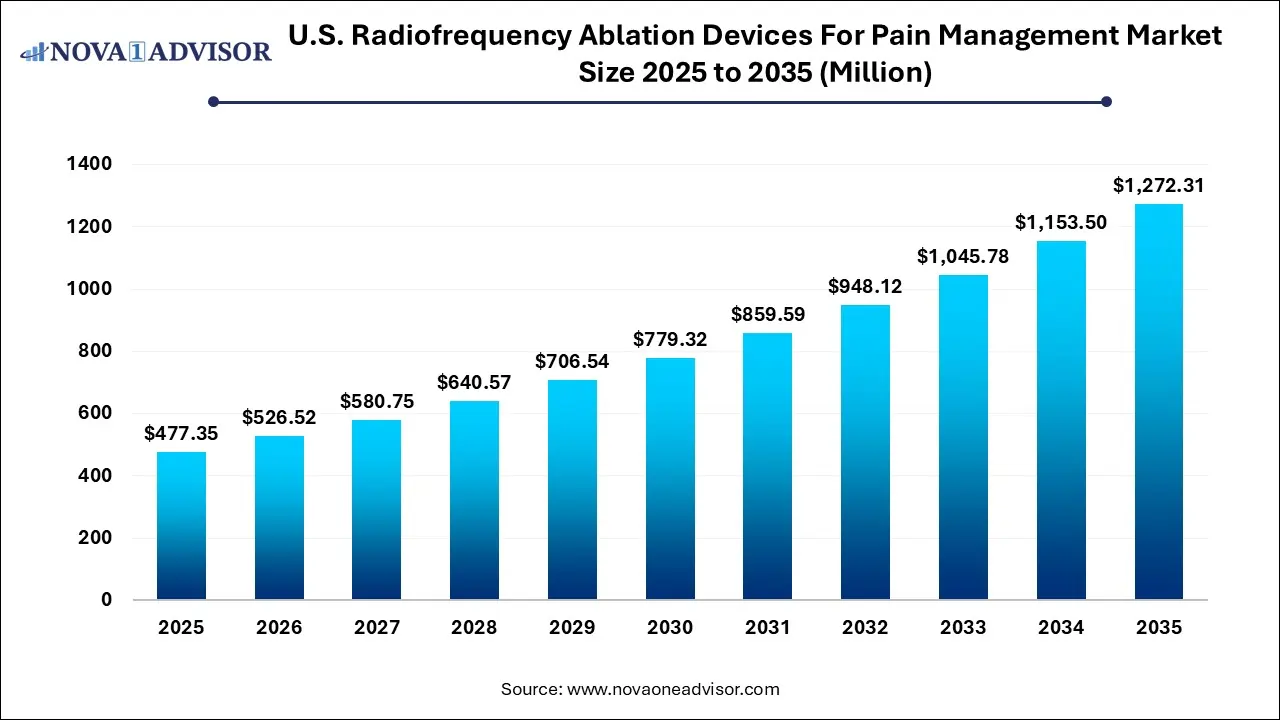
The U.S. radiofrequency ablation devices for pain management market size was estimated at USD 477.35 million in 2025 and is projected to increase from USD 526.52 million in 2026 to approximately USD 1,272.31 million by 2035, growing at a CAGR of 10.3% from 2026 to 2035. The U.S. radiofrequency ablation devices for pain management market is driven by the large aging demographic and increasing cases of neuropathic pain, lower back pain, and osteoarthritis, which demand targeted, long-lasting non-opioid pain solutions; strong insurance coverage and healthcare reimbursement policies in the U.S. reduce out-of-pocket costs, making procedures more accessible to patients; and a strong shift toward minimally invasive procedures.
Key Takeaways
- By product, the RFA electrodes/ probes segment held a dominant position in the market with a share of 44.00% in 2025.
- By product, the RFA cannula (or Needles) segment is the fastest growing between 2026 and 2035.
- By end use, the hospitals segment held a dominant position in the market with a share of 58.00% in 2025.
- By end use, the outpatient facilities segment is the fastest growing between 2026 and 2035.
Innovation Driving Transformation in the U.S. Radiofrequency Ablation Devices For Pain Management Market
U.S. radiofrequency ablation devices for pain management use high-frequency electrical energy to generate controlled heat, selectively disrupting targeted nerves or diseased tissue to provide long-lasting pain relief. In the U.S., these minimally invasive tools are increasingly favored for treating chronic conditions, such as spinal facet arthritis, osteoarthritis, and neuropathic disorders. Advantages include targeted therapy that preserves surrounding healthy tissue, reduced dependency on opioid medications, minimal scarring, and quick outpatient recovery times. The market is primarily driven by the rising geriatric demographic, continuous technological advancements (such as cooled RFA), and a broader healthcare shift away from long-term opioid prescriptions.
U.S. Radiofrequency Ablation Devices For Pain Management Market Trends
- Strategic Migration to Ambulatory Surgical Centers
The growing preference for performing RFA procedures in ambulatory surgical centers and specialty pain clinics rather than traditional hospitals is rapidly expanding access. Patient desire for quicker recoveries, lower out-of-pocket costs, and streamlined healthcare workflows drive this migration.
- Technological Evaluation in Cooled and Pulsed RFA Systems
Technological refinements have introduced specialized techniques, such as cooled RFA and pulsed RFA. These innovations allow physicians to safely and effectively treat complex conditions, such as chronic knee, hip, and spinal facet joint pain.
- Revenue Dominance of High-Volume Consumables
The single-use disposable products such as specialized probes, electrodes, and needles represent the largest revenue share in the market. Strict infection control protocols and recurring, per-procedure utilization naturally drive continuous, high-volume sales of these single-use components.
Key AI Integration in the U.S. Radiofrequency Ablation Devices For Pain Management Market
AI and ML are revolutionizing the U. radiofrequency ablation devices for pain management market by shifting it toward highly personalized, data-driven medicine. Algorithms analyze massive datasets of patient histories and imaging to predict treatment outcomes and precisely map anatomical targets, significantly reducing human error. AI-guided systems also enable real-time modulation of thermal energy delivery, allowing for optimal lesioning. This enhanced procedural precision minimizes tissue trauma, decreases reliance on long-term opioids, and improves overall patient satisfaction.
U.S. Radiofrequency Ablation Devices For Pain Management Market Report Scope
| Report Coverage | Details |
| Market Size in 2026 | USD 526.52 Million |
| Market Size by 2035 | USD 1,272.31 Million |
| Growth Rate From 2026 to 2035 | CAGR of 10.3% |
| Base Year | 2025 |
| Forecast Period | 2026 to 2035 |
| Segments Covered | Product, End-Use, By Region |
| Market Analysis (Terms Used) | Value (USD Million/Billion) or (Volume/Units) |
| Key Companies Profiled | Stryker Corporation; Abbott Laboratories; Medtronic plc; Boston Scientific Corporation; Avanos Medical, Inc; Epimed International, Inc.; Medline Inc.; Elevaris Medical Devices |
Market Dynamics
Driver
Shift to Minimally Invasive Procedures
The broader healthcare shift toward minimally invasive procedures drives RFA targets pain-transmitting nerves with targeted thermal energy instead of open surgery, yielding faster recovery times, fewer complications, and less postoperative pain. These benefits allow procedures to be safely performed in outpatient facilities and ambulatory care centers, cutting overall medical costs.
Restrain
Post-Procedure Complications
The market growth is hindered by unintended thermal damage to adjacent nerves or surrounding blood vessels, directly restricting growth. The adverse effects, such as post-ablation syndrome, prolonged numbness, and infection at the insertion site, cause patient discontent and hesitation toward undergoing the therapy. These complications trigger apprehension among physicians, prompting many to recommend more conservative, non-invasive treatments over RFA. The risk of these negative outcomes acts as a primary barrier to broader procedural adoption, tempering overall market expansion.
Opportunity
Integration of Imaging Technology and Ambulatory Surgery Centers
This synergy allows complex, image-guided pain management procedures to be shifted from traditional hospital inpatient settings to outpatient facilities. By utilizing real-time visualization, such as fluoroscopy and ultrasound in ASCs, physicians achieve extreme precision while targeting nerves and minimizing collateral tissue damage. Consequently, patients benefit from lower out-of-pocket costs, faster recovery times, and high-quality care, which accelerates the nationwide adoption of RFA treatments.
Segment Insights
By Product Insights
Why Did the RFA Electrodes/ Probes Segment Hold a 44.00% Share for the U.S. Radiofrequency Ablation Devices For Pain Management Market?
The RFA electrodes/ probes segment held a dominant position in the market with a share of 44.00% in 2025. Owing to its indispensable role in every procedure, recurring replacement demand, and increasing adoption of minimally invasive pain management techniques. The strong growing preference for RFA therapies over traditional open surgeries, using these targeted probes requires smaller incisions, resulting in shorter recovery periods and reduced need for-term pain medications.
The RFA cannula (or Needles) segment held a 24.00% share of the market in 2025, with the high adoption rate of minimally invasive radiofrequency ablation procedures as an alternative to traditional surgery fueling a massive, continuous demand for specialized disposable needles and cannulas. These high-precision consumables allow physicians to target deep nerve pathways with exact accuracy, protecting surrounding tissue while drastically reducing patient recovery times and post-operative complications.
The RFA generators segment held a 22.00% share of the market in 2025, with the technological advancements, upgrades to next-generation systems, and growing demand for precision-guided pain therapies. A surging volume of aging patients dealing with chronic back, neck, and joint pain has fueled demand for outpatient, minimally invasive RFA treatments.
The others segment held a 12.00% share of the market in 2025, with expanded clinical versatility, enabling physicians to target complex, hard-to-reach nerves with larger, more predictable lesion volumes. Continuous engineering innovations in single-use disposable devices enhance patient safety by eliminating cross-contamination risks and ensuring strict procedural sterility.
By End Use Insights
Why Did the Hospitals Segment Hold a 58.00% Share for the U.S. Radiofrequency Ablation Devices For Pain Management Market?
The hospitals segment held a dominant position in the market with a share of 58.00% in 2025. Owing to its advanced infrastructure, higher procedural volumes, broad reimbursement access, and ability to manage complex pain cases. Hospitals are more frequently covered by robust insurance policies, allowing patients to confidently access these costly but highly effective interventional treatments.
.webp "U.S. Radiofrequency Ablation Devices For Pain Management Market Share, By End Use 2025 (%)")
The outpatient facilities segment held a 30.00% share of the market in 2025, with the high overhead fees and complex administrative costs inherently tied to overnight hospital stays. The minimally invasive nature of RFA, which utilizes small incisions and local anesthesia, enables rapid recovery times and a swift return to daily routines.
The others segment held a 12.00% share of the market in 2025, due to safely blocking nerve signals to drastically improve patient mobility and walking effectiveness. The advanced technological versatility, including real-time image-guided generators and high-precision disposables, ensures rapid recovery times and shorter hospital stays.
U.S. Radiofrequency Ablation Devices For Pain Management Market Companies
- Stryker Corporation
- Medtronic plc
- Abbott Laboratories
- Boston Scientific Corporation
- Epimed International, Inc.
- Avanos Medical, Inc
- Elevaris Medical Devices
- Medline Inc.
Recent Developments
- In May 2025, Synaptrix announced positive feasibility study results for its NOVABLOC™ system, showing up to 20 days of opioid-free pain relief following total knee arthroplasty. The technology uses targeted RF neuromodulation to block pain while preserving motor function, aiming to improve rehabilitation outcomes and reduce opioid reliance.
- In April 2026, Avanos Medical, Inc. has agreed to be acquired by affiliates of American Industrial Partners in an all-cash transaction valuing the company at approximately $1.272 billion. Stockholders will receive $25.00 per share, representing a 72.1% premium over the closing price.
Segments Covered in the Report
This report forecasts revenue growth at country levels and provides an analysis of the latest industry trends in each of the sub-segments from 2021 to 2035. For this study, Nova one advisor, Inc. has U.S. radiofrequency ablation devices for pain management market.
By Product
- RFA Electrodes/ Probes
-
- Disposable
- Reusable
- RFA Cannula (or Needles)
- RFA Generators
- Others
By End-use
- Hospitals
- Outpatient Facilities
- Others
FAQ's

Proceed to Buy
Instant PDF delivery on confirmation

U.S. Radiofrequency Ablation Devices For Pain Management Market Size to Hit US...
 Request Customization
 Download Sample

Get a Sample of this Report
U.S. Radiofrequency Ablation Devices For Pain Management Market