

Vanishing Bone Disease Market Size, Share, and Trends 2026 to 2035
 Status Published
 Category Healthcare


Content
Vanishing Bone Disease Market Size and Growth 2026 to 2035
The global vanishing bone disease market size was valued at USD 3.85 billion in 2025 and is projected to grow from USD 4.25 billion in 2026 to USD 10.26 billion by 2035, at a CAGR of 10.3% from 2026 to 2035.
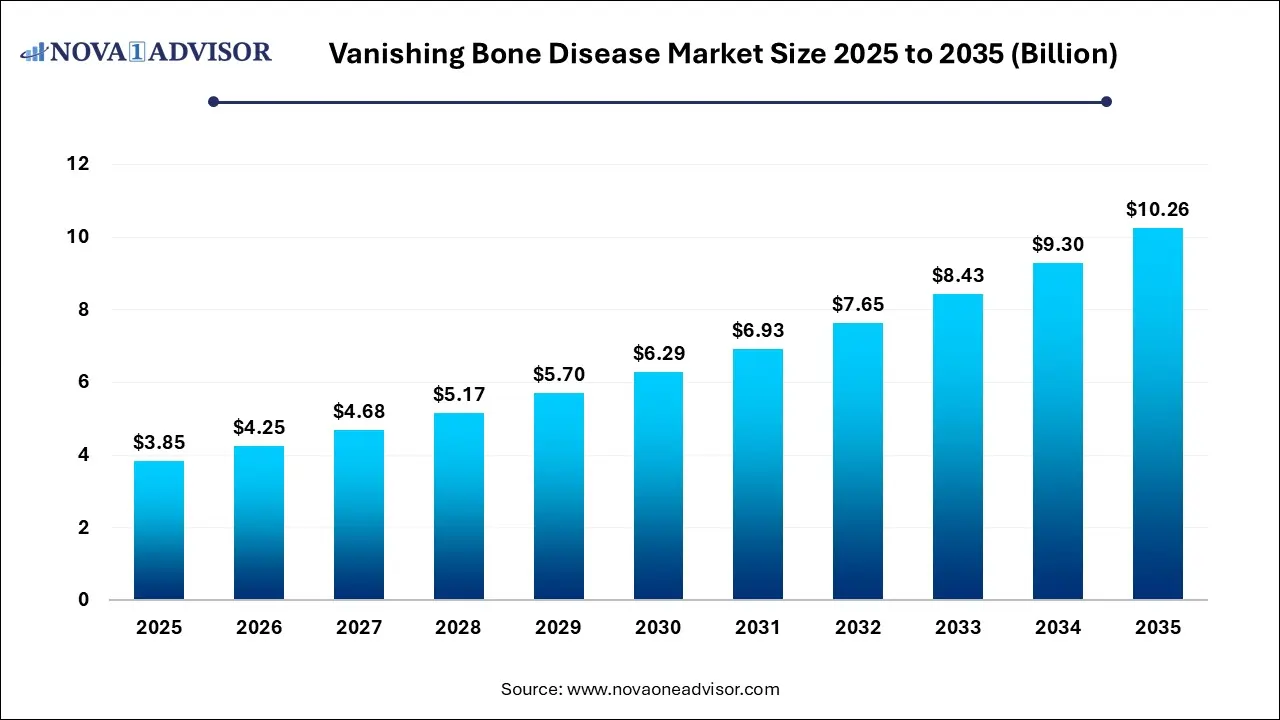
Key Takeaway:
- By diagnosis, the X-rays segment dominated the market and accounted for the largest revenue share in 2025.
- By diagnosis, the MRIs segment is the fastest-growing in the market in 2025.
- By treatment, the medicine therapy segment dominated the market and accounted for the largest revenue share in 2025.
- By end user, the hospitals and clinics segment dominated the market and accounted for the largest revenue share in 2025.
- By region, North America accounted for the largest revenue share in 2025.
Market Overview
The global vanishing bone disease market represents a highly specialized segment within the rare disease and orthopedic healthcare landscape. Vanishing Bone Disease (VBD), also known as Gorham-Stout disease, is an exceptionally rare musculoskeletal disorder characterized by progressive osteolysis, where normal bone tissue is gradually resorbed and replaced by abnormal vascular or lymphatic tissue. The disease can affect virtually any skeletal site, including the skull, spine, ribs, pelvis, clavicle, and facial bones, leading to severe functional impairment, deformity, chronic pain, and potentially life-threatening complications depending on the anatomical location involved.
Although the disease affects only a small patient population worldwide, increasing recognition among orthopedic surgeons, radiologists, oncologists, and rare disease specialists has contributed to improved diagnosis rates over the past decade. Historically, many patients experienced delayed diagnosis due to the disease's rarity and clinical resemblance to infections, malignancies, metabolic bone disorders, or inflammatory conditions. Today, advances in diagnostic imaging and multidisciplinary clinical evaluation are enabling physicians to identify Vanishing Bone Disease at earlier stages, facilitating timely therapeutic intervention and improved patient outcomes.
The market is primarily driven by advances in diagnostic technologies. Modern imaging modalities such as high-resolution computed tomography (CT), magnetic resonance imaging (MRI), nuclear medicine scans, and three-dimensional imaging allow clinicians to visualize progressive bone destruction with greater precision. These technologies also assist physicians in differentiating Gorham-Stout disease from other osteolytic disorders while supporting treatment planning and long-term disease monitoring.
Looking ahead, the Vanishing Bone Disease market is expected to experience moderate but sustained growth driven by improving diagnostic capabilities, expanding rare disease awareness, increasing research investments, and continued innovation in targeted therapeutic development. While the market remains relatively small compared to other musculoskeletal disorders, scientific advances and multidisciplinary care approaches are expected to significantly improve disease management over the coming decade.
Market Outlook
- Market Growth Overview: The global vanishing bone disease market is expected to grow significantly between 2025 and 2035, driven by the advancements in diagnostic imaging, growing targeted research and biologics, and increasing disease awareness.
- Sustainability Trends: Sustainability trends involve eco-friendly biomaterials, green manufacturing, and minimizing hazardous waste.
- Major Investors: Major investors in the market include Novartis AG, Amgen Inc., Roche Holding AG, Merck and Co Inc., and Medtronic plc.
How is AI Impacting the Global Vanishing Bone Disease Market?
Artificial Intelligence is playing an increasingly important role in the diagnosis and management of Vanishing Bone Disease by improving image interpretation, facilitating early diagnosis, supporting treatment planning, and accelerating rare disease research. Given the disease's rarity and complex presentation, AI-powered technologies offer valuable assistance in identifying subtle radiological abnormalities that may otherwise remain undetected during routine clinical evaluation.
One of the most significant applications involves automated analysis of radiological images. Deep learning algorithms trained on CT scans, MRI studies, and X-ray datasets can detect progressive osteolysis, cortical thinning, pathological fractures, and abnormal vascular proliferation with greater consistency than manual interpretation alone. AI-assisted image segmentation also enables physicians to quantify bone loss over time, supporting objective disease monitoring and treatment evaluation.
Artificial intelligence further contributes to differential diagnosis by comparing imaging findings against extensive databases containing other osteolytic disorders, including metastatic cancer, multiple myeloma, osteomyelitis, Paget's disease, and metabolic bone disorders. These decision-support systems help reduce diagnostic uncertainty while shortening the time required for definitive diagnosis.
Predictive analytics is another emerging application. Machine learning models analyze longitudinal clinical data, laboratory findings, imaging progression, and treatment responses to estimate disease progression and identify patients at higher risk of complications such as pathological fractures, spinal instability, or chylothorax. These predictions allow clinicians to initiate earlier intervention and optimize long-term management strategies.
AI also accelerates pharmaceutical research by analyzing genomic datasets, molecular signaling pathways, and published clinical evidence to identify potential therapeutic targets. Drug repurposing algorithms have become particularly valuable in rare disease research, enabling investigators to evaluate existing medications that may inhibit abnormal osteolysis or lymphatic proliferation without requiring lengthy early-stage drug discovery.
Digital pathology platforms supported by artificial intelligence further improve tissue analysis by identifying vascular and lymphatic abnormalities characteristic of Gorham-Stout disease. Combined with molecular diagnostics, these technologies contribute to more accurate disease classification and personalized treatment planning.
As AI continues integrating with precision medicine, cloud-based collaboration platforms, and international rare disease registries, it is expected to significantly improve diagnostic confidence, clinical decision-making, research efficiency, and patient outcomes within the global Vanishing Bone Disease market.
Vanishing Bone Disease Market Report Scope
| Report Coverage | Details |
| Market Size in 2026 | USD 4.25 Billion |
| Market Size by 2035 | USD 10.26 Billion |
| Growth Rate From 2026 to 2035 | CAGR of 10.3% |
| Base Year | 2025 |
| Forecast Period | 2026 to 2035 |
| Segments Covered | By Diagnosis, By Treatment, By End User, By Region |
| Market Analysis (Terms Used) | Value (USD Million/Billion) or (Volume/Units) |
| Regional Scope | North America; Europe; Asia Pacific; Central and South America; the Middle East and Africa |
| Key Companies Profiled | Varian Medical Systems, Inc., Elekta AB, C. R. Bard, Inc., Teleflex Incorporated, Vygon S.A. Medtronic plc., Cook Medical, Smiths Medical, ATMOS MedizinTechnik GmbH & Co. KG, Merck & Co., Sanofi-Aventis, F. Hoffmann-La Roche AG, and Novartis International AG are some prominent players in this market. |
Market Driver
Increasing Awareness and Earlier Diagnosis of Rare Bone Disorders
The growing awareness of rare musculoskeletal disorders among healthcare professionals is one of the primary drivers of the Vanishing Bone Disease market. Historically, Gorham-Stout disease was frequently misdiagnosed because its clinical presentation closely resembled infections, malignancies, inflammatory disorders, or metabolic bone diseases. Improved physician education, greater availability of advanced imaging technologies, and increasing publication of clinical case reports have significantly enhanced diagnostic accuracy.
Earlier diagnosis enables physicians to initiate treatment before extensive bone destruction occurs, improving patient outcomes and reducing severe complications. Specialized rare disease centers and multidisciplinary clinical teams further support comprehensive disease management by combining expertise from orthopedic surgery, radiology, oncology, pathology, thoracic surgery, and rehabilitation medicine. These improvements continue expanding demand for advanced diagnostic technologies and individualized therapeutic approaches.
Market Restraint
Extremely Low Disease Prevalence and Limited Clinical Evidence
The exceptionally low prevalence of Vanishing Bone Disease remains the greatest challenge facing market growth. Because only a limited number of confirmed cases are reported globally, conducting large-scale clinical trials is extremely difficult. Most treatment recommendations continue to rely on individual case reports, small observational studies, and physician experience rather than robust randomized clinical evidence.
This limited evidence base creates uncertainty regarding optimal treatment strategies, reimbursement policies, regulatory approvals, and commercial investment. Pharmaceutical companies may also hesitate to invest heavily in therapeutic development due to the relatively small patient population, slowing the introduction of new treatment options.
Market Opportunity
Development of Targeted Therapies for Rare Osteolytic Disorders
One of the most significant opportunities in the Vanishing Bone Disease market lies in developing targeted therapies that directly address the biological mechanisms responsible for abnormal bone resorption and lymphatic proliferation. Advances in molecular biology have identified pathways involving VEGF, mTOR, osteoclast activation, and immune regulation as promising therapeutic targets.
Biotechnology companies are increasingly exploring orphan drug development, biologic therapies, and drug repurposing strategies to improve disease management. As precision medicine, genomic profiling, and biomarker research continue advancing, personalized treatment approaches may significantly improve clinical outcomes while creating new commercial opportunities within this highly specialized rare disease market.
Segmental Insights
By Diagnosis
How did the X-rays segment dominate the Global Vanishing Bone Disease market?
The X-rays segment is driven by the widespred availability and cost-effectiveness compared to advanced scanning modalities, ensuring the mandatory first step within the standard clinical workflow. This non-invasive nature allows for immediate initial assessments, capturing a high volume of examinations across both emergency and routine orthopedic evaluations.
How did the MRIs segment expect to hold the fastest-growing Global Vanishing Bone Disease market in the coming years?
The MRIs segment is driven by ultra-high-field advancements in 3T and 7T scanners, which deliver precise mapping of bone marrow and soft tissue anomalies without exposing rare-disease patients to ionizing radiation. The integration of deep learning and artificial intelligence automates complex image segmentation, significantly reducing manual interpretation errors during longitudinal tracking.
By Treatment
How did the medicine therapy segment dominate the Global Vanishing Bone Disease market?
The medicine therapy segment is driven by expanding investigational pipelines and ongoing clinical research into novel biologic combinations that continually widen the therapeutic landscape, shifting the standard of care from symptomatic management to long-term, disease-modifying trajectories. As an ultra-rare skeletal disorder, clinical trends are moving rapidly away from broad, invasive surgical interventions toward specialized orphan drugs tailored to specific cellular pathways.
How did the other segments expect to hold the fastest-growing Global Vanishing Bone Disease market in the coming years?
The other segment is driven by the rapid adoption of synthetic bone grafts and bioactive proteins that eliminate disease transmission while optimizing skeletal regeneration. The online pharmacies and digital distribution networks enhance patient convenience and streamline access to long-term speciality pharmaceuticals.
By End User
How did the hospitals and clinics segment dominate the Global Vanishing Bone Disease market?
The hospitals and clinics segment is driven by the specialized invasive care units and emergency facilities essential for managing life-threatening disease complications, such as acute chylothorax and pathological fractures. The primary centers for rare-disease clinical trials and restricted orphan drug administration, hospitals remain the central hub, ensuring consistent patient throughput and high revenue generation.
How did the diagnostic centers segment expect to hold the fastest-growing Global Vanishing Bone Disease market in the coming years?
The diagnostic centers segment is driven by the widespred adoption of high-resolution MRI, CT scans, and precise bone densitometry for early detection and longitudinal osteolytic tracking. The integration of advanced biomarker and molecular testing to accurately identify lymphatic endothelial cell markers and establish clear differential diagnoses.
By Regional
How did the North America region account for the largest share in the Global Vanishing Bone Disease market?
North America is driven by the widespread patient access to advanced medical imaging techniques such as high-resolution MRIs and CT scans that drastically improve early tracking. The highly developed healthcare infrastructure is backed by robust insurance coverage mandates and legislative protections for rare diseases. The favourable financial and clinical frameworks encourage early adoption of innovative orphan drugs, establishing the region as the primary revenue generator for specialized skeletal therapeutics.
U.S. Global Vanishing Bone Disease Market Trends
The U.S.'s enhanced medical imaging allows for the early detection of progressive osteolysis and abnormal lymphatic tissue proliferation. The favourable government designations and increased dedicated orphan drug development pipelines.
How did the Asia-Pacific region become the fastest-growing Global Vanishing Bone Disease Market during the forecast period?
Asia Pacific is driven by massive demographic shifts and a rapidly growing geriatric population that has led to a surge in the prevalence of rare musculoskeletal and bone disorders. The expanded healthcare access, rising middle-class demographic, and increasing medical tourism allow for improved diagnosis and specialized care.
China Global Vanishing Bone Disease Market Trends
China has a strong reliance on mainstream therapies, where complex surgeries and specialized bisphosphonates remain the primary interventions to halt progressive osteolysis. The expanding pharmaceutical research into underlying osteolytic and lymphatic pathways is creating lucrative growth opportunities by opening up next-generation targeted therapy options, such as sirolimus.
How Did Europe Hold A Notable Share in the Global Vanishing Bone Disease Market?
Europe’s strong collaborative networks between European research institutions and pharmaceutical companies drive the continuous expansion of targeted therapies designed to inhibit underlying lymphatic and bone-destroying pathways. The routine clinical adoption of advanced imaging technologies across European hospitals enables the early detection of osteolytic conditions before life-threatening complications manifest.
Germany Global Vanishing Bone Disease Market Trends
Germany’s emergence of advanced biologics and targeted orphan drugs that maximize bone regeneration over traditional pharmaceuticals. This momentum is further propelled by pioneering gene therapy research exploring permanent cures for abnormal lymphatic tissue proliferation, alongside a diagnostic shift toward high-resolution MRIs and precision nuclear medicine.
Key Players in the Global Vanishing Bone Disease Market
- Varian Medical Systems, Inc.: Varian contributes by manufacturing advanced linear accelerators and radiation therapy systems, which are used to deliver targeted radiation to affected bones. This localized radiotherapy helps arrest the abnormal proliferation of blood or lymphatic vessels that drive bone resorption in vanishing bone disease patients.
- Elekta AB: Elekta supplies specialized oncology and radiotherapy solutions, such as radiosurgery and image-guided radiation therapy. Their precision equipment is utilized in palliative care protocols to reduce tumor-like vascular growth and halt the progression of osteolysis in patients.
- C. R. Bard, Inc.: Bard offers critical vascular and drainage devices, including peripherally inserted central catheters (PICCs) and pleural drainage systems.
Segments Covered in the Report
This report forecasts revenue growth at country levels and provides an analysis of the latest industry trends in each of the sub-segments from 2021 to 2035. For this study, Nova one advisor, Inc. has vanishing bone disease market.
By Diagnosis
- X-rays
- CT Scans
- MRIs
- Ultrasound
- Nuclear Medicine
- Others
By Treatment
- Medicine Therapy
- Bisphosphonates
- Vitamin D
- Interferon
- a-2b Interferon
- Calcium
- Adrenal extracts
- Androgens
- Bleomycin
- Others
- Radiation Therapy
- Chest drainage
- Thoracic Duct Ligation
- Pleurodesis
- Pleurectomy
- Others
By End-User
- Hospitals and clinics
- Diagnostic centers
- Ambulatory surgical centers
By Region
- North America
- Europe
- Asia-Pacific
- Latin America
- Middle East & Africa (MEA)
FAQ's

Proceed to Buy
Instant PDF delivery on confirmation

Vanishing Bone Disease Market Size to Hit USD 10.26 Billion by 2035
 Request Customization
 Download Sample

Get a Sample of this Report
Vanishing Bone Disease Market