

Vascular Patches Market Size, Share, and Trends 2026 to 2035
 Status Published
 Category Healthcare


Content
Vascular Patches Market Size and Growth 2026 to 2035
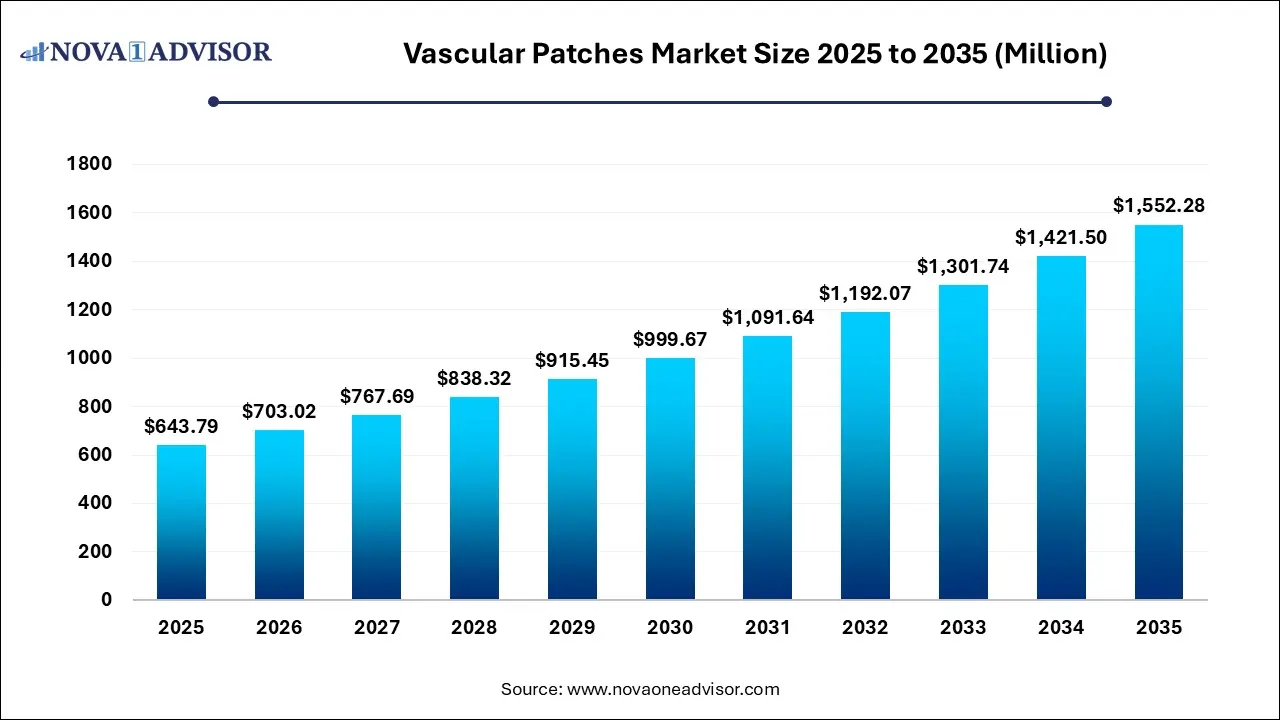
The global vascular patches market size was estimated at USD 643.79 million in 2025 and is projected to hit around USD 1,552.28 million by 2035, growing at a CAGR of 9.2% during the forecast period from 2026 to 2035.
Key Takeaway
- By material, the biologic segment dominated the market and accounted for the largest revenue share in 2025.
- By material, the synthetic segment is anticipated to witness the fastest CAGR over the forecast period.
- By application, the carotid endarterectomy segment dominated the market and accounted for the largest revenue share in 2025.
- By end user, the hospitals segment dominated the market and accounted for the largest revenue share in 2025.
- By region, North America accounted for the largest revenue share in 2025.
Market Overview
The vascular patches market represents a specialized segment within the cardiovascular medical devices industry. Vascular patches are implantable materials used to close blood vessels following surgical procedures. They help enlarge arteries, reinforce vessel walls, and reduce the risk of narrowing after repair. These patches are routinely utilized during carotid endarterectomy, abdominal aortic aneurysm repair, vascular bypass procedures, and other reconstructive surgeries.
The market has evolved considerably over the past decade. Historically, surgeons relied heavily on autologous tissue harvested from patients during surgery. Although clinically effective, autologous tissue harvesting increased operating time and introduced additional procedural complexities. Advances in biomaterials led to the development of synthetic and biologic vascular patches, offering standardized performance characteristics and greater procedural convenience.
The increasing prevalence of cardiovascular disease continues to drive demand. Aging populations, sedentary lifestyles, obesity, diabetes, smoking, and hypertension collectively contribute to rising incidences of arterial disease. Consequently, healthcare systems worldwide are witnessing higher numbers of interventions requiring vascular reconstruction.
For example, carotid artery disease affecting elderly patients frequently necessitates carotid endarterectomy procedures, where vascular patches improve vessel closure and minimize restenosis risk. Similarly, abdominal aortic aneurysm repairs often require patch reinforcement to restore structural integrity.
Technological advancements have also transformed product development. Manufacturers are investing heavily in tissue engineering, biologic processing techniques, anti-infective technologies, and hybrid biomaterials designed to optimize healing outcomes.
As healthcare providers increasingly emphasize improved surgical outcomes and reduced complication rates, the vascular patches market is expected to remain a critical component of cardiovascular surgery practice.
Market Outlook
- Market Growth Overview: The global vascular patches market is expected to grow significantly between 2025 and 2035, driven by the rising burden of cardiovascular diseases, expanding healthcare infrastructure and reimbursement, and a growing elderly demographic.
- Sustainability Trends: Sustainability trends involve a shift toward biocompatible biologics, tissue engineering and bioprinting, and eco-friendly manufacturing and ESG.
- Major Investors: Major investors in the market include Baxter International, LeMaitre Vascular, W. L. Gore & Associates, Getinge AB, B. Braun, and Terumo Corporation.
How is AI Transforming the Vascular Patches Market
Artificial intelligence is emerging as a transformative force across the vascular surgery ecosystem, indirectly reshaping the vascular patches market.
AI-powered imaging algorithms can analyze computed tomography angiography and duplex ultrasound data with remarkable precision. These systems assist surgeons in identifying plaque morphology, vessel dimensions, and lesion severity before surgery. Enhanced visualization enables more accurate patch selection and procedural planning.
Predictive analytics models are also improving patient stratification. By integrating demographic data, medical history, and diagnostic findings, AI tools can estimate postoperative complication risks, helping clinicians determine the most suitable surgical approach.
For instance, a patient with diabetes, extensive calcification, and multiple comorbidities may benefit from biologic patches that exhibit favorable healing characteristics. AI-supported recommendations can strengthen evidence-based decision-making.
Machine learning applications further support postoperative surveillance by detecting subtle indicators of restenosis or graft failure from imaging datasets. Early intervention reduces adverse events and healthcare costs.
Within manufacturing environments, AI enhances quality assurance through automated defect identification and process optimization. Manufacturers can improve consistency while minimizing material waste.
The future may witness personalized vascular patch development through AI-assisted biomaterial design. By analyzing tissue compatibility patterns and surgical outcomes, algorithms could guide the creation of next-generation patches tailored to specific patient populations.
Although AI adoption remains in relatively early stages within this niche segment, its influence on diagnosis, treatment planning, manufacturing efficiency, and outcome optimization is expected to grow substantially.
Vascular Patches Market Report Scope
| Report Coverage | Details |
| Market Size in 2026 | USD 703.02 Million |
| Market Size by 2035 | USD 1,552.28 Million |
| Growth Rate From 2026 to 2035 | CAGR of 9.2% |
| Base Year | 2025 |
| Forecast Period | 2026 to 2035 |
| Segments Covered | By Material, By Application, By End-user, By Region |
| Market Analysis (Terms Used) | Value (USD Million/Billion) or (Volume/Units) |
| Regional Scope | North America; Europe; Asia Pacific; Central and South America; the Middle East and Africa |
| Key Companies Profiled | Terumo Corporation (Japan), C. R. Bard, Inc. (US), B. Braun Melsungen AG (Germany), LeMaitre Vascular, Inc. (US), Maquet (Germany), W. L. Gore & Associates, Inc. (US), Admedus (Australia), CryoLife, Inc. (US), Labcor Laboratórios Ltda (Brazil), Baxter International Inc. (US), and Edwards Lifesciences Corporation (US) |
Segmental Insights
By Material
How did the biologic segment dominate the Global Vascular Patches market?
The biologic segment is driven by rapidly increasing demand to integrate seamlessly with native host tissue to promote natural cellular regrowth and reduce graft rejection rates. This high biocompatibility makes them the preferred choice for surgeons treating elderly, diabetic, or high-risk patients who face elevated threats of post-surgical complications.
How did the synthetic segment expected to hold the fastest-growing Global Vascular Patches market in the coming years?
The synthetic segment is driven by these materials delivering predictable mechanical durability and structural strength, which are highly valued by surgeons during long-term vascular bypass and large-vessel procedures. This combination of cost efficiency, manufacturing consistency, and robust structural performance establishes synthetic patches as a highly dependable and accessible staple in modern surgical environments.
By Application
How did the carotid endarterectomy segment dominate the Global Vascular Patches market?
The carotid endarterectomy segment is driven by established surgical guidelines and its proven efficacy in reducing recurrent ipsilateral strokes and artery restenosis compared to primary closure. This clinical superiority drives a massive, continuous procedural volume, as CEA remains one of the most frequently performed vascular surgeries globally to combat rising carotid artery disease within an aging population.
How did the bypass surgery segment expected to hold the fastest-growing Global Vascular Patches market in the coming years?
The bypass surgery segment is driven by the rising prevalence of coronary artery diseases and strokes across an aging global population, continuously artery diseases and strokes across an aging global population, continuously elevating the absolute number of necessary interventions. The favourable medical insurance coverage and established reimbursement frameworks across both developed and emerging economies.
By End Users
How did the hospitals segment dominate the Global Vascular Patches market?
The hospitals segment is driven by highly specialized vascular surgeons and dedicated medical teams equipped to safely execute delicate arterial reconstructions and navigate severe post-operative risks. The favourable government initiatives and structured healthcare reimbursement frameworks solidify hospitals as the most financially accessible and preferred treatment venues, cementing their dominance as the leading end-user segment in the global market.
How did the ambulatory surgical centers segment expected to hold the fastest-growing Global Vascular Patches market in the coming years?
The ambulatory surgical centers segment is driven by cost-effectiveness and ongoing payment reforms, where outpatient settings offer significantly lower operational costs that prompt favorable reimbursement policies from insurance providers and government programs, such as CMS. This transition is further accelerated by site-of-service expansions, as continuous advancements in minimally invasive surgical techniques and anesthesia protocols now allow routine vascular procedures to be performed safely on a same-day, outpatient basis.
By Regional
How did the North America region account for the largest share in the Global Vascular Patches market?
North America is driven by the aging population with high cardiovascular disease prevalence and advanced healthcare infrastructure. Favorable reimbursement policies, coupled with rapid adoption of minimally invasive, high-durability technologies, solidify the region's market leadership.
U.S. Vascular Patches Market Trends
The U.S. has seen clinicians increasingly favour biologic materials, such as bovine and equine pericardium, for their superior biocompatibility and lower risk of restenosis. While durable and cost-effective synthetic options, such as ePTFE and Dacron, remain staples for peripheral and abdominal procedures, the market is actively shifting toward cutting-edge tissue engineering, resorbable designs, and 3D bioprinting.
How did the Asia-Pacific region become the fastest-growing Global Vascular Patches Market during the forecast period?
Asia Pacific has a vascular patches by a massive patient pool facing rising rates of atherosclerosis and aortic aneurysms. Expanding healthcare infrastructure and booming medical tourism in hubs, such as India and Thailand, have vastly improved regional access to complex surgeries.
China Global Vascular Patches Market Trends
China’s rising volume of complex surgeries, such as carotid endarterectomies to treat widespread peripheral artery disease. Local cardiovascular surgeons strongly favor advanced biologic patches over synthetic options due to their superior flexibility, better tissue integration, and lower complication rates.
How Did Europe Hold A Notable Share in the Global Vascular Patches Market?
Europe’s large, aging demographic requires frequent carotid endarterectomy and vascular bypass surgeries. The region’s state-of-the-art specialized surgery centers and universal healthcare systems provide patients with widespread access to advanced medical treatments. Robust reimbursement policies across major economies, such as Germany, France, and the UK, ensure the steady adoption of premium patch technologies.
Germany Global Vascular Patches Market Trends
Germany’s distinct demographic shift toward an aging population that requires frequent vascular repair and carotid endarterectomy procedures. Clinics and hospitals across the country readily adopt premium medical devices due to a robust regulatory framework and favorable healthcare expenditure.
Key Players in the Global Vascular Patches Market
- LeMaitre Vascular, Inc.
LeMaitre manufactures well-known biologic patches, such as its XenoSure bovine pericardium patch, designed for superior biocompatibility and reduced restenosis. They also expand their market presence by acquiring and globally distributing complementary extracellular matrix patches to vascular surgeons.
- Baxter International, Inc.
Baxter supplies widely used biologic repair products, such as the VASCU-GUARD Vascular Repair Patch, which is derived from highly purified bovine tissue. This patch contributes to the market by providing surgeons with a safe, flexible closure option for peripheral vascular reconstruction and arteriovenous access revisions.
- W. L. Gore & Associates, Inc.
Gore is a leading innovator in synthetic materials, contributing staple products like the GORE-TEX Cardiovascular Patch.
Recent Developments
- February 2026: LeMaitre Vascular reported continued expansion of its biologic product portfolio and emphasized strengthening international distribution channels during its annual strategic update.
- January 2026: Baxter highlighted ongoing investments in advanced surgical solutions aimed at improving procedural efficiency and patient outcomes across cardiovascular care portfolios.
- November 2025: Industry participants intensified efforts to develop next-generation biomaterials emphasizing improved tissue integration and infection resistance.
- October 2025: Several vascular device manufacturers increased investments in surgeon education initiatives designed to support adoption of advanced patch technologies.
- September 2025: Companies expanded collaborative efforts with healthcare institutions to generate real-world evidence supporting clinical and economic value propositions.
Segments Covered in the Report
This report forecasts revenue growth at country levels and provides an analysis of the latest industry trends in each of the sub-segments from 2021 to 2035. For this study, Nova one advisor, Inc. has vascular patches market.
By Material
- Biologic Vascular Patches
- Synthetic Vascular Patches
By Application
- Carotid Endarterectomy
- Open Repair of Abdominal Aortic Aneurysms Vascular Bypass Surgery
- Others
By End-user
- Hospitals & Clinics
- Ambulatory Surgical Centers
By Region
- North America
- Europe
- Asia Pacific
- Middle East & Africa
FAQ's

Proceed to Buy
Instant PDF delivery on confirmation

Vascular Patches Market Size to Hit USD 1,552.28 Million by 2035
 Request Customization
 Download Sample

Get a Sample of this Report
Vascular Patches Market