

Ventilator Market Size Industry Analysis, Size, Trends, Leading Companies, Regional Outlook, and Forecast 2026 to 2035
 Status Published
 Category Healthcare


Content
Ventilator Market Size and Growth 2026 to 2035
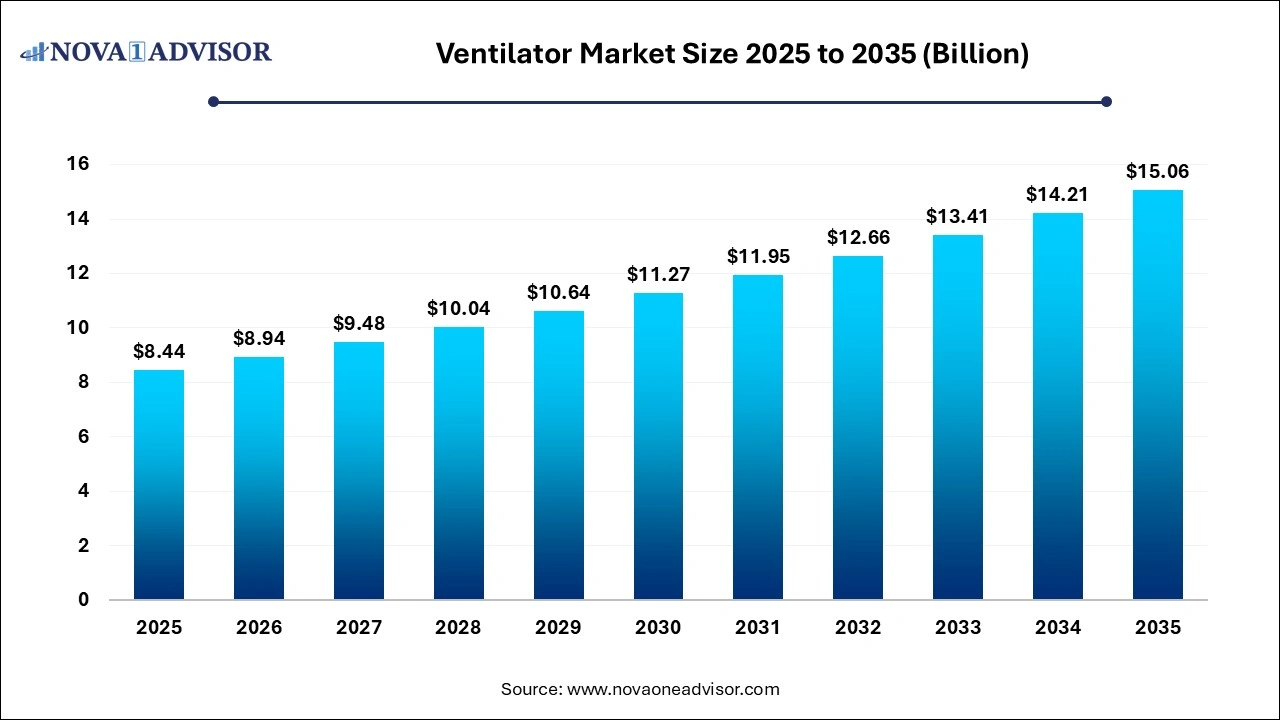
The global ventilator market size was valued at USD 8.44 billion in 2025 and is projected to grow from USD 8.94 billion in 2026 to USD 15.06 billion by 2035, at a CAGR of 5.96% from 2026 to 2035.
Key Takeaway:
- By type, the adult segment dominated the market with the largest share in 2025 and is expected to grow at the fastest CAGR over the forecast period.
- By interface, the invasive segment dominated the market with the largest share in 2025.
- By end user, the hospital segment dominated the market with the largest share in 2025.
- By region, North America dominated the market with the largest share in 2025.
Market Overview
The ventilator market includes medical devices that provide mechanical or assisted breathing support across intensive care, emergency care, operating rooms, neonatal units, transport settings, and home healthcare. Demand is closely associated with respiratory failure, COPD, severe pneumonia, ARDS, neuromuscular disorders, and other conditions requiring respiratory support.
Following the COVID-19 pandemic, market demand is increasingly shifting from emergency procurement toward sustainable critical-care infrastructure, equipment replacement, home respiratory support, and specialized ventilation. Technological development is also shaping competition, with modern ventilators incorporating advanced ventilation modes, automated pressure support, respiratory monitoring, connectivity, leak compensation, and data integration.
The market spans ICU, transport, neonatal, pediatric, and home-care ventilators, each requiring different performance characteristics. Manufacturers increasingly compete through clinical usability, automation, portability, connectivity, software capabilities, cybersecurity, service networks, and overall lifecycle value rather than ventilation performance alone.
Market Outlook
- Market Growth Overview: The global ventilator market is expected to grow significantly between 2025 and 2035, driven by the growing incidence of chronic respiratory diseases across the globe.
- Sustainability Trends: Sustainability trends involve growing emphasis on minimizing environmental footprints and optimizing power consumption.
- Major Investors: Major investors in the market include GE HealthCare, Koninklijke Philips N.V., Medtronic, Getinge AB, Drägerwerk AG & Co. KGaA, Hamilton Medical AG, and ResMed.
How AI is Impacting the Global Ventilator Market
Artificial intelligence is emerging as an important technology layer in the ventilator market, supporting patient monitoring, ventilation optimization, predictive analytics, alarm management, and clinical decision support. AI and machine-learning systems can analyze pressure, flow, respiratory effort, and other physiological data to identify patterns and support more personalized ventilation strategies.
AI can improve patient-ventilator synchrony, assist lung-protection strategies, identify changes in respiratory mechanics, and potentially support the prediction of deterioration or readiness for weaning. Intelligent alarm-management systems may also help prioritize clinically relevant alerts and reduce unnecessary alarm burden in intensive-care environments.
The growing connectivity of modern ventilators further supports AI applications by enabling data exchange, remote monitoring, and integration with hospital information systems. However, adoption in life-support environments requires strong clinical validation, reliability, explainability, cybersecurity, and regulatory compliance. Consequently, near-term opportunities are likely to center on clinician-supervised, validated AI-assisted ventilation rather than fully autonomous systems.
Major Trends in the Market
- Expansion of intelligent ventilation modes: Manufacturers are incorporating adaptive algorithms to improve patient-ventilator interaction and personalize respiratory support.
- Growth of non-invasive ventilation: NIV is increasingly used where clinically appropriate to avoid or delay invasive mechanical ventilation.
- Specialization for neonatal and pediatric care: Manufacturers are developing systems capable of delivering precise low-volume ventilation to vulnerable patients.
- Increasing portability: Lightweight transport ventilators and battery-powered systems are expanding respiratory support beyond conventional ICUs.
- Connected ventilator ecosystems: Wi-Fi, cellular connectivity, HL7 interfaces, cloud platforms, and remote monitoring are becoming increasingly relevant.
Ventilator Market Report Scope
| Report Coverage | Details |
| Market Size in 2026 | USD 8.94 Billion |
| Market Size by 2035 | USD 15.06 Billion |
| Growth Rate From 2026 to 2035 | CAGR of 5.96% |
| Base Year | 2025 |
| Forecast Period | 2026 to 2035 |
| Segments Covered | By Type ,By Interface, By End use, By Region |
| Market Analysis (Terms Used) | Value (USD Million/Billion) or (Volume/Units) |
| Regional Scope | North America; Europe; Asia Pacific; Central and South America; the Middle East and Africa |
| Key Companies Profiled | Getinge AB, Hamilton Medical AG, Drägerwerk AG & Co. KGaA, Koninklijke Philips N.V., GE HealthCare Technologies Inc., ResMed Inc., Fisher & Paykel Healthcare, Nihon Kohden Corporation, Mindray Medical International, Becton, Dickinson and Company, ZOLL Medical Corporation, Vyaire Medical, Breas Medical, Air Liquide Medical Systems, BPL Medical Technologies, React Health, SCHILLER, WEINMANN Emergency, SLE, Airon Corporation |
Major Driver: Rising Respiratory Disease Burden and Critical-Care Demand
The growing prevalence of respiratory diseases, acute respiratory failure, COPD, severe pneumonia, ARDS, neuromuscular disorders, and postoperative complications is sustaining demand for mechanical ventilation. Aging populations and advances in emergency medicine, surgery, trauma care, oncology, transplantation, and neonatal medicine are further increasing the number of patients requiring temporary respiratory support. At the same time, hospitals in emerging markets are expanding ICU capacity and replacing older equipment with ventilators offering improved monitoring, connectivity, automation, and patient-ventilator synchrony.
Major Restraint: High Cost, Regulatory Complexity, and Training Requirements
Advanced ventilators require sophisticated sensors, gas-delivery systems, processors, software, monitoring functions, batteries, and connectivity technologies, increasing both acquisition and lifecycle costs. Hospitals must also account for maintenance, calibration, replacement parts, accessories, software updates, and technical personnel. Because ventilators are life-support devices, manufacturers face stringent requirements for safety, performance, software integrity, cybersecurity, and post-market monitoring. Effective clinician training is equally important because advanced ventilation modes require appropriate knowledge and configuration.
Major Opportunity: Connected, Portable, and Home-Based Ventilation
The shift toward decentralized respiratory care is creating opportunities for portable and connected ventilators across ambulances, step-down units, rehabilitation centers, long-term care, specialty clinics, and selected home settings. Compact turbine-based systems, integrated batteries, flexible oxygen-management options, and wireless connectivity can support care across locations with varying infrastructure. Connected ventilators can additionally enable remote monitoring, equipment management, predictive maintenance, and centralized respiratory-care programs, while service contracts, consumables, software, and connectivity create opportunities for recurring revenue.
Segmental Insights
By Type
Why did the adult segment dominate the global ventilator market?
The adult segment dominated the market with the largest share in 2025 and is expected to grow at the fastest CAGR over the forecast period. The dominance and growth of the segment can be attributed to the growing volume of intensive care unit (ICU) admissions and a surge in the geriatric population across the globe. In addition, the transition toward home healthcare and portable medical systems enables the sustained long-term management of chronic conditions for adult patients beyond conventional clinical settings.
By Interface
Why did the invasive segment dominate the global ventilator market?
The invasive segment dominated the market with the largest share in 2025. The dominance of the segment can be linked to the surge in hospital admissions for severe respiratory failures and major surgeries needing precise and continuous airway control. Also, it is strongly preferred that critical scenarios rely on institutional, controlled, and invasive airway management rather than portable alternatives, leading to segment growth soon.
How did the non-invasive segment expected to hold the significantly growing global ventilator market in the coming years?
The non-invasive segment is expected to grow at the fastest CAGR over the forecast period. The growth of the segment can be driven by the growing prevalence of f chronic obstructive pulmonary disease (COPD) and increasing air pollution across the globe. Home-based non-invasive positive pressure ventilation, including continuous and bilevel positive airway pressure modalities, significantly reduces the financial expenditure associated with recurring institutional care.
By End User
Why did the hospital segment dominate the global ventilator market?
The hospital segment dominated the market with the largest share in 2025. The dominance of the segment is owing to the surge in geriatric population, with increased obstructive pulmonary disease (COPD) rates and use of innovative smart ventilators. Furthermore, government-backed healthcare expenditures and the development of new acute-care facilities in tier-2 and tier-3 municipalities serve as the primary driver for high-volume procurement activity.
How did the specialty clinics segment expected to hold the significantly growing global ventilator market in the coming years?
The specialty clinics segment is expected to grow at the fastest CAGR over the study period. The growth of the segment is due to the growing transition towards outpatient care and the surge in well-equipped private clinics. Moreover, specialty pulmonary and sleep clinics are increasingly managing stable or recovering chronic ventilation cases, further impacting positive market growth.
By Region
Why did the North American region account for the largest share of the global ventilator market?
North America dominated the market with the largest share in 2025. The dominance of the region can be attributed to ongoing technological integrations such as AI monitoring and portability, and the presence of well-established hospital infrastructure. In addition, public grants, pandemic preparedness initiatives, and formal home care reimbursement frameworks significantly enhance the accessibility of medical devices.
U.S. Global Ventilator Market Trends
The growth of the market in the country can be driven by the surge in the elderly population, who are more prone to severe cardiopulmonary disorders, and increased occurrences of chronic obstructive pulmonary disease (COPD). Also, sustained government funding, comprehensive pandemic preparedness frameworks, and ongoing capital enhancements in healthcare facilities ensure the maintenance of increased baseline equipment inventories.
- In March 2025, IMT Innovations officially unveiled its latest mechanical ventilator, the “box,” at its Swiss headquarters. Engineered specifically for critical and subacute clinical environments, this advanced system is fully optimized for intensive care settings.
Why did the Asia-Pacific region become the fastest-growing global ventilator market during the forecast period?
Asia Pacific is expected to grow at the fastest CAGR over the forecast period. The growth of the region can be credited to ongoing transition towards innovative portable ventilation technologies and extensive base populations in emerging economies such as China and India. Furthermore, favourable healthcare policies, increased national health budgets, and strategic public procurement initiatives designed to strengthen regional readiness for emergency and critical care services can fuel market growth shortly.
China Global Ventilator Market Trends
The market in the country is growing due to the increasing prevalence of chronic respiratory illnesses and ongoing transition towards local medical device manufacturing. Moreover, integrating smart monitoring and remote connectivity features enhances clinical outcomes and operational efficiency, leading to market growth soon.
Key Players in the Global Ventilator Market
- Getinge AB: Renowned for high-end Servo-series critical care systems (Servo-u, Servo-n), heavily focused on advanced ICU capabilities and software updates.
- Drägerwerk AG & Co. KGaA: It offers a comprehensive range of acute and hybrid transport ventilators like the Evita and Savina series, known for rugged clinical utility.
- Koninklijke Philips N.V.: It has a major footprint in both hospital-grade intensive systems and home/non-invasive respiratory care (Respironics line) with strong remote monitoring capacities.
Recent Development
- In March 2026, Mindray North America has officially entered the United States ventilator market with the commercial launch of its SV900 and SV700 ventilator systems. Headquartered in Mahwah, New Jersey, the company is recognized as the world's second-largest provider of acute care hospital ventilators.
Segments Covered in the Report
This report forecasts revenue growth at country levels and provides an analysis of the latest industry trends in each of the sub-segments from 2021 to 2035. For this study, Nova one advisor, Inc. has ventilator market.
By Type
- Adult
- Pediatric & Neonatal
By Interface
- Invasive
- Non-invasive
By End-User
- Hospitals
- Specialty Clinics
- Others
By Region
- North America
- Europe
- Asia-Pacific
- Latin America
- Middle East & Africa (MEA)
FAQ's

Proceed to Buy
Instant PDF delivery on confirmation

 Request Customization
 Download Sample

Get a Sample of this Report
Ventilator Market