

Ventilators Market Size, Share, Forecast Report, 2026-2035
 Status Published
 Category Healthcare


Content
Ventilators Market Size, Growth and Trends 2026 to 2035
The global ventilators market size was estimated at USD 3.88 billion in 2025 and is expected to be worth around USD 6.02 billion by 2035 with a CAGR of 4.5% from 2026 to 2035.
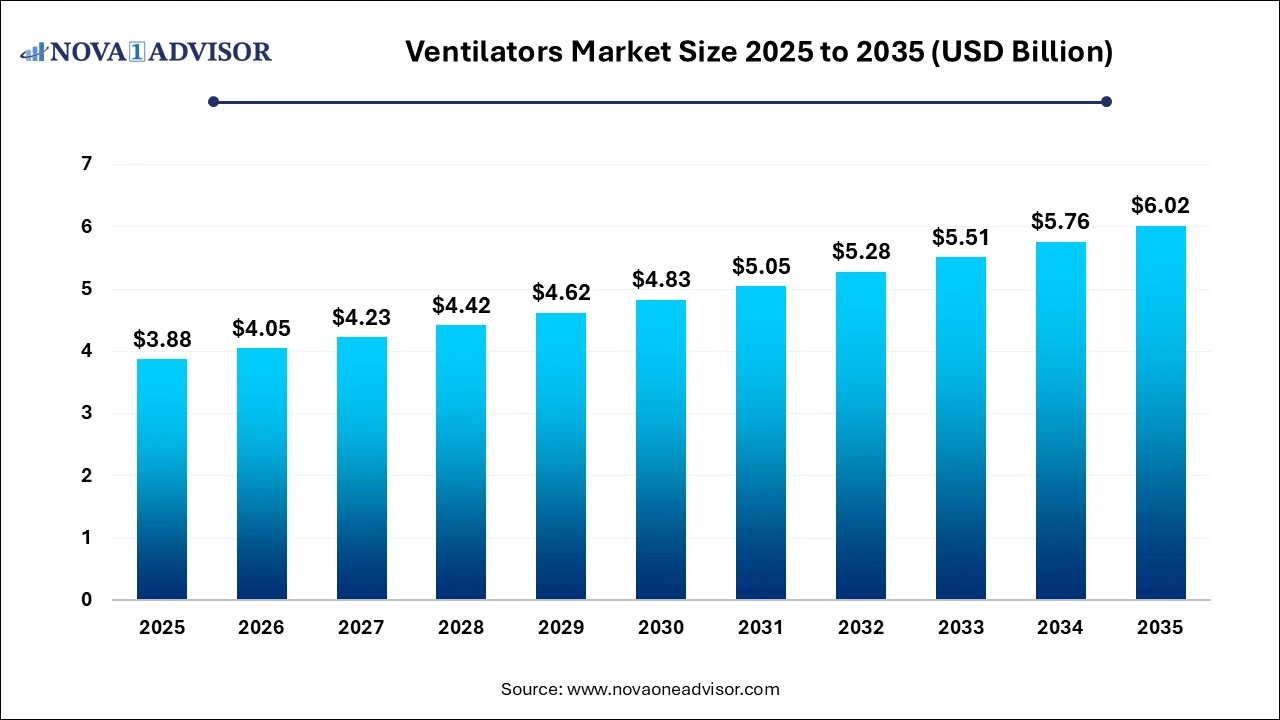
Ventilators Market Outlook
- Market Growth Overview: The ventilators market is expected to grow significantly between 2025 and 2034, driven by rising regulatory illness burden, growing geriatric population, and rising demand for portable and user-friendly homecare ventilators for long-term chronic care.
- Sustainability Trends: Sustainability trends involve eco-friendly and durable design, energy efficiency, circular economy practices, and smart and automated systems.
- Major Investors: Major investors in the market include Koninklijke Philips N.V., Medtronic, GE Healthcare, Drägerwerk AG & Co. KGaA, Getinge AB, ResMed Inc., Hamilton Medical.
Ventilators Market Report Scope
| Report Coverage | Details |
| Market Size in 2026 | USD 4.05 Billion |
| Market Size by 2035 | USD 6.02 Billion |
| Growth Rate From 2026 to 2035 | CAGR of 4.5% |
| Base Year | 2025 |
| Forecast Period | 2026 to 2035 |
| Segments Covered | By Mobality, By Type, By Interface, By End User |
| Market Analysis (Terms Used) | Value (USD Million/Billion) or (Volume/Units) |
| Regional Scope | North America; Europe; Asia Pacific; Central and South America; the Middle East and Africa |
| Key Companies Profiled | Philips Healthcare, ResMed Inc., Medtronic plc, Fisher & Paykel Healthcare |
Ventilators Market Segment Insights
By Mobality Insights
How did the Intensive Care Ventilators Segment Dominate the Ventilators Market?
The intensive care ventilators segment is driven by the rising prevalence of chronic respiratory diseases and the need for sophisticated critical care. High-end ICU ventilators have become the market's dominant segment. The technological breakthroughs, such as AI integration and closed-loop control systems, enhance real-time patient monitoring and outcomes. Post-pandemic infrastructure upgrades and supportive reimbursement policies further incentivise hospitals to invest in these high-performance systems.
How did the Portable Segment Expect to Hold the Fastest-Growing Ventilators Market in the Coming Years?
The portable segment is driven by the shift toward cost-effective, portable respiratory solutions, which are driving the rapid growth of user-friendly, non-invasive ventilation (NIV). Technological breakthroughs in turbine efficiency and AI integration have significantly enhanced battery life and functionality, making these devices vital for both aging populations and emergency ambulatory services. While North America currently leads the market, the Asia-Pacific region is poised for the fastest expansion due to surging healthcare investments and a rising incidence of respiratory disorders.
By Type Insights
How did the Adult/Pediatric Ventilators Segment Account for the Largest Share in the Ventilators Market?
The adult/pediatric ventilators segment is driven by the high necessity for invasive ventilation in ICUs and emergency departments to treat acute illnesses. Significant infrastructure investments across North America and the Asia-Pacific are further increasing the availability of these life-saving devices. The combination of demographic shifts and modernized clinical facilities ensures that ventilators remain a dominant, indispensable segment of the global medical technology market.
How did the Neonatal/Infant Ventilators Segment Expect to Hold the Fastest-Growing Ventilators Market in the Coming Years?
The neonatal/infant ventilators segment is driven by growing demand for specialized, gentle ventilation solutions tailored for fragile neonates. The significant NICU infrastructure expansion across emerging markets like India and China, where healthcare spending is surging. Technological breakthroughs in compact, non-invasive techniques allow for more accurate and less traumatic support, replacing traditional invasive methods.
By Interface Insights
How did the Intensive Ventilation Segment Account for the Notable Share in the Ventilators Market?
The intensive ventilation segment is driven by the escalating prevalanceof chronic respiratory diseases, such as COPD and ARDS, which has established high-performance ICU ventilators as the driving segment. The technological breakthroughs in AI-driven predictive analytics and lung-protective ventilation modes have significantly improved critical care outcomes. Massive infrastructure investments in both developed and emerging economies like China and India are further accelerating the deployment of these next-generation units. Backed by supportive government reimbursement policies, these advanced systems remain the primary choice for healthcare facilities aiming to modernize their life-saving capabilities.
How did the Non-Intensive Ventilation Segment Expect to Hold the Fastest-Growing Ventilators Market in the Coming Years?
The non-intensive ventilation segment is increasingly preferred over invasive ICU models because they reduce clinical complications, such as pneumonia, and eliminate the need for heavy sedation. Driven by AI-powered remote monitoring and enhanced battery life, modern NIV solutions offer a high-tech, patient-centric experience at a significantly lower cost. Its affordability and comfort make it the fastest-growing segment for both hospital step-down care and long-term domestic use.
By End User Insights
How did the Hospital and Clinic Segment Account for the Notable Share in the Ventilators Market?
The hospital and clinic segment is driven by the growing, consistent demand for advanced, invasive ventilators to treat acute respiratory failure and pneumonia. Massive global investments in ICU infrastructure expansion are replacing legacy systems with intelligent, high-end units capable of real-time patient monitoring. These devices are indispensable in emergency departments and post-operative care, where specialized ventilation is required for recovery and life support. Its unique capacity to host the complex, high-performance technology essential for managing life-threatening conditions.
How did the Home Care Segment Expect to Hold the Fastest-Growing Ventilators Market in the Coming Years?
The home care segment is driven by technological breakthroughs in portability, allowing lightweight and user-friendly ventilators to provide patients with greater mobility and independence. The integration of IoT and AI-driven remote monitoring further reduces hospital readmissions by allowing healthcare providers to track vitals and intervene in real-time via telehealth. The cost-effectiveness and comfort of non-invasive ventilation (NIV) make home care a superior, sustainable alternative to long-term hospital stays for aging populations.
Key Players in the Ventilators Market
- Philips Healthcare: Philips is a leading provider of comprehensive respiratory care solutions, including high-end ICU ventilators like the Trilogy series and portable, non-invasive ventilators for home care.
- ResMed Inc.: ResMed is a dominant leader in cloud-connected ventilators, focusing on sleep apnea and chronic obstructive pulmonary disease (COPD) management using advanced digital monitoring.
- Medtronic plc: Medtronic manufactures high-performance Puritan Bennett™ ventilators designed for critical care in intensive care units and emergency departments, playing a key role in acute respiratory support.
- Fisher & Paykel Healthcare: Fisher & Paykel specializes in the critical "consumables" side of ventilation, providing advanced heated humidification systems and Optiflow nasal high-flow therapy.
Segments Covered in the Report
By Mobility
- Intensive Care Ventilators
- High-end ICU Ventilators
- Mid-end ICU Ventilators
- Basic ICU Ventilators
- Portable/Transportable Ventilators
By Type
- Adult/Pediatric Ventilators
- Neonatal/Infant Ventilators
By Interface
- Invasive Ventilation
- Non-Invasive Ventilation
By Mode
- Combined Mode Ventilation
- Volume Mode Ventilation
- Pressure Mode Ventilation
- Others
By End User
- Hospitals and Clinics
- Home Care
- Ambulatory Care Centers
- Emergency Medical Service
Regional Analysis and Forecast
Further, this research study analyses market size, production, consumption and its advancement trends at global, regional, and country level for period 2026 to 2035 and covers following region in its scope:
- North America
- United States
- Canada
- Europe
- Germany
- United Kingdom
- Italy
- France
- Rest of EU
- Asia Pacific
- China
- India
- Japan
- Southeast Asia
- Rest of APAC
- Central & South America
- Brazil
- Argentina
- Rest of Central & South America
- Middle East and Africa
- UAE
- Saudi Arabia
- Rest of MEA

Proceed to Buy
Instant PDF delivery on confirmation

 Request Customization
 Download Sample

Get a Sample of this Report
Ventilators Market