

Viral Vector Manufacturing Market Size, Share, and Trends 2026 to 2035
 Status Published
 Category Healthcare


Content
Viral Vector Manufacturing Market Size and Growth 2026 to 2035
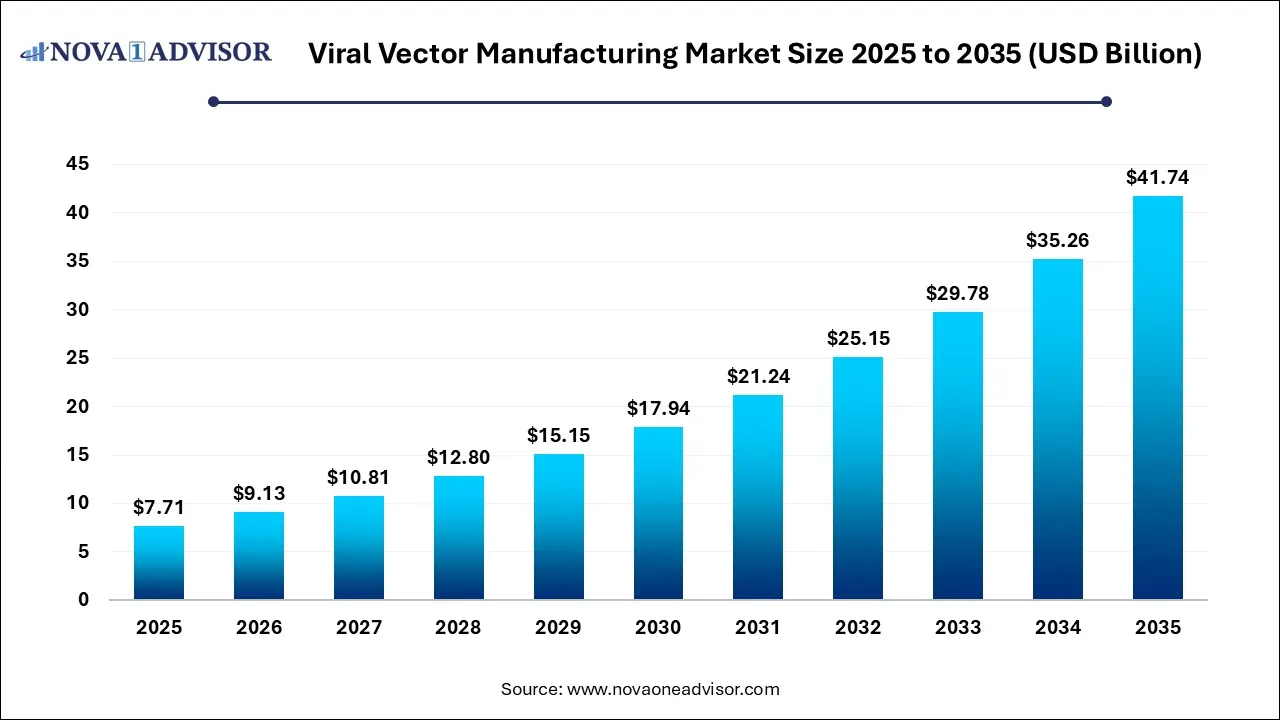
The global viral vector manufacturing market size was estimated at USD 1.48 billion in 2025 and is projected to hit around USD 2.16 billion by 2035, growing at a CAGR of 3.8% during the forecast period from 2026 to 2035.
Market Key Takeaways
- The viral vector manufacturing market is witnessing exponential growth driven by the rapid expansion of gene therapy and vaccine development.
- Adeno-associated viral (AAV) vectors dominate the market due to their safety profile and widespread use in gene therapies.
- Gene therapy remains the leading application segment owing to increasing approvals and clinical pipeline expansion.
- Pharmaceutical and biotechnology companies account for the largest share of demand due to intensive R&D investments.
- North America leads the market due to strong regulatory frameworks, advanced infrastructure, and presence of major players.
- Asia Pacific is expected to grow at the fastest pace due to increasing manufacturing capabilities and government support.
- AI and automation are increasingly being integrated into viral vector manufacturing processes to improve scalability and efficiency.
Market Overview
The viral vector manufacturing market has become a cornerstone of modern biotechnology, particularly in the fields of gene therapy, vaccine development, and advanced cell-based therapies. Viral vectors are engineered viruses used to deliver genetic material into cells, enabling the correction of genetic defects, the expression of therapeutic proteins, or the stimulation of immune responses. As the demand for personalized medicine and targeted therapies continues to grow, viral vectors have emerged as a critical enabling technology.
Over the past decade, the market has experienced rapid growth due to the increasing number of gene therapies entering clinical trials and receiving regulatory approvals. For instance, therapies targeting rare genetic disorders such as spinal muscular atrophy and hemophilia rely heavily on viral vectors for gene delivery. Similarly, the development of vaccines, particularly during global health crises such as the COVID-19 pandemic, has highlighted the importance of scalable and efficient viral vector manufacturing.
One of the key challenges in this market is the complexity of manufacturing processes. Viral vector production involves multiple stages, including cell culture, transfection, vector amplification, purification, and quality control. Each of these steps requires precise control and optimization to ensure high yield, purity, and safety. As a result, companies are investing heavily in advanced manufacturing technologies and infrastructure.
The market is also characterized by a high degree of collaboration between pharmaceutical companies, biotechnology firms, and contract development and manufacturing organizations (CDMOs). These partnerships are essential for scaling up production and accelerating the commercialization of new therapies. For example, many biotech startups rely on CDMOs for viral vector production due to the high capital and expertise requirements.
Furthermore, regulatory agencies are playing a crucial role in shaping the market. Stringent guidelines for the production and quality control of viral vectors are driving the adoption of standardized and automated manufacturing processes. This is leading to increased investment in closed systems and single-use technologies, which reduce contamination risks and improve process efficiency.
Market Outlook
- Market Growth Overview: The global viral vector manufacturing market is expected to grow significantly between 2025 and 2035, driven by the rising cases of disease prevalence, increasing public and private investment in biopharmaceutical research and development in regenerative medicine and cell therapy.
- Sustainability Trends: Sustainability trends involve process intensification and automation, sustainable manufacturing practices, and transition to a sustainability culture.
- Major Investors: Major investors in the market include Lonza Group, Thermo Fisher Scientific, Catalent, Sartorius, FUJIFILM Diosynth Biotechnologies, and WuXi AppTec.
How is AI Transforming the Viral Vector Manufacturing Market?
Artificial Intelligence (AI) is revolutionizing the viral vector manufacturing market by addressing some of the most critical challenges associated with production complexity, scalability, and quality control. Traditional viral vector manufacturing processes are highly labor-intensive and require extensive optimization. AI-driven solutions are enabling more efficient and reliable production workflows.
One of the primary applications of AI is in process optimization. Machine learning algorithms can analyze large datasets generated during vector production to identify optimal conditions for cell growth, transfection efficiency, and vector yield. For instance, AI models can predict the ideal timing for harvesting viral vectors based on real-time monitoring of cell culture parameters. This reduces variability and enhances productivity.
AI is also being used to improve quality control and assurance. Advanced analytics tools can detect anomalies in production processes, such as contamination or deviations in vector potency. This enables early intervention and reduces the risk of batch failures. In a highly regulated industry, such capabilities are invaluable for ensuring compliance and maintaining product quality.
Another significant impact of AI is in the development of digital twins—virtual replicas of manufacturing processes. These models allow companies to simulate different production scenarios and optimize processes without physical trials. This not only reduces costs but also accelerates the development and scale-up of new therapies.
For example, several leading biopharmaceutical companies are integrating AI platforms into their manufacturing operations to enhance efficiency and reduce time-to-market. These technologies are particularly beneficial in scaling up production for commercial applications, where consistency and reliability are critical.
Viral Vector Manufacturing Market Report Scope
| Report Coverage | Details |
| Market Size in 2026 | USD 9.13 Billion |
| Market Size by 2035 | USD 41.74 Billion |
| Growth Rate From 2026 to 2035 | CAGR of 18.4% |
| Base Year | 2025 |
| Forecast Period | 2026 to 2035 |
| Segments Covered | By Type, By Disease, By Application, By End-user, By Region |
| Market Analysis (Terms Used) | Value (USD Million/Billion) or (Volume/Units) |
| Regional Scope | North America; Europe; Asia Pacific; Central and South America; the Middle East and Africa |
| Key Companies Profiled | FUJIFILM Diosynth Biotechnologies U.S.A., Inc., Sanofi, Lonza, Merck KGaA, GENERAL ELECTRIC COMPANY, Oxford BioMedica, Spark Therapeutics, Inc., uniQure N.V., FinVector Vision Therapies, Brammer Bio, Cell and Gene Therapy Catapult, Cobra Biologics, REGENXBIO Inc., Kaneka Eurogentec S.A. |
Segmental Insights
By Type
How did the adeno-associated viral vectors segment dominate the Global Viral Vector Manufacturing market?
The adeno-associated viral vectors segment is driven by the superior safety profile and low genomic integration, making them the gold standard for FDA-approved gene therapies. Their leadership is sustained by large-scale manufacturing innovations and high clinical adoption within the rapidly expanding field of neurology and rare genetic disorders. The substantial infrastructure investment and the rise of specialized CDMOs have solidified AAV as the driving force of current biopharmaceutical growth.
How did the lentiviral vectors segment expect to hold the fastest-growing Global Viral Vector Manufacturing market in the coming years?
The lentiviral vectors segment is driven by its essential role in the booming CAR-T cell therapy for oncology. Their ability to deliver large genetic payloads to diverse cell types, combined with automated bioreactor scalability, has significantly reduced production hurdles. As clinical trials surge, strategic investments in high-titer producer cell lines are accelerating their commercial adoption and cost efficiency.
By Disease
How did the cancer segment account for the largest share in the Global Viral Vector Manufacturing market?
The membrane filtration segment is driven by the rapid commercialization of CAR-T therapies and a high volume of clinical trials. The rising global incidence of cancer, as highlighted by the WHO, is pushing the industry toward oncolytic virotherapies and advanced tumor-targeting treatments.
How did the genetic disorders segment expect to hold the fastest-growing Global Viral Vector Manufacturing market in the coming years?
The genetic disorders segment is driven by its critical role in treating conditions, such as hemophilia and spinal muscular atrophy. Innovation in AAV and lentiviral platforms has significantly boosted safety and efficiency, while a surge in global clinical trials sustains the demand for high-quality production. The favorable regulatory pathways and increased investments across North America and the Asia Pacific are actively accelerating the commercialization of these life-changing treatments.
By Application
How did the gene therapy segment account for the largest share in the Global Viral Vector Manufacturing market?
The gene therapy segment is driven by the massive surge in demand for viral vectors, particularly as high clinical success rates boost adoption. The dominance of in vivo therapies, which require significantly larger quantities of vectors for direct patient delivery. This demand is being met through AI-enhanced manufacturing and a strategic shift toward high-volume outsourcing, ensuring that precise, large-scale production keeps pace with therapeutic innovation.
How did the vaccinology segment expect to hold the fastest-growing Global Viral Vector Manufacturing market in the coming years?
The vaccinology segment is driven by the shift to suspension cell cultures and automated, continuous processing, which significantly enhance scalability and vector titers. The massive infrastructure investment by CDMOs is providing the high-capacity, GMP-compliant facilities needed to transition these innovations from research to commercial-scale production.
By End Use
How did the pharmaceutical and biotechnology companies segment account for the largest share in the Global Viral Vector Manufacturing market?
The pharmaceutical and biotechnology companies segment is driven by the aggressively scaling R&D and commercial production for rare diseases and oncology. The massive facility expansions from key players, such as Lonza and Thermo Fisher, alongside a highly supportive regulatory environment for advanced therapies. A strategic reliance on CDMO partnerships and the continued demand for viral vector-based vaccines ensure these firms remain the primary engine of industry growth.
How did the research institute segment expect to hold the fastest-growing Global Viral Vector Manufacturing market in the coming years?
The research institute segment is driven by the intensified research and development in gene editing and traditional cancer therapeutics. By forming strategic partnerships with biotech firms, these centers facilitate critical technology transfers and plot-scale production of advanced vector platforms. A surge in genomic research funding and vaccine optimization is ensuring a steady demand for high-quality, research-grade vectors globally.
By Region
North America dominated the viral vector manufacturing market due to its advanced healthcare infrastructure, strong regulatory framework, and presence of leading market players. The region is a major hub for gene therapy research and development.
Government support and funding programs further enhance the growth of the market in this region.
Asia Pacific is the fastest-growing region, driven by increasing investments in biotechnology, expanding manufacturing capabilities, and supportive government policies. Countries such as China and India are активно investing in life sciences research, creating significant opportunities for market players.
Key Players in the Global Viral Vector Manufacturing Market
- FUJIFILM Diosynth Biotechnologies U.S.A., Inc. ; As a leading Contract Development and Manufacturing Organization (CDMO), they provide comprehensive cGMP manufacturing services for AAV and Lentiviral vectors across facilities in the U.S. and UK, utilizing a platform approach to accelerate gene therapy development.
- Sanofi; Sanofi is pioneering the "Evolutive Vaccine Facility" (EVF) concept, utilizing modular, fully digital, and automated manufacturing platforms to produce recombinant DNA vaccines and viral vectors flexibly.
- Lonza; Lonza provides end-to-end viral vector manufacturing services (from process development to commercial production) for Adeno-associated virus (AAV) and Lentivirus, utilizing both suspension and adherent cell technologies.
- Merck KGaA; Operating through their Life Science business (MilliporeSigma), they provide specialized CDMO services, including their VirusExpress® platform for viral vector production.
Segments Covered in the Report
This report forecasts revenue growth at country levels and provides an analysis of the latest industry trends in each of the sub-segments from 2021 to 2035. For this study, Nova one advisor, Inc. has segmented the viral vector manufacturing market.
By Type
- Retroviral Vectors
-
- Lentiviral Vectors
- Gamma-Retroviral Vectors
- Adenoviral Vectors
- Adeno-Associated Viral Vectors
- Other Viral Vectors
By Disease
- Cancer
- Genetic Disorders
- Infectious Diseases
- Others
By Application
- Gene Therapy
- Vaccinology
By End-user
- Pharmaceutical and Biotechnology Companies
- Research Institutes
- Others
By Region
- North America
- Europe
- Asia Pacific
- Latin America
- Middle East and Africa (MEA)
FAQ's

Proceed to Buy
Instant PDF delivery on confirmation

Viral Vector Manufacturing Market Size to Hit USD 41.74 Billion by 2035
 Request Customization
 Download Sample

Get a Sample of this Report
Viral Vector Manufacturing Market