

Waste Management Market Size, Share, and Trends 2026 to 2035
 Status Published
 Category Healthcare


Content
Waste Management Market Size and Growth 2026 to 2035
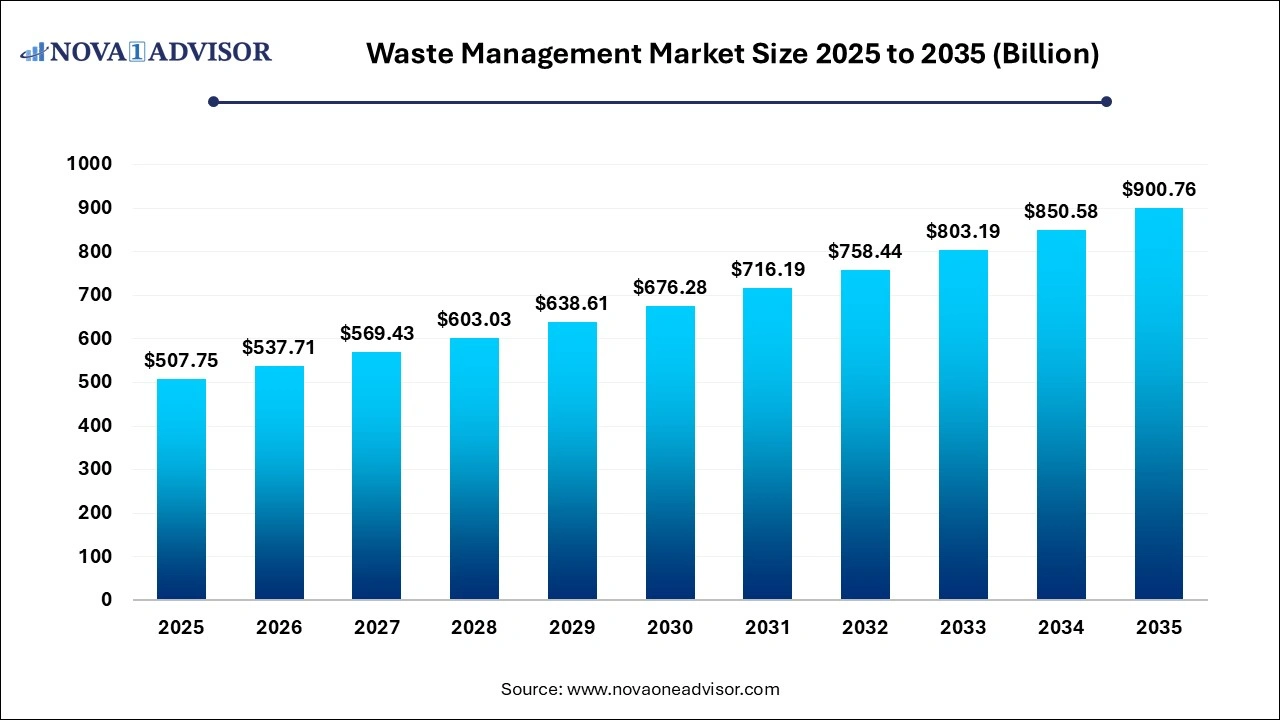
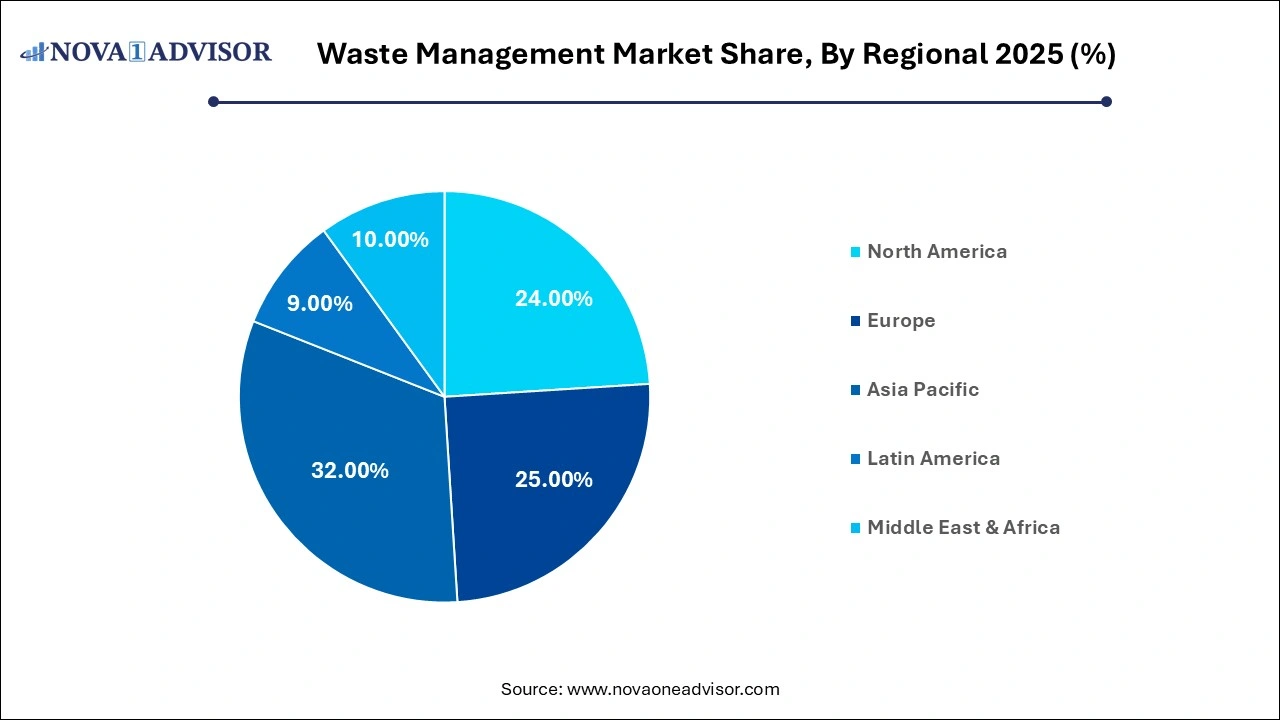
The global waste management market size was valued at USD 507.75 billion in 2025 and is projected to grow from USD 537.71 billion in 2026 to USD 900.76 billion by 2035, at a CAGR of 5.9% from 2026 to 2035. North America dominated the market, accounting for a revenue share of 24.0% in 2025.
Key Takeaway
- By waste type, the plastic segment dominated the market with the largest share in 2025.
- By waste type, the e-waste segment is expected to grow at the fastest CAGR over the forecast period.
- By service, the recycling segment dominated the market with the largest share in 2025.
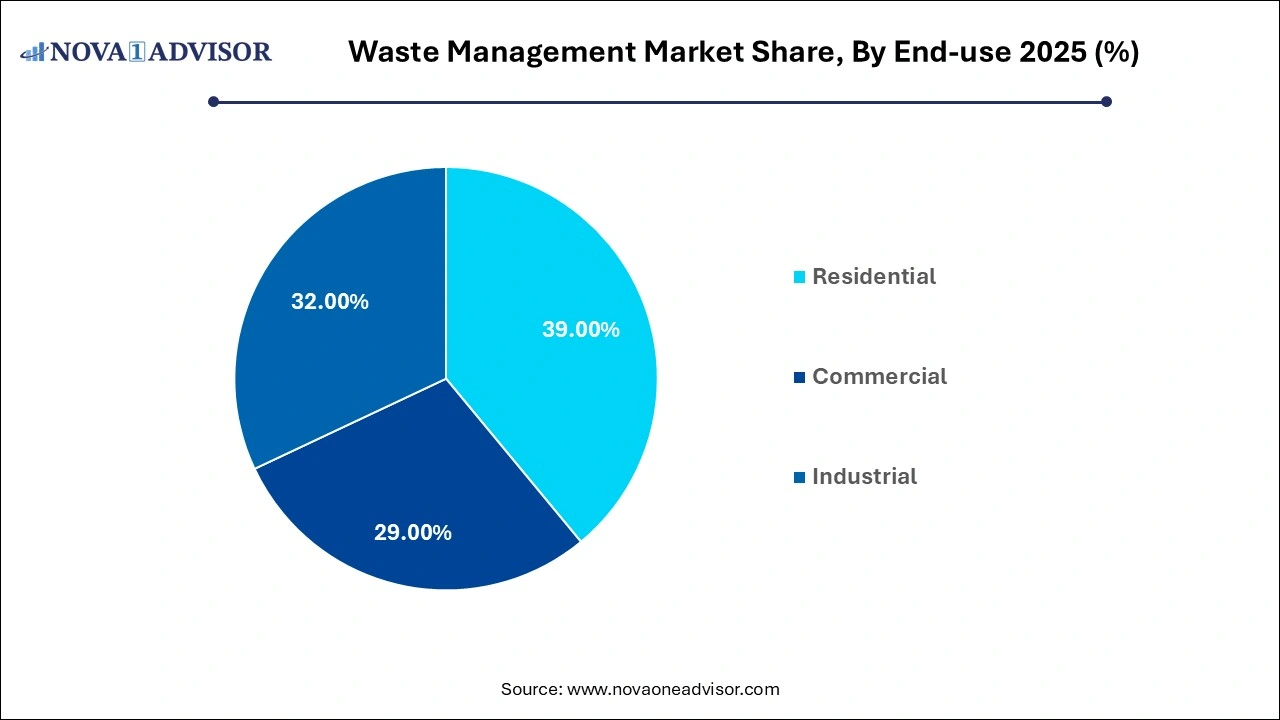
- By end user, the residential segment dominated the market with the largest share of 39.0% in 2025.
- By region, North America dominated the market with the largest share of 24.0% in 2025.
Market Overview
The global waste management market covers the collection, transportation, sorting, recycling, treatment, recovery, and disposal of municipal, industrial, commercial, healthcare, hazardous, and electronic waste. Rising urbanization, population growth, consumption, e-commerce, packaging use, and industrial activity are increasing both waste volumes and treatment complexity.
The market is shifting from traditional landfill-based disposal toward recycling, composting, waste-to-energy, anaerobic digestion, material recovery, and circular resource management. Technology is further transforming the industry through AI-powered sorting, robotics, smart bins, digital tracking, and automated recycling facilities.
Emerging economies offer significant infrastructure and service expansion opportunities, while developed markets are emphasizing landfill diversion and resource recovery. Overall, the industry is evolving from a basic sanitation service into a technology-enabled circular economy ecosystem.
Market Outlook
- Market Growth Overview: The waste management market is expected to grow significantly between 2025 and 2035, driven by the increasing electronic consumption across the globe.
- Sustainability Trends: Sustainability trends involve a growing emphasis on transition from conventional disposal to resource recovery.
- Major Investors: Major investors in the market include Waste Management, Republic Services, Veolia, SUEZ, Waste Connections, and Clean Harbors.
How is AI Impacting The Waste Management Market?
Artificial intelligence (AI) is reshaping the market by automating material recovery and reducing landfill waste via advanced computer vision and predictive analytics. Furthermore, real-time object recognition systems identify and extract contaminants, including hazardous lithium-ion batteries, before compromising processing streams.
AI is also helping operators optimize collection routes and fleet utilization by analyzing traffic, container-fill levels, historical volumes, weather, and demand patterns. Predictive analytics can identify potential equipment failures before breakdowns, reducing downtime and maintenance costs.
Landfill operators are increasingly exploring AI, automation, remote monitoring, and autonomous technologies to improve operational efficiency and safety. Meanwhile, AI-based contamination detection can improve the quality of recovered materials by identifying unwanted items during recycling.
Overall, AI is moving the waste management industry toward a more automated, predictive, efficient, and data-driven operating model, with future applications expected across emissions monitoring, digital waste traceability, facility management, and resource recovery.
Waste Management Market Report Scope
| Report Coverage | Details |
| Market Size in 2026 | USD 537.71 Billion |
| Market Size by 2035 | USD 900.76 Billion |
| Growth Rate From 2026 to 2035 | CAGR of 5.9% |
| Base Year | 2025 |
| Forecast Period | 2026 to 2035 |
| Segments Covered | Waste, Service, End User, Region |
| Market Analysis (Terms Used) | Value (USD Million/Billion) or (Volume/Units) |
| Regional Scope | North America; Europe; Asia Pacific; Central and South America; the Middle East and Africa |
| Key Companies Profiled | Waste Management (US), Veolia (France), Republic Services (US), SUEZ (France), and Waste Connections (US) Biffa (England), Clean Harbors (US), Covanta Holding (US), Daiseki (Japan), Hitachi Zosen (Japan), |
Market Driver – Rising Waste Generation and Urbanization
Population growth, rapid urbanization, rising incomes, and higher consumption are increasing global waste volumes, creating sustained demand for collection, transportation, treatment, recycling, and disposal services. Growing cities require reliable waste infrastructure, including collection fleets, transfer stations, recycling centers, treatment facilities, and sanitary landfills. The trend is particularly significant across Asia-Pacific, South Asia, and parts of Africa, where urban populations and consumption are expanding rapidly.
Market Restraint – High Infrastructure and Operating Costs
High capital and operating costs remain a major challenge for waste-management providers. Collection vehicles, sorting facilities, recycling plants, landfills, treatment systems, and environmental-control technologies require significant investment. Labor, fuel, maintenance, regulatory compliance, and transportation further increase operating expenses. Limited municipal budgets in developing economies can therefore slow infrastructure modernization and adoption of advanced waste-treatment technologies.
Market Opportunity – Transition Toward Circular Waste Management
The shift from disposal toward circular resource recovery is creating significant opportunities across the waste-management industry. Recycling, composting, anaerobic digestion, waste-to-energy, renewable natural gas, and recovery of materials from electronic and construction waste can transform waste into valuable resources. As governments introduce recycling targets, extended producer responsibility programs, landfill restrictions, and waste-diversion policies, companies can expand beyond traditional disposal services into resource recovery and secondary-material markets.
Segmental Insights
By Waste Type
Why did the plastic segment dominate the waste management market?
The plastic segment dominated the market with the largest share in 2025. The dominance of the segment can be attributed to the increasing e-commerce packaging waste demands and use of cutting-edge AI-enabled sorting and chemical recycling technologies. In addition, the increased global demand for convenience goods ensures that packaging remains the major product segment in the global market.
How did the e-waste segment expected to hold the significantly growing waste management market in the coming years?
The e-waste segment is expected to grow at the fastest CAGR over the forecast period. The growth of the segment can be credited to the stringent government rules and shorter electronic lifecycles. Also, the economic viability of recycling is significantly enhanced by robust market demand and increasing valuations for critical commodities, including gold, silver, copper, and lithium, leading to segment growth soon.
By Service
Why did the recycling segment dominate the waste management market?
The recycling segment dominated the market with the largest share in 2025. The dominance of the segment can be linked to the rapid urbanization, technological innovations in sorting, and surge in consumer sustainability awareness. Environmental, Social, and Governance criteria mandate that commercial enterprises rigorously monitor and reduce waste footprints within their supply chains.
How did the landfills segment expected to hold the significantly growing waste management market in the coming years?
The landfills segment is expected to grow at the fastest CAGR over the forecast period. The growth of the segment can be driven by its cost benefits over alternative treatment options and updated sanitary designs that enhance overall safety. Moreover, in regions where land is readily available, landfilling serves as the primary baseline option due to its significantly lower upfront costs as compared to advanced recycling technologies or high-heat incineration methods.
By End User
Why did the residential segment dominate the waste management market?
The residential segment dominated the market with the largest share in 2025. The dominance of the segment is owing to the stringent municipal mandates for source segregation and ongoing urbanization in major developing regions. Furthermore, decentralized and community-based initiatives focused on organic waste composting and biogas generation foster localized socioeconomic and environmental prospects.
How did the industrial segment expected to hold the significantly growing waste management market in the coming years?
The industrial segment is expected to grow at the fastest CAGR over the study period. The growth of the segment is due to stringent environmental regulations, ongoing urbanization, and a surge in green building adoption. Moreover, surging energy demands along with a raw material scarcity necessitate the conversion of non-recyclable waste into biogas or electricity, facilitating segment growth soon.
By Region
Why did the North American region account for the largest share of the waste management market?
North America dominated the market with the largest share in 2025. The dominance of the region can be attributed to the increasing volumes of municipal solid waste from urbanization and a surge in investments in circular economy principles. In addition, the vast manufacturing, energy, chemical, and oil and gas infrastructure, located predominantly within the United States and expanding across Canada, drives the demand for industrial waste management services.
U.S. Waste Management Market Trends
The growth of the market in the country can be driven by the increasing corporate circular-economy initiatives and ongoing integration of AI-powered sorting technologies. Also, high population densities and concentrated commercial hubs continuously generate a substantial baseline volume of municipal, industrial, and specialized medical waste.
Why did the Asia-Pacific region become the fastest-growing waste management market during the forecast period?
Asia Pacific is expected to grow at the fastest CAGR over the forecast period. The growth of the region can be credited to the rapid push towards a circular economy, ongoing industrialization, and heavy industrial output in emerging economies such as China and India. Furthermore, advanced artificial intelligence and automated robotic sorting infrastructure currently attain material recovery purity exceeding 99% for primary recyclables across India and China.
China Waste Management Market Trends
The market in the country is growing due to stringent government mandates such as "Zero Waste Cities" and extensive scale-up in waste-to-energy incineration infrastructure. Moreover, China maintains the largest waste-to-energy infrastructure network globally, using advanced incineration with energy recovery and anaerobic digestion to systematically substitute traditional landfill disposal methods.
Key Players in the Waste Management Market
- Veolia Environnement SA (France): A global giant providing water, waste, and energy management solutions. It expanded its reach significantly through major international asset acquisitions, solidifying its massive footprint in municipal and hazardous waste services.
- Waste Management, Inc. (WM) (United States): The leading North American provider of comprehensive waste management and environmental services, heavily investing in automated recycling facilities, renewable natural gas plants, and smart route optimization.
- Waste Connections, Inc. (United States): It operates secondary and exclusive regional markets across North America, focusing on solid waste collection, transfer, and disposal with strong localized operating margins.
Recent Developments
- In June 2026, ReFiber, powered by OterRi, inaugurated Mumbai’s comprehensive post-consumer textile waste collection and upcycling initiative on World Environment Day at the MVIRDC World Trade Centre in Mumbai. This programmatic undertaking seeks to establish a circular textile economy via systematic recovery, sorting, and upcycling.
Segments Covered in the Report
This report forecasts revenue growth at country levels and provides an analysis of the latest industry trends in each of the sub-segments from 2021 to 2035. For this study, Nova one advisor, Inc. has waste management market.
By Service
- Open Dumping
- Incineration/Combustion
- Landfill
- Recycling
- Composting & Anaerobic Digestion
By End User
- Residential
- Commercial
- Industrial
By Waste Type
- Hazardous
- E-waste
- Plastic
- Bio-medical Waste
- Others
By Region
- North America
- Europe
- Asia-Pacific
- Latin America
- Middle East & Africa (MEA)
FAQ's

Proceed to Buy
Instant PDF delivery on confirmation

Waste Management Market Size to Hit USD 900.76 Billion by 2035
 Request Customization
 Download Sample

Get a Sample of this Report
Waste Management Market