

Women Intimate Care Market Size, Share, Forecast Report, 2026 - 2035
 Status Published
 Category Healthcare


Content
Women Intimate Care Market Size and Growth 2026 to 2035
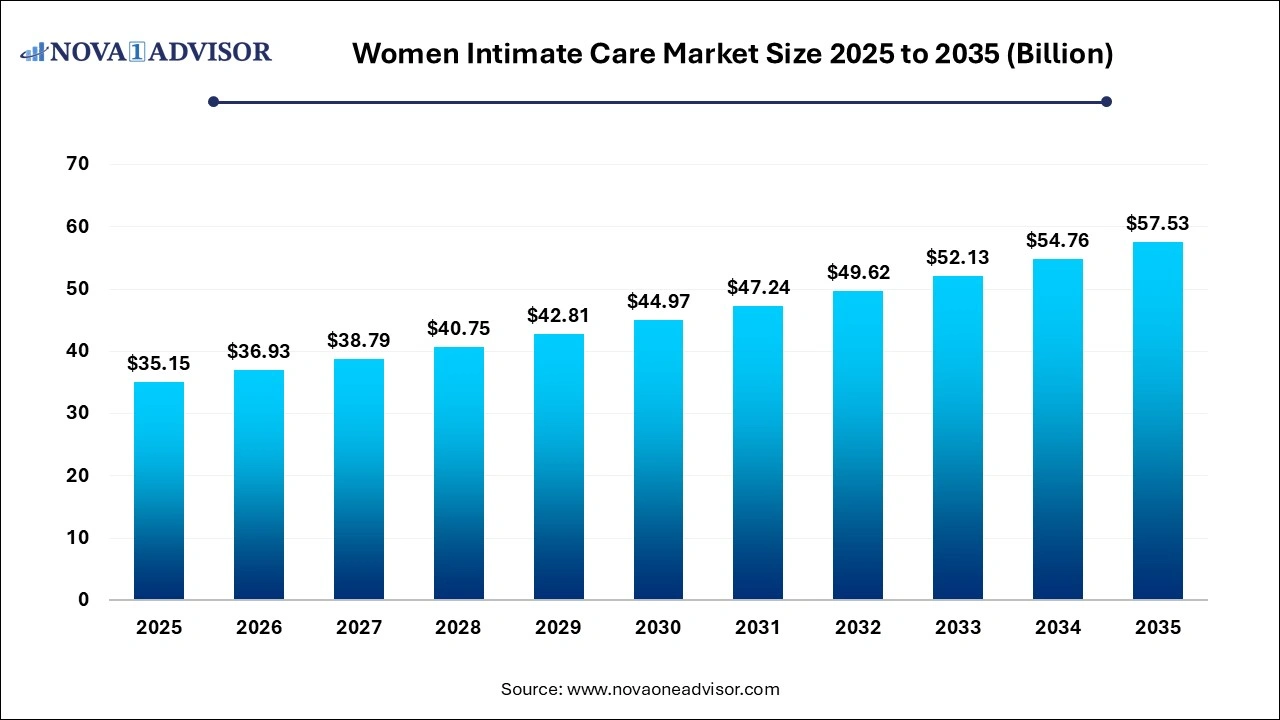
The global women intimate care market size was valued at USD 35.15 billion in 2025 and is projected to grow from USD 36.93 billion in 2026 to USD 57.53 billion by 2035, at a CAGR of 5.05% from 2026 to 2035.
Key Takeaway
- By product type, the intimate wash segment dominated the market with the largest share in 2025.
- By product type, the intimate wipes segment is expected to grow at the fastest CAGR over the forecast period.
- By distribution channel, the offline segment dominated the market with the largest share in 2025.
- By region, North America dominated the market with the largest share in 2025.
Market Overview
The global Women Intimate Care Market is evolving from traditional hygiene products toward a broader women’s wellness category, encompassing intimate washes, wipes, soaps, creams, gels, moisturizers, powders, and specialized care products. Growth is being supported by increasing awareness of intimate hygiene, greater interest in gentle and pH-conscious formulations, and demand for products tailored to sensitive skin, menstruation, postpartum care, dryness, exercise, travel, and menopause. Brands are also emphasizing transparent ingredients, microbiome-conscious formulations, and responsible product communication. At the same time, e-commerce, social media education, and direct-to-consumer channels are enabling emerging brands to reach consumers with specialized product portfolios and personalized positioning.
Market Outlook
- Market Growth Overview: The global women intimate care market is expected to grow significantly between 2025 and 2035, driven by the growing consumer preference for hygienic products.
- Sustainability Trends: Sustainability trends involve growing emphasis on sustainable materials and waste reduction.
- Major Investors: Major investors in the market include Procter & Gamble, Johnson & Johnson, Kimberly-Clark, Unicharm Corporation, Unilever, Sanofi, Edgewell Personal Care, and Reckitt Benckiser.
How is AI Impacting The Global Women Intimate Care Market?
Artificial intelligence (AI) is reshaping the market by transitioning the sector towards proactive self-care and personalized digital health apps. Furthermore, AI-driven health diagnostic tools, incorporated into leading personal care product ecosystems, enable extensive user populations to conduct confidential evaluations regarding sensitive medical conditions.
AI is also helping brands analyze consumer reviews, search trends, and online conversations to identify emerging demand for microbiome-conscious, fragrance-free, plant-derived, moisturizing, and menopause-oriented products. On the manufacturing side, AI can support formulation optimization, production monitoring, and quality consistency by analyzing large datasets related to ingredients, stability, performance, and consumer feedback.
Another important application is demand and inventory forecasting. By evaluating sales patterns, seasonal demand, promotions, regional preferences, and inventory levels across pharmacies, retailers, marketplaces, and direct-to-consumer channels, AI can help companies improve supply planning and reduce stock imbalances. However, AI-based consumer tools must maintain a clear distinction between product guidance and medical advice, particularly when users seek information about irritation, odor, dryness, or other intimate health concerns. Overall, AI is emerging as a supporting technology that can make the women intimate care industry more personalized, data-driven, and responsive to changing consumer needs.
Evolution Toward Intimate Wellness and Life-Stage Personalization
The Women Intimate Care Market is shifting from traditional hygiene products toward a broader intimate wellness ecosystem focused on cleansing, hydration, comfort, skin care, freshness, and life-stage-specific needs. Consumers increasingly seek products designed for situations such as exercise, sensitive skin, menstruation, postpartum recovery, perimenopause, and intimate dryness.
Brands are responding by developing specialized product portfolios rather than relying on one-size-fits-all solutions. For instance, The Honey Pot offers products addressing intimate cleansing, postpartum care, and perimenopause-related needs, illustrating how intimate-care brands are extending their offerings across different stages of women’s lives.
This evolution is creating opportunities for product bundles, subscriptions, personalized recommendations, and educational content, while allowing companies to build longer-term relationships with consumers. As intimate care becomes increasingly integrated with women's overall wellness, life-stage personalization is expected to remain an important product-development and competitive strategy.
Women Intimate Care Market Report Scope
| Report Coverage | Details |
| Market Size in 2026 | USD 36.93 Billion |
| Market Size by 2035 | USD 57.53 Billion |
| Growth Rate From 2026 to 2035 | CAGR of 5.05% |
| Base Year | 2025 |
| Forecast Period | 2026 to 2035 |
| Segments Covered | By Product Type, By Distribution Channel, By Region |
| Market Analysis (Terms Used) | Value (USD Million/Billion) or (Volume/Units) |
| Regional Scope | North America; Europe; Asia Pacific; Central and South America; the Middle East and Africa |
| Key Companies Profiled | The Procter & Gamble Company, Kimberly-Clark Corporation, Unilever PLC, Reckitt, Edgewell Personal Care, Unicharm Corporation, Kao Corporation, Prestige Consumer Healthcare Inc., The Honey Pot Company, Hindustan Unilever Limited, Marico Limited, Rael, LOLA, Natracare, Cora, Peptonic Medical AB, WaterWipes, Sliquid, Good Clean Love, Sirona Hygiene. |
Market Driver – Rising Awareness of Intimate Hygiene and Women’s Wellness
Growing awareness of intimate hygiene and women’s wellness is a key growth driver for the market. Consumers are increasingly seeking information about intimate skin sensitivity, menstrual hygiene, postpartum care, dryness, menopause, and product ingredients. Social media, online communities, healthcare content, influencers, and direct-to-consumer brands are making intimate wellness discussions more accessible, encouraging consumers to explore specialized products and compare formulations. Demand is also supported by busy lifestyles, which increase interest in convenient formats such as wipes, compact washes, and travel packs.
Market Restraint – Consumer Sensitivity, Misleading Claims, and Regulatory Complexity
The sensitive nature of intimate-care products creates challenges related to consumer trust, ingredient safety, product claims, and regulatory requirements. Brands must clearly distinguish cosmetic intimate care from medical treatment and substantiate product claims appropriately. Fragrances and certain cleansing or botanical ingredients may also raise concerns among consumers with sensitive skin. Cultural sensitivities can further limit physical-store purchases in some markets. However, e-commerce provides a more private purchasing environment and enables consumers to research ingredients, compare products, and review product information before buying.
Market Opportunity – Personalized and Life-Stage-Based Intimate Wellness
Personalized and life-stage-oriented products represent a major opportunity for market expansion. Companies can develop targeted offerings for active women, sensitive skin, postpartum recovery, perimenopause, dryness, and mature consumers, creating opportunities for premiumization and cross-selling. Microbiome-conscious formulations are also gaining attention as brands explore gentle approaches to intimate skin care. Sustainability provides another growth avenue through refillable bottles, reduced-plastic packaging, biodegradable wipes, and concentrated formulations. Together, personalization, life-stage care, microbiome-conscious positioning, and sustainable packaging can help brands differentiate beyond conventional intimate cleansing.
Segmental Insights
By Product Type
Why did the intimate wash segment dominate the global women intimate care market?
The intimate wash segment dominated the market with the largest share in 2025. The dominance of the segment can be attributed to the increasing hygiene awareness and growing demand for natural pH-balanced formulations. In addition, there is a growing consumer preference for organic, botanical, sulfate-free, and paraben-free formulations created to safeguard sensitive cutaneous barriers and preserve the natural microbiome.
How did the intimate wipes segment expected to hold the significantly growing global women intimate care market in the coming years?
The intimate wipes segment is expected to grow at the fastest CAGR over the forecast period. The growth of the segment can be credited to the growing consumer emphasis on on-the-go convenience and improved hygiene awareness. Also, the rising participation of women in the urban workforce drives the demand for discreet and efficient hygiene management solutions.
By Distribution Channel
Why did the offline segment dominate the global women intimate care market?
The offline segment dominated the market with the largest share in 2025. The dominance of the segment can be linked to its ability to physically inspect products and immediate product availability anywhere. Furthermore, pharmacists and beauty advisors deliver customized recommendations that cultivate consumer confidence among first-time purchasers within sensitive product categories.
How did the online segment expected to hold the significantly growing global women intimate care market in the coming years?
The online segment is expected to grow at the fastest CAGR over the forecast period. The growth of the segment can be driven by improved consumer privacy and extensive access to niche organic or specialist products, which are harder to find. Moreover, e-commerce platforms facilitate consumer access to specialized product formulations, including pH-balanced, chemical-free, and vegan alternatives that are frequently unavailable through conventional brick-and-mortar retail channels.
By Region
Why did the North American region account for the largest share of the global women intimate care market?
North America dominated the market with the largest share in 2025. The dominance of the region can be attributed to the growing demand for organic and natural formulations and ongoing product advancements such as pH-balanced washes. Furthermore, e-commerce marketplaces and subscription-based frameworks provide buyers with enhanced privacy, streamlined convenience, and access to an expanded range of specialized brands.
U.S. Global Women Intimate Care Market Trends
The growth of the market in the country can be driven by the ongoing transition towards clean-label formulations and increasing health literacy across the region. Also, digital health initiatives and social media platforms have mainstreamed discourse concerning intimate health, hence promoting proactive approaches to managing chronic conditions such as urinary tract infections and localized irritation.
- In June 2026, Lactomedi, a South Korean feminine care brand specializing in microbiome-focused intimate wellness solutions, has announced its nationwide retail expansion into CVS, making its product line available in more than 4,000 stores across the United States.
Why did the Asia-Pacific region become the fastest-growing global women intimate care market during the forecast period?
Asia Pacific is expected to grow at the fastest CAGR over the forecast period. The growth of the region can be credited to the growing disposable incomes and growing workforce participation among women, especially in emerging economies. Furthermore, public-sector sanitation initiatives and nonprofit educational campaigns effectively boost crucial health awareness, extending their impact into semi-urban and rural communities.
China Global Women Intimate Care Market Trends
The market in the country is growing due to the rapid urbanization and ongoing transition towards proactive personal hygiene and preventive health. Moreover, there is a growing consumer preference for chemical-free, organic, plant-based, and probiotic-infused formulations designed to accommodate sensitive skin and promote holistic, long-term well-being.
Key Players in the Global Women Intimate Care Market
- Unicharm Corporation: A dominant force in the Asia-Pacific region. Unicharm drives high revenue through its Sofy brand and commands significant market growth due to growing urbanization and disposable income in emerging APAC economies.
- Kimberly-Clark Corporation: The company expanded its ecosystem by acquiring a majority stake in Thinx, Inc., directly capturing the rapidly growing eco-friendly, reusable period underwear category.
- Namyaa Care (RG Biocosmetic): Namyaa focuses on specialized hygiene kits, intimate skin-lightening products, and herbal menstrual washes while utilizing online educational content to destigmatize intimate wellness.
Recent Developments
- In June 2026, Pyramid Consumer Healthcare has introduced 'i-choose,' a master brand unifying its women’s intimate care portfolio under a single corporate identity, while designating actor Sanya Malhotra as the brand ambassador for its menstrual hygiene and personal grooming divisions.
Segments Covered in the Report
This report forecasts revenue growth at country levels and provides an analysis of the latest industry trends in each of the sub-segments from 2021 to 2035. For this study, Nova one advisor, Inc. has women intimate care market.
By Product Type
- Intimate Wash
- Intimate Wipes
- Soaps
- Creams
- Powder
- Others (Gel, Moisturizers etc.)
By Distribution Channel
- Online
- Offline (Hypermarkets/Supermarkets, Pharmacies, Retail Stores, Others)
By Region
- North America
- Europe
- Asia-Pacific
- Latin America
- Middle East & Africa (MEA)
FAQ's

Proceed to Buy
Instant PDF delivery on confirmation

Women Intimate Care Market Size to Hit USD 57.53 Billion by 2035
 Request Customization
 Download Sample

Get a Sample of this Report
Women Intimate Care Market