

X-Ray Devices Market Size, Share, and Trends 2026 to 2035
 Status Published
 Category Healthcare


Content
X-Ray Devices Market Size and Growth 2026 to 2035
The global X-Ray devices market size was valued at USD 14.55 billion in 2025 and is projected to grow from USD 15.67 billion in 2026 to USD 30.55 billion by 2035, at a CAGR of 7.7% from 2026 to 2035.
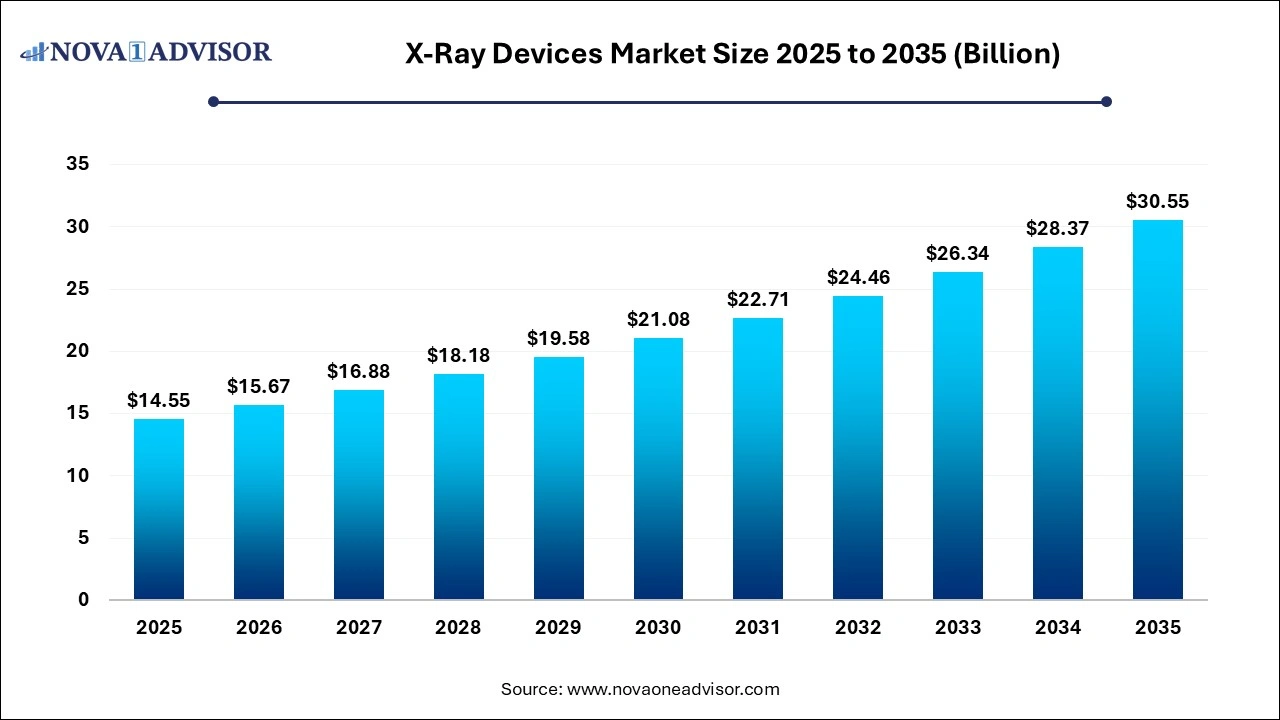
Key Takeaway
- By portability type, the portable X-ray segment dominated the market with the largest share in 2025.
- By portability type, the fixed X-ray segment is expected to grow at the fastest CAGR over the forecast period.
- By application, the X-ray devices for orthopaedic applications segment dominated the market with the largest share in 2025.
- By product type, the digital X-ray devices segment dominated the market with the largest share in 2025.
- By region, North America dominated the market with the largest share in 2025.
Market Overview
The global X-Ray Devices Market is expanding as healthcare providers increasingly adopt digital, portable, and AI-enabled imaging technologies. X-ray systems remain essential for rapid diagnosis across hospitals, imaging centers, specialty clinics, dental facilities, emergency departments, orthopedic practices, cardiovascular centers, and oncology settings. The shift from conventional film-based equipment toward digital radiography, wireless detectors, automated positioning, dose-management solutions, and connected imaging workflows is reshaping the market.
Growing demand for diagnostic imaging is supported by rising cases of orthopedic injuries, respiratory disorders, cardiovascular diseases, cancer, and dental conditions, alongside aging populations requiring more frequent medical assessment. Portable and mobile X-ray systems are gaining particular attention because they enable bedside imaging in intensive care units, emergency rooms, operating theaters, and other settings where moving patients can be difficult or risky.
Manufacturers are also integrating advanced image-processing software, AI-assisted analysis, cloud connectivity, and workflow automation to improve image quality, reduce repeat examinations, optimize radiation exposure, and accelerate clinical decision-making. These developments are broadening the role of X-ray devices from standalone imaging equipment toward intelligent, connected diagnostic platforms.
Market Outlook
- Market Growth Overview: The global X-ray devices market is expected to grow significantly between 2025 and 2035, driven by the growing volume of chronic diseases across the globe.
- Sustainability Trends: Sustainability trends involve growing adoption of sustainable and modular designs and use of artificial intelligence to lower radiation doses.
- Major Investors: Major investors in the market include GE HealthCare, Siemens Healthineers AG, Koninklijke Philips N.V., Canon Medical Systems Corporation, and Fujifilm Holdings Corporation.
How is AI Impacting The Global X-Ray Devices Market?
Artificial intelligence (AI) is reshaping the market by fuelling a shift from conventional hardware to smart and software-driven diagnostic systems. Furthermore, advanced deep learning software diminishes visual noise and enhances contrast resolution, empowering medical professionals to identify subtle osseous fractures and incipient pulmonary alterations that frequently elude detection on conventional radiographic imaging.
Major Trends in the X-Ray Devices Market
- Rapid migration from analog to digital radiography: Healthcare providers are replacing older film-based and conventional systems with digital detectors and connected imaging platforms.
- Growth of mobile and portable imaging: Portable systems are increasingly used in intensive care units, emergency departments, operating rooms, ambulatory settings, and remote healthcare locations.
- AI-assisted image analysis: AI is moving into image enhancement, abnormality detection, quality assurance, positioning, and workflow prioritization.
- Wireless detector adoption: Wireless flat-panel detectors are improving bedside mobility and enabling more flexible examination workflows.
- Dose optimization: Manufacturers are developing systems capable of producing useful diagnostic images with lower radiation exposure through improved detectors and software.
X-Ray Devices Market Report Scope
| Report Coverage | Details |
| Market Size in 2026 | USD 15.67 Billion |
| Market Size by 2035 | USD 30.55 Billion |
| Growth Rate From 2026 to 2035 | CAGR of 7.7% |
| Base Year | 2025 |
| Forecast Period | 2026 to 2035 |
| Segments Covered | By Portability, By Product Type, By Application, By Region |
| Market Analysis (Terms Used) | Value (USD Million/Billion) or (Volume/Units) |
| Regional Scope | North America; Europe; Asia Pacific; Central and South America; the Middle East and Africa |
| Key Companies Profiled | GE HealthCare Technologies Inc., Siemens Healthineers AG, Koninklijke Philips N.V., FUJIFILM Holdings Corporation, Canon Medical Systems Corporation, Shimadzu Corporation, Carestream Health, Konica Minolta, Inc., Agfa-Gevaert N.V., Hologic, Inc., Samsung Electronics / Samsung Healthcare, Mindray Medical International Limited, Ziehm Imaging GmbH, United Imaging Healthcare, Planmed Oy |
Major Market Driver
Rising demand for fast and accessible diagnostic imaging is driving X-ray device adoption across hospitals, emergency departments, orthopedic clinics, dental facilities, and diagnostic centers. Growing patient volumes, trauma cases, chronic diseases, and healthcare expansion are increasing the need for rapid imaging, while portable systems enable bedside diagnosis for critically ill and immobile patients.
Major Market Restraint
High acquisition and infrastructure costs remain a challenge, particularly for smaller hospitals and rural healthcare facilities. Advanced digital X-ray systems require investment in detectors, software, networking, maintenance, staff training, and system integration, encouraging providers to consider refurbished equipment, leasing, and phased upgrades.
Major Market Opportunity
AI-enabled portable X-ray imaging offers strong growth potential by combining bedside imaging with automated image processing, quality optimization, workflow assistance, and AI-supported abnormality detection. Connected portable systems can also enable rapid image sharing and remote interpretation, expanding access to specialized radiology services.
Segmental Insights
By Portability Type
Why did the portable X-ray segment dominate the global X-ray devices market?
The portable X-ray segment dominated the market with the largest share in 2025. The dominance of the segment can be attributed to the growing need for point-of-care diagnostics and ongoing technological miniaturization. In addition, the rising transition toward decentralized medical care and remote clinical settings necessitates the adoption of lightweight, portable medical devices.
How did the fixed X-ray segment expected to hold the significantly growing global X-ray devices market in the coming years?
The fixed X-ray segment is expected to grow at the fastest CAGR over the forecast period. The growth of the segment can be credited to the growing patient volume in hospitals and its better image clarity as compared to other alternatives. Also, advanced overhead tube suspensions and high-resolution direct radiography detectors deliver optimal image clarity required for complex diagnostic evaluations.
By Application
Why did the X-ray devices for orthopaedic applications segment dominate the global X-ray devices market?
The X-ray devices for orthopaedic applications segment dominated the market with the largest share in 2025. The dominance of the segment can be linked to the growing incidence of musculoskeletal disorders and the rapid increase in the geriatric population globally. High-resolution digital radiography (DR) and mobile C-arm systems significantly enhance intraoperative visualization and optimize surgical planning protocols.
How did the X-ray devices for dental applications segment expected to hold the significantly growing global X-ray devices market in the coming years?
The X-ray devices for dental applications segment are expected to grow at the fastest CAGR over the forecast period. The growth of the segment can be driven by the growing prevalence of oral disease conditions and increasing demand for cosmetic dentistry. An increasing number of adults are seeking cosmetic dental procedures, such as implants and orthodontic alignment, which requires comprehensive radiographic imaging before the commencement of treatment.
By Product Type
Why did the digital X-ray device segment dominate the global X-ray devices market?
The digital X-ray device segment dominated the market with the largest share in 2025. The dominance of the segment is owing to its rapid image processing, lower radiation doses, and smooth integration with hospital digital networks. Furthermore, hospitals increasingly favor digital health care systems over legacy analog methods to minimize patient wait times and optimize the administration of electronic health records.
How did the analog X-ray device segment expected to hold the significantly growing global X-ray devices market in the coming years?
The analog X-ray device segment is expected to grow at the fastest CAGR during the study period. The growth of the segment is due to its high durability, low upfront costs, and increasing demand in rural or resource-limited healthcare facilities. Moreover, traditional analog units feature straightforward mechanical constructions, which facilitate more accessible and cost-effective repairs in remote regions lacking specialized technical assistance.
By Region
Why did the North American region account for the largest share of the global X-ray devices market?
North America dominated the market with the largest share in 2025. The dominance of the region can be attributed to the growing incidence of chronic and orthopaedic diseases and the ongoing transition towards portable and digital radiography. In addition, strong healthcare spending, broad insurance protection, and favourable regulatory frameworks drive ongoing technological advancements and equipment modernizations across the medical sector.
U.S. Global X-Ray Devices Market Trends
The growth of the market in the country can be driven by the growing incidence of chronic illnesses and ongoing technological innovations to update digital and AI-powered systems. Also, the growing preference for ambulatory surgical centers, urgent care clinics, and home healthcare services is significantly driving the adoption of compact, mobile, and portable X-ray systems.
- In March 2026, Royal Philips has attained U.S. Food and Drug Administration (FDA) 510(k) clearance for EchoNavigator R5.0 with DeviceGuide, an advanced artificial intelligence software engineered to assist clinicians during complex minimally invasive mitral valve interventions.
Why did the Asia-Pacific region become the fastest-growing global X-ray devices market during the forecast period?
Asia Pacific is expected to grow at the fastest CAGR over the forecast period. The growth of the region can be credited to the surge in healthcare investments and increasing burdens of age-related illnesses, especially in emerging economies such as China and India. Furthermore, increased capital investment from both the government sector and private investors toward the modernization of public and private healthcare facilities has propelled the deployment of advanced digital radiography (DR) systems.
China Global X-Ray Devices Market Trends
The market in the country is growing due to the growing prevalence of chronic diseases and robust domestic manufacturing capabilities. Moreover, a robust local manufacturing ecosystem diminishes equipment procurement costs and fuels the deployment of indigenous, AI-enabled diagnostic platforms.
Key Players in the Global X-Ray Devices Market
- Siemens Healthineers: It offers a robust portfolio of fixed and mobile digital radiography systems, such as the Multix and Mobilett families, known for high patient throughput and integrated workflow automation.
- Koninklijke Philips N.V.: It delivers versatile digital diagnostic imaging systems, focusing on ceiling-suspended and mobile radiography units tailored for trauma and intensive care settings.
- FUJIFILM Holdings: It is a major pioneer in portable and mobile digital X-ray units, widely recognized for its proprietary FDR D-EVO detector technology and image enhancement software.
Recent Developments
- In July 2026, Navi Medical Technologies has secured A$6.8 million in funding to boost the United States commercialization of its proprietary Neonav® vascular access technology. Following strategic FDA clearances and the initiation of clinical evaluations at prominent American pediatric hospitals, this capital injection positions the firm for significant international expansion.
Segments Covered in the Report
This report forecasts revenue growth at country levels and provides an analysis of the latest industry trends in each of the sub-segments from 2021 to 2035. For this study, Nova one advisor, Inc. has X-Ray devices market.
By Portability
- Fixed X-Ray Devices
- Portable X-Ray Devices
By Product Type
- Analog X-Ray Device
- Digital X-Ray Device
By Application
- X-Ray Device for Orthopedic Applications
- X-Ray Device for Dental Applications
- X-Ray Device for Cardiovascular Disease (CVD) Applications
- X-Ray Device for Oncology Applications
- X-Ray Device for Other Applications
By Region
- North America
- Europe
- Asia-Pacific
- Latin America
- Middle East & Africa (MEA)
FAQ's

Proceed to Buy
Instant PDF delivery on confirmation

 Request Customization
 Download Sample

Get a Sample of this Report
X-Ray Devices Market