

AI detector market Size, Share, and Trends 2026 to 2035
 Status Published
 Category Healthcare


Content
AI detector market Size and Growth 2026 to 2035
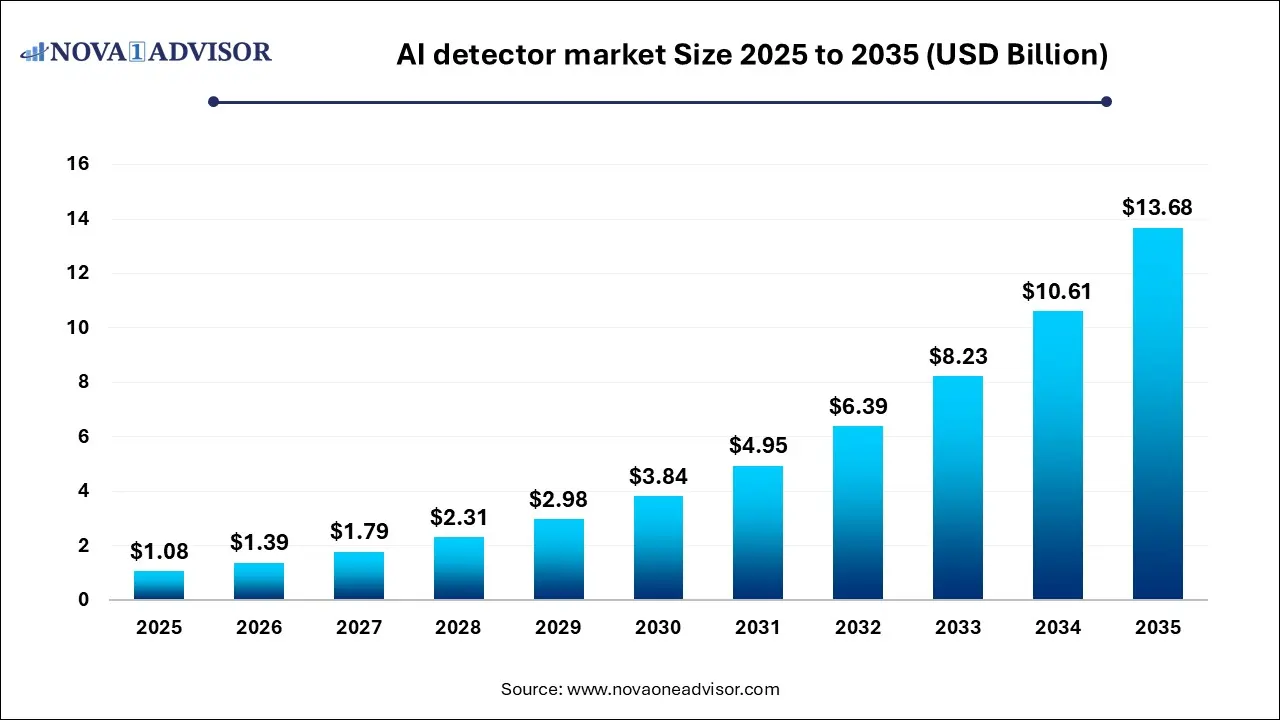
The global AI detector market size was estimated at USD 1.08 billion in 2025 and is projected to hit USD 13.68 billion by 2035, growing at a CAGR of 28.9% from 2026 to 2035.
AI detector market Key Takeaways
- By component, the software segment dominated the market in 2025.
- By component, the hardware segment is expected to have the fastest growth rate during the forecast years.
- By application, the academic integrity segment dominated the market as of this year in 2025.
- By application, the deepfake and synthetic media detection segment is expected to grow at the fastest rate over the forecast period.
- By deployment model, the on-premise segment led the market as of this year.
- By deployment model, the cloud-based segment is seen to have the fastest growth rate.
- By end user, the education sector was the most dominant segment this year in 2025.
- By end user, hospitals are seen to be the fastest growing segment in the upcoming years.
- By region, North America held the largest market share in 2025.
- By region, Asia-Pacific is estimated to grow the fastest all throughout the forecast period.
What is an AI Detector?
AI detectors, also known as AI writing detectors or AI content detectors, are tools that are designed to identify texts that are generated by artificial intelligence tools. These detectors are particularly useful for educators, publishers, recruiters and social media moderators who want to ensure the authenticity and genuineness of any written content. These systems and tools are increasingly being deployed in today’s day and age in order to uphold transparency, prevent plagiarism and ensure accountability in AI-assisted workflows. As awareness regarding ethical AI practices rises globally, the adoption of AI detection solutions continues to accelerate.
What are the Key Market Trends?
- Improved Accuracy: Continuous advancements in algorithms are leading to higher accuracy in detecting AI-generated text.
- Integration with Existing Platforms: AI detectors are increasingly being integrated with existing content management systems and plagiarism checkers to enhance efficiency.
- Multilingual Support: The expansion of multilingual support is seen to significantly broaden the market’s reach.
- Content Creation: Businesses and freelance writers are seen increasingly adopting Ai detector tools to verify the originality of their content.
- Sophisticated Algorithms: The market is also witnessing the development of more sophisticated algorithms that are capable of identifying increasingly nuanced forms of AI-generated text.
Role of Artificial Intelligence in Detecting Tool”
The impact of artificial intelligence on detection tools is quite significant. It has led to the development of more sophisticated, thorough and accurate detection systems. AI has completely revolutionized the way these tools operate, enabling them to identify and analyze content in a more effective manner.
AI detectors are now able to leverage advanced algorithms that can identify patterns and other anomalies, which helps to distinguish human text from AI-generated content. These algorithms are highly adaptable and are continuously learning as new AI technologies emerge. The integration of machine learning and deep learning has also significantly enhanced the abilities of these tools. These technologies allow for the recognition of intricate patterns and objects in images, videos, and even text.
Through all these factors, we can see that the future of the AI detector market looks promising, with the ongoing innovation and the development of more sophisticated algorithms. This innovation will continue to impact detection systems across various domains.
Report Scope of AI detector market
| Report Coverage | Details |
| Market Size in 2026 | USD 1.39 Billion |
| Market Size by 2035 | USD 13.68 Billion |
| Growth Rate From 2026 to 2035 | CAGR of 28.9% |
| Base Year | 2025 |
| Forecast Period | 2026-2035 |
| Segments Covered | By Component, By Application, By Deployment Mode, By End User, By Region |
| Market Analysis (Terms Used) | Value (US$ Million/Billion) or (Volume/Units) |
| Regional scope | North America; Europe; Asia Pacific; Latin America; MEA |
| Key Companies Profiled | AI Detector Pro (AIDP), Copyleaks, Crossplag, GPTZero, Hive Moderation, Neuralwriter, Originality.AI, Reality Defender, Sensity, Sightengine, Truepic, Turnitin, Writer.com |
Market Dynamics
Driver
Increasing Prevalence of AI Applications
One of the key drivers that is propelling the market is the increasing prevalence of AI applications across various sectors such as finance, healthcare, and media. As AI systems become more and more integrated in critical decision-making processes, the need for tools that can detect AI algorithms for fairness, accuracy, and transparency becomes quite crucial. Additionally, regulatory bodies worldwide are also beginning to enforce stringent guidelines that mandate the use of AI detection tools to ensure compliance with ethical standards and data protection laws.
Another significant market driver is the rising awareness about data security and privacy concerns. With the increasing volume of data being processed by AI systems, the potential for misuse and breaches has also risen. AI detection tools play a crucial role here by helping in identifying and mitigating these risks, thus protecting sensitive information. This growing focus is expected to propel the demand for AI detection solutions, further leading to market growth and development.
Restraint
High Implementation Costs
Despite various growth prospects, the market does have its fair share of restraints. One such restraint is the high cost that is associated with implementing and maintaining AI detection tools. For many organizations, especially SMEs, the initial investment required for deploying these tools can be quite high, posing to be a significant barrier. Moreover, extra maintenance and support costs can add to the financial burden, thus limiting the widespread adoption of AI detection tools.
Moreover, this market requires skilled labor to operate and manage these tools, which further adds to the costs. As a result, organizations may delay adoption or seek alternatives that are less effective, hindering the overall growth and penetration of AI detector tools. This slows down market growth and development.
Opportunity
Rise of Cyberattacks and Big Data
The increasing frequency and complexity of cyberattacks is opening up new areas of opportunity and innovation for the AI detector market. Cybercriminals often make use of AI in order to carry out complex attacks, thus making it critical for organizations to adopt advanced detection tools that are able to identify malicious AI in real time. As businesses all over the world continue to face escalating threats like phishing, ransomware and identity theft, ensuring robust cybersecurity protocols becomes a priority.
- Advanced AI detection tools can provide organizations with the intelligence and resources needed to deal with these attacks before they escalate. This helps in ensuring data integrity, enhancing security and reducing overall cybersecurity risks.
The influx of data generated daily across various sectors is also another such opportunity that necessitates the use of powerful analytics tools, driving demand for AI detection solutions. As businesses utilize big data for decision-making, the need for transparent and reliable AI processes becomes important. AI detection tools can identify various types of bias, inaccuracies, or unethical practices in datasets, ensuring better decision-making outcomes. Additionally, as organizations strive for data-driven insights while also maintaining ethical standards, detection tools become quite essential. Moreover, the rising focus on harnessing big data analytics serves as a important factor for growth and innovation.
Segmental Analysis
By Component Insights
Which component dominated the market in 2025?
The software segment dominated the market in 2025 due to the increasing demand for advanced AI detection algorithms and platforms that can be integrated into existing systems. The advantage of this segment lies in the fact that it offers flexibility and scalability, thus making them a preferred choice for companies and businesses who are looking to enhance their AI detection capabilities.
Hardware components segment is seen to have the fastest growth throughout the forecast period. This segment is crucial for the effective deployment of AI detection tools. These include specialized processors and sensors that enable real-time data analysis and anomaly detection. It is expected to witness significant growth due to the ongoing advancements in AI-specific hardware technologies.
By Application Insights
Which application led the market as of this year?
The academic integrity segment led the market as of this year. This dominance is due to the rising use of generative AI tools among students for assignments, projects and assessments. Educational institutions are seen actively adopting advanced detection systems to make sure about content originality, ensure fair evaluation, and maintain the credibility of academic qualifications. The increasing adoption of online and hybrid learning environments has further accelerated the demand for scalable and effective AI detectors.
The deepfake and synthetic media detection segment is expected to grow at the fastest rate over the forecast period. This growth is driven by the increasing sophistication and accessibility of AI-generated audio, video and image content. Organizations across media, government, and enterprise sectors are investing heavily in detection technologies in order to deal with misinformation, identity fraud and reputational risks.
By Deployment Mode Insights
Which deployment mode was the most dominant segment as of this year?
On-premises deployment was the most dominant segment as of this year in 2025. This segment involves the installation of AI detection tools within the enterprise’s own data centers. This method offers greater control over data and system security, making it an ideal choice for organizations with stringent data protection requirements.
Cloud-based deployment is estimated to have the fastest growth rate throughout the forecasted years. This growth is because it offers greater flexibility and scalability. They can be easily accessed and managed from anywhere, making them a popular option for organizations who have widely distributed operations. Their lower upfront costs and reduced maintenance requirements associated with cloud deployment drive its adoption.
By End User Insights
Which end user held the largest market share in 2025?
The education segment held the largest market share in 2025, due to the growing adoption of generative AI tools in student assignments and remote learning environments. Schools and universities are seen increasingly integrating detection systems with learning-management platforms in order to ensure academic integrity and prevent plagiarism. As a result, the education segment is set to grow and develop rapidly as academic institutions prioritize verification and authenticity.
The healthcare sector is expected to be the fastest growing segment in the upcoming years. This segment relies heavily on AI detection tools in order to ensure the accuracy and reliability of AI-driven diagnostic and treatment systems. These tools help in identifying any biases or inaccuracies that are present in the AI algorithms, thus enhancing patient outcomes and maintaining trust in AI-based healthcare solutions.
By Regional Analysis
Why did North America dominate the market in 2025?
North America dominated the AI detector market in 2025. This dominance is driven by the high adoption rate of AI technologies and the presence of major AI solution providers in the region. The United States, in particular, is at the forefront of AI research and development, as it is home to a number of tech giants and startups who continue to invest heavily in advanced AI detection tools. The region’s strong regulatory framework also encourages the rapid adoption of these tools, driving the market’s position forward even more.
What are the advancements in Asia-Pacific?
Asia Pacific is anticipated to witness the fastest growth during the forecast period, driven by rapid digital transformation in emerging economies such as China and India. The region is increasingly investing in AI research and development, leading to the proliferation of AI applications across various sectors. The growing awareness about data security and the need for robust AI detection mechanisms is also expected to drive the demand for AI detection tools in the region.
Top Key Players
- AI Detector Pro (AIDP)
- Copyleaks
- Crossplag
- GPTZero
- Hive Moderation
- Neuralwriter
- Originality.AI
- Reality Defender
- Sensity
- Sightengine
- Truepic
- Turnitin
- Writer.com
Recent Developments
- In August 2025, Turnitin expanded its AI writing detection capabilities by launching an advanced feature to identify content altered by AI bypasser or “humanizer” tools. This enhancement enables educators to detect not only AI-generated text but also material intentionally modified to evade detection systems. Turnitin's AI bypasser detection enables educators to uphold academic integrity detecting AI-generated content even if it's been modified by bypassers, with the sole aim of evading detection.
- In July 2025, Copyleaks, the AI content analysis and governance platform trusted by educators worldwide, announced the launch of AI Logic. This groundbreaking feature within their award-winning AI Detector is the first to offer such transparency, transforming AI detection from a mysterious "black box" into a clear educational tool. Educators can now see why content is flagged as AI-generated.
Segments Covered in the Report
By Component
- Software
- Hardware
- Services
By Application
- Academic Integrity
- Content Verification
- Plagiarism Detection
- Deepfake and Synthetic Media Detection
- Code Authenticity Checking
- Misinformation and Disinformation Detection
- Others
By Deployment Mode
- On-Premises
- Cloud
By End User
- BFSI
- Healthcare
- Retail and E-commerce
- Media and Entertainment
- Manufacturing
- IT and Telecommunications
- Others
By Region
- North America
- Latin America
- Europe
- Asia-Pacific
- Middle East and Africa
FAQ's

Proceed to Buy
Instant PDF delivery on confirmation

 Request Customization
 Download Sample

Get a Sample of this Report
AI detector market