

Allergy Skin Test Market Size, Share, Forecast Report, 2026-2035
 Status Published
 Category Healthcare


Content
Allergy Skin Test Market Summary
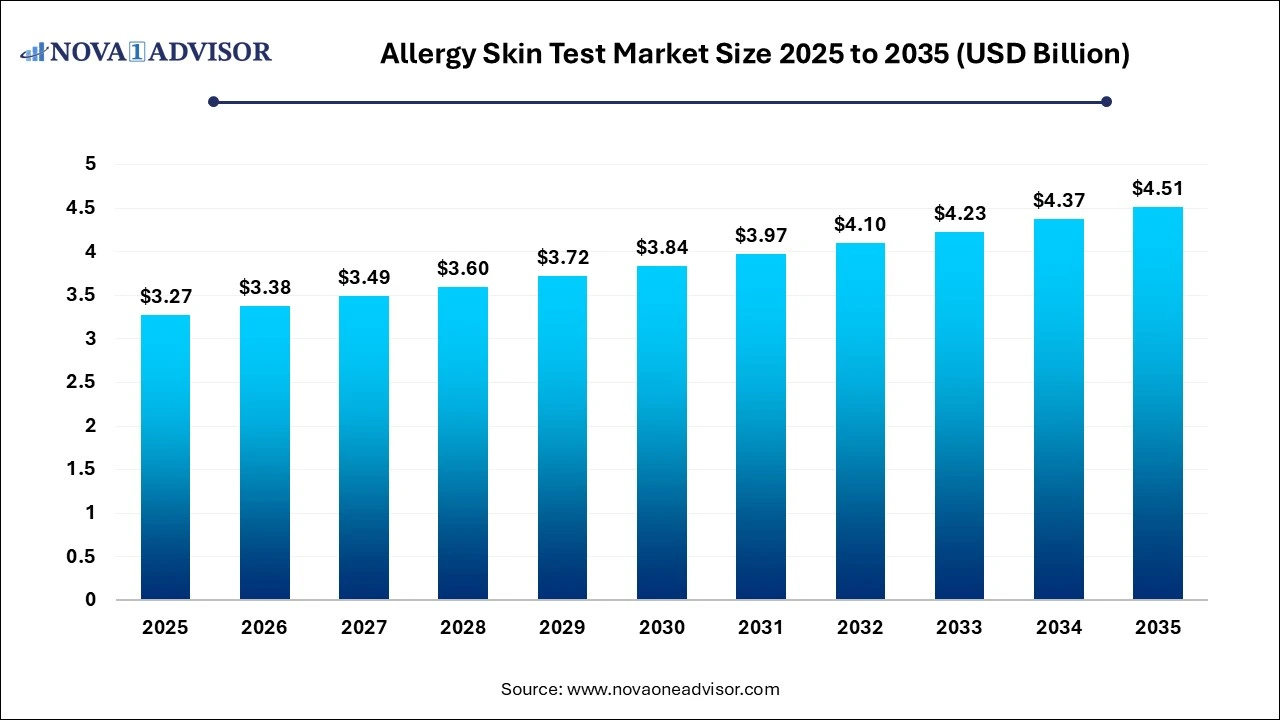
The global allergy skin test market size was estimated at USD 3.27 billion in 2025 and is projected to hit around USD 4.51 billion by 2035, growing at a CAGR of 3.26% during the forecast period from 2026 to 2035.
Market Key Takeaways:
- The Allergy Skin Test Market is experiencing steady growth due to the rising prevalence of allergic diseases and increasing awareness of allergy diagnosis.
- Artificial Intelligence (AI) is transforming the market by enhancing the accuracy, speed, and efficiency of allergy testing.
- Key trends include the rising demand for personalized medicine, growing adoption of homecare testing solutions, and advancements in allergy testing technologies.
- The primary driver of market growth is the increasing prevalence of allergies worldwide, while a significant restraint is the potential for false positives and negatives in certain skin test types.
- Opportunities lie in the development of more accurate, non-invasive tests and the expansion of allergy testing services in emerging markets.
Market Overview
The Allergy Skin Test Market plays a pivotal role in diagnosing various allergic conditions by assessing a patient's sensitivity to different allergens. Allergies are increasingly prevalent worldwide, with a notable rise in conditions such as asthma, rhinitis, and food allergies, leading to growing demand for allergy testing services. Skin testing, including prick, intradermal, and patch tests, is one of the most commonly used diagnostic methods due to its ease of use, cost-effectiveness, and rapid results.
Skin tests typically involve exposing the skin to a small amount of allergen and observing the body’s response, such as a raised bump or redness, which indicates an allergic reaction. The allergy skin test market is also supported by the increasing demand for immunotherapy treatments, which require accurate allergy diagnosis for effective treatment planning.
With advancements in healthcare infrastructure, particularly in developed regions, and the growing awareness of the importance of diagnosing allergies, the Allergy Skin Test Market is set to expand further. Rising healthcare expenditure, along with an increase in the number of allergists and specialized allergy clinics, is expected to further fuel market growth.
The market includes various segments based on test type, allergen type, end user, and region, and each of these categories is experiencing unique growth dynamics. The demand for innovative allergy tests, especially those that can be used in homecare settings, is growing, as patients seek more convenient diagnostic solutions.
Market Outlook
- Market Growth Overview: The global allergy skin test market is expected to grow significantly between 2025 and 2035, driven by the rising prevalence of allergies, growing awareness and diagnosis rate, and shift toward personalized medicine.
- Sustainability Trends: Sustainability trends involve eco-friendly consumables and production, minimally and precise testing devices, and efficient lab practices.
- Major Investors: Major investors in the market include Thermo Fisher Scientific Inc., Siemens Healthineers AG, Danaher Corporation, bioMérieux SA, and ALK-Abelló.
How is AI Transforming the Allergy Skin Test Market?
Artificial Intelligence (AI) is making significant contributions to the Allergy Skin Test Market by improving the precision and speed of test results. AI algorithms are being applied to interpret and analyze the data generated from skin tests, allowing for more accurate identification of allergens and better prediction of allergic reactions.
AI-powered diagnostic tools use machine learning to analyze large datasets and provide insights into allergy trends and patterns, improving diagnostic accuracy and offering personalized recommendations. For instance, AI models can predict the likelihood of a patient reacting to certain allergens based on previous skin test data, medical history, and other relevant factors.
Additionally, AI is enhancing the ability to automate allergy tests in homecare settings, where patients can conduct tests under remote supervision. The use of AI-driven technologies in allergy skin tests is reducing human error, providing more consistent results, and enabling better decision-making for healthcare providers and patients. As AI technologies continue to evolve, they are expected to drive greater innovation and efficiency in allergy testing processes, offering faster and more reliable results.
Major Trends in the Market
- Adoption of AI Technologies: AI is being integrated into allergy testing platforms to enhance diagnostic accuracy, reduce human error, and enable personalized treatment planning.
- Rise of Homecare Testing: Increasing demand for at-home allergy tests is contributing to market growth, as patients seek more convenient and accessible solutions for diagnosing allergies.
- Shift Towards Non-Invasive Testing: There is growing interest in non-invasive allergy testing methods, such as blood tests and saliva tests, driven by patient preference and advancements in diagnostic technologies.
- Personalized Medicine: With the rise of personalized healthcare, allergy tests are being increasingly used to tailor treatments to individual patients based on their specific allergy profiles.
- Increasing Prevalence of Allergic Diseases: The growing incidence of allergies, especially in urban areas, is driving demand for more accurate and efficient allergy testing methods.
Allergy Skin Test Market Report Scope
| Report Coverage | Details |
| Market Size in 2026 | USD 3.38 Billion |
| Market Size by 2035 | USD 4.51 Billion |
| Growth Rate From 2026 to 2035 | CAGR of 3.26% |
| Base Year | 2025 |
| Forecast Period | 2026 to 2035 |
| Segments Covered | Test Type, Allergen Type, End User, Application, Regional |
| Market Analysis (Terms Used) | Value (USD Million/Billion) or (Volume/Units) |
| Regional Scope | North America; Europe; Asia Pacific; Central and South America; the Middle East and Africa |
| Key Companies Profiled | Thermo Fisher Scientific (US), Merck KGaA (DE), Abbott Laboratories (US), Roche Diagnostics (CH), Siemens Healthineers (DE), BD (US), Hoffmann-La Roche (CH), Alere (US) |
Driver: Increasing Prevalence of Allergies
The increasing prevalence of allergic diseases is the primary driver of growth in the Allergy Skin Test Market. Allergies, including asthma, allergic rhinitis, food allergies, and insect stings, have become more common over the past few decades, with both environmental and genetic factors playing a role in their rise. According to the World Health Organization (WHO), the global burden of allergic diseases is significant, with millions of people suffering from asthma and other allergic conditions, particularly in developed countries.
As the number of allergy cases rises, the demand for effective diagnostic solutions, including skin tests, is increasing. Accurate allergy testing is critical for managing allergic diseases, preventing severe reactions, and planning appropriate treatment. In particular, the rise in food allergies, especially among children, has spurred the need for widespread allergy testing. The growing awareness of the importance of early diagnosis in managing allergies further contributes to market demand, as patients and healthcare providers seek effective testing solutions.
Restraint: False Positives and Negatives in Allergy Skin Tests
A significant restraint in the Allergy Skin Test Market is the potential for false positives and false negatives in certain skin test types. While skin tests are highly effective for many allergens, they are not foolproof. False positives can occur when the skin reacts to an allergen that does not actually cause an allergic response, leading to unnecessary treatment or avoidance of specific allergens. On the other hand, false negatives can result in missed diagnoses, where the test fails to detect an actual allergy, delaying appropriate treatment.
These inaccuracies can be attributed to various factors, including the patient's skin sensitivity, the concentration of the allergen used in the test, and the testing technique itself. As a result, healthcare providers often use skin tests in conjunction with other diagnostic methods, such as blood tests, to confirm diagnoses. However, the possibility of false results can still hinder the widespread adoption of allergy skin tests, particularly in sensitive or high-risk patients.
Opportunity: Growth of Personalized Allergy Testing
One of the most promising opportunities in the Allergy Skin Test Market is the growth of personalized allergy testing. Personalized medicine is a rapidly evolving field, and allergy testing is no exception. By utilizing detailed patient histories, genetic information, and specific immune responses, personalized allergy tests are becoming increasingly popular for developing tailored treatment plans.
Advances in technology allow for more precise identification of allergens and better prediction of an individual’s response to specific allergens. Personalized allergy testing can help patients avoid unnecessary allergen exposure, improve treatment efficacy, and reduce the risk of severe allergic reactions. This trend is particularly beneficial in the management of chronic allergies, such as asthma, where long-term treatment plans can be optimized based on a patient’s unique allergy profile.
Furthermore, personalized allergy testing can enhance immunotherapy treatments, which involve exposing patients to small amounts of allergens over time to desensitize their immune systems. By identifying the most relevant allergens for each patient, personalized allergy testing can significantly improve the effectiveness of immunotherapy, making it a key opportunity for market growth.
Segmental Insights
By Test Type
How did the prick test segment dominate the Global Allergy Skin Test market?
The prick test segment is driven by its ability to simultaneously evaluate up to 50 distinct allergens with high sensitivity and rapid results within 155 minutes. Its superior cost-effectiveness relative to in-vitro blood analysis makes it the primary initial screening tool for airborne, food, and venom-based sensitivities in modern practices. The minimal invasiveness of the procedure offers a safer and less painful diagnostic alternative to intradermal injections for a broad patient demographic.
How did the blood test segment expect to hold the fastest-growing Global Allergy Skin Test market in the coming years?
The blood test segment is driven by its superior safety profile, providing a critical alternative for patients with severe sensitivities or dermatological conditions that preclude traditional skin testing. The technological breakthroughs, such as component-resolved diagnostics and laboratory automation, which enhance analytical precision and facilitate high-throughput processing. The integration of these advanced blood tests into telemedicine and digital health platforms is dramatically expanding patient access to specialized allergy management services.
By Allergen Type
How did the environmental allergens segment account for the largest share in the Global Allergy Skin Test market?
The environmental allergens segment is driven by an escalating global burden of respiratory allergies, particularly asthma and allergic rhinitis, necessitating a sustained increase in diagnostic testing volumes. The convergence of heightened public awareness and supportive governmental policies for early intervention is institutionalizing routine allergy screening as a standard of preventive healthcare.
The food allergens segment accounts for the largest share in the Global Allergy Skin Test market.
The food allergens segment is driven by the global escalation of asthma and allergic rhinitis cases. The diversification into comprehensive food allergy diagnostics is reshaping the sector into a multifaceted pillar of the healthcare industry. This market distribution reflects a dual demand for environmental screening alongside the high-revenue potential of specific food triggers, particularly within pediatric populations.
By End User
How did the hospitals segment account for the largest share in the Global Allergy Skin Test market?
The hospitals segment is driven by providing a comprehensive, one-stop infrastructure that integrates specialized expertise with advanced analytical equipment. As the primary setting for high-risk evaluations, these institutions ensure the safe management of severe allergic reactions through expert supervision and immediate emergency intervention capabilities.
How did the allergy clinics segment expect to hold the fastest-growing Global Allergy Skin Test market in the coming years?
The allergy clinics segment is driven by the shift toward early, cost-effective diagnostic protocols that prioritize personalized treatment planning. Clinics are increasingly integrating advanced, high-throughput automated platforms to enhance procedural speed and analytical precision, allowing them to manage higher patient volumes effectively. The institutionalization of allergy testing within routine health checkups and the expansion of specialized outpatient networks.
By Application
How did the diagnosis segment account for the largest share in the Global Allergy Skin Test market?
The diagnosis segment is driven by its superior utility in evaluating environmental and food-based allergens. The global surge in allergy prevalence, exacerbated by rapid urbanization and environmental pollutants, is mandating a sustained increase in clinical testing volumes. The continuous advancements in the standardization of allergen extracts and the safety of testing kits are reinforcing the accuracy and reliability of these essential diagnostic protocols.
How did the immunotherapy segment expect to hold the fastest-growing Global Allergy Skin Test market in the coming years?
The immunotherapy segment is driven by offering a non-invasive, self-administered alternative to traditional injections, significantly improving patient adherence and clinical adoption. This shift is being reinforced by the integration of molecular and recombinant DNA technologies, which are enhancing the efficacy of personalized allergen vaccines and novel therapeutic approaches.
By Regional
How did the North America region account for the largest share in the Global Allergy Skin Test market?
North America’s mature healthcare infrastructure and a high concentration of market-leading manufacturers who facilitate the early adoption of automated, high-throughput testing systems. The favorable reimbursement policies and government-backed awareness initiatives significantly lower barriers to access, ensuring consistently high testing rates across the region.
U.S. Global Allergy Skin Test Market Trends
The U.S. is shifting toward early diagnosis and more sophisticated, high-throughput laboratory automation. This evolution is being propelled by the adoption of component-resolved diagnostics, which provide the molecular precision necessary to support the growing demand for personalized allergy treatments. The high-recurring revenue of specialized consumables and reagents ensures a stable and growing ecosystem for advanced diagnostic innovation.
How did the Asia Pacific region hold the fastest-growing Global Allergy Skin Test Market in the forecast period?
Asia Pacific’s substantial capital investments in the healthcare infrastructure of China, India, and Japan have significantly broadened patient access to advanced laboratory services. A strategic shift toward proactive, preventive care is driving higher adoption rates for early-stage screening as both providers and patients prioritize long-term allergy management.
China Global Allergy Skin Test Market Trends
China’s escalating prevalence of respiratory and dermatological conditions among the rising middle class has institutionalized the use of high-precision automated platforms alongside traditional in-vivo testing. The market is increasingly defined by the high recurring revenue of diagnostic consumables, which are critical for maintaining the high-volume testing required in modern outpatient settings.
Key Players in the Global Allergy Skin Test Market
- Thermo Fisher Scientific
As a leader in allergy diagnostics, Thermo Fisher provides the "gold standard" ImmunoCAP™ Specific IgE blood tests and fully automated Phadia™ Laboratory Systems to identify allergen sensitivities.
- Arlington Scientific, Inc.
Arlington Scientific contributes to the diagnostic market by manufacturing specialized allergy testing tools, including the AccuTest 48-well and 60-well allergen trays designed for precise skin testing.
- Cell Science Systems
Cell Science Systems develops and performs advanced, personalized, functional laboratory testing, including the Alcat Test, to identify sensitivities and chronic inflammation at the cellular level.
Segments Covered in the Report
This report forecasts revenue growth at country levels and provides an analysis of the latest industry trends in each of the sub-segments from 2021 to 2035. For this study, Nova one advisor, Inc. has segmented the allergy skin test market.
By End User
- Hospitals
- Allergy Clinics
- Diagnostic Laboratories
- Homecare Settings
By Test Type
- Prick Test
- Intradermal Test
- Patch Test
- Blood Test
By Application
- Diagnosis
- Research
- Immunotherapy
By Allergen Type
- Environmental Allergens
- Food Allergens
- Insect Allergens
- Medication Allergens
By Region
- North America
- Europe
- Asia Pacific
- Latin America
- Middle East and Africa (MEA)
FAQ's

Proceed to Buy
Instant PDF delivery on confirmation

 Request Customization
 Download Sample

Get a Sample of this Report
Allergy Skin Test Market