

Apoptosis Assays Market Size, Share, Forecast Report, 2026-2035
 Status Published
 Category Healthcare


Content
Apoptosis Assays Market Size and Growth 2026 to 2035
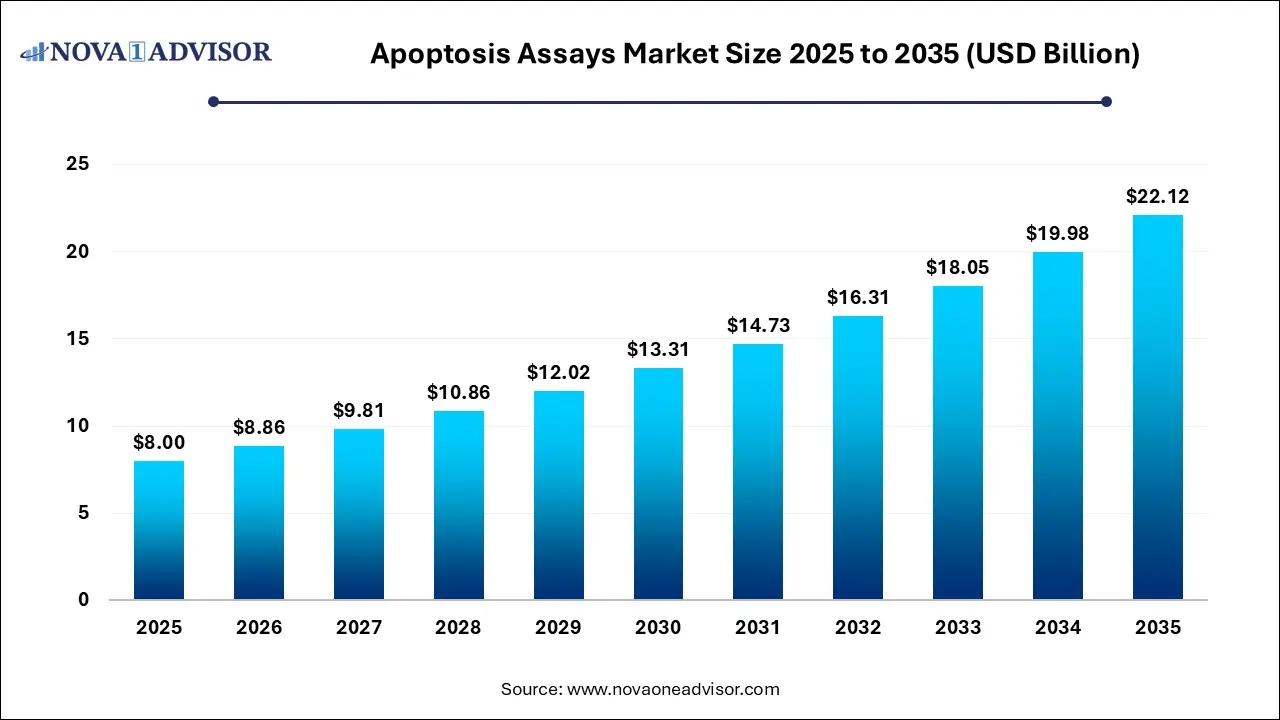
The global apoptosis assays market size was estimated at USD 8.00 billion in 2025 and is projected to hit around USD 22.12 billion by 2035, growing at a CAGR of 10.7% during the forecast period from 2026 to 2035.
Market Key Takeaways
- The Apoptosis Assays Market is experiencing growth driven by the increasing importance of apoptosis research in understanding disease mechanisms, such as cancer and neurological disorders.
- Artificial Intelligence (AI) is significantly impacting the market by enhancing the precision and efficiency of apoptosis detection.
- Key market trends include technological advancements in apoptosis assays, growing applications in drug discovery, and the increasing focus on personalized medicine.
- The market faces challenges such as high costs associated with complex assays and the difficulty in standardizing methods.
- A major opportunity lies in the increasing investment in research and development, especially in stem cell research and cancer therapies.
Market Overview
The global Apoptosis Assays Market has been steadily growing as apoptosis, or programmed cell death, plays a crucial role in understanding various biological processes, especially in the development of diseases such as cancer, neurodegenerative disorders, and cardiovascular diseases. The increasing prevalence of these diseases, coupled with advancements in molecular biology, has spurred demand for more effective and efficient apoptosis detection techniques. The market includes a range of products such as kits, reagents, instruments, and services tailored to meet the needs of researchers and pharmaceutical companies. Additionally, apoptosis assays are pivotal in areas like drug discovery, stem cell research, and clinical diagnostics.
As more organizations and research institutions focus on personalized medicine, the demand for precise and reliable apoptosis assays is expected to continue growing. Researchers and pharmaceutical companies are seeking assays that not only provide accurate results but are also cost-effective and easy to implement.
Market Outlook
- Market Growth Overview: The global apoptosis assays market is expected to grow significantly between 2026 and 2035, driven by the increasing prevalence of chronic diseases, expansion of drug discovery and developments, and increasing adoption of personalized medicine.
- Sustainability Trends: Sustainability trends involve miniaturization and reducing waste, lyophilization and reducing cold chain dependence, and animal-free alternatives.
- Major Investors: Major investors in the market include Thermo Fisher Scientific Inc., Merck KGaA, BD (Becton, Dickinson and Company), Bio-Rad Laboratories, and Danaher Corporation.
How is AI Transforming the Apoptosis Assays Market?
Artificial intelligence (AI) is transforming the Apoptosis Assays Market by enabling more accurate and faster analysis of apoptotic cell death. AI-powered image recognition and data analysis tools are improving the precision of apoptosis detection, especially in large-scale screening efforts. AI algorithms can automate image analysis in fluorescence microscopy, providing faster insights and reducing human error in interpretation. Moreover, AI helps in predicting apoptosis based on cell morphology and gene expression data, which enhances the speed of drug development.
In addition, AI-driven predictive models are playing a significant role in understanding how apoptosis pathways are activated in various diseases. By integrating AI with apoptosis assays, pharmaceutical companies can better predict drug responses and toxicity, thus accelerating drug discovery and personalized treatments. As these technologies become more widely adopted, they are poised to further transform apoptosis research, making it more efficient and cost-effective.
Major Trends in the Apoptosis Assays Market
- Technological Advancements: The market is witnessing the development of more sophisticated and reliable apoptosis detection technologies, such as advanced fluorescence microscopy and real-time PCR techniques.
- Integration of AI in Assays: The application of artificial intelligence in apoptosis assays is improving data analysis, reducing time-to-results, and enhancing the overall accuracy of assays.
- Growing Applications in Drug Discovery: Apoptosis assays are increasingly used in drug discovery, particularly in oncology and immunotherapy, to screen compounds that target apoptotic pathways.
- Focus on Personalized Medicine: As personalized medicine becomes more prominent, there is a growing need for apoptosis assays that can predict individual responses to specific therapies.
- Increased Funding for Research: Governments and private investors are increasing funding for apoptosis-related research, driven by the need to understand apoptosis in the context of cancer and other diseases.
Apoptosis Assays Market Report Scope
| Report Coverage | Details |
| Market Size in 2026 | USD 8.86 Billion |
| Market Size by 2035 | USD 22.12 Billion |
| Growth Rate From 2026 to 2035 | CAGR of 10.7% |
| Base Year | 2025 |
| Forecast Period | 2026 to 2035 |
| Segments Covered | Product, Detection Technology, Application,End User, Region |
| Market Analysis (Terms Used) | Value (USD Million/Billion) or (Volume/Units) |
| Regional Scope | North America; Europe; Asia Pacific; Central and South America; the Middle East and Africa |
| Key Companies Profiled | Abcom plc, Merck KGaA (Germany), Thermo Fisher Scientific (US), Bio-Rad Laboratories (US), GE Healthcare (US), Danaher Corporation (US), Becton, Dickinson and Company (US), Sartorius AG (Germany), Geno Technology (US), GeneCopoeia, Inc. (US), and Promega Corporation (US) |
Market Driver: Growing Prevalence of Cancer
One of the primary drivers of the Apoptosis Assays Market is the increasing prevalence of cancer globally. Cancer is characterized by the failure of apoptotic mechanisms, leading to the uncontrolled growth of malignant cells. As apoptosis assays are critical in understanding the mechanisms of cancer cell death, pharmaceutical and biotechnological companies are investing heavily in developing advanced apoptosis detection technologies. The rising number of cancer diagnoses, along with the growing demand for targeted therapies, has increased the need for reliable and accurate apoptosis assays to facilitate the development of cancer drugs. These assays enable researchers to identify compounds that can induce apoptosis in cancer cells, thereby improving therapeutic outcomes.
Market Restraint: High Cost and Complexity of Assays
Despite the growing demand, the Apoptosis Assays Market faces several challenges, including the high cost and complexity associated with certain assay technologies. The advanced reagents, kits, and instruments required for apoptosis detection are expensive, which can limit their adoption, especially among smaller research laboratories or institutions with constrained budgets. Furthermore, the complex nature of some assays, such as those involving fluorescence microscopy or western blotting, requires highly specialized training and expertise. This adds to the operational costs and can hinder the broader implementation of these assays in clinical settings.
Market Opportunity: Increasing Investment in Stem Cell Research
An emerging opportunity for the Apoptosis Assays Market lies in the increasing investment in stem cell research. Stem cells have the potential to regenerate damaged tissues, and their role in apoptosis is crucial for understanding their therapeutic applications. Researchers are increasingly focused on apoptosis assays to investigate stem cell differentiation, survival, and apoptosis under various conditions. This focus on stem cell research is expected to drive the demand for apoptosis assays, as these tools are critical for monitoring the behavior of stem cells in drug screening, regenerative medicine, and gene therapy applications. With government and private sector funding increasing for stem cell research, there is significant potential for growth in this area.
Segmental Insights
By Product
How did the kits segment dominate the Global Apoptosis Assays market?
The kits segment is driven by its ability to deliver consistent, high-throughput results via advanced markers, making them indispensable for accelerating oncology and drug development timelines. Continuous innovation in multiplexing capabilities ensures they remain the preferred choice for both specialized research and large-scale clinical applications. The high demand for standardized, time-efficient workflows has established kits as the market's primary product segment.
By Detection Technology
How did the flow cytometry segment account for the largest share in the Global Apoptosis Assays market?
The flow cytometry segment is driven by its unparalleled ability to provide multi-parameter, high-throughput analysis with extreme precision. Its versatility in measuring DNA fragmentation and mitochondrial potential makes it the gold standard for characterizing complex cell populations in oncology and immunology. The integration into standardized clinical trial protocols secures its position as an indispensable tool in the global apoptosis assays market.
How did the fluorescence microscopy segment expect to hold the fastest-growing Global Apoptosis Assays market in the coming years?
The fluorescence microscopy segment is driven by the shift toward live-cell imaging and automated high-content analysis. The integration of AI-based imaging and super-resolution techniques enables researchers to visualize subcellular apoptotic processes with unprecedented precision and speed. Significant R&D investments in personalized medicine and targeted cancer therapies are fueling the demand for these sensitive, automated screening solutions.
By Application
How did the drug discovery and development segment account for the largest share in the Global Apoptosis Assays market?
The drug discovery and development segment is driven by the integration of high-throughput screening and advanced detection tools, which allows for rapid, sensitive evaluation of drug efficacy and regulatory toxicology profiles. The massive biopharmaceutical R&D spending aimed at addressing chronic diseases through targeted therapies. These assays are indispensable for ensuring that new drug candidates transition safely from the lab to clinical application.
How did the stem cell research segment expect to hold the fastest-growing Global Apoptosis Assays market in the coming years?
The stem cell research segment is driven by the shift toward complex models like 3D organoids and iPSCs requires these high-precision assays to monitor cell death within physiologically relevant, human-simulated environments. By optimizing anti-apoptotic mechanisms, researchers can significantly enhance therapeutic outcomes for conditions like myocardial infarction, where cell survival is often more vital than angiogenesis.
By End User
How did the pharmaceutical and biological companies segment account for the largest share in the Global Apoptosis Assays market?
The pharmaceutical and biological companies segment is driven by the massive, high-volume requirements for high-throughput screening in drug discovery and preclinical studies. These firms rely on apoptosis assays to validate the mechanisms of action for novel oncology treatments and biologics, such as monoclonal antibodies. Consistent, large-scale R&D investment ensures a continuous demand for standardized kits and reagents to maintain clinical and regulatory precision.
How did the research institute segment expect to hold the fastest-growing Global Apoptosis Assays market in the coming years?
The research institute segment is driven by a surge in fundamental and translational research into cancer and neurodegenerative pathways. The rapid adoption of high-performance tools, such as high-throughput flow cytometry and advanced imaging, allows these labs to bridge the gap between basic science and clinical application. Increased government and private funding, particularly across the Asia-Pacific region, is significantly expanding research capabilities and infrastructure.
Key Players in the Global Apoptosis Assays Market
- Abcam plc: Abcam contributes by providing a diverse and high-quality portfolio of apoptosis-related antibodies, kits, and reagents designed for the sensitive detection of cell health changes.
- Merck KGaA: As a leader in the apoptosis assay kits market, Merck offers a robust suite of products and technologies, significantly expanded by the acquisition of Sigma-Aldrich, that support a wide array of research workflows.
- Thermo Fisher Scientific: As a market leader, Thermo Fisher provides a comprehensive portfolio of apoptosis products, including imaging platforms, flow cytometers, and reagents under brands such as Invitrogen.
- Bio-Rad Laboratories: Bio-Rad contributes to the market by providing trusted, versatile instrumentation and reagent development, particularly in flow cytometry and microplate reader technologies for cancer research.
Segments Covered in the Report
This report forecasts revenue growth at country levels and provides an analysis of the latest industry trends in each of the sub-segments from 2021 to 2035. For this study, Nova one advisor, Inc. has segmented the apoptosis assays market.
By Product
- Kits
- Reagents
- Instruments
- Others
By Detection Technology
- Flow Cytometry
- Fluorescence Microscopy
- Western Blot Assessment
- Gel Electrophoresis
- Others
By Application
- Drug Discovery and Development
- Stem Cell Research
- Others
By End User
- Pharmaceutical and Biological Companies
- Research Institutes
- Others
By Region
- Americas
- North America
- US
- Canada
- South America
- North America
- Europe
- Western Europe
- Germany
- France
- Italy
- Spain
- UK
- Rest of Western Europe
- Eastern Europe
- Western Europe
- Asia-Pacific
- Japan
- China
- India
- Australia
- South Korea
- Rest of Asia-Pacific
- Middle East & Africa
- Middle East
- Africa
FAQ's

Proceed to Buy
Instant PDF delivery on confirmation

 Request Customization
 Download Sample

Get a Sample of this Report
Apoptosis Assays Market