

COVID-19 impact on Medical Supplies Market Size, Share, Forecast Report, 2026-2035
 Status Published
 Category Healthcare


Content
COVID-19 impact on Medical Supplies Market Size, Growth and Trends 2026 to 2035
The global COVID-19 impact on medical supplies market size was estimated at USD 100.35 billion in 2025 and is expected to reach USD 359.17 billion by 2035, growing at a CAGR of 13.6% from 2025 to 2035.
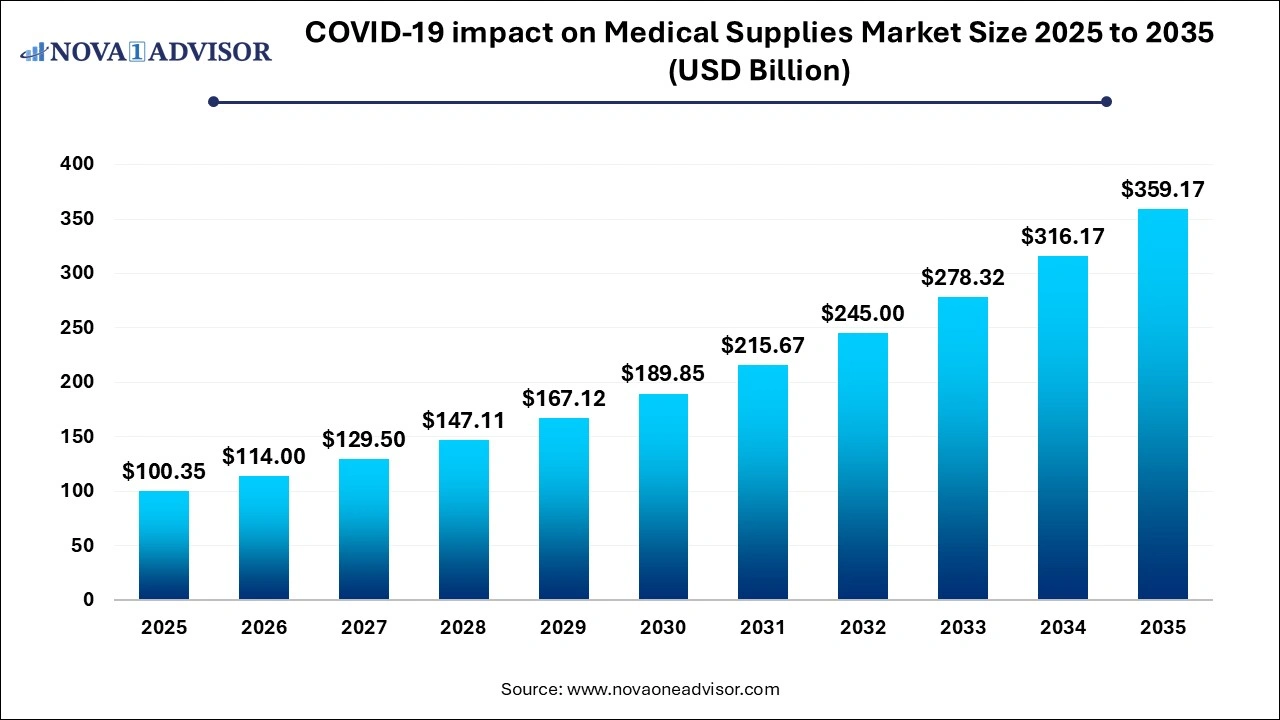
COVID-19 impact on Medical Supplies Market Outlook
- Market Growth Overview: The COVID-19 impact on medical supplies market is expected to grow significantly between 2026 and 2035, driven by the rising chronic disease burden, growing geriatric population, and increasing worldwide healthcare expenditure.
- Sustainability Trends: Sustainability trends involve circular economy and device reprocessing, eco-friendly and bio-based materials, and green procedures and supplier transparency.
- Major Investors: Major investors in the market include Johnson & Johnson, Medtronic, Becton, Dickinson and Company, and Baxter International.
Report Scope of COVID-19 impact on Medical Supplies Market
| Report Coverage | Details |
| Market Size in 2026 | USD 14.00 Billion |
| Market Size by 2035 | USD 359.17 Billion |
| Growth Rate From 2026 to 2035 | CAGR of 13.6% |
| Base Year | 2025 |
| Forecast Period | 2026 to 2035 |
| Segments Covered | By Type, By End User |
| Market Analysis (Terms Used) | Value (USD Million/Billion) or (Volume/Units) |
| Regional Covered | North America; Europe; Asia Pacific; Latin America; MEA |
| Key Companies Profiled | Cardinal Health, Inc. (US), Becton, Dickinson and Company (US), Johnson & Johnson (US) |
COVID-19 impact on Medical Supplies Market Segment Insight
By Type Insight
How did the Infusion and Injectable Supplies Segment Dominate the COVID-19 Impact on Medical Supplies Market?
The infusion and injectable supplies segment is driven by its indispensable role in administering life-saving medications, fluids, and eventually vaccines to a global patient pool. The demand for products surged as hospitalized patients required continuous IV delivery for sedatives, pain management Drugs , and anti-infectives, with some respiratory-related treatments experiencing growing demand. The post-pandemic shift toward home-based infusion therapy, where user-friendly injectable formats allow for the long-term management of chronic diseases outside of overburdened hospitals.
How did the Catheters or In-vitro Diagnostics Segment Expect to Hold the Fastest-Growing COVID-19 impact on Medical Supplies Market in the Coming Years?
The catheters or in-vitro diagnostics segment is driven by the fundamental shift toward early disease detection and minimally invasive treatments. The integration of AI-powered molecular testing and point-of-care diagnostics for chronic conditions like cancer and diabetes. The catheter market is expanding rapidly as aging populations increasingly require cardiovascular and urological interventions that prioritize shorter hospital stays. The rise of home-based diagnostic kits and "hospital-at-home" models, which utilize simplified, high-tech consumables to manage complex health needs outside traditional clinical settings.
By End User Insight
How did the hospitals segment dominate the COVID-19 impact on Medical Supplies Market?
The hospitals segment is driven by a high volume of inpatient admissions requiring a continuous flow of high-value consumables, including infusion sets, diagnostic catheters, and advanced wound care supplies. The hospitals possess the robust procurement infrastructure and financial capacity to maintain large-scale stockpiles of PPE, sterilization equipment, and ventilators to mitigate supply chain disruptions. The healthcare facilities continue to modernize their ICUs and surgical suites, and the hospital remains the centralized hub for complex clinical interventions that consume the vast majority of global medical hardware and disposables.
How did the Home Care Settings Segment Expect to Hold the Fastest-Growing COVID-19 Impact on Medical Supplies Market in the Coming Years?
The home care settings segment is driven by a strategic shift toward decentralised healthcare and the rising demand for aging-in-place solutions. This growth is primarily fueled by advancements in remote patient monitoring (RPM) and IoT-enabled devices, which allow patients to manage chronic conditions like diabetes and respiratory disorders with clinical precision from home. Its cost-effectiveness offers savings compared to hospital stays while simultaneously reducing the risk of hospital-acquired infections.
Key Players in the COVID-19 impact on Medical Supplies Market
- Cardinal Health, Inc. (US): This distributor contributed by retrofitting manufacturing lines to produce millions of face masks and gowns while donating over 2.2 million surgical gowns to the U.S. Strategic National Stockpile.
- Becton, Dickinson and Company (US): BD played a critical role by supplying billions of safety-engineered syringes and needles for global vaccination campaigns and diagnostic catheters for ICU care.
- Johnson & Johnson (US): The company’s primary contribution was the development and global distribution of its single-dose COVID-19 vaccine, which was recognized for its unique shelf-stability in diverse climates.
This report categorizes the medical supplies market into the following segments
By Type
- Diagnostic supplies
- Sample collection consumables
- Diagnostics catheters
- Disinfectants
- Intubation & ventilation supplies
- Personal protection equipment
- Sterilization supplies
- Infusion and injectable supplies
- Dialysis consumables
- Peritoneal dialysis consumables
- Hemodialysis consumables
- Wound care supplies
- Advanced wound dressings
- Surgical wound care
- Traditional wound care
- Radiology supplies
- Other medical supplies
By End User
- Hospitals
- Physician’s Offices/Clinics
- Other End Users
By Region
- North America
- US
- Canada
- Europe
- Germany
- France
- UK
- Italy
- Spain
- Rest of Europe (RoE)
- Asia Pacific
- China
- Japan
- India
- Rest of Asia Pacific (RoAPAC)
- Rest of the World (RoW)

Proceed to Buy
Instant PDF delivery on confirmation

COVID-19 impact on Medical Supplies Market Size to Worth Around USD 359.17 Bn ...
 Request Customization
 Download Sample

Get a Sample of this Report
COVID-19 impact on Medical Supplies Market